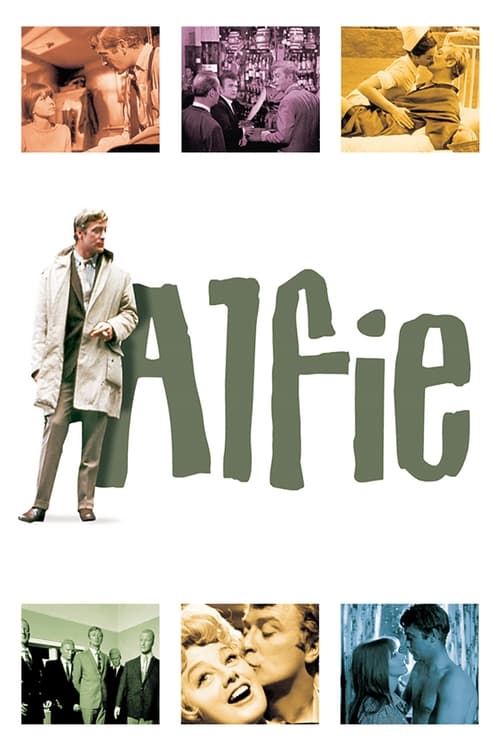
Alfie
1966 · Lewis Gilbert
For when you want charm with a sting in it — a film that seduces you for an hour and then makes you answer for enjoying it. Comfort viewing on the surface, a quiet gut-punch underneath.
What it's about
A Cockney chauffeur in swinging-sixties London works his way through a string of women — married, single, young, lonely — treating seduction as a craft and commitment as a trap, and telling you all about it straight to camera. Then life starts pushing back: an unplanned pregnancy, illness, and encounters he can't charm his way out of force him to look at what his freedom has actually cost the people around him, and himself.
The experience
It starts as a breezy, wickedly funny comedy of conquest — Alfie's confidences to the camera make you complicit in his charm — and then, almost without your noticing, it turns cold under your feet. By the end the laughs have curdled into something genuinely sad, and one late sequence lands with a bluntness that's still shocking.
Performances
Michael Caine, in the role that made him a star: he plays Alfie's callousness and his charisma as the same quality, and his direct-to-camera monologues are so easy and intimate you keep forgiving a man you shouldn't. Vivien Merchant is devastating in a small but crucial role.
The craft
Bill Naughton adapted his own play, and the fourth-wall-breaking narration — Alfie confiding in you mid-scene, mid-seduction — is used with a precision few films have matched since. Lewis Gilbert shoots mid-sixties London with a documentary looseness, and a smoky jazz score keeps the swagger going even as the story sours. The famous title song arrives like a verdict.
Why it matters
One of the defining films of the British sixties boom, it launched Michael Caine internationally and proved a mainstream comedy could smuggle in genuinely harsh material about sex, class, and consequence. Its talking-to-camera antihero has been echoed ever since.
Snapshot
Alfie is the film that turned Michael Caine from a promising supporting player into an international star, and one of the most commercially and culturally resonant products of the British cinema's mid-1960s boom. Adapted by Bill Naughton from his own stage play (itself grown from a 1962 BBC radio play), it follows Alfie Elkins, a working-class Cockney chauffeur and serial seducer who narrates his own amorous campaign directly to the camera — and, by the film's end, finds the philosophy of conquest hollowing out beneath him. What begins as a breezy, knowing comedy of seduction darkens into a study of selfishness and its costs, pivoting on a backstreet abortion sequence that remains among the most unflinching scenes in popular British film of the decade. The film fused the social candor of the British New Wave with a glossier, more metropolitan and explicitly sexual register, and it became a touchstone for the so-called "Swinging London" cycle even as it interrogated the male appetites that cycle tended to celebrate.
Industry & production
Alfie was produced for Paramount Pictures on a modest budget, part of the wave of Hollywood-financed, British-made films that defined the period — American studios chasing the international success of British product (the Bond series, the Beatles films, the kitchen-sink dramas) by underwriting local talent. Lewis Gilbert produced as well as directed, working with a property that had already proven itself across multiple media: Naughton's radio play Alfie Elkins and His Little Life, the subsequent West End stage version, and a 1964 Broadway run in which Terence Stamp played the title role. Stamp, who had originated Alfie on stage, declined the screen part; the role passed to Caine, then known chiefly for Zulu (1964) and, that same season, The Ipcress File (1965).
The production was governed by economy. It was shot largely on London locations and at studio facilities, and the choice to film in Techniscope — a two-perforation widescreen process that halved raw stock consumption while yielding an anamorphic-style aspect ratio — was a frankly budgetary decision that also gave the film a wide, observational frame. The subject matter brought the film into direct contact with the censorship regime of the day: its frank treatment of casual sex and, above all, its abortion sequence earned an X certificate in Britain, and the material had to be handled in the United States in the final years before the Production Code gave way to the ratings system. That candor was a commercial gamble that paid off; Alfie was a substantial hit relative to its cost and helped persuade Hollywood that adult-themed British pictures had a transatlantic audience.
Technology
The defining technical choice was Techniscope, used here both for thrift and for its particular widescreen texture. Because it exposed only two perforations per frame rather than the standard four, Techniscope was cheaper to shoot but produced a grainier negative when blown up and printed to standard anamorphic release prints — a quality that suits the film's semi-documentary urban exteriors. The film was made in color, a deliberate departure from the monochrome that had dominated the preceding kitchen-sink cycle (Saturday Night and Sunday Morning, A Taste of Honey); the move to color aligned Alfie with the brighter, consumerist visual mode of mid-decade London rather than the gritty industrial North. Sound was recorded conventionally for the period, but the film's most distinctive sonic technology is arguably its score (see Sound), a commissioned jazz soundtrack rather than a library or orchestral cue package.
Technique
Cinematography
Otto Heller, a veteran Czech-born cinematographer whose credits already included Peeping Tom (1960) and The Ipcress File, shot Alfie. His work here balances two registers: a location-realist mode for the London streets, the Thames embankment, the cramped flats and convalescent homes Alfie moves through, and a more composed, frontal mode for the direct-address passages in which Alfie confides to the lens. The widescreen frame is used to isolate Alfie within his environments — to make the city legible around him — while keeping him insistently central. Heller's color is naturalistic rather than pop-saturated, which keeps the film tethered to its social-realist roots even as its subject drifts toward fashionable hedonism. The grain inherent to the Techniscope origination reinforces the documentary feel of the exteriors.
Editing
The film's structure is episodic and picaresque, a chain of liaisons, and the editing serves that accumulation: each affair is a discrete movement, punctuated by Alfie's turns to camera, which function almost as chapter breaks or asides. The cutting must constantly negotiate the shift between the diegetic scenes and these direct addresses without breaking momentum, and the film's rhythm depends on the comic timing of Alfie's commentary against the action it interrupts or reframes. The tonal management — the gradual darkening from comic conquest to moral reckoning — is achieved partly through pacing, as the buoyant early episodes give way to longer, heavier sequences (Lily's abortion, the confrontation with mortality and loneliness) that the editing allows to breathe.
Mise-en-scène / staging
Alfie stages class and milieu with precision: the chauffeur's uniform and the borrowed glamour of other men's cars; the modest rented rooms; the contrast between Alfie's pretensions and his actual circumstances. The film's spaces are those of working London — pubs, convalescent homes, riverside walks, cheap flats — and the staging keeps Alfie perpetually in transit, a man passing through other people's lives. The single most charged piece of staging is the abortion: the kitchen-table procedure, the abortionist's clinical detachment, and the aftermath in which Alfie confronts the physical reality of what his evasions have produced. The restraint and specificity of that staging is what gives the scene its force.
Sound
The score is by the jazz saxophonist Sonny Rollins, one of the rare instances of a major jazz figure scoring a British feature; his playing gives the film a loose, melancholy, improvisatory undercurrent that complicates the comedy. Separately, the title song "Alfie," written by Burt Bacharach and Hal David, became one of the most famous songs ever associated with a film — a torch ballad that poses, as a question, exactly the moral the film dramatizes ("What's it all about?"). The song was recorded by several artists in connection with the film and its afterlife (Cher's recording accompanied the American release, and versions by Cilla Black and Dionne Warwick became enduring hits); its plaintive interrogation of Alfie's creed is essentially the film's thesis set to music. The other crucial element of the soundscape is the voice itself — Caine's confiding, fourth-wall-breaking narration, which is less a conventional voiceover than a continuous spoken performance addressed to the audience.
Performance
Caine's performance is the film's engine and its lasting achievement. He plays Alfie as charming, glib, and self-justifying, addressing the camera with a conspiratorial intimacy that implicates the viewer in his worldview before quietly withdrawing the comfort of that complicity. The role demands that the audience like Alfie enough to follow him and judge him enough to feel the reckoning, and Caine modulates between the two without ever signaling the shift too plainly. The film is also notable for its ensemble of women — including Vivien Merchant as Lily, the married woman whose pregnancy precipitates the crisis; Shelley Winters as Ruby, the older lover who finally turns the tables on Alfie; and a roster of British actresses (Julia Foster, Jane Asher, Shirley Anne Field, Millicent Martin) in roles that the film, to its credit, allows moments of dignity and interiority even as Alfie reduces them to "birds." Merchant's restraint in the abortion arc is widely regarded as the film's other great performance.
Narrative & dramatic mode
The film's signature device is sustained direct address: Alfie narrates his own story to the camera, editorializing, boasting, rationalizing, and occasionally — fatally — letting slip the loneliness under the swagger. This is the heart of its dramatic mode. The breaking of the fourth wall makes the audience Alfie's confidant and, ultimately, the witness to his self-deception; we are given his self-image and then shown the gap between it and his conduct. The structure is picaresque and episodic, a sequence of affairs rather than a tightly plotted arc, which suits a protagonist who treats life as a series of conquests with no through-line. The dramatic turn comes when consequence finally attaches to appetite — the abortion forces Alfie to confront a reality he cannot narrate away — and the film closes not on resolution but on a man left genuinely uncertain, the song's question hanging over him.
Genre & cycle
Alfie sits at the intersection of several cycles. It is a comedy-drama, but it belongs most clearly to the mid-1960s "Swinging London" cycle — films attuned to a newly permissive, consumerist, sexually liberated metropolitan culture — while standing somewhat askance from that cycle's celebratory tendencies. Where many Swinging London films luxuriated in liberation, Alfie anatomizes its costs, particularly for the women on the receiving end of male freedom. It is also a late, transitional descendant of the British New Wave / kitchen-sink cycle: it retains that movement's working-class protagonist, regional-class authenticity, and social candor, but trades the industrial North for London and monochrome realism for color. Its frank treatment of abortion and casual sex aligns it with the broader loosening of censorship across Anglo-American cinema in the period.
Authorship & method
The film is the product of a genuine collaboration between Naughton, Gilbert, and Caine. Bill Naughton adapted his own material across radio, stage, and screen, and the direct-address technique — Alfie talking to the audience — carries over from the theatrical conception; the screenplay's voice is unmistakably Naughton's, rooted in his ear for working-class London speech and his moralist's interest in a character who must be undone by his own philosophy. Lewis Gilbert directed with an unobtrusive, performance-centred craft; a versatile professional whose career spanned war pictures, three James Bond films (You Only Live Twice, The Spy Who Loved Me, Moonraker), and later character pieces (Educating Rita, Shirley Valentine), Gilbert's contribution was to keep the film's tonal control and to trust Caine's command of the camera. Otto Heller provided the cinematography (see above), Sonny Rollins the jazz score, and Michael Caine a performance so identified with the part that it effectively defined his early stardom. The Bacharach–David song stands slightly outside the production proper but became inseparable from the film's identity.
Movement / national cinema
Alfie is a quintessentially British film of the moment when British cinema was both at its most internationally visible and most dependent on American finance. It belongs to the lineage that runs from the social realism of the late-1950s/early-1960s New Wave into the more glamorous, sexually frank London cinema of the mid-decade. Its national specificity is fundamental: the class textures, the idiom, the geography of working London, and a particular British strain of moral seriousness lurking beneath comic surfaces. At the same time, its Hollywood backing and transatlantic success exemplify the hybrid Anglo-American production model that sustained the British industry in these years.
Era / period
The film is precisely datable to the mid-1960s inflection point: after the kitchen-sink wave had established working-class realism as commercially viable, during the brief efflorescence of "Swinging London," and just as censorship was loosening on both sides of the Atlantic. It captures a culture in the midst of the sexual revolution but before that revolution's terms had been settled — which is precisely its subject. The abortion sequence is historically pointed: in Britain, Alfie preceded the 1967 Abortion Act, so its depiction of a backstreet procedure registers the lived reality of illegality, and the film's willingness to show that reality is part of its claim to seriousness.
Themes
The governing theme is the emptiness of a life organized around consumption — of women, of pleasure, of self-image — and the film's structure is designed to expose that emptiness gradually. Masculinity is interrogated rather than endorsed: Alfie's creed of non-attachment is revealed as a defense against intimacy and, finally, against mortality and loneliness. The film is unusually attentive, for its moment, to the human cost borne by the women Alfie uses, and the abortion arc transforms an abstract philosophy of freedom into a concrete moral weight. Other persistent threads include class and aspiration (the chauffeur living vicariously through borrowed luxury), the gap between self-narration and conduct, and the ultimate inadequacy of the question the film keeps asking — "What's it all about?" — to which Alfie has no answer.
Reception, canon & influence
Alfie was both a critical success and a popular one. It received the Special Jury Prize at the 1966 Cannes Film Festival and went on to multiple Academy Award nominations — including Best Picture, Best Actor for Caine, Best Supporting Actress for Vivien Merchant, Best Adapted Screenplay for Naughton, and Best Original Song — though it won none of them. The performance established Caine, alongside The Ipcress File, as a leading man and as a particular kind of star: the articulate, self-aware working-class Englishman, a persona he would develop for decades.
The influences on the film run backward through Naughton's own theatrical and radio source, through the British New Wave's working-class realism, and through a longer literary tradition of the picaresque rake-figure undone by experience. Its forward legacy is considerable. The direct-address confessional mode it popularized has been widely imitated, and the figure of the charming-but-hollow male narrator whose worldview the film ultimately dismantles became a recurring device in subsequent cinema and television. The film fixed an image of mid-1960s London and of a certain masculine type so firmly that "Alfie" entered common usage as shorthand for the type. The title song's afterlife as a standard kept the film's central question in circulation well beyond the picture itself. A 2004 Hollywood remake, relocating the character to contemporary New York and starring Jude Law, attests to the durability of the premise, though it is generally regarded as a lesser work whose existence mainly underscores how specific the original was to its time, place, and lead performance.
A Deleuzian reading
He keeps turning to look at you.
The full Deleuzian reading of Alfie →
Reception
A smash in 1966 — Cannes jury prize, five Oscar nominations, and the film that made Michael Caine a star — it's now watched through a much warier lens, with modern viewers debating whether it indicts its charming cad or lets him off easy.
How Alfie was received, from release to now →
Influences: the films it descends from and the films it influenced
- Room at the Top (1959) — Established the British New Wave template Alfie inherits — the sexually predatory working-class male climber whose conquests are charted as a ledger of self-advancement rather than romance.
- Saturday Night and Sunday Morning (1960) — Supplied the unrepentant working-class hedonist anti-hero whose defiant first-person creed ('don't let the bastards grind you down') Alfie restages as a philosophy the film exists to dismantle.
- A Taste of Honey (1961) — Pioneered the New Wave's frank, unsentimental staging of working-class women's pregnancy and abandonment that Alfie's backstreet-abortion sequence darkens further.
- Tom Jones (1963) — Modeled the picaresque-rake structure and, crucially, the to-camera address and knowing winks — the libertine confiding his conquests directly to the audience — that Alfie converts from comic device into moral trap.
- The L-Shaped Room (1962) — Set the boarding-house milieu and the pre-1967 abortion crisis as dramatic terrain, the same social-realist register Alfie's tonal darkening exploits.
- Billy Liar (1963) — Provided the fantasist working-class male protagonist whose self-narrated inner world the camera privileges, a subjectivity Alfie externalizes into literal address.
- The Ipcress File (1965) — Shot by Otto Heller, it forged Caine's articulate working-class star persona — the same cinematographer and the same cool, watchful Caine that Alfie immediately repurposed into its lead.
- Ascenseur pour l'échafaud (1958) — Established the improvised-jazz film score (Miles Davis) as modernist commentary on a drifting protagonist, the precedent for Sonny Rollins's improvised solos under Alfie.
- Up the Junction (1968) — Extended the unflinching backstreet-abortion staging and working-class-women ensemble into harder social realism after Alfie made the subject screenable.
- Poor Cow (1967) — Inverts Alfie's perspective to the used-and-discarded woman's point of view, carrying the New Wave's episodic working-class chronicle into Loach's documentary realism.
- Annie Hall (1977) — Built its whole architecture on the confessional to-camera narrator that Alfie popularized — the charming man addressing us directly while the film exposes the flaws in his account.
- Ferris Bueller's Day Off (1986) — Revived the direct-address charming-rogue narrator who recruits the audience as accomplice to his philosophy, the seductive complicity Alfie weaponized.
- High Fidelity (2000) — The purest heir: a self-aware male narrator confides his romantic conquests to camera while the film systematically dismantles the worldview he's selling us.
- Trainspotting (1996) — Combines picaresque-episodic structure with first-person address by an unreliable working-class hedonist whose creed the narrative ultimately undercuts.
- Alfie (2004) — The direct remake transplanting the to-camera confessional and the hollow-charmer arc to New York, its relative failure proving how specific the device was to Caine and to 1966 London.
- Bridget Jones's Diary (2001) — Codified the British direct-to-camera confessional protagonist whose running first-person commentary frames episodic romantic misadventure—the diaristic narration device Bridget gender-flips.
- Educating Rita (1983) — Gilbert's earlier Caine vehicle establishes his self-effacing, script-deferential direction that protects the performance, and Caine's working-class charm as the film's structuring center.
- Enola Holmes (2020) — A protagonist who sustains an intimate, confessional direct address throughout, steering audience sympathy and narrating his own scheme—the same audience-as-confidant relationship Enola is built around.
- Enola Holmes 2 (2022) — Gilbert's sustained to-camera narration by a roguish protagonist confiding his motives is a foundational British direct-address template feeding the Bradbeer method.
- Darling (1965) — The mirror-image swinging-London study of amoral social ascent and the emptiness of consumption, told through an attractive protagonist the film coolly indicts.
- The Knack ...and How to Get It (1965) — Shares the mid-60s swinging-London survey of casual sexual conquest, treating seduction as an acquirable consumer skill set in the same milieu.
- Georgy Girl (1966) — Released the same year, it pairs swinging-London mores with a chart-topping title song built into the film's identity, the same song-as-thesis device Bacharach–David supplied Alfie.
Similar films
- Darling (1965) — influence & lineage
- The Ipcress File (1965) — influence & lineage
- Annie Hall (1977) — influence & lineage
- Billy Liar (1963) — influence & lineage
- Saturday Night and Sunday Morning (1960) — influence & lineage
- The Italian Job (1969) — shared sensibility
- City Lights (1931) — shared sensibility
- The Servant (1963) — shared sensibility