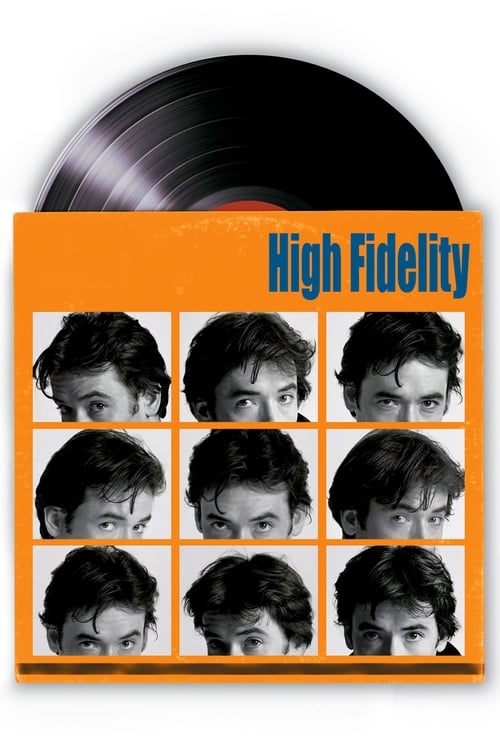
High Fidelity
2000 · Stephen Frears
For post-breakup nights, music-nerd nights, or whenever you want a romantic comedy with actual teeth — comfort food that occasionally bites the hand feeding it.
What it's about
Rob Gordon owns a struggling Chicago record store, worships pop music, and has just been dumped. Talking straight into the camera, he counts down his top five all-time breakups and tracks down the exes to ask what actually went wrong — a self-audit that keeps circling back to Laura, the one who just left, and to the uncomfortable possibility that the problem is him.
The experience
Funny, talky, and stinging in the way only honest self-portraits are — you laugh at Rob's snobbery, then wince because you recognize it. It moves like a great mixtape: quick, moody, sequenced for maximum feeling.
Performances
John Cusack makes constant direct-address feel like confession from a friend — charming and quietly damning at once — while Jack Black, as the store's tyrannical taste-cop clerk, delivers a breakout comic performance that threatens to walk off with the film.
The craft
The fourth-wall-breaking script (adapted from Nick Hornby's novel) turns interior monologue into cinema, and Stephen Frears keeps the tone balanced between comedy and genuine hurt. The wall-to-wall soundtrack isn't decoration — it's characterization; watch it with good speakers and the record-store scenes sing.
Why it matters
It became the definitive film about pop obsessives — the list-makers and taste-guardians — and its top-five framing and record-store banter seeped permanently into how people talk about music and fandom; it later spawned a TV reimagining.
Snapshot
High Fidelity is a romantic comedy-drama about Rob Gordon, the thirty-something owner of a struggling Chicago record store, who responds to being dumped by his girlfriend Laura by interrogating his romantic past — cataloging his "top five all-time breakups" and tracking down the women in question to ask what went wrong. Adapted by John Cusack and his collaborators from Nick Hornby's 1995 novel, and directed by the protean British filmmaker Stephen Frears, the film transplants Hornby's North London milieu to the American Midwest while preserving its essential subject: the way obsessive consumers of pop culture — men, specifically — use taste, lists, and curation as both a substitute for and a shield against emotional adulthood. Built around John Cusack's near-continuous direct address to the camera, the film is less a plot than a confession, structured by music and by the protagonist's own self-serving narration. It became a defining text of turn-of-the-millennium pop-cultural masculinity, launched Jack Black as a comic force, and has remained a touchstone for any later work concerned with record-store culture, mixtapes, and the male romantic narrator who knows he is the problem but cannot quite stop talking.
Industry & production
The film was a Touchstone Pictures release — Disney's adult-oriented label — produced through Cusack's own Dogstar Films alongside Working Title Films, the British production company most associated with Hornby and Richard Curtis adaptations. The package reflected a particular early-2000s economy: a mid-budget, star-driven literary adaptation aimed at an adult audience, the kind of film a major studio still routinely financed before the theatrical mid-budget largely migrated to television and streaming.
Cusack was the engine. He optioned and developed the material, co-wrote the screenplay with his longtime writing partners D.V. DeVincentis and Steve Pink (the Grosse Pointe Blank team) together with Scott Rosenberg, and starred. Frears was brought on as director — a hired hand in the best sense, an adaptable craftsman rather than the originating author. The most consequential development decision was geographic: relocating Hornby's London to Chicago. Hornby himself publicly endorsed the move, and the change is more than cosmetic. Chicago's record-shop and indie-music geography (the production used a Wicker Park–area storefront for the fictional Championship Vinyl) gave the story an authentic American specificity rather than a transatlantic translation that rang false.
Technology
High Fidelity is a conventional turn-of-the-century studio production in its means — shot photochemically on 35mm, finished and distributed in the standard manner of a 2000 theatrical release — and it makes no claim on technological novelty at the level of image-making. Its real relationship to technology is thematic, and unusually pointed for its moment. The film is a love letter to an analog object — the vinyl record — and to an analog craft — the hand-compiled mixtape — at the precise historical instant those forms were being rendered obsolete. Released in March 2000, it arrived during the first wave of Napster and consumer file-sharing, with the physical record store entering the decline that would define the following decade. The film never names this directly, but its fetishization of physical media, alphabetized-versus-autobiographical record collections, and the tactile labor of sequencing a tape now reads as an elegy composed at the threshold of the digital transition. The technology that matters here is the format, not the camera.
Technique
Cinematography
The film was photographed by Seamus McGarvey, relatively early in a career that would later encompass Atonement, We Need to Talk About Kevin, and large studio spectacle. The visual approach is deliberately unshowy and intimate, organized around the central conceit of direct address: the camera must function as a confidant, so framing repeatedly isolates Cusack and lets him turn into the lens. McGarvey favors a grainy, lived-in palette appropriate to a cramped, perpetually under-lit record shop and a Chicago of bars, apartments, and rain. The aesthetic is closer to character-driven American independent cinema of the period than to glossy studio romance — a naturalism that keeps the film's whimsical devices grounded.
Editing
Editing was handled by Mick Audsley, one of Frears's most enduring collaborators (their partnership runs through Dangerous Liaisons, The Grifters, and beyond). The cut carries an unusually heavy structural burden because the film is built from fragments: direct-address monologue, flashbacks to the five breakups, present-tense scenes in the shop and apartment, and recurring fantasy interludes. Audsley's editing manages the constant slippage between Rob's narration and the dramatized past without disorienting the viewer, using music as a connective tissue across temporal jumps. The film's comic timing — particularly in the store, where dialogue overlaps and digresses — is substantially an editorial achievement.
Mise-en-scène / staging
Championship Vinyl is the film's controlling space, a dense, cluttered shrine of crates, posters, and obscure stock that functions as a visible externalization of its inhabitants' interior lives. The shop's geography — counter as pulpit, back room as confessional, the front door as a threshold for unworthy customers — organizes much of the staging. The production design treats record collections as character: how a person shelves their music is, in the film's logic, who they are. Costume and décor place the men in a uniform of defensive, knowing shabbiness. The mise-en-scène consistently stages taste as identity, making physical objects do the work of characterization.
Sound
Sound, predictably, is the film's most distinctive register. An original score was composed by Howard Shore, but the soundtrack is dominated by curated source music — needle-drops chosen with the same discrimination the characters claim for themselves. The most celebrated set-piece is diegetic and self-referential: Barry boasts he can sell anyone anything, drops the needle on The Beta Band, and the store fills with customers — the film demonstrating its own thesis that the right song, well-deployed, is persuasion. Music is not accompaniment but argument and plot, the medium through which the characters court, compete, and confess. The sound design also serves the direct-address structure, modulating between the intimacy of Rob's voice to the camera and the busy ambient texture of the shop.
Performance
Cusack anchors the film with a performance built on rueful self-awareness, carrying nearly every scene and speaking much of it straight to the audience — a sustained act of charm that must also expose the character's evasions. Iben Hjejle, the Danish actress cast as Laura, plays the romantic counterweight with a grounded reserve that resists the film's male solipsism. The supporting ensemble is deep: Todd Louiso as the painfully shy Dick and, above all, Jack Black as the bullying, exuberant Barry, whose climactic musical performance functions as the film's release valve. High Fidelity is widely credited as Black's breakout, the role that translated his anarchic energy into a mainstream career. Smaller turns — Tim Robbins as the insufferable new-age rival, Lisa Bonet as the singer Marie De Salle, Joan Cusack as Laura's friend, and a fantasy-sequence cameo by Bruce Springsteen as himself, dispensing counsel to Rob — round out an unusually well-stocked cast.
Narrative & dramatic mode
The film's defining formal choice is the unreliable first-person confessional delivered in direct address. Rob narrates his own story to us, breaking the fourth wall continuously, and the dramatic engine is the gap between his self-presentation and his behavior — he tells us he is the wronged party even as the film shows us otherwise. The structure is associative and list-driven rather than linear: the "top five breakups" framing licenses a series of flashbacks, and the present-tense plot (the attempt to win Laura back) is interwoven with this retrospective audit. The mode is comic but with a melancholic undertow; its arc is one of belated self-knowledge, the narrator gradually conceding what the audience has understood all along. The device descends from a lineage of charming-cad direct address — most obviously Alfie — and from the playful fourth-wall comedy of Ferris Bueller's Day Off, repurposed here for emotional reckoning rather than mere wink.
Genre & cycle
High Fidelity sits at the intersection of romantic comedy, character drama, and the literary adaptation, but its more specific genre identity belongs to a turn-of-the-millennium cycle: the Generation X male-arrested-development comedy, in which fluency in pop culture stands in for maturity. It is a close cousin of the Grosse Pointe Blank school of ironic, music-saturated American comedy (sharing personnel), and part of the broader Nick Hornby adaptation cycle — Fever Pitch and, later, About a Boy — that brought the author's diagnosis of perpetual male adolescence to the screen. Within romantic comedy, it is notable for inverting the genre's usual sympathies: it is structured as a wooing narrative while subjecting its wooer to sustained critique.
Authorship & method
The film is a study in distributed authorship. Frears, the credited director, is the consummate adaptable professional — a filmmaker with no fixed signature style who has moved across British social realism (My Beautiful Laundrette), period literary adaptation (Dangerous Liaisons), American neo-noir (The Grifters), and prestige drama (The Queen). His method is to serve the material and the actors rather than to impose a visual program, which makes him an apt steward of a project whose authorial center of gravity lay elsewhere. That center was Cusack, who as co-writer, producer, and star functioned as the film's true auteur in the sense of controlling vision and tone — the screenplay he shaped with DeVincentis, Pink, and Rosenberg renders Rob in his own register. The key collaborators reinforce this division of labor: cinematographer Seamus McGarvey supplying intimate naturalism, editor Mick Audsley (Frears's trusted hand) managing the fractured structure, and composer Howard Shore providing score beneath a soundtrack whose curation was itself an authorial act. Underwriting all of it is Hornby, whose novel supplies the voice, the structure, and the central conceit; the adaptation is faithful in spirit even as it changes continents.
Movement / national cinema
The film resists tidy national classification, and that hybridity is itself significant. It is an American story — relocated to Chicago, performed largely by American actors, steeped in American indie-music geography — directed by a leading figure of post-1980s British cinema and produced in part through a British company devoted to Hornby's very English sensibility. It belongs less to any movement than to the transatlantic studio production of its era, in which British directors and companies routinely made American films. If it has a stylistic affiliation, it is to the American independent-inflected character comedy of the 1990s rather than to any British realist or heritage tradition, even as its source DNA is unmistakably English.
Era / period
High Fidelity is precisely datable to the cusp of the millennium, and much of its resonance derives from where it stands in time. It captures the last fully analog moment of music consumption before the digital rupture — a culture of independent record stores, physical browsing, and mixtapes as romantic currency — at the very instant that culture began to collapse. It is also a document of late-1990s Generation X sensibility: ironic, reference-laden, suspicious of sincerity yet aching for it. Viewed from later decades, the film functions as a period piece about a world that vanished almost immediately after it was filmed, its nostalgia retroactively sharpened by the obsolescence of everything it celebrates.
Themes
The film's governing theme is the relationship between taste and character — Rob's recurring question of whether what you like is what you are like, and his slow discovery that a curated identity is not the same as a formed self. Around this orbit several others: arrested development and the difficulty of male maturity; the use of ranking, listing, and cataloging as a defense against emotional chaos, an attempt to impose order on feelings that resist it; nostalgia as both pleasure and trap; and the gendered nature of cultural connoisseurship, the way the film's men weaponize expertise and exclude rather than connect. Underlying the comedy is a genuine inquiry into commitment and fear — Rob's serial self-sabotage as a flight from the vulnerability of choosing one person, one future, over the open-ended freedom of perpetual dissatisfaction. The film grants its protagonist no easy redemption; his growth is partial, hard-won, and conscious of its own incompleteness.
Reception, canon & influence
High Fidelity was warmly received on release, widely praised for its sharp script, Cusack's central performance, and Jack Black's scene-stealing supporting turn, and is generally regarded as one of the more successful Hornby adaptations and a high point of its particular comic subgenre. (Precise box-office and award particulars are best confirmed against primary records rather than asserted here.) Its influences run backward to the charming-narrator tradition of Alfie and the fourth-wall play of Ferris Bueller's Day Off, to the music-saturated irony of Grosse Pointe Blank, and above all to Hornby's novel, whose voice and architecture it preserves.
Its forward influence has been considerable and durable. The film helped fix "record-store culture" as a recognizable cinematic and cultural register — the snobbish clerk, the mixtape as love letter, the top-five list as a unit of feeling — a vocabulary later echoed across film, television, and music writing. It was central to launching Jack Black, whose Barry led directly toward Tenacious D and School of Rock. Most concretely, it generated a 2020 television adaptation produced for Hulu, which reconceived Rob as a woman played by Zoë Kravitz — the daughter of Lisa Bonet, who had appeared in the 2000 film — a lineage that neatly literalizes the work's preoccupation with inheritance and the passing-down of taste. More diffusely, High Fidelity remains the reference point invoked whenever later work takes up the figure of the pop-obsessed romantic narrator who mistakes a record collection for a personality — the rare comedy whose central insight about its own protagonist has only sharpened with time.
A Deleuzian reading
He turns to look at you.
The full Deleuzian reading of High Fidelity →
Reception
A modest hit in 2000 that critics liked but nobody called a landmark — it's since hardened into THE Gen-X music-nerd touchstone, the film every record-store clerk and playlist obsessive gets compared to.
How High Fidelity was received, from release to now →
Influences: the films it descends from and the films it influenced
- Tom Jones (1963) — Establishes the British-literary-adaptation device of a rogueish protagonist breaking the fourth wall to confide in the audience, the address-to-camera mechanism Rob inherits to narrate his own romantic history.
- Alfie (1966) — The charming-cad narrator who pauses the action to justify his serial romantic failures directly to camera — the exact confessional-philanderer posture (cited in the dossier) that Rob adopts as comedy of self-exposure.
- The Graduate (1967) — Pioneers scoring romantic arrested-development with curated pop records (Simon & Garfunkel) rather than orchestral underscore, making the soundtrack itself an authorial commentary on the protagonist's drift.
- Mean Streets (1973) — Sources its needle-drops as diegetic jukebox/record cues that externalize a character's interior life, the technique High Fidelity literalizes by making record selection itself the language of feeling.
- American Graffiti (1973) — Builds an entire film on a wall-to-wall pop-record soundtrack functioning as cultural and generational register, the precedent for treating a curated song catalog as the film's emotional architecture.
- Annie Hall (1977) — Combines direct address with a fragmented, non-chronological autopsy of a failed relationship narrated by a self-deceiving male lead — the structural and tonal template for Rob's reviewing of his 'top-five' breakups.
- Ferris Bueller's Day Off (1986) — Cited in the dossier as a direct influence for its sustained, intimate to-camera address in which the hero explains his worldview as the film proceeds, the fourth-wall play Rob extends.
- The Grifters (1990) — Frears working in American neo-noir with editor Mick Audsley, the same director-editor partnership whose fractured cutting later manages High Fidelity's time-jumping flashback structure.
- Grosse Pointe Blank (1997) — Built by the same Cusack/DeVincentis/Pink writing-producing unit and pioneers their signature: a music-saturated, ironic Cusack protagonist whose needle-drop soundtrack carries his arrested interior life.
- About a Boy (2002) — A subsequent Nick Hornby adaptation that preserves his ironic first-person voiceover of a stunted man-child narrator, directly extending the Hornby-voice-faithful adaptation method High Fidelity established.
- School of Rock (2003) — Cited in the dossier as the direct vehicle for Jack Black's persona launched by Barry — the manic record-snob enthusiasm of that breakout role becomes the film's comic engine.
- Garden State (2004) — Turns curated needle-drops into an explicit authorial statement (the 'this song will change your life' mixtape ethos), inheriting High Fidelity's premise that soundtrack curation is character and confession.
- Juno (2007) — Deploys an obscure-music-taste-as-identity register where record/song knowledge signals selfhood and romantic compatibility, the 'taste-as-identity' vocabulary High Fidelity fixed in cinema.
- Nick and Norah's Infinite Playlist (2008) — Builds its romance on the mixtape-as-love-letter and record-store-culture vocabulary the dossier credits High Fidelity with codifying, treating playlist-making as the central act of courtship.
- (500) Days of Summer (2009) — Extends the inverted-rom-com using a fragmented, non-linear relationship autopsy narrated by a music-obsessed male romantic who mistakes his taste for a personality — High Fidelity's central insight restaged.
- Scott Pilgrim vs. the World (2010) — Organizes its romance through a literal list-driven structure (the seven exes) around a pop-music-obsessed slacker narrator, inheriting the top-five/list-as-unit-of-feeling architecture.
- Trainspotting (1996) — Contemporary British transatlantic-facing adaptation pairing direct-address narration with aggressive needle-drop curation and fragmented montage, the same fusion of literary voice and pop-music editing.
- Almost Famous (2000) — Released the same year, it shares the analog-elegy and rock-criticism sensibility, treating record collecting and music taste as a moral identity and the soundtrack curation as the authorial act.
- 101 Reykjavik (2000) — Contemporary sibling in direct first-person confession of an arrested man-child whose pop-music taste is used as the structuring device for self-narration.
- The Man Who Copied (2003) — A romantic-comedy narrator who speaks straight to camera and organizes his love life into list-like digressions — the same fusion of direct address with rom-com confession.
- Day of the Wacko (2002) — Arrested intellectual man addresses the camera to catalog his grievances and failures, a near-contemporary parallel of the direct-address confessional list as comic form.
Similar films
- (500) Days of Summer (2009) — influence & lineage
- Trainspotting (1996) — influence & lineage
- Ferris Bueller's Day Off (1986) — influence & lineage
- Annie Hall (1977) — influence & lineage
- Bridget Jones's Diary (2001) — shared sensibility
- The Big Lebowski (1998) — shared sensibility
- The Notebook (2004) — shared sensibility
- Modern Romance (1981) — shared sensibility