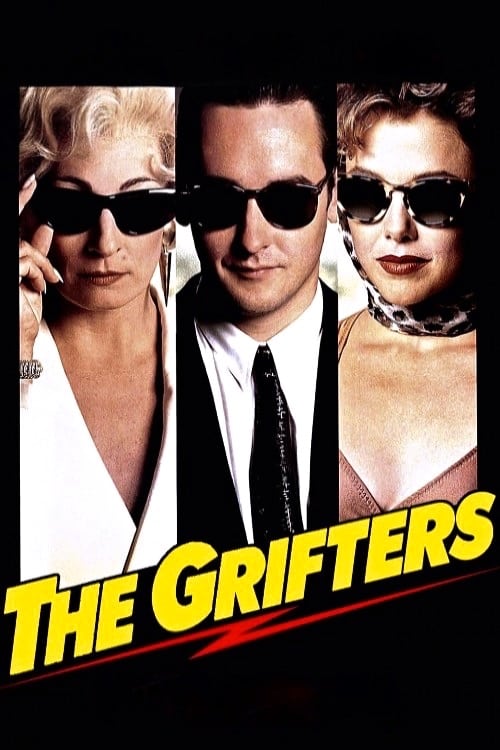
The Grifters
1990 · Stephen Frears
For a night when you want crime with teeth — smart, adult, and unsentimental, the kind of noir that leaves a bruise. Not comfort viewing; you'll come out the other side a little rattled and glad of it.
What it's about
Roy Dillon works small cons in Los Angeles bars — palmed twenties, loaded dice — and keeps his winnings hidden even from himself. Then his mother Lilly, who's spent decades moving mob money at the racetracks, walks back into his life at the same moment his girlfriend Myra reveals she's angling for a much bigger score. Three professional swindlers, each playing an angle on the other two, and family is no protection at all.
The experience
Lean, mean, and getting colder by the reel — it starts as a sly caper and tightens into something genuinely chilling. You watch it the way you'd watch a card game where everyone's cheating: half-grinning, increasingly aware someone's going to get hurt.
Performances
Anjelica Huston is ferocious as Lilly, all hard-won survival instinct under a peroxide shell, and Annette Bening is dazzlingly slippery as Myra — the two of them circling John Cusack's Roy like sharks who happen to love him.
The craft
Stephen Frears shoots sun-bleached LA like it's already a crime scene, and the script strips Jim Thompson's pulp novel down to pure momentum — no fat, no mercy. The film earned four Oscar nominations, and its finale is one of the coldest closing stretches in American crime cinema.
Why it matters
It led the early-'90s revival of pulp novelist Jim Thompson on screen and helped make the neo-noir a prestige form again, proving hard-boiled material could earn Academy attention without softening.
Snapshot
The Grifters is a neo-noir adapted from Jim Thompson's 1963 pulp novel, directed by the British filmmaker Stephen Frears in his first American-set feature and produced under the patronage of Martin Scorsese. It distills the con-artist underworld of mid-century American crime fiction into a lean, vicious chamber drama about three professional swindlers — Roy Dillon (John Cusack), a small-time short-con operator; his estranged mother Lilly (Anjelica Huston), who launders and runs money at the racetrack for a mob bankroll; and his girlfriend Myra (Annette Bening), a sexual confidence trickster angling for a long-con score. The film's engine is the Oedipal collision between the two women over Roy, resolved in one of American cinema's coldest endings. Released at the front edge of a brief Jim Thompson revival, it earned four Academy Award nominations and became a touchstone of the neo-noir cycle that ran through the 1990s. Its reputation rests on the precision of its performances, the chill of its moral universe, and the unusual sight of a director associated with British social realism handling pure American genre material.
Industry & production
The project's deepest roots lie with Scorsese, who had long admired Thompson's fiction and ultimately took a producing role rather than directing. The screenplay was entrusted to Donald E. Westlake, himself a major crime novelist (and, as "Richard Stark," the creator of the Parker novels) — a casting of writer to material that gave the adaptation an insider's fluency with the grift and with noir's fatalism. Westlake's script is famously faithful to Thompson's structure and pitiless tone while compressing and clarifying the novel's mechanics.
Frears came to the film off an extraordinary run — My Beautiful Laundrette (1985), Prick Up Your Ears (1987), Sammy and Rosie Get Laid (1987), and the prestige hit Dangerous Liaisons (1988). The Grifters was his decisive move into American production, and the pairing of a British outsider with quintessentially American pulp was itself part of the film's marketing identity. The film was produced for a modest budget and distributed in the United States by Miramax, then ascending as the dominant independent-prestige distributor; The Grifters was one of the titles that helped cement Miramax's awards-season playbook at the turn of the decade. It opened in limited release in December 1990 to qualify for awards and expanded into 1991.
The production gathered a crew of Frears's trusted collaborators alongside seasoned American craftspeople, and the casting proved central to its success: Huston and Bening were both at career-defining moments, Bening in particular breaking through to wide recognition. Precise budget and grosses are not something I can cite from memory with confidence, so I'll flag that the film is generally understood as a modestly budgeted independent prestige release rather than a studio blockbuster, and leave the exact figures unstated.
Technology
The Grifters is a conventional 35mm production of its era, and its technological interest lies less in apparatus than in restraint. Shot photochemically and finished for standard theatrical release, it makes no use of optical novelty beyond one conspicuous device — a split-screen prologue that introduces the three principals in parallel, dividing the frame to show Roy, Lilly, and Myra each in motion before the narrative converges them. This is an old technique (rooted in silent-era and 1960s multi-image experiments) deployed for a precise structural purpose: to assert from the first frames that these are three separate operators running three separate games whose lines will cross. Beyond that flourish, the film's technical signature is its commitment to naturalistic, available-feeling light and a period-agnostic Los Angeles that reads as both contemporary and timeless. The record on any specialized technical processes used in the production is thin, and I won't invent detail; the film is best understood as a craft object made with standard tools used with discipline.
Technique
Cinematography
The cinematography is by Oliver Stapleton, a frequent Frears collaborator. His work here resists the high-contrast, rain-slicked expressionism that "neo-noir" often implies. Instead the film favors a flatter, sun-struck Los Angeles — motel rooms, racetracks, diners, cheap apartments — lit to feel banal rather than glamorous, which makes the violence and treachery land harder for arriving in ordinary daylight. Color is used pointedly: Lilly is repeatedly associated with reds and bruised tones, and the palette tightens toward the claustrophobic in the film's enclosed climaxes. The camera tends to observe with composed, slightly clinical framing, holding actors in the frame long enough for the audience to read the calculation behind every gesture. The effect is a noir of exposure rather than shadow — the genre's moral darkness rendered in unforgiving light.
Editing
The editing is by Mick Audsley, another core Frears collaborator. After the parallel-montage prologue, the cutting settles into a controlled, scene-driven rhythm that privileges performance and the slow tightening of the trap over kinetic display. Audsley's work is most conspicuous at the hinges of violence — Lilly's beating by her mob employer, the racetrack reckoning, and the final apartment confrontation — where the cutting is tense but never frantic, refusing to let catharsis dissipate the dread. The film's overall tempo is patient, accumulating menace through duration and juxtaposition rather than acceleration.
Mise-en-scène / staging
The staging is intimate and theatrical in the best sense: much of the film's power comes from two- and three-handed scenes in confined rooms, where blocking encodes the power struggle. The recurrent triangulation of Roy between the two women is dramatized spatially — who stands, who sits, who controls the door. Production design leans into a deliberately unfixed period feel, with costuming and décor (Lilly's wardrobe, Myra's performative glamour, Roy's anonymous bachelor neatness) doing characterological work. The geography of grifting — the sailor's short con, the racetrack skim, the long-con apparatus Myra describes — is staged with documentary attention to method, so that the audience learns the craft as the characters practice it.
Sound
The sound design is unshowy and naturalistic, ceding the expressive register largely to the score. The film's most discussed aural element is in fact the music; ambient sound otherwise serves realism. The notorious final scene draws much of its horror from a sudden, almost banal physical sound and the silence around it, a restraint characteristic of the whole film's refusal of melodramatic underlining.
Performance
Performance is where The Grifters is most celebrated. Anjelica Huston's Lilly is a study in armored survival — maternal, predatory, and terrified in shifting proportions — and the role is widely regarded as the peak of her career. Annette Bening's Myra is a revelation of brassy, dangerous sexuality laced with desperation, a performance that vaulted her to stardom. John Cusack, cast against his clean-cut image, plays Roy as a guarded, wounded technician of the small con, his blankness the still center the two women orbit. Pat Hingle is memorably brutal as Lilly's mob overseer Bobo, and the supporting ranks (including J.T. Walsh) sharpen the milieu. The film is essentially an actors' triangle, and its enduring stature owes more to these performances than to any other single element.
Narrative & dramatic mode
The narrative is a tragic crime drama built on classical noir fatalism: characters whose professional deceit has hollowed out their capacity for trust are destroyed precisely by the relationships they cannot fake their way out of. The dramatic mode is ironic and closed — every con contains the seed of its own exposure, and the film withholds the genre's occasional escape hatches. Westlake's adaptation organizes the action around the distinction between the short con (immediate, low-stakes street swindles) and the long con (elaborate, relational, high-yield), mapping that distinction onto character: Roy's caution, Myra's ambition, Lilly's grim institutional survival. The plot tightens like a noose toward an ending of genuine transgression, in which maternal love, theft, and death collapse into a single act. It is one of the few American films of its period to honor pulp tragedy without softening it into redemption.
Genre & cycle
The Grifters is a central document of the neo-noir revival, but it is also specifically a Jim Thompson adaptation, arriving amid a concentrated late-'80s/early-'90s rediscovery of Thompson's bleak fiction — the same season produced James Foley's After Dark, My Sweet (1990), and Thompson's novels would continue to be mined through the decade. Within the broader noir tradition, the film belongs to the lineage of con-artist and "grifter" pictures and to the strain of noir centered on doomed family and erotic triangles. It distinguishes itself from glossier neo-noir by its daylight grime and its refusal of style-as-consolation, aligning it more with the genre's literary-pulp source than with its glamorous studio iterations.
Authorship & method
The film's authorship is genuinely collaborative, which is itself the point. Frears is a director known for deferring to material and actors rather than imposing a fixed visual signature; his method across films as varied as Laundrette, Dangerous Liaisons, and The Grifters is to serve the script and the performances with intelligent, unobtrusive craft. That self-effacement made him an apt vessel for Thompson and Westlake's hard material. Westlake, a master of the form, supplied an adaptation faithful to Thompson's structure and chill. Scorsese's producing presence connects the film to his lifelong championing of American genre and pulp traditions. The longtime craft team — cinematographer Oliver Stapleton, editor Mick Audsley — provided continuity with Frears's British work, while the score came from a genuine giant of American film music: Elmer Bernstein, whose career stretched back to the 1950s. Bernstein's music — at once nostalgic and ominous — supplies much of the film's emotional architecture and its connective tissue to classic Hollywood noir and crime scoring. The combination of British directorial restraint, an American novelist-screenwriter, and a veteran American composer gives the film an unusual transatlantic authorship.
Movement / national cinema
The film sits at a crossroads of national cinemas. It is an American story, in American genre idiom, made by a director formed within the 1980s British cinema of social observation and the Channel 4/independent ecosystem that produced My Beautiful Laundrette. Frears imported an outsider's eye to Los Angeles, and critics have often noted that his lack of sentimental investment in American myth sharpens the film's coldness. It thus belongs more to a transnational "British directors working in America" moment than to any home-grown American movement, even as its genre DNA is wholly American. It is not part of an organized movement so much as a meeting point between British craft cinema and American pulp.
Era / period
Released at the turn of the 1990s, The Grifters is a product of the maturing American independent-prestige sector — the Miramax era of mid-budget, awards-oriented adult dramas that flourished before the model contracted. Its sensibility looks backward to mid-century pulp and classic noir while speaking to a contemporary moment increasingly drawn to morally bleak, character-driven crime stories. The early '90s neo-noir wave it helped lead would soon broaden, and the film stands as an early, austere marker of that cycle, made before the genre tipped toward postmodern pastiche.
Themes
The film's governing theme is the corrosion of intimacy by deceit: people who lie for a living cannot stop, and the grift consumes the one relationship — mother and son — that might have saved them. The Oedipal triangle is explicit, with Myra functioning as a younger mirror of Lilly and Roy caught between desire and a primal maternal bond. Other through-lines include the contrast of short con versus long con as ways of living; money as the only stable language these characters share; the body as the site where the con finally fails (illness, beatings, the fatal accident); and a pervasive American fatalism in which mobility and reinvention curdle into entrapment. Survival itself becomes monstrous — the final act is a horrifying expression of self-preservation indistinguishable from love and from murder.
Reception, canon & influence
The Grifters was critically acclaimed on release and earned four Academy Award nominations — Best Director (Frears), Best Adapted Screenplay (Westlake), Best Actress (Huston), and Best Supporting Actress (Bening) — a notable concentration of recognition for a hard-edged independent crime film, and a marker of how seriously it was taken in its season. (I'll note rather than guess at other awards-body results, which I can't recall with precision.)
Its lines of influence run backward to a rich tradition: Jim Thompson's pulp fatalism above all, but also classic film noir, the con-artist picture, and the moral coldness of American crime fiction generally; Bernstein's score deliberately echoes that classic-Hollywood lineage. Scorsese's involvement situates it within his decades-long advocacy for American genre material as serious art.
Forward, the film helped power the early-'90s neo-noir and Jim Thompson revival, demonstrating that pulp tragedy could carry prestige acclaim and major performances. It cemented Bening as a star and stands as the defining role of Huston's career. More diffusely, its model — literate adaptation of hardboiled fiction, performance-forward, stylistically restrained — informed the decade's appetite for con-artist and grifter narratives and for noir that found its darkness in daylight rather than shadow. It remains a frequently cited touchstone in discussions of neo-noir, of Thompson adaptations, and of the brief golden age of Miramax-era American independent drama.
A Deleuzian reading
Three boxes, three bodies.
The full Deleuzian reading of The Grifters →
Reception
A critical darling on release — four Oscar nominations including Best Director and a spot on many 1990 top-ten lists — it has since slipped into 'criminally underseen' territory, the neo-noir cinephiles keep telling each other to catch up with.
How The Grifters was received, from release to now →
Influences: the films it descends from and the films it influenced
- Double Indemnity (1944) — Supplies the noir-fatalism architecture The Grifters inherits — a tragic machine in which the trap is sprung in the opening reel and the rest of the film is the slow closing of a vise the characters cannot escape.
- Out of the Past (1947) — Establishes the femme fatale whose manipulation is inescapable and whose intimacy is itself the con, the model for Lilly and Myra as women whose affection is indistinguishable from a play.
- Nightmare Alley (1947) — The foundational grifter-tragedy: a con man's rise from short cons to the big score and his moral disintegration, the exact descent-of-the-operator arc the film traces through Roy.
- The Lady Eve (1941) — Codifies the con-as-seduction and the professional grifter team working a mark, the cardsharp-romance mechanics that The Grifters strips of comedy and renders fatal.
- Sweet Smell of Success (1957) — Doubly ancestral — Elmer Bernstein's nostalgic-yet-ominous urban-predator scoring is the same idiom he extends here, and a British director working hardboiled American material anticipates Frears's transatlantic authorship.
- Coup de Torchon (1981) — The major art-cinema Jim Thompson adaptation (of Pop. 1280) that proved the novelist's pulp fatalism could carry prestige treatment, clearing the path for the Thompson revival The Grifters powered.
- The Getaway (1972) — An earlier adaptation drawn directly from a Jim Thompson novel, part of the source-fidelity-to-Thompson lineage Westlake's screenplay honors.
- House of Games (1987) — Makes the confidence game itself the subject — the tell, the short con, the long con as dramatized procedure — the immediate restrained precursor that taught audiences to read grift as craft.
- Paper Moon (1973) — The Depression-era parent/child con team running short cons prefigures the Lilly–Roy dynamic, where the grifter bond and the parental bond are corrosively entangled.
- The Sting (1973) — Defines the elaborate long-con plot architecture against which The Grifters sets its explicit short-con/long-con distinction — Roy the small operator, Lilly the syndicate's long-con earner.
- Chinatown (1974) — Relocates noir into glaring sunlight — the daylight-noir cinematography that finds darkness in color and light rather than shadow — while centering an incest taboo akin to the film's oedipal triangle.
- The Killing (1956) — Descends directly from Jim Thompson's hard-bitten pulp idiom — the same writer credited with The Killing's dialogue — extending that mistrustful, double-crossing con-artist talk to feature length.
- The Last Seduction (1994) — Carries forward the performance-forward grifter picture with a femme fatale whose long con is the entire plot engine, descending from the film's model of pulp tragedy as star vehicle.
- The Spanish Prisoner (1997) — Extends the con-film as prestige form, building its whole structure on the long-con architecture and the audience's mistrust of every apparent intimacy.
- High Fidelity (2000) — Frears working in American neo-noir with editor Mick Audsley, the same director-editor partnership whose fractured cutting later manages High Fidelity's time-jumping flashback structure.
- Nine Queens (2000) — Builds the professional-con milieu around familial betrayal and trust-as-commodity, where intimacy is another mark to be worked and loyalty is priced into the play.
- Dangerous Liaisons (1988) — Frears's prior film and method rehearsal: deceit-as-seduction, triangulated blocking of competing manipulators, and a self-effacing camera that subordinates style to performance — the approach he carries intact into The Grifters.
- The Hit (1984) — Frears's earlier crime picture with the same continuity of British craft team and restraint, establishing the performance-forward, unobtrusive crime sensibility he brought to American pulp.
- After Dark, My Sweet (1990) — Released the same year as a Jim Thompson adaptation — a sun-blasted daylight-noir in the identical restrained, tragic register, the twin pillar of the 1990 Thompson revival.
- The Hot Spot (1990) — Contemporary daylight noir from a hardboiled pulp source (Charles Williams), extending the same heat-and-sunlight reframing of the genre away from shadow.
- Bound (1996) — Jim Thompson–derived con-artist noir of layered betrayals where every character is running a scheme, sharpening the double-cross-upon-double-cross structure Bound perfects.
Similar films
- House of Games (1987) — influence & lineage
- The Sting (1973) — influence & lineage
- Jackie Brown (1997) — often watched together
- The Asphalt Jungle (1950) — shared sensibility
- L.A. Confidential (1997) — shared sensibility
- GoodFellas (1990) — shared sensibility
- L'Argent (1983) — shared sensibility
- Heat (1995) — shared sensibility