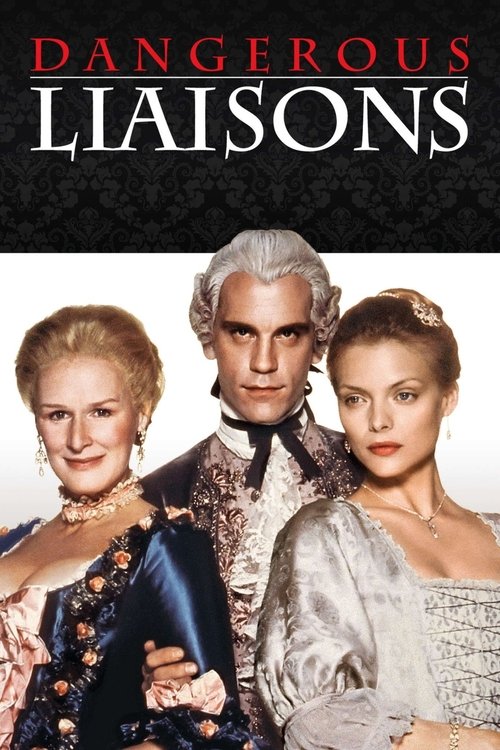
Dangerous Liaisons
1988 · Stephen Frears
For when you want to feel clever and a little wicked — a costume drama with venom in it, best savored when you're in the mood for scheming, gorgeous rooms, and dialogue you'll want to quote. It ends up hitting harder than a comfort watch, so save it for a night you can take a bruise.
What it's about
In the drawing rooms of 18th-century France, two aristocratic ex-lovers — the Marquise de Merteuil and the Vicomte de Valmont — treat seduction as a blood sport played for reputation and revenge. She sets him a wager: corrupt the virginal fiancée of a man who wronged her, and while he's at it, he decides to conquer a famously virtuous married woman for the pure sport of it. The trouble starts when the game stops feeling like a game.
The experience
Deliciously cruel and razor-witted — every conversation is a duel, and half the fun is watching people say beautiful things while doing terrible ones. It's elegant and wickedly funny for a long stretch, then the cruelty starts drawing real blood and the film turns unexpectedly devastating.
Performances
Glenn Close is terrifyingly controlled as Merteuil, letting whole wars play out behind a polite smile; John Malkovich makes Valmont's reptilian charm weirdly seductive; and Michelle Pfeiffer breaks your heart as the virtuous woman caught in their game.
The craft
Christopher Hampton's screenplay, adapted from his own play and Laclos's scandalous novel, is a machine of perfect, poisonous dialogue, and Stephen Frears shoots faces the way other directors shoot battles — the close-ups do the storytelling. The candlelit interiors, sumptuous costumes, and powdered artifice make the emotional violence hit harder for being so beautifully dressed.
Why it matters
It set the modern standard for the barbed costume drama and inspired a wave of adaptations and updates of the same story, while Close's Merteuil became one of the defining screen villainesses of her era.
Snapshot
Dangerous Liaisons is Stephen Frears's adaptation of Christopher Hampton's 1985 stage play, itself drawn from Pierre Choderlos de Laclos's 1782 epistolary novel Les Liaisons dangereuses. It transposes a notoriously interior, letter-bound narrative — a chronicle of seduction conducted entirely on paper — into a film of glances, drawing rooms, and verbal fencing. The Marquise de Merteuil (Glenn Close) and the Vicomte de Valmont (John Malkovich), former lovers turned co-conspirators, treat sexual conquest as warfare and reputation as the only currency that matters in their closed aristocratic world. When Valmont's calculated seduction of the pious, married Madame de Tourvel (Michelle Pfeiffer) curdles into genuine love, the game's machinery turns on its operators. The film is most remarkable for its tonal control: it plays the cruelty of its characters as wit while never letting the audience forget the human cost beneath the epigrams. It became a substantial critical and awards success, winning three Academy Awards, and stands as one of the defining literary period films of the late 1980s.
Industry & production
The film originated not directly from the novel but from a specific theatrical success. Hampton's Les Liaisons Dangereuses premiered with the Royal Shakespeare Company in 1985, directed by Howard Davies, with Alan Rickman as Valmont and Lindsay Duncan as Merteuil, and transferred to acclaim in the West End and on Broadway. The screen rights and the play's proven structure gave the film project momentum. Frears, who had built his reputation in British television and in mid-1980s independent features (My Beautiful Laundrette, Prick Up Your Ears, Sammy and Rosie Get Laid), was an unexpected choice for a glossy costume picture — and that incongruity is part of the film's identity.
The production is best understood alongside a competing project. Miloš Forman was simultaneously developing his own Laclos adaptation, Valmont, with a separate script. Frears's production moved quickly to reach screens first, releasing in late 1988 well ahead of Forman's 1989 film. The race shaped both pictures' reception, with Dangerous Liaisons arriving as the leaner, sharper, and more commercially successful of the two.
Produced for Warner Bros. with Norma Heyman and Hank Moonjean among the producers, the film was shot largely on location in France. Its great houses and gardens — period châteaux in the Île-de-France region — supplied an authenticity of scale and surface that a soundstage could not match, and grounded the production's substantial art-direction and costume investment. The casting of American actors in the principal aristocratic roles was a deliberate, debated decision discussed further below; it carried both commercial logic (bankable stars) and an artistic argument about performance idiom.
Technology
Dangerous Liaisons is a conventional late-1980s 35mm production, and its technical interest lies less in apparatus than in the disciplined application of standard tools to a period subject. There is no showy reliance on novel camera or lab processes. The film's "technology," in the meaningful sense, is the technology of the period setting it reconstructs — the candle, the mirror, the corset, the writing desk — and the cinematographic craft of lighting interiors that would, historically, have been lit by flame and daylight through tall windows. Where a film like Kubrick's Barry Lyndon (1975) had pursued radical low-light capture, Frears and his cinematographer worked within orthodox means, using practical-seeming sources and warm interior light to evoke the era without making the technique itself the subject. The record does not indicate any unusual technical innovation, and it would be a mistake to claim one.
Technique
Cinematography
Philippe Rousselot, the French cinematographer who had worked with Diva-era Beineix and would soon shoot for Robert Redford, photographs the film with a controlled, painterly warmth. Interiors favor a golden, candle-suggestive palette against the cool stone and silk of the rooms; the imagery consistently recalls eighteenth-century portraiture and genre painting without tipping into pastiche. Crucially, Rousselot's camera is at the service of performance and architecture. The framing emphasizes thresholds, doorways, and the geometry of formal rooms — visual analogs for a society organized around surveillance, propriety, and the strategic management of who sees what. The film lets faces do the dramatic work, holding on reactions long enough for the gap between spoken politeness and private calculation to register.
Editing
Mick Audsley, a frequent Frears collaborator, cuts the film for the rhythm of dialogue and intrigue rather than for spectacle. The editing's chief task is to preserve the play's verbal architecture — its long scenes of negotiation and parry — while opening them out cinematically. Reaction shots are timed to expose the second meaning beneath a line; the film repeatedly cuts to a listener's face to reveal the wound or the advantage that the speaker's courtesy conceals. The pacing tightens in the final movement as the conspirators' scheme collapses, the duel and its aftermath delivered with restraint rather than melodramatic acceleration.
Mise-en-scène / staging
This is the film's signal achievement. Production designer Stuart Craig and costume designer James Acheson construct a world of overwhelming material richness — gilt, brocade, powder, and porcelain — that is also a moral environment. The opulence is never neutral decoration: it is the armor and the arena of the characters. The famous dressing sequences that bracket the film, in which Merteuil and Valmont are assembled by servants into their public selves, stage the central idea visually — that identity here is a costume, a performance maintained for an audience of equals. Frears stages conversations as duels of position, using the depth and formality of the rooms to map power. The result earned Academy Awards for both Art Direction and Costume Design.
Sound
The sound design serves intimacy and verbal precision. In a film whose plot turns on overheard remarks, withheld confessions, and the exact wording of letters, clarity of dialogue is paramount, and the mix privileges it. Ambient detail — the rustle of heavy fabric, the click of a closing door, the hush of large rooms — reinforces the sense of a sealed, hothouse society. The film's musical and aural texture together evoke a world where every utterance is potentially a move.
Performance
The acting is the film's engine, and its casting is its boldest stroke. Glenn Close plays Merteuil as a woman whose intelligence has been weaponized by a society that offers her no other field of action; her final, devastating unmasking — the collapse of the public mask — is among the great screen endings of its decade. John Malkovich's Valmont is deliberately unconventional: insinuating, reptilian, physically ungainly in a way that refuses the obvious romantic-rake reading and makes his eventual susceptibility to real feeling genuinely disorienting. Michelle Pfeiffer's Tourvel supplies the film's moral and emotional center, her vulnerability played without sentimentality. Uma Thurman (as the convent-fresh Cécile de Volanges) and Keanu Reeves (as the earnest Danceny) round out the younger pawns. The choice of American actors — and American-inflected, naturalistic line delivery — was a calculated rejection of mannered "period" diction, intended to make the eighteenth-century cruelty feel immediate rather than embalmed.
Narrative & dramatic mode
The source is one of literature's most celebrated epistolary novels: a story told entirely through letters, in which the reader assembles the truth from competing, self-serving accounts. Hampton's adaptation makes the decisive structural translation, converting correspondence into confrontation — letters become scenes, and the private voice becomes spoken performance. The dramatic mode is that of the chamber play opened into cinema: tightly plotted intrigue driven by dialogue, with a clear two-act architecture of scheme and consequence. The narration is essentially classical and linear, following the conspiracy's design and then its unraveling. Its distinctive register is irony — the audience understands the predatory machinery beneath the courtly surface, so that politeness reads as menace and seduction as conquest. The tragedy emerges from the genre of comedy of manners: the very wit that makes the characters delightful is the instrument of their and others' destruction.
Genre & cycle
Dangerous Liaisons belongs to the literary-costume-drama cycle that flourished in the mid-to-late 1980s and into the 1990s, a period when adaptations of canonical texts — frequently English-language, frequently prestige-aimed — became a reliable engine of awards-season cinema. Within that cycle it occupies a specific niche: the period film as moral autopsy rather than nostalgic spectacle. It is also a key entry in the modern screen lineage of Laclos's novel, a lineage that includes Roger Vadim's 1959 modern-dress Les Liaisons dangereuses, Forman's contemporaneous Valmont (1989), and later the high-school transposition Cruel Intentions (1999) and the Korean-set Untold Scandal (2003). Frears's film is the version against which the others are measured.
Authorship & method
Frears is a director without a fixed visual signature, which is itself his method: he is an actor's and a writer's director who adapts his approach to the material and then concentrates on performance and tone. Coming to Dangerous Liaisons from socially engaged British contemporary subjects, he brought an outsider's skepticism to the costume genre, refusing to let the surfaces become the point. His decision to cast for psychological immediacy over period decorum is the clearest authorial mark on the film.
The collaboration is genuinely collective. Christopher Hampton, adapting his own stage play, won the Academy Award for Best Adapted Screenplay; his control of the dialogue's wit and cruelty is fundamental to the film's identity. Philippe Rousselot's cinematography, Stuart Craig's production design, and James Acheson's costumes together build the physical world. Mick Audsley's editing preserves the verbal architecture. George Fenton's score draws on the idiom of eighteenth-century classical music to underscore the drama; it received an Academy Award nomination for Best Original Score. The film is thus best read as the meeting of Frears's performance-first sensibility with Hampton's dramatic structure inside a lavishly realized design envelope.
Movement / national cinema
The film sits at a transatlantic crossroads. It is the work of a British director and a British playwright, with a French cinematographer, shot in France, and populated by American stars, financed and distributed through a Hollywood studio. It is not the product of a self-conscious film movement; rather, it belongs to a strain of internationally financed prestige cinema in which British literary and theatrical talent supplied the creative spine while American studios supplied the stars and the distribution muscle. Within Frears's own career it marks the pivot from his distinctly British 1980s output toward the more international and Hollywood-facing work that followed.
Era / period
Made in 1988, the film reflects a moment when the literate, star-driven costume adaptation was a viable mainstream commercial proposition, before the franchise economy narrowed that space. Its subject — the ancien régime aristocracy of pre-Revolutionary France — is treated with an awareness, implicit but unmistakable, of the world about to be swept away; the characters' decadence is the decadence of a class on the eve of its erasure. The historical irony is dramaturgical rather than stated: the film does not lecture about 1789, but the airlessness of its sealed society carries the foreknowledge of collapse. As a late-1980s artifact it also speaks, in displaced costume, to its own decade's interest in ambition, performance, and the cynical management of image.
Themes
The film's central theme is power exercised through sexuality — seduction as a form of social warfare, and reputation as the field on which that war is fought. It is acutely concerned with gender: Merteuil's long monologue about having had to invent herself, to master deception because society granted women no open avenue to power, reframes her cruelty as the deformed product of constraint. Sincerity and performance form a second axis — the terror of the story is that Valmont, having made authenticity impossible by treating everything as a game, cannot survive the arrival of a real feeling. Pride, vanity, and the impossibility of confessing love without losing face drive the catastrophe. Beneath the wit runs a current of genuine moral seriousness about the human wreckage — chiefly Tourvel's and Cécile's — that the protagonists' amusements leave behind.
Reception, canon & influence
Dangerous Liaisons was received as a major critical success and a strong awards contender, praised especially for Hampton's screenplay and for the central performances of Close, Malkovich, and Pfeiffer. It won three Academy Awards — Adapted Screenplay (Hampton), Art Direction (Stuart Craig), and Costume Design (James Acheson) — and received further nominations including Best Picture, Best Actress for Close, Best Supporting Actress for Pfeiffer, and Best Original Score for Fenton. It outperformed its rival Laclos adaptation, Forman's Valmont, both critically and commercially, and that head-to-head became part of its story.
Looking backward, the film's influences are layered: the eighteenth-century novel of Laclos, the theatrical tradition of the comedy of manners, Hampton's own stage adaptation and its RSC staging, and the broader visual culture of period portraiture that informs its look. Vadim's earlier modern-dress film established that the material could live on screen, but Frears's version proved it could do so in full period dress without losing its bite.
Looking forward, its legacy is substantial. It cemented Laclos's novel as a perennial screen property and directly anticipated the run of teen and transposed adaptations — most visibly Cruel Intentions (1999), which relocates the intrigue to a Manhattan prep school, and Untold Scandal (2003), which moves it to Joseon-era Korea. It marked a career turning point for Frears and a high-water mark for Close, Malkovich, and Pfeiffer in this register. More broadly, it became a touchstone for how to adapt a "difficult," interior literary classic into vivid, intelligent popular cinema — proof that period drama could be sharp, cruel, and emotionally serious at once. Within the late-1980s revival of the literary costume film, it remains one of the form's enduring models.
A Deleuzian reading
Start with the two scenes that bracket the film: a woman and a man being dressed.
The full Deleuzian reading of Dangerous Liaisons →
Reception
A prestige hit on release — three Oscars and a Best Picture nomination — it has only grown in stature, now widely seen as the definitive screen Laclos and home to one of Glenn Close's towering performances, with her Best Actress loss regularly filed under 'Oscar injustices'.
How Dangerous Liaisons was received, from release to now →
Influences: the films it descends from and the films it influenced
- Les Liaisons dangereuses (1959) — First proved Laclos's epistolary intrigue could be dramatized as a screen seduction-game of paired predators, establishing the Merteuil–Valmont conspiratorial duet that Frears reinstates in period dress.
- The Earrings of Madame de... (1953) — Codified material opulence as moral environment — a single luxury object circulating through aristocratic hands to expose the cruelty beneath manners, the staging logic behind Frears's dressing sequences and prop-laden interiors.
- The Rules of the Game (1939) — Defined the cinematic comedy of manners with threshold framing and doorway compositions that catch lovers eavesdropping, the spatial grammar Frears uses to stage overheard betrayals.
- Letter from an Unknown Woman (1948) — Built an entire film on the device of the read letter governing time and dramatic irony, the epistolary-to-dramatic translation Hampton and Frears foreground in Merteuil and Valmont's weaponized correspondence.
- Barry Lyndon (1975) — Established candlelit, painterly eighteenth-century interiors lit to resemble period portraiture, the cinematographic reference point for Rousselot's warm low-key light and tableau staging.
- The Heiress (1949) — Model for the literary costume drama as a chamber piece of emotional cruelty, using reaction-shot rhythm on a wronged woman to convert period decorum into devastating betrayal.
- The Go-Between (1971) — Harold Pinter's screenplay turned a period novel into a cold architecture of class and erotic manipulation, the prestige-literary template of using a child/go-between's eye for dramatic irony that Hampton's verbal precision extends.
- The Devil's Eye (1960) — Power-geometry staging of seduction as a formal game in which blocking and physical positioning diagram psychological domination — extends the tradition of erotic comedy in which staging technique itself enacts the moral argument, the tradition The Devil's Eye participates in through its infernal-seduction scenes.
- The Age of Innocence (1993) — Adopts material-opulence-as-moral-environment and reaction-shot rhythm to dramatize sexual repression policed by surfaces, treating dinner settings and gloves as the period drama's true battlefield.
- Ridicule (1996) — Extends sexuality-and-wit-as-warfare into the verbal cruelty of pre-Revolutionary Versailles, where the perfectly aimed bon mot is a weapon, sharing the comedy-of-manners-as-bloodsport register.
- Cruel Intentions (1999) — Direct transposition of Hampton's seduction-wager plot to a Manhattan prep school, preserving the Merteuil–Valmont pact and the bet-on-a-virtuous-target structure beat for beat.
- Quills (2000) — Carries the libertine-as-articulate-predator into Revolutionary France, sustaining the comedy-of-manners idea that language and seduction are instruments of power dressed in period opulence.
- Untold Scandal (2003) — Relocates the Laclos intrigue to Joseon-era Korea while retaining the epistolary scheming and material-opulence staging, proving the seduction-game architecture portable across costume traditions.
- Marie Antoinette (2006) — Pushes pre-revolutionary decadence and dressing sequences to the foreground, using costume and confectionary surfaces as the moral and emotional environment Frears first weaponized.
- Atonement (2007) — Christopher Hampton's screenplay reprises his signature device of a destroying letter and reordered dramatic irony, extending the epistolary-to-dramatic adaptation method he won the Oscar for here.
- Chéri (2009) — Frears's own return to the period seduction drama, again pairing American/naturalistic casting against opulent design and candlelit interiors to anatomize love as a campaign of erotic strategy.
- The Favourite (2018) — Modernizes sexuality-as-warfare into a triangular court power-game, using candlelit wide-angle interiors and a comedy-of-manners cruelty where intimacy is pure tactical maneuver.
- Ripley's Game (2002) — Source of Malkovich's signature persona of seductive intelligent cruelty (Valmont) — the remaking of another person in the corrupter's amoral image — that he ports almost intact into his Ripley.
- Interview with the Vampire (1994) — The direct crew rehearsal — Philippe Rousselot's candle- and firelight-motivated period interiors cut by Mick Audsley, whose habit of trimming away from an act of cruelty just before impact becomes the elliptical-violence grammar of the vampire kills.
- Valmont (1989) — The rival Laclos adaptation released a year later, offering a softer, more naturalistic and sensuous reading of the same novel — the direct head-to-head that defines Frears's harsher, wit-forward approach by contrast.
- The Grifters (1990) — Frears's prior film and method rehearsal: deceit-as-seduction, triangulated blocking of competing manipulators, and a self-effacing camera that subordinates style to performance — the approach he carries intact into The Grifters.
Similar films
- The Age of Innocence (1993) — influence & lineage
- Marie Antoinette (2006) — influence & lineage
- The Favourite (2018) — influence & lineage
- The Rules of the Game (1939) — influence & lineage
- Barry Lyndon (1975) — influence & lineage
- Damage (1992) — same viewing thread
- Closer (2004) — same viewing thread
- The French Lieutenant's Woman (1981) — shared sensibility
All the films related to Dangerous Liaisons →
Watch it with: curated runs of related films
- Love as a Wrecking Ball — Watch these when you want desire pushed all the way to self-destruction — affairs and infatuations that leave nothing standing.