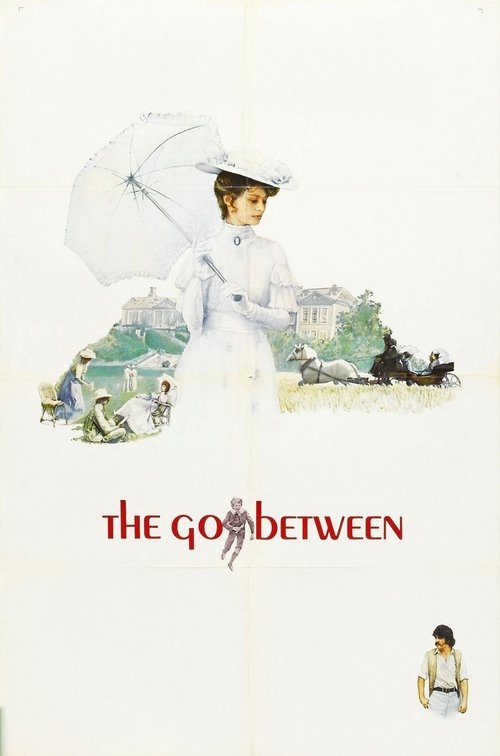
The Go-Between
1971 · Joseph Losey
For a patient, contemplative evening when you want beauty with an ache in it — a slow burn about memory, class, and lost innocence. This is a challenge-and-reward film, not a comfort watch.
What it's about
In the summer of 1900, a schoolboy named Leo stays at a friend's grand country house in Norfolk and falls under the spell of Marian, the family's beautiful grown daughter. Flattered to be useful to her, he begins secretly ferrying letters between Marian and Ted Burgess, a tenant farmer — not fully grasping what he's carrying, or what it could cost everyone if the letters came to light. It's a golden summer with something dangerous humming underneath.
The experience
Languid and sun-drenched on the surface, quietly devastating underneath — the tension builds not through action but through glances, silences, and the slow dawning of what a child half-understands. It leaves a melancholy that lingers well after the end.
Performances
Julie Christie and Alan Bates smolder as the lovers, saying everything the era forbids through looks alone, while young Dominic Guard carries the film as Leo with remarkable, unforced sensitivity. Margaret Leighton is quietly chilling as the mother who may see more than she lets on.
The craft
Harold Pinter's script is a marvel of restraint — whole class wars fought in polite small talk — and Losey shoots the English countryside so it feels both idyllic and oppressive, like a paradise with rules. Michel Legrand's insistent, ominous score keeps warning you that this summer is being remembered, not lived.
Why it matters
It won the Palme d'Or at Cannes in 1971 and stands as the crowning collaboration between Losey and Pinter, shaping the tradition of British period drama that dissects the past rather than prettifying it.
Snapshot
The Go-Between is the third and final feature-length collaboration between the exiled American director Joseph Losey and the playwright Harold Pinter, following The Servant (1963) and Accident (1967). Adapted from L. P. Hartley's 1953 novel, it recounts a single Edwardian summer in Norfolk through the memory of Leo Colston, a middle-class schoolboy who, while staying at the grand house of a wealthy classmate, becomes the unwitting courier of love letters between the daughter of the family, Marian Maudsley, and a tenant farmer, Ted Burgess. The film is at once a tender coming-of-age story and a cold anatomy of the English class system, organized around Hartley's celebrated opening sentence — "The past is a foreign country: they do things differently there" — which Pinter and Losey translate into a structure of haunted recollection. It won the Grand Prix du Festival (the top prize, today the Palme d'Or) at Cannes in 1971, the high-water mark of the Losey–Pinter partnership, and remains a touchstone of the literate, painterly British heritage film a decade before that term hardened into a genre.
Industry & production
The film belongs to the late phase of British art-cinema production that had grown out of the 1960s, when American studio money and independent producers underwrote a wave of ambitious, director-driven English pictures. It was produced by John Heyman's company, with Norman Priggen — a longtime Losey collaborator — among the producing team, and released through EMI/MGM-EMI distribution channels. The project had a protracted gestation: Pinter's screenplay existed for several years before financing came together, and Losey, who had wanted to make it earlier, took it up after the Cannes-feted Accident had confirmed the commercial and critical viability of the Pinter partnership.
Production was shot largely on location in Norfolk, using real Edwardian-era country houses and farmland to ground the period world rather than studio reconstruction; Melton Constable Hall served as the principal "Brandham Hall," with Norwich and surrounding villages supplying additional locations. The decision to shoot in authentic interiors and the East Anglian landscape — rather than on sets — was central to the film's texture, lending the sense of an oppressive, sun-heavy summer pressing against the rituals of the household. The cast married established stars with newcomers: Julie Christie and Alan Bates, both at the peak of their fame, as Marian and Ted; Edward Fox as Marian's intended, the disfigured aristocrat Hugh Trimingham; Margaret Leighton as the watchful Mrs. Maudsley; and Michael Redgrave as the aged Leo in the framing scenes. The pivotal role of the boy Leo went to the young, untrained Dominic Guard. Beyond these well-documented points, the granular budget and box-office record is not something I can state with precision here, and I will not invent figures.
Technology
The Go-Between was made with the conventional 35mm color photochemical technology of its moment, and its technical interest lies less in novel apparatus than in the disciplined use of available tools. It was shot in color on 35mm in a standard widescreen ratio, the format that had become the norm for prestige British features. There is no reliance on the optical trickery or self-conscious zoom-driven style that marked some contemporaneous filmmaking; instead the production leaned on careful exposure for naturalistic available-light interiors and the high, flattening light of an English summer. The most consequential "technology" is arguably the cutting and sound apparatus deployed to interleave time frames — the film's flash-forwards to the older Leo are achieved through editing and sound design rather than any dissolve-heavy optical convention, a restrained approach that keeps the temporal disruptions sharp and unmarked.
Technique
Cinematography
The photography is by Gerry Fisher, who had shot Accident for Losey and would remain a key collaborator. Fisher's images are luminous but never merely pretty: the Norfolk summer is rendered in heavy greens and golds, with the heat made almost tactile. Losey and Fisher favor a composed, frequently static or slowly moving camera that frames characters within the architecture of the great house and the geometry of the landscape — figures are repeatedly placed against doorways, windows, and the lines of the estate, so that the class structure is built into the visual field. The camera observes Leo observing; much of the film's tension comes from sightlines, from what the boy can and cannot see, and from the way the adults' transactions are caught at a slight, watchful distance. The recurring motif of the heat, the cut cornfield, and the deadly nightshade plant are given visual weight without underlining.
Editing
The editing is by Reginald Beck, a frequent Losey collaborator. Its boldest feature is the handling of time. Rather than confining the present-day frame to a prologue and epilogue, the film threads brief, initially cryptic glimpses of the older Leo's return — decades later — into the body of the period narrative. These flash-forwards arrive without explanatory cushioning, so that the viewer, like the man remembering, must gradually assemble the meaning of the future from fragments. This associative, memory-driven cutting is the structural correlate of Hartley's "foreign country" of the past: the editing makes the film an act of recollection rather than a straightforward chronicle.
Mise-en-scène / staging
Mise-en-scène is where Losey's authorship is most legible. Production design by Carmen Dillon furnishes the Edwardian world with a density of period detail — costume, furnishing, the apparatus of upper-class leisure (the cricket match, the formal meals, the carriages) — that is never decorative for its own sake but always expressive of hierarchy. Losey stages social ritual as a kind of theater of class: who sits where, who serves whom, who is permitted to cross thresholds. The great house functions as a stratified machine, and Leo's movements through it — up and down stairs, in and out of rooms, across the boundary between the manor and Ted's farm — trace the lines of a system he does not yet understand. The cricket match and the concert that follows are set-pieces in which the social order performs itself.
Sound
The sound design contributes materially to the film's unease, particularly Michel Legrand's score. Legrand's music is unusually austere and ominous for a period romance — built around a stark, repetitive piano-and-orchestral figure that recurs with the force of a premonition. Rather than sweetening the love story, the score forewarns of catastrophe, binding the sunlit past to the desolation of the future. Ambient sound — the drone of a hot summer, the hush of grand interiors — is used sparingly and precisely to heighten the sense of stillness before rupture.
Performance
The performances are calibrated to the film's reticent, observational mode. Julie Christie plays Marian with a charm that conceals calculation, never letting the audience fully resolve whether she is careless, trapped, or cruel. Alan Bates gives Ted a rough physical warmth that makes the cross-class attraction credible and dangerous. Margaret Leighton, as Mrs. Maudsley, builds a portrait of vigilant maternal control that culminates in the film's devastating exposure scene. Edward Fox's Trimingham embodies a wounded, courteous aristocracy. At the center, Dominic Guard's Leo is a study in watchful innocence — a boy flattered into complicity, then broken by knowledge — and Michael Redgrave's brief appearances as the old Leo carry the weight of a life arrested by that summer. The acting style is restrained, Pinteresque in its reliance on what goes unspoken.
Narrative & dramatic mode
The dramatic mode is memory-tragedy filtered through a child's limited point of view. The narrative is structured as recollection: an old man returning to the scene of a formative trauma, the bulk of the film unfolding as the remembered summer with the future bleeding intermittently into it. This double time-scheme means the audience experiences the events with the boy's incomplete comprehension while sensing, through the flash-forwards and Legrand's score, that the idyll is doomed. Pinter's screenplay is a model of dramatic compression and subtext: dialogue is spare, meaning lodged in pauses, evasions, and euphemism. The "go-between" device makes Leo both the engine of the plot and its victim — an instrument used by adults whose desires he cannot name — so that the film becomes a study of innocence enlisted into a transaction it does not understand, and the cost it pays.
Genre & cycle
The film sits at the intersection of the literary period adaptation, the coming-of-age story, and the cross-class romantic tragedy. In British terms it is a precursor to what would later be called the "heritage film," but it is sharply distinct from the nostalgic strain of that cycle: where later heritage cinema often luxuriated in the surfaces of the English past, The Go-Between deploys those surfaces critically, as the visible evidence of a rigid and damaging class order. Within the Losey filmography it belongs to a cycle of English pictures dissecting class — most directly The Servant and Accident, the other two Pinter collaborations — and it shares with them an outsider's cold-eyed scrutiny of British social codes.
Authorship & method
The Go-Between is best understood as the product of a genuine authorial partnership rather than a single auteur. Joseph Losey, an American blacklisted in the McCarthy era who rebuilt his career in Britain, brought the perspective of an exile to English class ritual, and a directorial method grounded in expressive staging, controlled camera movement, and the use of architecture and décor as moral commentary. Harold Pinter, as screenwriter, supplied the dramaturgy of subtext and silence and the formal audacity of the interwoven time-scheme; the adaptation is widely regarded as one of the finest examples of his screen work. The collaboration was reciprocal and well-matched — Losey's visual rigor and Pinter's verbal economy reinforcing one another.
Among the key collaborators: cinematographer Gerry Fisher, who realized the heavy summer light and the compositional discipline; composer Michel Legrand, whose forbidding score is one of the film's defining authorial gestures; editor Reginald Beck, who executed the memory structure; and production designer Carmen Dillon, whose period world makes the class system materially present. The source author, L. P. Hartley, supplies the governing conceit and the framing meditation on memory. Beyond these established credits and the well-documented Losey–Pinter working relationship, I will not speculate about specific on-set anecdotes that are not securely part of the record.
Movement / national cinema
The film is a product of British cinema in the long aftermath of the early-1960s New Wave, but it is not a New Wave film in the kitchen-sink sense. Where that movement had turned toward contemporary working-class realism, The Go-Between turns to the past and to the upper and tenant classes, applying a comparably critical social intelligence to a period setting. Its standing is complicated and enriched by Losey's status as an American émigré working within, yet slightly outside, the British film establishment — a vantage that lets the film treat English class custom with anthropological detachment. It also reflects the period's reliance on international finance and festival prestige (its Cannes triumph) as the engine of serious English filmmaking.
Era / period
Two eras are in play. The film was made in 1971, at a moment when British cinema was negotiating the decline of 1960s exuberance and increasingly drawn to literary adaptation and historical subjects. Its diegetic period is the Edwardian high summer just before the First World War — a world the film presents, with hindsight, as a doomed order. That period setting is not incidental: the rigidity of Edwardian class and sexual codes is the very mechanism of the tragedy, and the film's structure of retrospection invites the viewer to see this golden, stratified England as something already lost, "a foreign country" whose certainties would not survive the century. The contrast between the radiant past and the gray, depleted future glimpsed in the framing scenes carries the film's elegiac historical sense.
Themes
The central themes are memory and the irrecoverability of the past; the violence of the English class system; the loss of innocence; and the gulf between desire and the social codes that police it. Leo's role as messenger makes him the literal medium through which a forbidden cross-class love is conducted, and his ruin dramatizes how a child is conscripted into, and scarred by, adult transgression and the punishment that follows. The recurring image of the deadly nightshade — beautiful and poisonous — condenses the film's view of the enchanted summer: alluring on its surface, lethal underneath. Heat functions as an index of mounting pressure toward the inevitable exposure. Above all, the film is about how a single summer can fix a life, and how memory keeps the past alive as both treasure and wound.
Reception, canon & influence
Critically, the film was received as a major work and crowned with the Grand Prix at the 1971 Cannes Film Festival, the most prestigious endorsement available to it and the peak achievement of the Losey–Pinter collaboration. It has been widely praised for Pinter's screenplay, Legrand's score, and the performances of Christie, Bates, and Leighton, and it consolidated the reputation of the three Losey–Pinter films as a high point of intelligent British cinema. (I am not able to reproduce specific contemporary review quotations or precise award tallies reliably, and will not fabricate them.)
Looking backward, the film's influences run through L. P. Hartley's novel and its framing meditation on memory; through Pinter's distinctive theatrical method of subtext and silence; and through Losey's own prior dissections of English class in The Servant and Accident. Its larger artistic inheritance is the English literary tradition of the lost Edwardian summer and the retrospective narrator.
Looking forward, The Go-Between helped establish a template for the serious literary period film in Britain — the careful adaptation of a classic novel, location shooting in authentic period settings, and a critical rather than merely nostalgic treatment of the English past — that would inform the heritage cinema of the 1980s and after, even as much of that later cycle softened the social critique the film keeps sharp. Its memory-structure and its use of an unreliable, limited child's-eye perspective remain influential models for adaptations concerned with how the past is remembered rather than simply depicted. Within Pinter's career it stands as one of the canonical demonstrations of what his spare, subtextual writing could achieve on screen, and within Losey's it endures as perhaps his most fully realized English film.
A Deleuzian reading
Start with the heat.
The full Deleuzian reading of The Go-Between →
Reception
It won the Palme d'Or at Cannes in 1971, yet somehow drifted into 'forgotten prizewinner' territory for decades — now it's steadily reclaimed as the crown of the Losey–Pinter collaborations and a quiet ancestor of everything from Atonement to heritage-cinema at large.
How The Go-Between was received, from release to now →
Influences: the films it descends from and the films it influenced
- The Servant (1963) — First Losey–Pinter collaboration that codified the method carried into The Go-Between: architecture and décor (the staircase, mirrors) deployed as a moral diagram of class power, with meaning carried in Pinteresque pauses rather than dialogue.
- Accident (1967) — The immediate Losey–Pinter precedent for the interwoven time-scheme — surface calm of English ritual punctured by a fractured chronology and withheld subtext, the dramaturgy Pinter then refined into the flash-forward structure here.
- Last Year at Marienbad (1961) — Source of the formal audacity of an uncertain, interwoven temporality and the slow tracking camera gliding through grand architecture as the visual register of memory — the European model behind Pinter's time-scheme.
- Hiroshima mon amour (1959) — Established the memory-edit grammar in which a present image triggers and intercuts the past without signposting, the associative cutting Reginald Beck executes between Leo's two ages.
- Brief Encounter (1945) — The English template of a doomed, class-bounded romance narrated retrospectively, its emotional repression and framing recollection feeding the film's restrained surface and backward-looking structure.
- Great Expectations (1946) — Model for the faithful prestige adaptation of a canonical English novel filtered through a child's limited, dawning comprehension of adult class machinery.
- The Innocents (1961) — A child as the limited, unreliable witness to adult sexuality, realized through deep-focus architectural compositions and a heavy, oppressive period world — the child's-eye-on-corruption craft the film inherits.
- The Magnificent Ambersons (1942) — Losey's retrospective narration of a class world's destruction positions the narrator in the same relation to his past as Welles's voice-over: revisiting the exact period interiors where power was exercised over him, the long-take staging making social confinement visible as a spatial and temporal force operating on bodies in real time.
- The Fallen Idol (1948) — A boy made the physical carrier of adult correspondence — prop-driven plot in its purest form — whose misreading of a class-crossing affair detonates it, with the great house's rooms and thresholds functioning as an explicit class diagram.
- Don't Look Now (1973) — Pushes the film's flash-forward/memory editing toward full premonitory montage — fragments of image cut in before their meaning resolves, extending the associative time-cutting into a structuring principle.
- The Hireling (1973) — Another L. P. Hartley adaptation of cross-class intimacy and post-Edwardian repression that took the Cannes Grand Prix two years later, directly extending the same source-author and class-rupture material.
- The French Lieutenant's Woman (1981) — Harold Pinter's screenplay reprises his dual-time adaptation device — a present frame interleaved with a period story — as the structural engine for a literary heritage subject.
- A Room with a View (1986) — Inherits the serious-literary-period-film template — careful classic-novel adaptation, authentic location shooting, an Edwardian-summer palette — that The Go-Between helped establish for 1980s heritage cinema.
- Howards End (1992) — Extends the device of making the class system materially present through houses and property, with production design rendering social hierarchy as physical space, as Carmen Dillon's period world does here.
- The Remains of the Day (1993) — Carries forward the Pinteresque dramaturgy of servant-class subtext and silence — emotion legible only in restraint and the unsaid across a master–servant divide.
- The Age of Innocence (1993) — Choreographs class through the staging of social ritual and uses a retrospective narration over décor-as-constraint, extending the architectural-framing-as-moral-commentary method to Gilded Age New York.
- Atonement (2007) — The most direct heir: a child's misreading of cross-class desire across an Edwardian-style hot summer, structured as a meditation on how the past is (mis)remembered rather than simply depicted — the film's unreliable child's-eye memory-frame made central.
- Dangerous Liaisons (1988) — Harold Pinter's screenplay turned a period novel into a cold architecture of class and erotic manipulation, the prestige-literary template of using a child/go-between's eye for dramatic irony that Hampton's verbal precision extends.
- Saltburn (2023) — Hot-summer English country-house class transgression delivered through a retrospective frame that recolors the remembered events — the same memory-as-confession structure and estate-as-character staging.
- When Marnie Was There (2014) — Losey's memory-frame structure — a manor-house past coded as class and foreignness, revealed through withheld exposition and a late recognition — parallels Marnie's storybook Western otherness (the blonde girl in the mansion) and its buried-relation reversal.
- Maurice (1987) — Stages cross-class love across the English country-house threshold, using the estate's architecture as the literal boundary between social worlds — the threshold-motif staging Maurice reuses at Penge.
- Summer of '42 (1971) — Same year, same Michel Legrand idiom of a forbidding/yearning score laid over a retrospective narrator's account of a vanished summer and a boy's loss of innocence.
Similar films
- The Servant (1963) — influence & lineage
- Atonement (2007) — influence & lineage
- The Remains of the Day (1993) — influence & lineage
- Howards End (1992) — influence & lineage
- Brief Encounter (1945) — influence & lineage
- The French Lieutenant's Woman (1981) — influence & lineage
- Call Me by Your Name (2017) — same viewing thread
- The Best of Youth (2003) — same viewing thread
All the films related to The Go-Between →
Watch it with: curated runs of related films
- The Past Is a Foreign Country — A run of films that reach back through memory — lost summers, vanished friends, the golden light of a place you can never return to — best watched in a row when you're in the mood to ache a little.