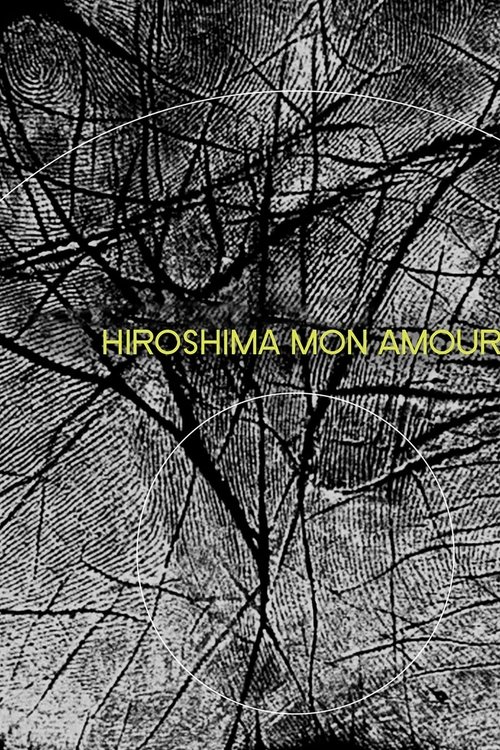
Hiroshima Mon Amour
1959 · Alain Resnais
For a quiet, late-night watch when you want something haunting and romantic to chew on for days — a challenge, not a comfort, but a beautiful one. Reach for it when you're in the mood to feel time and memory as physical things.
What it's about
A French actress in Hiroshima to shoot an anti-war film falls into a brief, intense affair with a Japanese architect. Over one night and morning, their conversation keeps circling back to the war — to the city's atomic devastation, and to a first love she buried in the French town of Nevers and has never spoken of since. It's a love story where the real drama is memory: what two people can and can't tell each other about the worst things that ever happened to them.
The experience
Hypnotic and hushed — it moves like a whispered conversation at 3 a.m., drifting between past and present until the two start to bleed together. It's sensual and mournful at once, and it gets under your skin slowly rather than grabbing you.
Performances
Emmanuelle Riva is extraordinary — she plays remembering itself, letting a buried grief surface across her face in real time, often in a single unbroken murmur.
The craft
Resnais cuts between present-day Hiroshima and flashes of the past with an editing rhythm that mimics how memory actually intrudes — a hand, a street, a face, gone again. Marguerite Duras's incantatory dialogue is practically a poem spoken aloud, and the black-and-white images of bodies and city are stark and tactile. Good speakers matter: the film lives in voices and score.
Why it matters
A founding shockwave of the French New Wave, it rewrote the rules for how films could handle time and memory, and its fractured flashback style echoes through decades of cinema since.
Snapshot
A French actress (credited only as "Elle") and a Japanese architect ("Lui") spend a night and a morning in Hiroshima in the summer of 1957, two decades after the atomic bombing. Their encounter unlocks a buried wartime memory: during the Occupation, Elle had loved a German soldier in Nevers; when he was killed, she was publicly shorn and confined to a cellar by her family. The film moves between present Hiroshima, the documentary record of the bomb's destruction, and the traumatic fragment of Nevers — splicing together two catastrophes, one historical and collective, one private and nearly unspoken. Structured less as a story than as a long, densely woven conversation between bodies and memories, the film refuses catharsis and ends on an act of naming: "Hi-ro-shi-ma" and "Nevers" become each other's proper nouns, cities substituting for selves that cannot be fully known.
Industry & production
Hiroshima mon amour emerged from an unlikely commission. The Paris-based producer Anatole Dauman of Argos Films, working in co-production with the Japanese company Daiei, initially asked Resnais to make a short documentary about the atomic bomb — a companion piece to his landmark Nuit et Brouillard (1955). Resnais declined: he felt that the existing documentary footage of Hiroshima was so overwhelming that any conventional treatment would merely replicate what had already been seen. His solution was to engage a writer who had never written a screenplay.
Marguerite Duras — already a novelist and associated with the intellectual Left Bank milieu — accepted the commission with the explicit understanding that she was writing a literary text rather than a conventional script. Her "ciné-roman," published by Gallimard in 1960 before the film's wide release, reads as prose poetry interspersed with stage directions; it circulated as a literary work in its own right and became foundational to a generation of French writers thinking about the relationship between narrative and cinema. Duras and Resnais held extensive conversations about the architecture of the piece, but the director has consistently credited her with the film's essential conception.
Shooting took place in two phases: location work in Hiroshima (including the Peace Memorial Museum and the rebuilt city's streets) and studio and location work in Nevers and Paris. The two national production contexts required two separate cinematographers, one Japanese, one French. The shoot was completed on a modest budget; there is no well-documented figure in the published record, and any specific number should be treated with caution.
Emmanuelle Riva, a stage actress with limited screen experience, was cast as Elle. Eiji Okada, one of Japan's leading film actors of the period (he would appear the following year in Hiroshi Teshigahara's work), plays Lui. Neither character is given a proper name in the film; their anonymity is structural.
Technology
The film was shot in black and white, a deliberate choice that aligns it with the documentary footage it incorporates and with the tonality of memory. Color would have been available — indeed, the French New Wave was beginning to use it — but monochrome preserves the photographic and archival register that Resnais wanted to invoke.
The opening sequence uses actual newsreel footage and photographs from the Hiroshima Peace Memorial Museum alongside staged footage of the two lovers, requiring seamless intercutting between documentary and fiction film stocks. The differences in grain, contrast, and frame stability between the archival material and the newly shot footage are legible, and Resnais does not attempt to disguise them; the material heterogeneity is part of the argument the opening makes about the difference between witnessing and knowing.
Synchronous location sound was recorded on the Hiroshima sequences. The French sequences, particularly the Nevers flashbacks, were shot with a lighter, more mobile camera — handheld passages appear during the most fragmented memory sequences — enabling the rapid editing rhythms that characterize them.
Technique
Cinematography
The two directors of photography divided the film along national and dramatic lines. Sacha Vierny, who would become Resnais's primary collaborator across the following decade and a half, shot the sequences set in France — the Nevers flashbacks and the Paris-shot studio work — bringing a meticulous compositional control that holds the fragmented imagery in precise frames. Michio Takahashi shot the Hiroshima sequences, including the documentary-inflected museum passages and the location work in the rebuilt city.
The film's most celebrated cinematographic gesture is its opening: a close-up on two bodies intertwined, filmed with extreme proximity, their skin glistening as if covered in ash or dew. The shot is ambiguous — the bodies are almost abstract at first, an intimacy that could be read as erotic or mortuary, and the visual uncertainty is the point. As the sequence proceeds, shots of the lovers alternate with photographs and footage of bomb victims, charred metal, shadows burned into stone. The rhyme is visceral and philosophically aggressive.
In the later Hiroshima passages, Vierny's frames of the city streets at night — the neon-lit bars, the wide boulevards — are composed with the same cold elegance that would mark his later work with Robbe-Grillet and Marguerite Duras herself.
Editing
The editing is the film's central formal achievement. Henri Colpi, working with assistants Jasmine Chasney and Anne Sarraute, constructed a system of temporal and associative cuts that had little precedent in commercial cinema. The Nevers flashback sequences are presented as intrusions rather than conventional flashbacks: brief, sharp, discontinuous images — the German soldier's hand, the sunlit quay, a face — that recur and accumulate rather than unfold in linear exposition. These "flash-cuts" anticipate the discontinuous memory structures that would become standard in art cinema for decades.
The film's dialogue-as-narration creates a rhythmic counterpoint to the editing: Elle's voice, describing what she "saw" in Hiroshima, continues over images that contradict or complicate her claims. The collision between the verbal and visual registers — a technique directly related to Resnais's documentary practice — gives the editing an argumentative as well as emotional force.
Colpi went on to direct Une aussi longue absence (1961), which won the Palme d'Or; his work on Hiroshima mon amour represents one of the great editing debuts of the postwar period, though the credit history between Colpi and his collaborators is not always precisely documented in secondary literature.
Mise-en-scène / staging
Resnais's staging is calibrated to produce proximity without ease. The hotel room scenes — long stretches of dialogue between two people in enclosed space — have none of the theatrical relief of conventional filmed conversation; the camera stays close, the actors are rarely given the release of reaction shots, and the editing does not break tension so much as accumulate it. The sense of confinement is deliberate: the conversation cannot end because its real subject cannot be resolved.
The Hiroshima street scenes, by contrast, place Elle in long shot, a foreign figure moving through a city that surrounds her in its ordinary life — trams, pedestrians, the sound of Japanese street commerce — indifferent to the memory she carries. The contrast between interior claustrophobia and exterior anonymity is one of the film's structural rhymes.
The Nevers flashbacks are staged with the heightened, slightly unreal clarity of traumatic memory: the locations (the quay, the cellar, the street at Liberation) are precise but the figures in them are held at the edge of visibility, as if on the point of dissolution.
Sound
Giovanni Fusco composed the music for the Japanese sequences; Georges Delerue composed for the French sequences. Both scores are restrained — spare melodic figures that work with rather than against the silence that the film periodically allows. Fusco had worked with Antonioni (L'Avventura would follow the next year), and his contribution to Hiroshima mon amour shares the same quality of emotional withholding.
The dialogue is the dominant sound event. Duras's language — aphoristic, repetitive, formally strange — is delivered by Riva and Okada in something closer to recitation than conventional dramatic speech. The voices sometimes appear to emanate from no specific spatial position, blurring the line between spoken dialogue and internal monologue. The famous opening exchange ("You saw nothing in Hiroshima. Nothing." / "I saw everything. Everything.") is conducted partly in voice-over, the synchronization between image and voice deliberately unstable.
Performance
Emmanuelle Riva's performance is among the great film acting achievements of the French cinema. She carries the paradox of Duras's character — a woman who is simultaneously present in the conversation with Lui and trapped in the recursive pull of Nevers — without sentimentality and without the conventional markers of expressionist breakdown. The performance is interior in the clinical sense: Riva withholds precisely as much as she reveals, and the camera's sustained attention to her face becomes an inquiry into what performance can and cannot show.
Eiji Okada's role is structurally harder: Lui functions partly as interlocutor, partly as mirror, partly as the representative of a catastrophe he has survived and that Elle can only claim to have "seen." His measured, attentive stillness holds the film's conversational frame without domesticating the material.
Narrative & dramatic mode
The film belongs to no conventional narrative mode. Its closest literary antecedent is the European modernist novel — Faulkner's time-fractured narration, Woolf's interior stream, Duras's own prose fiction — rather than any cinematic tradition. There is a notional story (the affair, its single day and night, its end), but the film's energy is generated by what refuses to be told: the Nevers episode, which circles back three times before it is partially assembled, and the Hiroshima catastrophe, which cannot be witnessed by anyone who was not there to be destroyed by it.
The film poses its central problem as an epistemological one: what can we know of another's suffering? Lui's insistence that Elle "saw nothing" is not cruelty but philosophical precision — the claim that the museum, the documentary footage, the rebuilt city are not Hiroshima. Elle's counter-insistence that she saw everything is equally sincere, and equally untenable. The personal grief of Nevers and the collective death of Hiroshima are not equivalent — the film never pretends they are — but each illuminates the other's conditions of unknowability.
Genre & cycle
Hiroshima mon amour defies genre classification by design. It is sometimes described as a melodrama, and the Nevers material has the emotional architecture of one — forbidden love, punishment, survival — but Resnais and Duras systematically refuse melodrama's cathartic pleasures. It is partly a war film, partly a love story, partly an essay film, partly a literary experiment in cinematic form. Its classification as a founding text of the French New Wave is accurate but requires the qualification that Resnais occupied a distinct position within that formation.
The film belongs to what critics have called the "Left Bank" tendency within the New Wave — associated with Resnais, Chris Marker, and Agnès Varda — which was distinguished from the Cahiers du Cinéma group (Godard, Truffaut, Chabrol, Rivette) by its closer ties to literary modernism, documentary practice, and the French Communist intellectual tradition. Left Bank films tended to be more formally rigorous and more explicitly political than the Cahiers films; Hiroshima mon amour is the clearest exemplar of the tendency.
Authorship & method
Resnais's directorial method on Hiroshima mon amour was collaborative in an unusually literal sense. He has consistently described his films as emerging from dialogue with his writers — he did not write his own screenplays — and in this case the collaboration with Duras produced a text that was structurally complete before shooting began. The editing, however, was where Resnais did his most decisive creative work; the temporal architecture of the Nevers sequences, the rhythm of the opening intercutting, the film's overall modulation between present and past were constructed in the cutting room.
Sacha Vierny's contribution as cinematographer to the French sequences established a working relationship with Resnais that would continue through L'Année dernière à Marienbad (1961), Muriel (1963), and beyond. Vierny's precise, slightly cold framing — images held at a slight remove from the emotional material they depict — became a signature of Resnais's visual style.
Henri Colpi as editor brought a musical sensibility (he was also a musicologist) to the associative structure of the cutting, and there is a case to be made that the film's rhythms are primarily his, executed under Resnais's close supervision.
Duras's position is particularly complex. She wrote Hiroshima mon amour as a commission but quickly recognized in the subject matter a convergence with her own preoccupations — desire, memory, colonial and occupied France, the persistence of the traumatic past into the present. Her published "ciné-roman" version makes explicit what the film can only gesture toward: the extent to which Nevers is a wound that cannot close, and the extent to which the text itself is a formal attempt to speak that wound into something communicable.
Movement / national cinema
The film occupies a pivotal position in French cinema at the moment of its transformation. Truffaut's Les Quatre Cents Coups and Godard's À bout de souffle were both released in 1959–60, and the French New Wave was crystallizing as a recognizable formation. Hiroshima mon amour is often grouped with these films in retrospective accounts of the period, and in certain respects — location shooting, anti-illusionist narrative, the foregrounding of cinematic form — the resemblances are real.
But Resnais was a decade older than the Cahiers generation, had trained as a documentarist and short filmmaker rather than as a critic, and was associated with a different political and intellectual tradition. His film is less interested in Hollywood genre cinema than those of Godard or Truffaut; its debts are to the Nouvelle Vague as a literary phenomenon as much as a cinematic one. The co-production structure — French-Japanese, with a Japanese lead and Japanese locations — also places it somewhat outside the domestic concerns of the Cahiers films.
Era / period
The film sits at the intersection of several late-1950s historical pressures. The memory of the Second World War — German occupation, the atomic bomb, the moral catastrophe of what had been done and by whom — was barely a decade old when Resnais shot the film. The French intellectual left, to which both Resnais and Duras belonged, was engaged in sustained debates about complicity, collaboration, and the politics of memory: how to account for the war without false comfort or false guilt.
Simultaneously, the late 1950s saw the collapse of the French colonial empire — the Algerian War was ongoing during the film's production — and a related crisis of French national self-understanding. Hiroshima mon amour does not address this directly, but its meditation on guilt, silence, and the bodies that bear the marks of political violence is not politically innocent in context.
Themes
The film's primary philosophical concern is the relationship between individual memory and historical catastrophe — the question of whether personal grief and collective destruction are commensurate, can illuminate each other, or must remain sealed in separate registers. Resnais and Duras frame this as an epistemological problem: knowing and not-knowing, witnessing and being unable to witness, are the film's central verbs.
Forgetting is treated with as much complexity as remembering. Elle describes the way Nevers has faded from her — the German soldier's face becoming indistinct — with something between relief and horror. The film proposes forgetting not as healing but as another form of damage, the attrition of the self that suffered. Lui's final injunction to her to "remember Hiroshima" — naming her by the city where she learned to forget — conflates the private and the historical wound.
The body is central: as archive (the skin that carries the marks of love and catastrophe), as evidence (the documentary images of burned bodies), as intimacy (the lovers' physical encounter), and as limit (the point at which language reaches the edge of what can be said). The film opens on skin that might be ash and closes on names, as if moving from the most physical to the most abstract register of human identity.
Reception, canon & influence
Critical reception. Hiroshima mon amour screened at Cannes in May 1959 as an official French entry, though it was not entered in the main competition — accounts differ as to whether this was a decision by the French selection committee or a mutual agreement, and the record on this point is incomplete. Its reception among critics was immediate and overwhelmingly affirmative. The film won the International Critics' Prize (FIPRESCI Award) at Cannes, and French criticism quickly recognized it as a work of major ambition. Marguerite Duras's screenplay was nominated for the Academy Award for Best Writing, Story and Screenplay Written Directly for the Screen at the 32nd Academy Awards (1960), an unusual honor for a French art film at that time.
Influences on the film (backward). Resnais drew directly on his own documentary practice, particularly Nuit et Brouillard (1955), in the intercutting of archival and dramatic material. The literary influences acknowledged or clearly present include Faulkner's temporal fracturing (which Duras had absorbed), the French Nouveau Roman's suspension of conventional narrative causality, and the philosophical writing of Maurice Blanchot on memory, disaster, and the limits of testimony. Neorealist location shooting — the use of the actual rebuilt Hiroshima rather than studio reconstruction — is a visible debt, though the film's conclusions about what can be seen are anti-neorealist.
Legacy (forward). The film's formal legacy is immense and still insufficiently charted. The associative memory-cut — the brief, disorienting intrusion of the past into the present without conventional flashback framing — became one of the most widely used techniques in art and commercial cinema alike. The structural principle of intercutting personal and historical registers of catastrophe has been deployed, with varying degrees of sophistication, in scores of subsequent films. Alain Resnais's own Muriel (1963) and L'Année dernière à Marienbad (1961) extend the formal experiments; Chris Marker's La Jetée (1962) and later Sans Soleil (1983) develop the meditation on memory and photography in adjacent directions.
More broadly, the film's influence on the global art cinema of the 1960s and 1970s was foundational. Michelangelo Antonioni's explorations of emotional alienation and temporal dislocation in the early 1960s develop in a space that Hiroshima mon amour helped open. The film is frequently cited — if not always with precision — in discussions of the subjective memory film that runs from Agnès Varda through Wong Kar-wai to more recent work on trauma, testimony, and cinematic time.
In the English-speaking world, the film was a discovery text for a generation of filmmakers and cinephiles who encountered it in repertory cinema and university film courses from the 1960s onward. Its status in the canon is now secure: it regularly appears in critical surveys of the greatest films, and its opening sequence — bodies, ash, documentary, intimacy — remains one of the most analyzed passages in the history of cinema. What has perhaps been less noticed is the degree to which the film's difficulty — its refusal to tell the viewer how to feel, its insistence that some things cannot be witnessed at a remove — remains its most demanding and its most honest quality.
A Deleuzian reading
Two bodies, shot so close they stop being bodies.
The full Deleuzian reading of Hiroshima Mon Amour →
Reception
Pulled from official Cannes competition in 1959 to avoid upsetting the American delegation over its atomic-bomb subject matter, it still detonated — the Cahiers critics treated it as year zero of modern cinema, and it's now a permanent fixture of the art-house canon alongside Breathless and The 400 Blows.
How Hiroshima Mon Amour was received, from release to now →
Influences: the films it descends from and the films it influenced
- The Passion of Joan of Arc (1928) — Dreyer's systematic deployment of facial close-ups so extreme that spatial context is eliminated established the extreme-proximity cinematographic register Resnais opens with — the intertwined bodies are filmed at the same annihilating closeness, making flesh ambiguous before it becomes legible.
- Paisà (1946) — Rossellini's intercutting of actual war-devastated Roman and rural locations with staged fiction — where documentary grain and fictional smoothness coexist without apology — established the mixed archival/fictional register that Resnais inherits for the atomic footage passages, letting the material difference between stocks do argumentative work.
- Letter from an Unknown Woman (1948) — Ophüls's voiceover memory structure — a narrator recounting the past in a letter read in the present, while images illustrate scenes the letter cannot fully contain — prefigures Hiroshima's image-voice counterpoint, where Duras's dialogue describes what the images refuse to confirm and the gap between saying and showing generates the film's epistemological pressure.
- Rashomon (1950) — Kurosawa's narrative architecture — multiple irreconcilable accounts of a single past event that cannot be resolved into truth — established the epistemological structure Resnais adapts: the past as permanently inaccessible despite, and because of, the testimony of those who lived it.
- Children of Hiroshima (1952) — Shindo's direct incorporation of Hiroshima Peace Memorial archive photographs and survivor accounts within a constructed dramatic frame — fiction entering documentary space without dissolving the seam — was the immediate Japanese precedent for Resnais's documentary-fiction intercut approach to atomic material.
- Night and Fog (1955) — Resnais's own commissioned short, the direct predecessor of Hiroshima, perfected the intercutting of archival footage with present-tense narration running at temporal counterpoint to the images, and developed the monochrome archival register that Hiroshima then migrates from landscape into private memory.
- Wild Strawberries (1957) — Resnais extended Wild Strawberries' technique of cutting cleanly into traumatic memory without optical transitional effects, then made the viewer's temporal disorientation an explicit formal subject rather than a navigable architecture — pushing Bergman's calibrated abruptness into structural vertigo.
- Battleship Potemkin (1925) — Resnais's dialectical intercut between the woman's Nevers trauma and the Hiroshima documentary archive applies the stone-lions editorial logic to temporal rather than spatial collision — two image-registers whose juxtaposition generates political-affective meaning that neither strand contains independently, transposing Eisenstein's rhetorical montage into phenomenology of memory.
- Brief Encounter (1945) — Resnais systematizes Brief Encounter's memory-insert technique — present reality interrupted by involuntary images from another time — into a formal method: the fantasy insert becomes flashback-as-trauma-recurrence, the retrospective voiceover becomes direct address, and a transit city replaces the railway junction as the liminal space where past and present collapse into each other.
- Elevator to the Gallows (1958) — Resnais develops the phenomenological female city-walk — a woman moving through an environment that exceeds its narrative function — from the template Moreau establishes wandering nocturnal Paris; Resnais systematizes the staging as a grammar of consciousness moving through hostile space, absorbing rather than traversing the city.
- Le Plaisir (1952) — Marguerite Duras's literary voice-over — prose rhythms that contradict rather than caption the images, creating temporal displacement between spoken memory and visible present — translates the Ophülsian narrator-as-temporal-ironist device Le Plaisir's Jean Servais voice established into the register of trauma and forgetting.
- Last Year at Marienbad (1961) — Resnais and Robbe-Grillet, again with Sacha Vierny as cinematographer, extend Hiroshima's epistemological instability by dissolving any stable boundary between memory and present tense, so that the flash-cut intrusions of the Nevers sequences become the film's entire temporal register — no secure 'now' remains from which the past can be distinguished.
- La Jetée (1962) — Marker builds an entire film from the flash-cut memory structure Resnais deploys in the Nevers sequences, using still photographs as the unit of montage with a detached voiceover running against rather than describing the images, enacting memory as a series of frozen frames that cannot reconstitute continuous experience.
- Muriel, ou le Temps d'un retour (1963) — Resnais's next fiction feature deploys the same flash-cut intrusion system — here applied to Algerian War trauma — using discontinuous home-movie-style fragments that erupt into present-set scenes without ever coalescing into conventional flashback, extending Hiroshima's refusal to grant the past a stable, retrievable form.
- Persona (1966) — Bergman extends Hiroshima's unstable voice-synchronization into formal identity-exchange: Alma's voice gradually absorbs Elisabet's silence until the two women's faces literally merge onscreen, while the film's opening flash-cut through burning celluloid directly echoes Resnais's intrusive memory fragments as material ruptures in the film's own surface.
- India Song (1975) — Duras, applying her own literary-script method from Hiroshima but now directing, completely uncouples voice from body: characters move onscreen in silence while offscreen voices discuss them in past tense, extending Hiroshima's image-voice counterpoint to total dissociation — the logical terminus of the technique she first developed for Resnais.
- Sans Soleil (1983) — Marker's essay-film uses a voiceover-letter structure — a woman reading a correspondent's letters over images that rarely illustrate them — extending Hiroshima's image-voice counterpoint and epistemology of witnessing-and-unknowability to the problem of cultural memory across national difference, including Japan as a site of layered historical time.
- Shoah (1985) — Lanzmann enters into explicit formal argument with Hiroshima by refusing all archival footage of the Holocaust, insisting that present-tense survivor testimony is the only legitimate mode — a counter-position that presupposes and is defined against Resnais's documentary-fiction intercut, making Shoah's method only fully legible in relation to Hiroshima's.
- Vagabond (1985) — Varda deploys an epistemological structure that directly echoes Hiroshima's: a series of witness testimonies about a dead woman frame and interrupt the fictional narrative, constructing a protagonist who remains permanently unknowable despite the accumulation of accounts — the same refusal of catharsis grounded in the same structural conviction that the other cannot be fully possessed through narration.
- The Currents (2025) — Pioneers editing that braids present perception with intruding memory, the recursive temporal grammar in which the remembered keeps surfacing into the now.
- Three Colors: Red (1994) — Resnais and editor Henri Colpi establish the non-linear parallel time-stream edited for accumulation of feeling rather than causal plot; Kieślowski and Witta inherit this unhurried, meaning-over-momentum rhythm for Red's cross-cutting.
- Wings of Desire (1987) — Resnais braids whispered interior monologue against found documentary images of historical atrocity, making subjective memory and historical site mutually inscribed; Wenders and Handke extend this grammar to the angels' overlapping overhearing of Berliners' inner voices layered over the divided city's topography.
- Breathless (1960) — Resnais and editor Henri Colpi's cuts between present-tense Hiroshima and memory-time Nevers — splicing incompatible temporal states without conventional transition — dismantled the classical suture the year before Godard systematized the intra-scene jump cut as a repeatable editing grammar.
- Night and Fog in Japan (1960) — Oshima, in direct formal dialogue with Resnais, used flash-cut collisions between the 1951 and 1960 Anpo student protests — traumatic political fragments erupting into a present-set wedding scene — adopting Hiroshima's editing syntax of intrusive memory while redirecting it toward Japanese left-wing political conscience.
- Vivre sa vie (1962) — Godard's chapter-structured essay-film deploys image-voice counterpoint through intertitles and suspended sound that periodically replace rather than accompany the image, while Karina's interior-withholding performance — the camera watching a face that will not disclose — extends the Left Bank mode of performance Riva established.
- Ashes and Diamonds (1958) — Resnais developed the diegetic-counterpoint editing logic simultaneously: a doomed brief love affair cross-cut against irrupting historical catastrophe, with a structurally ironic finale that refuses consolation—the same post-war thaw grammar applied to French-Japanese memory rather than Polish resistance.
- L'Avventura (1960) — Resnais arrives the year before at an independent formulation of elliptical editing that refuses chronological causality — cutting between Hiroshima and memory-Nevers in a grammar that enacts psychological time rather than story time — co-inventing with Antonioni the art-cinema editing paradigm.
- La Notte (1961) — Resnais established the template of two figures whose communication failure is rendered through elliptical cutting rather than expository dialogue, and Emmanuelle Riva's performance of withdrawn interiority without expressive display directly prefigures Jeanne Moreau's non-expressive behavior as La Notte's central performance mode.
- Point Blank (1967) — The sound-bridge technique — carrying dialogue or sound from one timeframe across a hard cut into another — that structures Point Blank's flashbacks descends directly from Resnais's collision of present voice and past image.
- The Pawnbroker (1965) — The brief, involuntary inserts of past horror that puncture a present-tense scene — memory cutting in as a flash rather than a dissolve — is the editing grammar Lumet and Rosenblum directly adapted for Nazerman's recollections.
- The Belly of an Architect (1987) — Establishes the Vierny–Resnais essayistic mode of treating architecture and the body as memory-objects, the painterly art-film grammar Greenaway extends into curated tableaux.
- The Constant Gardener (2005) — Ancestor of the memory-architecture editing — involuntary flashbacks of the lost beloved intruding on the present as the film's organizing temporal logic.
- Memories of Underdevelopment (1968) — Establishes the braiding of first-person interior-monologue voiceover with documentary and archival footage, treating memory itself as a montage principle that Sergio's narration reworks.
- The Man Who Sleeps (1974) — Marries a nouveau-roman literary text (Duras) as incantatory, second-person-inflected voiceover to a body wandering the city, dissolving plot into recited language — the template for word-over-drift the seed radicalizes.
- Ballad of a Soldier (1959) — Reconstructs war and love through flashback editing intercut against the present, the withheld, memory-driven emotional suspense that parallels Ballad's episodic-flashback construction.
Similar films
- La Jetée (1962) — influence & lineage · same viewing thread
- Last Year at Marienbad (1961) — influence & lineage · often watched together
- Muriel, or the Time of Return (1963) — influence & lineage
- Rashomon (1950) — influence & lineage
- Sans Soleil (1983) — influence & lineage
- India Song (1975) — influence & lineage
- Night and Fog (1956) — same viewing thread
- Woman in the Dunes (1964) — same viewing thread
All the films related to Hiroshima Mon Amour →
Watch it with: curated runs of related films
- The Vanishing Self — A run of 1960s–70s modernist art cinema where identity comes undone — people simply vanish, faces are remade, memory bleeds into hostile landscape — that rewards being watched in a stretch, each film deepening the last's dread.
Film essays and courses that include it
- How Cuts Think: From Soviet Montage to New Hollywood Rhythm
- Duration and Doubt: The Art Film from Dreyer to Kiarostami
- Radical Attention: A Century of Art Cinema
- Jump Cut: The Nouvelle Vague from Birth to Dissolution
- A School of Looking: French Cinema's Seven Decades of Formal Invention
- The Ache of Distance: Cinema's Language of Longing
- The Shape of Longing: How Cinema Reinvented Romance
- The Vow and Its Violation: A Century of Marriage on Screen
- The Weight of Absence: Cinema's Grammar of Grief
- Witness: Cinema's Century of War and Its Wound
- The Architecture of Forgetting
- The Grammar of Longing: Cinema's Great Forbidden Love
- The French Invention: From Grand Illusion to Caché
- In-Yeon: Impossible Love and the Immigrant Self
- What Light Remains: The Impressionist Memory Film
- What the Frame Cannot Hold: Cinema's Long Reckoning with Off-Screen Atrocity
- The Revolution That Disappeared
- The Machine That Remembers