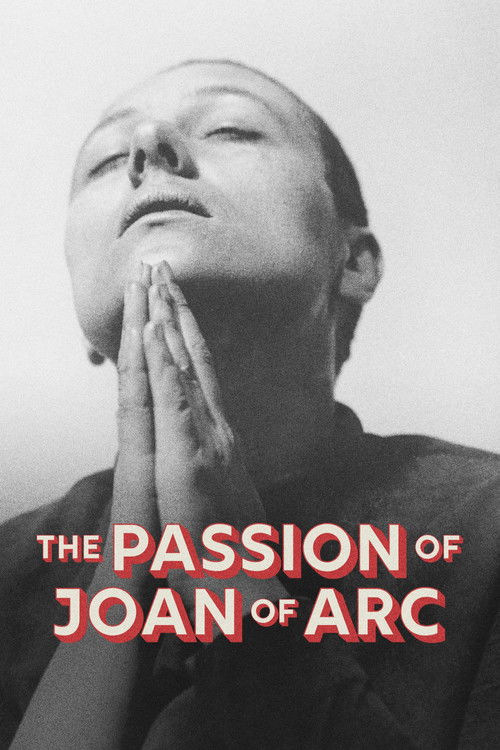
The Passion of Joan of Arc
1928 · Carl Theodor Dreyer
For when you want to be moved to your core — a film to watch alone, with full attention, when you're ready to feel something enormous. Challenging in form, devastating in effect.
What it's about
One day, one trial. A teenage Jeanne d'Arc stands before a court of church officials who interrogate, threaten, and torment her over her claim that God spoke to her — and she must choose between saving herself and holding to what she believes is the truth. A silent film from 1928 that strips a vast historical drama down to faces in a room.
The experience
Overwhelming in the most intimate way possible: the camera lives inches from Joan's face, and her fear, exhaustion, and defiance hit with a force that feels almost physical. Nearly a century old and it still leaves people wrecked.
Performances
Renée Jeanne Falconetti, in what is widely considered her only major screen role, gives what many call the greatest performance ever filmed — every doubt and flicker of faith passing across her unmade-up face in close-up.
The craft
Carl Theodor Dreyer built the film almost entirely from extreme close-ups, shooting faces without makeup against stark bare sets, so the drama plays out on skin and in eyes rather than in spectacle. It proves how little cinema needs — no sound, no color, no scenery — to be shattering.
Why it matters
A cornerstone of world cinema whose influence on how directors film the human face is incalculable; its original negative burned, and the film survives thanks to a near-complete print found in 1981 in a Norwegian psychiatric hospital.
Snapshot
One of the undisputed masterworks of world cinema, Carl Theodor Dreyer's account of Jeanne d'Arc's trial and execution collapses a vast historical drama into a single, airless day of ecclesiastical interrogation, psychological torture, and martyrdom. Shot almost entirely in extreme close-up, stripped of conventional pageantry and period spectacle, the film operates less as historical reconstruction than as a sustained phenomenological inquiry into faith, suffering, and institutional cruelty. The performance by Renée Jeanne Falconetti — in what is widely considered her only substantial screen appearance — remains one of the most studied and celebrated acts in cinema history. The film's original negative was destroyed by fire; a near-complete print was discovered in 1981 in a Norwegian psychiatric hospital, restoring it to general circulation in essentially the form Dreyer intended. It has appeared near or at the top of nearly every major critical canon since and occupies a singular position as both a formal experiment and a devotional object.
Industry & production
The film was produced by the Société Générale des Films, a French company that commissioned Dreyer — by then known for Master of the House (1925) and earlier Scandinavian work — to make a prestige picture on a French historical subject. Dreyer was given considerable creative latitude, a resource that proved as enabling as it was costly. Production took place through 1927 into 1928 on custom-built sets erected at studios in the Paris region. The scale of the physical production was substantial: entire interiors and courtyards were constructed in full, including architectural elements the camera would never directly film, so that actors could move freely and Dreyer could select angles unpredictably. The nominal source material was a 1925 novel by Joseph Delteil, but Dreyer largely set the novel aside and worked directly from the actual Latin trial transcripts — the Procès de condamnation et de réhabilitation — compiled from the 1431 proceedings at Rouen. This archival grounding gave the dialogue its particular austerity: much of what the judges say on screen corresponds closely to the historical record.
Dreyer cast the stage actress Renée Jeanne Falconetti after reportedly seeing her in a light comedy at the Comédie des Champs-Élysées and recognizing in her face a quality of anguished depth incongruous with her material. Falconetti, who had made very limited prior screen appearances, agreed to the project and submitted to Dreyer's demanding preparation process. The clerics and inquisitors were played largely by nonprofessionals — men Dreyer found whose faces conveyed the physical weight he wanted — though the cast also notably included Antonin Artaud as the sympathetic friar Massieu.
The production ran over schedule and over budget. The Société Générale des Films was not commercially pleased with the results, and the film's French release in 1928 was troubled by censorship pressure from Catholic organizations offended by its portrayal of the Church hierarchy. Versions were cut or modified for various national markets. The original camera negative was destroyed in a fire at the UFA laboratories, and a second fire later destroyed a safety copy; the film was effectively a "lost" work for decades, known only through degraded prints of varying provenance. In 1981, a complete print — corresponding to what researchers believe is very close to Dreyer's final cut — was discovered at the Dikemark psychiatric hospital in Norway, apparently having been stored there since a distribution period in the early sound era. That print became the basis for modern restorations.
Technology
The film was shot on panchromatic film stock, which at the time was newer and more sensitive to the full visible spectrum than the orthochromatic stock that had dominated silent-era production. Panchromatic stock rendered skin tones and subtle facial gradations with far greater fidelity, and Dreyer and cinematographer Rudolph Maté exploited this systematically: the actors wore no conventional theatrical makeup, an almost unheard-of choice in 1927. Falconetti's face, and the faces of the judges, were recorded with an exposure system designed to capture the finest surface detail — pores, tears, creases — in ways that orthochromatic stock and the heavy greasepaint of studio convention would have obscured or homogenized. The sets were reportedly painted in a neutral pinkish-buff tone calibrated to work with the panchromatic emulsion.
The camera equipment was standard professional apparatus of the era, but its deployment was anything but conventional. The construction of full, open sets meant the camera could be positioned at floor level, above eye level, canted on its axis, or placed at close range without being blocked by standing sets — a physical freedom that translated directly into the film's disorienting spatial grammar.
Technique
Cinematography
Rudolph Maté's camerawork is inseparable from the film's identity. Dreyer and Maté made the close-up — specifically the extreme close-up of the human face — the film's primary unit of expression, used not as punctuation within a conventional shot hierarchy but as the dominant register for scene after scene. The standard rules of screen geography are systematically suspended: eyeline matches are frequently refused, establishing shots are minimized or withheld, and spatial continuity between the interrogators and the interrogated is kept deliberately unstable. The viewer is rarely permitted to orient within the room; instead the space of the film is constituted almost entirely by the space of faces and their relations to one another across cuts.
Maté's lighting is stark and directional, often placing light sources in positions that emphasize the sculptural texture of faces rather than conventional studio glamour. The work avoids soft fill light and atmospheric diffusion, producing an almost forensic luminosity. Camera angles frequently depart from horizontal: shots are taken from slightly below or above, the frame occasionally tilted, so that heads hang against plain white walls or bare sky in compositions that read as iconic rather than naturalistic. The result has drawn comparison to medieval religious art — specifically to the flat, hieratic spaces of manuscript illumination and the severe frontality of Byzantine icon painting — though whether this was a programmatic reference or an emergent property of formal choices made for other reasons is not definitively established in the historical record.
Editing
The editing pattern is rapid by the standards of late silent cinema, generating an almost percussive rhythm during the interrogation sequences through accumulation of close-ups that do not resolve into conventional spatial logic. The cuts frequently do not match eyelines in the expected way; a cut from Falconetti looking left does not necessarily produce a judge looking right. This refusal of the shot/reverse-shot's implicit guarantee of shared space creates a persistent sense of isolation — Joan is physically present among her interrogators but ontologically separated from them. The overall effect is less that of a scene being filmed than of a mental state being rendered directly. Editing pace shifts significantly for the final sequence of the execution, where the rhythm opens out and Dreyer introduces crowds and spatial scale largely absent from the trial sequences, producing a structural and emotional release that depends on everything that preceded it.
Mise-en-scène / staging
The physical sets designed under Hermann Warm — who had previously been the art director on The Cabinet of Dr. Caligari (1920) — are notably abstract: arched corridors, whitewashed walls, flagstone floors, barred windows. They suggest a medieval penal and ecclesiastical environment without any antiquarian accumulation of period detail. There are almost no props, no ornamental surfaces, nothing to anchor the eye in material culture. The effect is to make the film feel simultaneously historical and timeless, even allegorical. The actors in the trial sequences are blocked in ways that deny the conventional theatrical logic of stage space — judges loom at the edges of frames rather than being placed frontally, and Falconetti is frequently isolated against architectural voids. The exterior execution sequence, with its crowd of townspeople and soldiers, is shot with more conventional spatial coverage and represents a deliberate stylistic shift.
Sound
The film is silent, produced in the last period before synchronized sound became technically and commercially mandatory in France. It was exhibited with live musical accompaniment in 1928, as was standard practice; no original score was commissioned by Dreyer or the Société Générale des Films that has canonical status. Over the course of the twentieth century the film has been shown with a wide range of musical accompaniments, from orchestral arrangements to electronic scores. The American composer Richard Einhorn wrote Voices of Light (1994), an oratorio for vocal soloists, chorus, and orchestra designed for simultaneous performance with the film; this work has become one of the more frequently encountered pairings in revival screenings and recordings. Dreyer himself expressed interest in a sound version in the early 1930s, but no such version was completed.
Performance
Falconetti's performance is the film's most discussed and most irreducible element. In a film built from close-ups of the human face, her face becomes the primary terrain of the narrative, and she fills that terrain with what critics have consistently described as an extraordinary interior presence. The performance does not rely on the exaggerated gestural code common in silent-era acting; instead Dreyer extracted from Falconetti a mode of expression so concentrated and restrained that it reads less as acting in the theatrical sense and more as a form of exposed interiority. Various accounts, of disputed precision, describe Dreyer requiring Falconetti to kneel on stone floors between takes to maintain her physical and psychological state; the degree to which such methods were employed and Falconetti's own attitude toward them has been a subject of scholarly discussion, and the record here is not fully clear. What is clear from the film itself is that the performance deploys tears, silence, and minute muscular shifts around the eyes and mouth with a precision and consistency that functions as articulate language.
Antonin Artaud, appearing as the friar Massieu, brings to his relatively brief screen time the same quality of extreme physical expressiveness he theorized in his theatrical writings; his face in close-up has its own iconic intensity, and the shots of him registering anguish at Joan's treatment carry real weight. The judges and inquisitors — many of them non-actors chosen for physiognomy — collectively constitute a counter-portrait: fleshy, skeptical, self-satisfied, their faces reading as indices of institutional power.
Narrative & dramatic mode
The film's narrative structure is radically compressed: the story takes place essentially within a single day, from the final session of interrogation through recantation, re-condemnation, and burning. There is no backstory, no vision sequence dramatizing Joan's divine communications, no flashback to her campaigns. The viewer arrives in medias res, already inside the trial. This compression, drawn from the structure of the actual trial documents rather than conventional narrative biography, transforms the film's mode from historical epic to something closer to chamber drama or passion play. Causality in the conventional sense is minimal: the outcome is known, the theological and political machinery is already in motion, and the drama consists not of whether Joan will die but of the quality of her resistance and her inner state as she approaches death. This narrative mode — anti-teleological in one sense, teleological in the deepest sense — gives the film its character as devotional object as much as dramatic narrative.
Genre & cycle
The film belongs to a tradition of hagiographic and martyrological cinema that reaches back to the earliest years of the medium, with Joan of Arc as one of silent cinema's most frequently revisited subjects — Georges Méliès had filmed her story in 1900, and Cecil B. DeMille produced a version in 1916. Dreyer's film participates in this tradition while fundamentally transforming its conventions: where earlier Joan films emphasized spectacle, military pageant, and melodramatic incident, Dreyer's is wholly interior. The film also sits within a broader category of prestige historical drama that French cinema pursued in the late 1920s as a cultural and industrial strategy. More broadly, it is a founding text of what later critics would theorize as "slow cinema" or cinema of duration and contemplation, though these terms postdate the film by decades.
Authorship & method
Dreyer (1889–1968) is one of cinema's most thoroughly theorized auteurs. Born in Denmark, he worked across national contexts — Denmark, Sweden, Norway, Germany, France — but maintained throughout his career a consistent set of preoccupations: religious experience, institutional persecution, the inner life made visible on the human face. The Passion of Joan of Arc is often described as the fullest early expression of his mature style, one he would continue developing through Vampyr (1932), Day of Wrath (1943), Ordet (1955), and Gertrud (1964).
Rudolph Maté (1898–1964) was, at the time of this film, early in a career that would extend through landmark work on Dodsworth (1936), Foreign Correspondent (1940), and Gilda (1946) before he turned to directing. His collaboration with Dreyer here is one of the great director-cinematographer partnerships of the silent era, and questions about the precise attribution of formal choices between them remain open — as is usually the case in such partnerships.
Hermann Warm's contributions to the production design extended the visual intelligence he had brought to German Expressionism, though the style of the sets here is closer to asceticism than Expressionist distortion. The screenplay credit belongs formally to Dreyer, with the historical trial transcripts as the primary source; Joseph Delteil received an acknowledgment related to the original commission but Dreyer's adaptation was substantively his own.
Movement / national cinema
The film is a French production made by a Danish director, and it resists clean assignment to any single national cinema. In the context of late French silent cinema, it is anomalous: contemporary French production was oriented toward popular genres, adaptations of literary classics, and commercially driven historical spectacle. Dreyer's film was a foreign-funded exception that fit no clear industrial category. In the context of Danish and Scandinavian cinema, it represents the fulfillment of certain tendencies visible in the films of Victor Sjöström and Mauritz Stiller — interiority, formal severity, the face as expressive instrument — pushed to an extreme that Dreyer's Scandinavian predecessors had not reached. The film is therefore best understood as an international or trans-national work, produced at a moment when European art cinema was not yet a fully coherent commercial or critical category.
Era / period
The film belongs to the final phase of the silent era in Europe, made and released in 1928 — the same year in which The Jazz Singer (1927) had already signaled synchronized sound's commercial inevitability in the United States, and in which French studios were beginning to anticipate conversion. In this sense the film represents both the late culmination of possibilities that silent cinema had developed — the expressive close-up, the visual rhythm of editing, the art of pure performance before a camera — and an elegy for a mode that was about to be displaced. The loss of the original negative and the film's subsequent semi-disappearance meant that its historical impact was more delayed and discontinuous than it might otherwise have been.
Themes
Faith and its relationship to institutional religion is the film's most explicit and sustained theme: Joan's direct, unmediated experience of the divine stands against the bureaucratic, textual, politically compromised authority of the Church court, and the film is consistently structured so that the viewer's identification is with her interiority rather than their procedure. The theology the film implicitly proposes — that authentic spiritual experience is both real and unintelligible to institutional power — gives it a devotional character that cuts across confessional lines.
Suffering as witness is closely related: the film is a passion narrative in the precise sense derived from Christian iconography, tracing the progressive physical and psychological degradation of a body that becomes, through its suffering, a site of meaning. The close-up functions here as a devotional instrument in the same sense that religious portraiture functions — fixing the suffering face so it can be contemplated. Gender and power run through every scene: Joan's vulnerability to the court is inseparable from her femaleness in a clerical, male space, and Dreyer's camera consistently positions her face as small and isolated against the looming architecture of masculine authority. The film does not editorialize on this; it simply shows it.
Reception, canon & influence
Critical reception and troubled early life. The film opened in Paris in October 1928 to a mixed commercial response, partly because it was unlike any historical film audiences expected. Catholic groups in France and elsewhere lobbied for cuts or bans, which they obtained in several markets. The destruction of the original negative and a second print left the film in a degraded state for decades; audiences who encountered it before 1981 often did so through poor prints that incompletely represented Dreyer's intentions. The Dikemark discovery — a fully intact print found in a storage room of the Norwegian psychiatric hospital, whose provenance remains somewhat mysterious — transformed the film's accessibility and enabled modern restorations. It has since ranked among the top ten or twenty films in the Sight & Sound decennial poll and its equivalent surveys consistently across several decades.
Influences on the film (backward). Dreyer drew on multiple traditions. German Expressionism contributed the architectural starkness and the use of face-to-architecture contrast, filtered through collaborators like Warm. Swedish and Danish silent cinema provided a model of interiority and natural-light realism. The actual trial documents gave the film a historical authority and a spare documentary texture that most historical filmmaking had not attempted. Dreyer had also studied religious painting carefully, and while specific painterly sources are debated in the scholarly literature, the film's composition in terms of flat, frontally-lit faces against white grounds clearly engages the iconographic tradition of devotional portraiture.
Legacy and forward influence. The film's influence on subsequent filmmaking is substantial but often diffuse, transmitted through filmmakers' firsthand encounters with the film rather than through industrial or stylistic continuities in the conventional sense. Ingmar Bergman cited it as among the works most essential to his own formation as a filmmaker, and the extreme close-up as a vehicle for interiority that runs through Persona (1966) and Cries and Whispers (1972) is directly in dialogue with Dreyer's practice. Jean-Luc Godard staged a scene in Vivre sa vie (1962) in which his protagonist Anna Karina watches the film in a cinema and weeps, explicitly making Falconetti's face a mirror for his own heroine's condition — one of cinema's most lucid acts of homage and theoretical argument simultaneously. Robert Bresson's entire practice of using non-actors, suppressing conventional performance, and reducing mise-en-scène to its irreducible elements can be understood as a continuation of methods Dreyer pioneered here, though Bresson developed these in his own independent direction. The film has been a touchstone for later filmmakers returning to the Joan of Arc material: Jacques Rivette's Jeanne la Pucelle (1994) and Bruno Dumont's Jeannette (2017) and Jeanne (2019) each engage with the tradition Dreyer's film anchors, whether by extension or deliberate counter-proposition. More broadly, the film stands as the founding document for a mode of filmmaking — contemplative, face-centered, duration-based, interior — whose influence on art cinema in the second half of the twentieth century is difficult to overstate.
A Deleuzian reading
Start with the tear.
The full Deleuzian reading of The Passion of Joan of Arc →
Reception
Censored by the Archbishop of Paris, cut by British censors, and then thought lost for decades after fires destroyed the original negatives — until a complete print turned up in 1981 and cemented its climb into the Sight & Sound top tier, where critics now routinely rank it among the greatest films ever made.
How The Passion of Joan of Arc was received, from release to now →
Influences: the films it descends from and the films it influenced
- The Cabinet of Dr. Caligari (1920) — Hermann Warm served as set designer on both Caligari and Joan of Arc; Dreyer's abstract minimalist courtyards and chambers — built for psychological effect rather than period verisimilitude — directly inherit Caligari's principle that theatrical architectural construction should externalize interior states rather than simulate historical reality.
- Intolerance (1916) — Griffith's systematic use of the facial close-up as the primary emotional unit during the Judean story's trial and condemnation sequences established the formal vocabulary — judgment administered through faces rather than through establishing spaces — that Dreyer absolutizes into Joan of Arc's total grammar.
- Häxan (1922) — Christensen's witch-trial docudrama applies extreme close-up scrutiny to women's faces during inquisition sequences, using nonprofessional subjects cast for their physiognomies, in the same Scandinavian film culture in which Dreyer was working; both films treat the interrogated female body as the site of institutional violence and the camera as an extension of the tribunal's gaze.
- The Phantom Carriage (1921) — Sjöström's use of the extreme close-up to render spiritual anguish and moral reckoning — particularly the death-vision sequences where faces register interiority without theatrical gesture — established the close-up as an instrument of spiritual inquiry in Nordic silent cinema that Dreyer inherits and absolutizes.
- Sunrise: A Song of Two Humans (1927) — Charles Rosher and Karl Struss's panchromatic cinematography without theatrical greasepaint on Murnau's 1927 film demonstrated that the face shot on the newer emulsion could serve as a natural landscape of tonal gradation; Rudolph Maté and Dreyer applied the identical panchromatic-without-makeup logic at extreme proximity, exploiting the stock's sensitivity to skin texture in ways orthochromatic emulsion would have obscured.
- Day of Wrath (1943) — Dreyer directly extends Joan of Arc's formal grammar: a woman accused before a religious tribunal, close-up accumulation during interrogation, the same systematic refusal of eyeline-match continuity between accuser and accused, and the face as the primary architectural space of institutional violence and spiritual endurance.
- Ordet (1955) — Dreyer extends Joan of Arc's percussive close-up accumulation and the long-held face in spiritual extremis into a narrative culminating in miraculous resurrection; the editing grammar of the climactic scene — refusing master shots entirely in favour of close-up accumulation — is a direct continuation of the formal language Joan of Arc developed.
- Diary of a Country Priest (1951) — Bresson's hagiographic mode — the suffering face of a solitary spiritual figure held in close-up through institutional indifference and physical decline — applies Dreyer's principle that the face in extremis constitutes a devotional image; Bresson explicitly acknowledged the debt, and his use of nonprofessional-inflected performance to suppress theatrical mediation descends directly from Dreyer's approach.
- Trial of Joan of Arc (1962) — Bresson returns to the same 1431 Rouen trial transcripts Dreyer used as his script source, casting nonprofessional 'models' whose faces register spiritual ordeal without theatrical inflection, making the formal contrast between his restrained duration and Falconetti's expressivity a deliberate critical dialogue with Dreyer's film across the same archival material.
- Vivre sa vie (1962) — Godard stages a scene in which Nana watches Dreyer's film and silently weeps in a close-up mirroring Falconetti's, then structures his own film as a series of close-up tableaux of a woman's face under social and institutional persecution — directly citing Joan of Arc's percussive close-up accumulation as his formal template for the female face as the site of societal violence.
- Persona (1966) — Bergman's opening montage includes frames from Dreyer's film; Sven Nykvist's extreme close-ups of Ullmann's and Andersson's faces as the film's primary spatial unit — culminating in the composite superimposition of the two faces — extend Dreyer's inquiry into the extreme close-up as an instrument of psychological dissolution and identity crisis under sustained institutional and interpersonal scrutiny.
- L'Humanité (1999) — Dumont casts nonprofessional actors specifically for their faces' capacity to hold suffering without theatrical mediation, constructs the film around extreme close-ups held in long duration, and explicitly cites Dreyer as his formal model for treating the face as a devotional object — the face in endurance rather than expression — under institutional scrutiny.
- Silent Light (2007) — Reygadas casts nonprofessional Mennonite community members — directly echoing Dreyer's principle of casting for faces rather than for trained performance — and structures the film's climax as a resurrection scene whose visual grammar of the close-up face in transcendence consciously quotes Joan of Arc's formal approach to the miraculous body.
- Son of Saul (2015) — Nemes adopts Dreyer's systematic refusal of establishing shots and organizes the entire film around the extreme close-up of a single face in a single day of institutional persecution, with all surrounding horror held deliberately out of focus in the shallow-depth background — translating Joan of Arc's formal grammar of spiritual endurance and refused spatial orientation into a Holocaust context.
- First Reformed (2017) — Schrader, who analyzed Dreyer's formal method in his 1972 monograph 'Transcendental Style in Film,' applies Joan of Arc's hagiographic structure and single-location compression to a contemporary narrative of spiritual persecution, using Dreyer's close-up grammar of a solitary figure's face in institutional crisis as the explicit methodological template.
- The Testament of Ann Lee (2025) — Foregrounds the face and voice of a female prophet in ecstatic possession through plain, unornamented framing that treats spiritual rapture as the primary photographic subject.
- Breaking the Waves (1996) — Dreyer's construction of martyrdom through sustained, uncomfortably held close-ups of the female face—refusing audience distance through relentless frontal coverage—establishes the visual-theological template von Trier applies to Watson: the face as the film's primary landscape, close-up held past decorum until spiritual interiority becomes legible.
- If I Had Legs I'd Kick You (2025) — Severs the suffering face from any coherent surrounding geography, forcing the viewer into restricted knowledge of where the body actually is — the formal root of Bronstein anchoring nearly every shot to one face.
- J'Accuse (1919) — Builds an entire film from the extreme close-up on unmade-up faces shot on hard stock, so that the face carries the argument the intertitle would otherwise state — the logic of Gance's accusing close-ups made total.
Similar films
- Ordet (1955) — influence & lineage · often watched together
- Day of Wrath (1943) — influence & lineage
- Diary of a Country Priest (1951) — influence & lineage
- The Cabinet of Dr. Caligari (1920) — influence & lineage · often watched together
- Persona (1966) — influence & lineage · often watched together
- Vivre Sa Vie (1962) — influence & lineage · often watched together
- Häxan (1922) — influence & lineage · often watched together
- The Phantom Carriage (1921) — influence & lineage · often watched together
All the films related to The Passion of Joan of Arc →
Film essays and courses that include it
- The Constructed Self: A Century of Gender and Identity on Screen
- Duration and Doubt: The Art Film from Dreyer to Kiarostami
- Radical Attention: A Century of Art Cinema
- Truth on Trial: The Courtroom Film from Dreyer to Triet
- The Grammar of Shadow: Black & White Cinema from Caligari to Raging Bull
- The Habit and the Void: Faith, Institution, and Doubt in World Cinema
- Four Walls, Infinite Pressure: The Chamber Cinema Canon
- The Art of Duration: Slow Cinema from Dreyer to Tarr
- The Silence of God: Cinema's Argument with the Divine
- The Face Under Trial: A Century of Justice on Film
- The Interior Eye: Cinema's Search for Lives Felt From Within
- In Camera: The Institutional Chamber Thriller from Joan to Conclave
- She Burns Everything Down: A Century of Feminine Fury
- Into the Skin: Cinema's Greatest Performances of Total Commitment
- The Face That Cannot Act
- You Can Only Film the Doubt