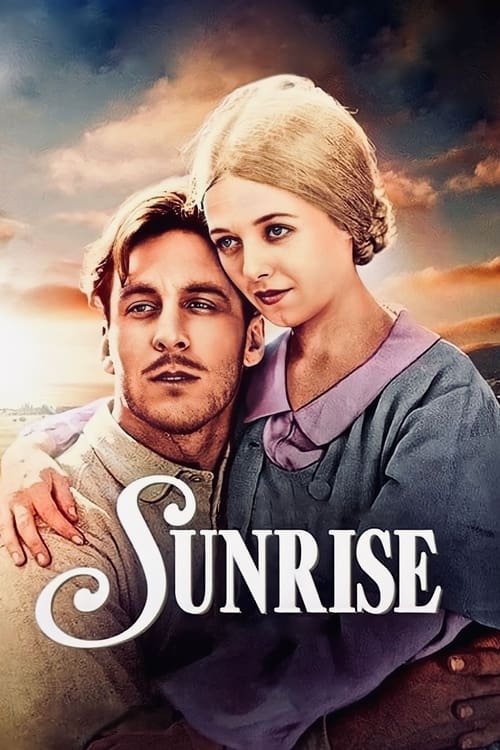
Sunrise: A Song of Two Humans
1927 · F. W. Murnau
For a cozy night in when you want to fall in love — with a couple, and with what movies can do. It's the perfect first silent film: emotional, fast-moving, zero homework required.
What it's about
A farmer, seduced by a scheming woman from the city, is talked toward a terrible plan: get rid of his wife and start over. What follows is a journey — from a moonlit marsh to the roaring lights of the city — that becomes one of the movies' great stories of guilt, forgiveness, and a marriage finding out what it's made of.
The experience
It sweeps you up — terror in the first act melting into tenderness, comedy, and pure romantic joy, then tightening again as a storm rolls in. For a silent film it feels astonishingly alive; people regularly come out of it in tears.
Performances
Janet Gaynor is luminous as the wife — her face carries the whole emotional arc from fear to radiance — and George O'Brien makes the husband's guilt physical, moving like a man dragging a weight.
The craft
Murnau, given a Hollywood studio's full resources, unchained the camera — it glides through marshes and traffic, dreams superimpose over reality, and an enormous city set bends perspective like a fable. Nearly a century later it remains a masterclass in visual storytelling, and it's transporting on a big screen with live or recorded score.
Why it matters
Often named the summit of the silent era, it won at the very first Academy Awards and its floating camerawork and expressive light became a permanent part of Hollywood's toolkit.
Snapshot
Sunrise is the film most often cited when critics wish to name the apex of the silent era. A universal fable of marital betrayal, near-murder, and redemption, it was made by a German director working for the first time in Hollywood, with a German screenwriter, two exceptional cinematographers, and studio resources of an unprecedented scale. Its grammar — the liberated moving camera, superimposed fantasy states, a city set built as a philosophical argument — became a template that Hollywood absorbed slowly and filmmakers have been studying ever since. It is as formally complete a film as has been made in any era.
Industry & Production
William Fox, seeking prestige and European artistic legitimacy for his studio, recruited F. W. Murnau in 1926 with an offer of extraordinary creative autonomy — rare for a foreign-language director arriving on studio terms. Fox provided a large budget, a sprawling backlot, and minimal interference, conditions almost unheard-of in an industry already organized around producer control. Murnau brought his habitual collaborator Carl Mayer, the German screenwriter who had scripted The Cabinet of Dr. Caligari, The Last Laugh, and Scherben, to adapt Hermann Sudermann's 1917 novella Excursion to Tilsit. The resulting production was lavish: a full-scale city streetscape with forced-perspective buildings, a working trolley line, and an elaborate lakeside set were all constructed on the Fox lot. The shoot was demanding, technically obsessive, and over schedule. Despite the critical adulation that followed, the film did not recover its costs at the domestic box office; American audiences in 1927 were already primed for sound and less receptive to a European-inflected fable told entirely through image. The record on precise production costs and final earnings is incomplete in readily available sources, so specific figures should be treated with caution.
Technology
Sunrise arrived at the precise pivot of film technology. Released in September 1927, weeks before The Jazz Singer, it was premiered not as a silent film but as a sound film — one of the first to use Fox's Movietone sound-on-film process, which recorded a fully synchronized orchestral score and selective sound effects (traffic noise, a pipe organ, ambient crowd sound) directly onto the film strip. There is no dialogue; the film communicates its narrative entirely through image, intertitle, and music. This made it a transitional object: technically a sound film and eligible for the sound-era Oscars, yet constructed with the visual language of late silent cinema at its most refined. The cinematography also benefited from improvements in orthochromatic and early panchromatic film stocks that allowed for greater tonal latitude. The production made extensive use of multiple-exposure in-camera effects — superimposed ghost figures, dissolving visions — and of an elaborate system of cranes, tracking dollies, and camera mounts that Murnau's team devised or adapted. A camera was at points attached to vehicles and even secured to the body of an actor to produce the vertiginous identification shots that critics remarked upon immediately.
Technique
Cinematography
The film was shot by Charles Rosher and Karl Struss, who shared the inaugural Academy Award for cinematography at the first Oscar ceremony in 1929. Their partnership joined two distinct sensibilities: Rosher was a British-born Hollywood veteran who had built his reputation in precision lighting and portraiture, primarily through his long collaboration with Mary Pickford; Struss was an American pictorialist photographer whose still work had exhibited a soft, painterly quality influenced by the Photo-Secession movement. Together they developed a visual approach that uses deep, atmospheric shadow in the opening swamp sequences — shafts of moonlight cutting through manufactured fog — and transitions, as the film moves into the city, to a brighter, busier, more overwhelming light that carries its own moral valence. The famous shot that tracks alongside the Man and the Wife as they walk from the countryside onto a city street and the surrounding world gradually transforms around them deploys multiple exposures, a moving camera, and seamless matte work to render a subjective geography that could not exist in any physical space. In the final storm sequence, the photography shifts again to documentary urgency, dark water and broken reeds filling the frame with genuine natural chaos.
Editing
The film's editing is rhythmically sensitive rather than analytically aggressive. Cuts are used to guide emotional comprehension, but the primary instrument of continuity is the moving camera — Murnau preferred to develop scenes through spatial exploration rather than through the breakdown of space into coverage. Long takes in which the camera travels with characters give the film a quality of sustained attentiveness unusual even among ambitious silents. The editing accelerates meaningfully during the storm and during the phantasmagoric city sequence, where the rapid succession of attractions and consumer spectacle mirrors the disorientation of the rural couple transplanted into urban modernity.
Mise-en-scène / Staging
The production design by Rochus Gliese is foundational to the film's meaning. The city street was built at a scale that allowed the camera to move through it, with buildings constructed at graduating diminishing heights and widths to force the perspective lines into an exaggerated vanishing point — the effect is of a city that is simultaneously real and dreamlike, abundant and threatening. The swamp set, by contrast, uses natural textures pushed toward abstraction through lighting: the reeds, the waterline, the mist are all legible but feel mythic. Murnau stages his characters against these environments with an expressionist awareness of figure-ground relationships: the Wife, in her simple country dress, appears vulnerable and small in the city; the Man, muscular and physically dominant, becomes morally shrunken in the same frames. The unnamed characters — credited only as The Man, The Wife, The Woman from the City — operate as archetypes, and the staging reinforces this constantly: the city woman's first appearance in the swamp, lit from below, draws directly on the visual vocabulary of the femme fatale that German cinema had codified.
Sound
As noted under Technology, the film carries a synchronized Movietone score composed by Hugo Riesenfeld, with sound effects. There is no spoken dialogue. The score functions as emotional annotation and in some sequences as rhythmic counterpoint to the editing. The use of ambient urban sound — the trolley bell, crowd noise — was sufficiently novel in 1927 that contemporary reviewers commented on it specifically. The film's sonic construction anticipates the integrated sound design that would become standard only later; it is not an afterthought.
Performance
Janet Gaynor's work as the Wife is the emotional center of the film, and the performance is remarkable for its restraint and physical specificity. Where the expressionist acting tradition called for broad gesture and stylized body language, Gaynor inhabits a more interior register — her terror in the boat is communicated through stillness and micro-expression more than through histrionics. George O'Brien as the Man brings a physical intensity earned partly through his earlier action-film career; his bulk and awkwardness in scenes of tenderness give the character an authentic ambivalence. Margaret Livingston's Woman from the City is more schematic, functioning primarily as an emblem of dangerous urban sexuality, and the performance is calibrated accordingly — stylized where the others are naturalistic. Gaynor's awards recognized work across multiple 1927 films (7th Heaven, Street Angel, and Sunrise), as the inaugural Best Actress Oscar operated on a different eligibility structure than later years; the prize nonetheless reflects a critical consensus about her achievement across this period.
Narrative & Dramatic Mode
The film operates as a secular parable. Its characters have no names, its setting has no fixed geography, and its narrative arc — seduction toward murder, failure of resolve, reconciliation, nearly catastrophic loss, restoration — follows a pattern closer to folk tale or myth than to psychological realism. Carl Mayer's script is structured as a triptych: the swamp, the city, the storm. Each section has a distinct visual register and emotional temperature. The drama is not propulsive in the thriller sense; it is meditative, building feeling through accumulation of image and gesture. The decision to leave the wife and husband nameless was deliberate — Murnau and Mayer explicitly understood the film as a universal human story rather than a specific psychological case study. This abstraction can register as coldness on first viewing; on reflection, it is the source of the film's durability.
Genre & Cycle
Sunrise does not belong cleanly to any single genre. It draws on the German Kammerspiel tradition — intimate dramas of bourgeois or rural life observed with unsentimental precision — and on the melodramatic conventions of the domestic triangle. It incorporates elements of the city film (the European Stadtfilm of the mid-1920s, including Ruttmann's Berlin, released the same year) without being reducible to that form. The film was positioned by Fox as prestige art cinema but carried the emotional structures of popular melodrama. Its formal ambition places it within a loose international cycle of high-modernist silent films — Dreyer's The Passion of Joan of Arc (1928), Eisenstein's work, Epstein's La Chute de la maison Usher (1928) — that represented one possible direction for narrative cinema before sound rerouted the art form.
Authorship & Method
Murnau came to Sunrise with a fully formed visual sensibility developed across his German period. Der letzte Mann (1924), made with cinematographer Karl Freund, had introduced the entfesselte Kamera — the unchained camera, freed from tripod placement to move through space as an expressive instrument — as a formal principle, not merely a technique. On Sunrise, Murnau extended this approach with larger resources and greater sophistication. His method was intensely previsual: he reportedly worked from detailed storyboards and shot diagrams, and the camera movements were planned rather than improvised. Carl Mayer's script, written in what Mayer himself called a "script of light" — prose descriptions of visual rhythm and mood rather than conventional scene descriptions — gave Murnau a literary correlate to his visual thinking. Rochus Gliese's production design translated this into buildable space. The collaboration was genuinely collective at the level of conception; the directorial vision was Murnau's alone in its final realization.
Movement / National Cinema
Sunrise occupies the intersection of German Expressionism and Hollywood classicism. It is neither: it draws on the expressive visual language that Murnau had developed in Germany while deploying American studio resources and working within American commercial exhibition. The film belongs to a moment — roughly 1924–1930 — when European directors, cinematographers, and screenwriters reshaped Hollywood's visual culture from within. Murnau, Lubitsch, Leni, and later Wilder and Zinnemann brought European compositional habits and attitudes toward mise-en-scène that gradually became absorbed into the studio house style. Sunrise is the most concentrated single expression of this exchange: a European artistic intelligence given American industrial means, producing something that neither tradition could have generated alone.
Era / Period
The film belongs to the final maturation of the silent era — the years between roughly 1924 and 1928 when silent cinema achieved its greatest formal sophistication just as it was being rendered obsolete. This is historically poignant: the most technically and artistically ambitious silents were made in full knowledge that the form was ending. Sound arrived before Sunrise could find its full audience, and Murnau himself died in an automobile accident in 1931, before completing a significant body of sound work. Tabu (1931), his final film, was shot silent with synchronized music and, like Sunrise, represents a late expression of the visual values he had spent his career developing.
Themes
The film is constructed around the opposition between nature and the city, but it does not endorse simple pastoral nostalgia. The countryside at the film's opening is dark, wet, morally compromised — the husband's obsession with the city woman has already corrupted the rural idyll before the city is shown. The city, when it appears, is overwhelming but also full of genuine pleasure: the couple's afternoon of dancing, photographs, and fairground excess is joyful as well as disorienting. The film's true subject is the marriage itself — specifically the possibility of repair after betrayal. The Wife's willingness to forgive the Man after his murderous impulse is not presented as weakness but as a kind of moral enormity, a grace that the film treats with something close to religious awe. Death and resurrection — the Wife's apparent drowning and recovery — gives the emotional arc a mythic dimension that critics have linked to the film's Romantic German sources. The archetypal city woman, who disappears from the film once her function as temptress is served, carries the anxiety of modern femininity; the Wife's survival and the marriage's renewal represent a conservative affirmation that the film earns through the seriousness with which it has entertained the alternative.
Reception, Canon & Influence
Contemporary critical reception was largely rapturous. Sunrise won three awards at the first Academy Awards ceremony in 1929: cinematography, actress (Gaynor), and a special category designated "Unique and Artistic Picture" that was never awarded again — an acknowledgment that the film exceeded normal evaluative categories. The commercial performance was another matter: American audiences in 1927 were anticipating and increasingly demanding sound, and a silent prestige film without stars of the first commercial magnitude did not perform as Fox had hoped.
The film's canonical rehabilitation proceeded through cinephile institutions rather than popular rediscovery. Henri Langlois's Cinémathèque Française was central to keeping the film in circulation during decades when it was not commercially available. The politique des auteurs critics of Cahiers du Cinéma in the 1950s incorporated Murnau into their canon of directorial masters, and the film was regularly screened in art-cinema and university contexts from the 1960s onward. Pauline Kael, Andrew Sarris, and later scholars from multiple critical traditions placed it among the handful of films that defined what the medium could do at its most serious. The 2012 Sight & Sound poll of critics ranked it fifth among the greatest films ever made; the directors' poll placed it similarly. It has held or improved its position across multiple polling cycles.
The film's influence operates at several levels. Its most immediate effect was on the visual culture of late-silent and early-sound Hollywood: the mobile camera, the use of the subjective shot, the integration of fantasy imagery through superimposition, became part of the Hollywood vocabulary partly through the absorption of techniques Murnau had demonstrated. More diffusely, its model of the poetic, image-driven narrative that expresses interiority through landscape and movement rather than dialogue has been a touchstone for filmmakers working outside genre convention. Terrence Malick's visual approach in Days of Heaven (1978) and throughout his later work — the camera as attending consciousness, the natural world as moral register — is regularly discussed in relation to Sunrise. The film's insistence that cinema is capable of a lyric mode unavailable to literature or theater, and that this mode can accommodate strong feeling without sentimentality, remains its deepest legacy.
A Deleuzian reading
Watch the camera leave him.
The full Deleuzian reading of Sunrise: A Song of Two Humans →
Reception
A famous case of acclaim without box office: Fox gave Murnau a blank check, critics swooned in 1927, audiences mostly shrugged, and the coming of sound buried it. Decades later it climbed all the way to the top tier of the Sight & Sound poll and is now routinely called the peak of silent cinema.
How Sunrise: A Song of Two Humans was received, from release to now →
Influences: the films it descends from and the films it influenced
- The Last Laugh (1924) — Karl Freund's 'entfesselte Kamera' — camera mounted to a chest harness, bicycle, and elevator cage — gave Murnau the continuous-tracking-shot grammar he then scaled up in Sunrise's city-walk and trolley sequences.
- The Cabinet of Dr. Caligari (1920) — Carl Mayer co-wrote both scripts; the painted expressionist sets as psychological landscape — streets that converge abnormally, walls that lean inward — gave Murnau and Mayer the direct template for Sunrise's city set as moral architecture.
- Scherben (1921) — Carl Mayer's kammerspiel script format — a rural domestic triangle drama told with near-total absence of intertitles, psychological revelation delivered through behavioral close observation alone — is the direct structural template for Sunrise's screenplay.
- Nosferatu (1922) — Murnau's systematic use of actual natural exteriors — the Wismar mudflats, the plague ship — timed and framed to feel mythic without painted-set artifice established the atmospheric-shadow grammar in natural locations that Sunrise's swamp sequences extend.
- Variété (1925) — Karl Freund's subjective camera strapped to a trapeze bar and mounted to convey a performer's vertiginous point-of-view gave the European-Hollywood exchange its most radical moving-camera grammar; Rosher and Struss absorbed these identification-shot techniques directly for Sunrise.
- Faust (1926) — Carl Hoffmann's atmospheric shadow photography and the massive forced-perspective Wittenberg set — constructed so the camera could travel through a geometrically distorted townscape — gave Murnau his immediate technical precedents for Sunrise's fog-swamp and city-horizon shots, made the same production year.
- Lonesome (1928) — Fejős's extended Coney Island sequence — a couple separated and tracked by a roving camera through densely populated urban amusement space — is a direct structural and visual citation of Sunrise's stadtfilm section, including the tracking shot through crowd as instrument of disorientation.
- The Crowd (1928) — Vidor adopted Sunrise's stadtfilm grammar wholesale: forced-perspective office towers receding to a vanishing point, location tracking shots through dense Manhattan crowds, the couple dwarfed by urban architecture — all repurposed as the visual language for individual anonymity in mass modernity.
- Tabu (1931) — Murnau's final film transplants Sunrise's full formal method — secular parable, no-dialogue storytelling over synchronized score, expressionist staging of human figures against an overwhelming natural landscape — onto actual South Seas locations rather than studio-built environments.
- City Lights (1931) — Chaplin's insistence on sustaining a synchronized orchestral score with no spoken dialogue after sound was commercially established directly cites the Sunrise Movietone model — demonstrating that the new sound-on-film technology could serve pure visual storytelling rather than replace it.
- Ugetsu (1953) — Kazuo Miyagawa's extended moving-camera shots that follow characters continuously through environments — prioritizing spatial exploration over analytical coverage — directly descend from the Murnauian principle of the camera as sustained moral witness, which Mizoguchi absorbed through his documented study of German silent cinema.
- Portrait of Jennie (1948) — Joseph H. August's multiple-exposure superimpositions — a ghostly woman dissolving in and out of natural and urban landscapes — directly cite Rosher and Struss's technique for rendering fantasy states as simultaneous visual realities rather than cutaway visions, which Sunrise had established as the grammar for subjective interiority.
- Days of Heaven (1978) — Nestor Almendros cited Rosher and Struss's atmospheric natural-light photography in Sunrise as a direct influence on his 'magic hour' approach; the sustained long take as the primary instrument of emotional development over analytical cutting is a direct inheritance of Murnau's camera-over-editing principle.
- Nostalghia (1983) — Tarkovsky's doctrine — stated in Sculpting in Time with explicit reference to Murnau — that the single extended take holds moral weight the cut destroys is most purely realized here; Giuseppe Lanci's long takes sustain space as ethical attention in direct descent from Murnau's moving-camera method.
- Resurrection (2025) — The 'unchained camera' gliding unbroken through built-up false-perspective sets is the direct precedent for Bi's roving, set-traversing long takes.
- La Strada (1954) — Murnau's template for the rural parable built around a brutish man and an innocent woman: expressionist lighting within naturalistic location settings, dissolve-heavy editing as the punctuation of moral and temporal transitions, and a parable-simple moral geometry that strips social context away so that elemental figures — grace versus violence — can be read without mediation.
- The Passion of Joan of Arc (1928) — Charles Rosher and Karl Struss's panchromatic cinematography without theatrical greasepaint on Murnau's 1927 film demonstrated that the face shot on the newer emulsion could serve as a natural landscape of tonal gradation; Rudolph Maté and Dreyer applied the identical panchromatic-without-makeup logic at extreme proximity, exploiting the stock's sensitivity to skin texture in ways orthochromatic emulsion would have obscured.
- Brief Encounter (1945) — Murnau's fantasy inserts — expressionistically lit visions of an alternate life cut abruptly into a realist narrative surface — establish the editing technique Lean applies to Laura's romantic reveries, where subjective imagery intrudes on represented reality as psychological necessity rather than authorial commentary.
- Seventh Heaven (1927) — Produced simultaneously at Fox with the same Movietone synchronized-score process; Ernest Palmer's chiaroscuro cinematography of a studio-built Paris rendered as expressionist romantic space shares Sunrise's hybrid of constructed environment and atmospheric-shadow lighting applied to a secular fable of love.
- The Docks of New York (1928) — Harold Rosson's harbor-fog atmospheric shadow cinematography — dense smoke diffusing lamplight over working-class figures in a single-night moral triangle — directly inherits the Murnau school's chiaroscuro grammar and applies it to the kammerspiel format Mayer had codified.
Similar films
- Days of Heaven (1978) — influence & lineage
- The Last Laugh (1924) — influence & lineage
- The Crowd (1928) — influence & lineage
- Faust (1926) — influence & lineage
- City Lights (1931) — influence & lineage
- City Girl (1930) — shared sensibility
- All Quiet on the Western Front (1930) — shared sensibility
- Silent Light (2007) — shared sensibility
All the films related to Sunrise: A Song of Two Humans →
Film essays and courses that include it
- Painted Shadows: German Expressionism and the Grammar of Dread
- The Grammar of Shadow: Black & White Cinema from Caligari to Raging Bull
- The Ache of Distance: Cinema's Language of Longing
- The Shape of Longing: How Cinema Reinvented Romance
- The Vow and Its Violation: A Century of Marriage on Screen
- The Land Speaks: Rural Landscape as Moral Force
- Until Morning: The Dusk-to-Dawn Film
- The Organism Made of Strangers
- The Art That Sound Killed at Its Peak