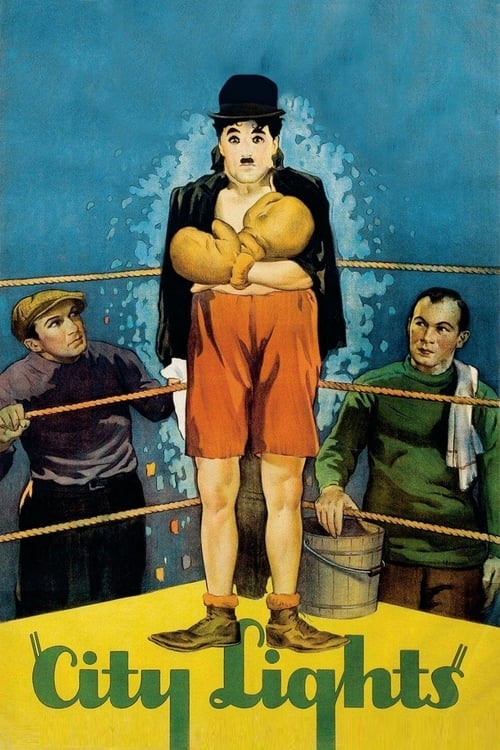
City Lights
1931 · Charlie Chaplin
For when you need your faith in movies — or people — restored: a comfort watch that still lands a real emotional punch. Perfect for a cozy night, a first silent film, or when you want to laugh and then quietly cry.
What it's about
Chaplin's Tramp falls for a blind flower girl who, through a happy accident, believes he's a wealthy gentleman. To keep the illusion alive — and to pay for the eye operation that could restore her sight — he scrapes for money any way he can, helped and hindered by a millionaire who adores him when drunk and doesn't know him when sober. It's a love story told entirely in gesture, with a boxing ring, a city street, and a flower stand for a stage.
The experience
It swings between some of the funniest physical comedy ever filmed and moments of almost unbearable tenderness — you'll laugh out loud at the boxing match and find yourself blindsided by feeling at the end. Ninety-odd minutes that move like a dream.
Performances
Chaplin's Tramp is at his peak — every shrug and hat-tip legible from across a room — and Virginia Cherrill gives the flower girl a grace that makes the fantasy worth believing. The final close-up of Chaplin's face is one of the most celebrated pieces of acting on film.
The craft
Made as a silent in defiance of the talkie revolution, it's pantomime polished to perfection — gags built, timed, and reshot until they're inevitable — with a lush musical score Chaplin composed himself. The precision is invisible until you notice nothing is wasted; it plays beautifully with a crowd.
Why it matters
Released after Hollywood had converted to sound, it proved silent storytelling could still triumph and became the benchmark for blending comedy with genuine emotion — the ending alone is one of the most revered scenes in all of cinema.
Snapshot
City Lights is Charlie Chaplin's silent tramp comedy released into a film world that had already converted to sound. Subtitled "A Comedy Romance in Pantomime," it follows the Tramp as he falls in love with a blind flower girl who mistakes him for a millionaire, and befriends a suicidal drunkard who is generous when intoxicated and cold when sober. The Tramp scrapes together money — through a humiliating boxing match and the erratic largesse of the millionaire — to pay for an operation that restores the girl's sight, then takes the fall for a theft and goes to prison. The film closes on one of the most studied scenes in cinema: the now-sighted girl recognizes her benefactor by touch, and the Tramp's face registers terror, hope, and tenderness at once. It is at once Chaplin's most sentimental and most disciplined work — a deliberate, defiant assertion of pantomime's expressive sufficiency at the precise moment the industry had declared it obsolete.
Industry & production
City Lights was produced and self-financed by Chaplin and distributed through United Artists, the company he had co-founded in 1919 with Douglas Fairbanks, Mary Pickford, and D. W. Griffith. As his own producer working at his own Hollywood studio (Chaplin Studios on La Brea Avenue), Chaplin enjoyed a degree of creative autonomy almost unique in the period — and he used it to make a commercially reckless choice. By the time the film went into production in earnest (work spanned roughly 1928 to 1930), the sound revolution touched off by The Jazz Singer (1927) was essentially complete; theaters had wired for sound and audiences expected talking pictures. Chaplin gambled that the Tramp — a wordless, universal figure whose comedy depended on gesture — would lose his essence if he spoke, and he bet his own fortune on silence.
The production was famously protracted and perfectionist. Chaplin shot enormous quantities of film, reworked sequences repeatedly, and shut the production down for long stretches while he solved narrative or performance problems. The most notorious example, documented in Kevin Brownlow and David Gill's Unknown Chaplin (which preserved surviving outtakes), is the scene in which the flower girl first mistakes the Tramp for a wealthy man — the gag hinges on her hearing a car door slam and assuming her customer is its owner. Chaplin reshot the moment exhaustively over many days, struggling to make the mechanics of the misunderstanding read clearly in pantomime; the episode has become a standard illustration of his obsessive method. Precise budget and box-office figures vary across sources and I won't assign exact numbers here, but the picture was widely reported as costly and, against expectation, a substantial commercial and critical success that vindicated Chaplin's gamble.
A persistent production strain was Chaplin's fraught relationship with his leading lady, Virginia Cherrill, whom he had cast despite her lack of acting experience. He grew dissatisfied, fired her at one point, and tested replacing her with Georgia Hale, his co-star from The Gold Rush; surviving test footage of Hale in the role exists. Ultimately Chaplin rehired Cherrill — reportedly because reshooting her completed scenes would have been ruinously expensive — and her performance, particularly in the finale, became indispensable to the film.
Technology
The defining technological fact of City Lights is what it refused. Chaplin declined to make a talkie, but he did not ignore sound entirely: the film carries a synchronized musical score and selective sound effects recorded to the print, making it a "silent" picture only in the sense that no one speaks dialogue. This hybrid status let Chaplin both preserve pantomime and editorialize about sound itself. The opening scene — civic dignitaries unveiling a statue — renders the officials' speeches as honking, kazoo-like gibberish, a direct satire of the talkies' newly verbose screen. Later, a swallowed whistle turns the Tramp into an involuntary noisemaker, a gag that exists only because synchronized sound made it possible. Chaplin thus used the new technology against itself, demonstrating that he could deploy sound and still prove it unnecessary to his art. The score was recorded with orchestra and locked to the image, a considerable technical undertaking in its own right for a man who could not read or notate music.
Technique
Cinematography
Photography was led by Roland Totheroh, Chaplin's long-serving cameraman, working with Gordon Pollock. The visual style is functional and self-effacing in the classical Chaplin manner: the camera serves the performer. Chaplin generally favored stable framing and full or medium-full shots that kept the whole body legible, because physical comedy depends on the audience seeing gesture, posture, and timing in space. The camera rarely calls attention to itself. The crucial exception is the final shot, which moves into a tight close-up on the Tramp's face — a deviation from Chaplin's usual reticence that concentrates the film's entire emotional charge into a held image of a single expression.
Editing
Chaplin cut for clarity and comic rhythm rather than for montage effect. His editing logic is built around the gag and the gesture: shots are held long enough for an action to complete and its consequence to register, and cuts arrive on comic or emotional beats. The boxing sequence is the bravura set piece of the cutting — a choreographed dance between the Tramp, his opponent, and the referee, edited to sustain a near-balletic geometry of bodies circling in and out of frame. By contrast, the recognition finale is built from a restrained alternation of looks between the girl and the Tramp, the editing slowing to let the audience read each shift in his face.
Mise-en-scène / staging
City Lights is a film of stark social staging: the gleaming city of the millionaire's mansion, nightclubs, and limousines set against the sidewalk world of the flower girl's corner and the Tramp's poverty. The millionaire's drunk-and-sober gag is essentially a staging conceit — the same set and the same man become two opposite social worlds depending on his state. Chaplin's blocking is meticulous, designed so that misunderstandings (the girl's blindness, the millionaire's selective recognition) play with absolute legibility in space. Props are weaponized for comedy and pathos alike: the flower, the cigar, the boxing ropes, the bandaged hand. The settings are studio-built and stylized rather than documentary, a generalized "city" that functions as moral landscape.
Sound
Because the film has no spoken dialogue, the score does the work that speech does elsewhere — it carries mood, marks character, and underlines comedy. Chaplin composed the music himself, and it is among his most enduring achievements as a melodist. The flower girl is associated with the song "La Violetera" by the Spanish composer José Padilla; Chaplin's use of the melody later became the subject of a copyright dispute, with Padilla pursuing legal action over the uncredited use. The score otherwise blends sentimental themes for the romance with brisk comic underscoring for the gags, integrating the selective sound effects (the whistle, the gibberish speeches) as punctuation.
Performance
The film is a showcase for Chaplin's pantomime at its peak — the Tramp's dignity-in-indignity, the precision of his physical timing, the capacity to pivot from slapstick to heartbreak within a single sequence. Virginia Cherrill's flower girl is essential and frequently underrated; her stillness and the delicacy of her blindness playing make the central deception credible and the recognition devastating. Harry Myers as the millionaire sustains a difficult two-faced role, and Hank Mann delivers the boxing opponent as comic foil. The performances are stylized toward clarity rather than naturalism, but the finale draws from Chaplin and Cherrill a register of emotional truth that exceeds the film's otherwise broad comic idiom.
Narrative & dramatic mode
The film operates in a mode of sentimental comedy braided with romance and social pathos. Its structure is episodic in the tradition of silent comedy — a series of set pieces (the statue unveiling, the suicide rescue, the nightclub, the boxing match) — but these episodes are tightly motivated by a single throughline: the Tramp's quest to fund the girl's cure. The central engine is dramatic irony built on two asymmetries of knowledge: the blind girl cannot see that her benefactor is a tramp, and the millionaire cannot recognize the Tramp when sober. Chaplin sustains both deceptions across the film and then collapses them in the ending, when sight restores truth. The dramatic mode shifts decisively in the final scene from comedy to something closer to tragedy held in suspension — the film refuses to resolve whether the girl's recognition brings acceptance or loss, ending on the question rather than the answer.
Genre & cycle
City Lights belongs to the silent feature comedy as perfected in the 1920s by Chaplin, Buster Keaton, and Harold Lloyd, and specifically to Chaplin's own cycle of Tramp features (The Kid, The Gold Rush, and later Modern Times). It synthesizes the genre's two strains — knockabout physical comedy and sentiment — that Chaplin had long fused more boldly than his peers. Within the broader film cycle of its moment, it is an anomaly: a silent comedy released into the talkie era, effectively a late, defiant masterpiece of a form the industry had abandoned. Its closest sibling is Chaplin's own Modern Times (1936), which similarly clung to pantomime years after sound's triumph.
Authorship & method
City Lights is among the purest expressions of single-author cinema. Chaplin directed, produced, wrote, starred in, and composed the score, financing it himself and controlling every stage at his own studio. His method was improvisatory at the level of invention and obsessive at the level of execution: he would develop gags on the floor, shoot vast amounts of film, and reshoot relentlessly until a sequence achieved the clarity and feeling he sought. Key collaborators served his vision rather than imposing their own. Roland Totheroh, his cinematographer across most of his major work, provided the stable, performer-centered photography Chaplin's comedy required. Because Chaplin could not read or write musical notation, he composed by humming and playing melodies that professional arrangers transcribed and orchestrated — Arthur Johnston is associated with the musical arrangement on the film. The result is unusually unified: virtually every expressive choice traces back to one sensibility.
Movement / national cinema
The film stands somewhat apart from movements. It is a product of Hollywood's studio system, yet Chaplin's independence as a United Artists principal kept him outside the assembly-line norms of the major studios. As an artist Chaplin was English-born and music-hall-trained, and that British variety tradition — its pantomime, its sentimental-comic register, its underdog pathos — informs the Tramp at his roots even within an American industrial context. His universality also placed him beyond any national cinema; the Tramp's wordlessness made him legible worldwide, and City Lights was consciously built to preserve that international reach against the linguistic fragmentation that sound imposed on film.
Era / period
City Lights is a hinge object of the transition era — the precise moment, 1927–1931, when sound remade the medium. It is simultaneously the last great flowering of silent feature comedy and a commentary on the form's supersession. Its sentimentality and its imagery of poverty also register the cusp of the Great Depression: the gulf between the millionaire's nightclub world and the flower girl's sidewalk corner reads, in retrospect, as a Depression-era parable of wealth's caprice and the dignity of the poor, even as the film's conception predates the crash.
Themes
The film's governing theme is sight and blindness, literal and moral. The girl is physically blind and therefore "sees" the Tramp truly — as a kind, generous benefactor — while the sighted world sees only a vagrant. The millionaire's drunkenness is a moral blindness that makes him generous; sobriety restores his sight and his coldness. The ending turns on the terrible ambiguity of literal sight restored: now that the girl can see, will she still recognize the worth she perceived when blind? Around this run Chaplin's perennial themes — the dignity of the outsider, the cruelty and absurdity of class, love as self-sacrifice, and the gap between social identity and inner worth. The film argues, finally, that true seeing is a matter of the heart, and stakes everything on whether the girl possesses it.
Reception, canon & influence
Contrary to industry expectations, City Lights was met with strong critical acclaim and commercial success on release, confirming that Chaplin's gamble on silence had paid off and that the Tramp retained his hold on audiences. Over subsequent decades its reputation only grew, and it is now routinely ranked among the greatest films ever made; it has appeared at or near the top of critical and directorial polls and is frequently named the finest of Chaplin's features. The finale in particular became a touchstone of film criticism. James Agee, in his celebrated essay "Comedy's Greatest Era," singled out the last scene as the summit of screen acting, and Chaplin himself reportedly regarded that close-up as among the finest things he ever did. Admiration from filmmakers has been consistent and emphatic across generations.
The influences on the film are Chaplin's own: the English music-hall pantomime of his youth, the slapstick traditions of his Keystone and Mutual short comedies, and the sentimental-comic synthesis he had refined through The Kid and The Gold Rush. Its influence forward runs through the entire lineage of comedy that fuses laughter with genuine feeling — the principle that pathos and slapstick can occupy the same frame without cheapening either. The closing close-up became a model for how a single held expression can resolve an entire film, cited in discussions of screen acting and ending construction ever since. More broadly, City Lights stands as the enduring proof-of-concept for visual storytelling: a demonstration, made against the grain of its own moment, that the moving image can convey the deepest emotion without a word.
A Deleuzian reading
The last shot is a face, and Chaplin spent the whole film earning the right to hold it.
The full Deleuzian reading of City Lights →
Reception
Chaplin released a silent film three years into the talkie era — Hollywood thought it was commercial suicide, audiences made it a smash anyway. It's never needed reappraisal; it just kept climbing, from hit to fixture on greatest-films-ever lists.
How City Lights was received, from release to now →
Influences: the films it descends from and the films it influenced
- Tillie's Punctured Romance (1914) — The Keystone feature where Chaplin learned Sennett's accelerated slapstick collision-and-chase timing, the metronome of physical gag rhythm he would later slow down and refine into the gag-cutting of City Lights.
- The Immigrant (1917) — A Mutual short that crystallized Chaplin's performer-centered framing — the locked, full-figure stable shot that keeps the whole body legible for pantomime — the photographic grammar Totheroh carried into City Lights.
- Broken Blossoms (1919) — Griffith's hushed sentimental melodrama and use of the held facial close-up as the emotional summit of a scene modeled the restraint Chaplin drew on for his final recognition close-up.
- Seven Years Bad Luck (1921) — Linder's genteel comic dandy — the elegant gentleman undone by mishap — is the direct persona ancestor of the Tramp's incongruous gallantry, and Linder's precision prop-gag construction (the mirror routine) prefigures Chaplin's object choreography.
- The Kid (1921) — Chaplin's first feature to prove slapstick and genuine pathos could share a single frame without cheapening either — the tonal synthesis that City Lights perfects.
- The Gold Rush (1925) — Refined the self-contained pantomime set piece built on transformed objects (the dance of the dinner rolls), the gag-as-feeling construction that structures City Lights' boxing and flower-girl sequences.
- Sunrise: A Song of Two Humans (1927) — Chaplin's insistence on sustaining a synchronized orchestral score with no spoken dialogue after sound was commercially established directly cites the Sunrise Movietone model — demonstrating that the new sound-on-film technology could serve pure visual storytelling rather than replace it.
- A Woman of Paris: A Drama of Fate (1923) — The final recognition is pure seed technique: a detail insert of hands on a flower, a held close-up of a face that does almost nothing, and no title to tell you what has been understood — the restraint Chaplin trained on other people's faces in 1923, turned back on his own.
- The Circus (1928) — Converts the ring-as-proscenium into the boxing match, choreographing referee, opponent and Tramp as one rotating unit inside a sustained frontal wide take; it also inaugurates the dictated-melody scoring method Chaplin would apply retroactively to The Circus in 1969.
- Modern Times (1936) — Extends the same gamble — a fundamentally silent comedy carried by a Chaplin-composed synchronized score — and pushes the sound-satire of City Lights' opening into full mechanized burlesque of the talkie era.
- Limelight (1952) — Carries forward the total-authorship model (directed, written, starred, self-scored) and the music-hall pantomime roots, deepening the pathos-and-performance fusion into an explicit elegy for the silent craft.
- La Strada (1954) — Gelsomina is a direct heir of the Chaplin tramp-clown — pantomime pathos in a single expressive body — and Fellini stages comedy and heartbreak in the same frame in the City Lights manner.
- The 400 Blows (1959) — Truffaut resolves the entire film on a final held close-up of an ambiguous face, the direct inheritance of City Lights' closing shot as the technique of ending a film on one unresolved expression.
- Playtime (1967) — Tati builds a near-wordless feature on choreographed visual gags and sound used as comic object rather than dialogue, extending Chaplin's principle that the moving image and a designed soundtrack can carry comedy without speech.
- WALL-E (2008) — Stanton's largely dialogue-free first act is an avowed Chaplin homage — pantomime romance between two figures carried by gesture and a synchronized score, reviving City Lights' silent-storytelling-with-music model.
- The Artist (2011) — A modern silent feature told through pantomime and a synchronized score with no spoken dialogue, consciously reconstructing the exact formal gamble — and the sentiment-through-silence aesthetic — that City Lights made against the coming of sound.
- The Great Dictator (1940) — Chaplin's immediately preceding film achieved full synchronous music and sound effects while keeping all dialogue pantomimic — the arc from City Lights to The Great Dictator maps the precise steps by which Chaplin learned to use his own voice as a comic instrument after fifteen years of silent performance.
- Up (2009) — The 'Married Life' montage directly inherits Chaplin's technique of compressing a relationship's full emotional arc through music-driven silent images, substituting gestural and spatial recurrence for dialogue — love, loss, and time encoded without a word spoken.
- Nights of Cabiria (1957) — Cabiria's tragicomic tonal architecture—comedy as an oblique approach to suffering, the resilient clown-figure undone and reconstituted—derives from the Tramp's structural sentimentality, a debt Fellini and Masina explicitly acknowledged.
- It Happened One Night (1934) — Model of sentiment disciplined by precise comic timing and tenderness toward the common man — the emotional grammar the 'Capra touch' inherits.
- Edward Scissorhands (1990) — The near-silent performance carries all emotion through face and pantomime gesture rather than dialogue, descending from Chaplin's tender, inarticulate outsider.
- Safety Last! (1923) — Lloyd's silent thrill set piece is built, like Chaplin's boxing match, on meticulously rehearsed spatial choreography where the gag's geometry is the whole drama — peer craft in single-take physical comedy staging.
- Sherlock Jr. (1924) — Keaton's contemporaneous mastery of gag built through editing and exact bodily mechanics represents the parallel pole of silent visual storytelling, sharing City Lights' faith that the cut and the body, not the title card, carry meaning.
- Queen Christina (1933) — Mamoulian's celebrated final shot — Garbo's deliberately blank held close-up inviting the viewer to project emotion — is the contemporaneous companion to City Lights' ambiguous closing face as the device that resolves a film through a single unbroken expression.
- The Man Without a Past (2002) — Silent-comedy timing — pathos built from a marginal figure's deadpan physical routines and a wordless romance across a class gap — supplies the gag-and-heartbreak rhythm beneath Kaurismäki's minimalism.
Similar films
- Modern Times (1936) — influence & lineage · same viewing thread · often watched together
- The Kid (1921) — influence & lineage · same viewing thread · often watched together
- Limelight (1952) — influence & lineage · same viewing thread
- The Artist (2011) — influence & lineage · same viewing thread
- Sherlock Jr. (1924) — influence & lineage · often watched together
- The Circus (1928) — same viewing thread
- The General (1926) — same viewing thread
- The Great Dictator (1940) — shared sensibility
All the films related to City Lights →
Watch it with: curated runs of related films
- The Great Silent Clowns — The masters of physical comedy back to back — watch these to feel the unbroken line from Chaplin's Tramp and Keaton's stone face to Tati's tiptoeing Monsieur Hulot.