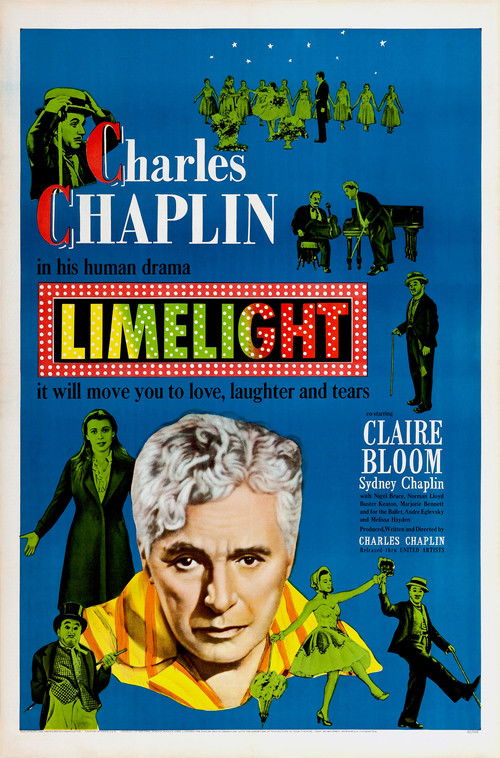
Limelight
1952 · Charlie Chaplin
For a reflective evening when you want a good cry and a film about second chances — comfort viewing with an ache in it. Reach for it when the idea of an old artist passing the torch sounds like exactly the story you need.
What it's about
London, 1914. Calvero, a once-beloved music hall clown whose audiences have deserted him, rescues a despairing young ballet dancer named Terry and sets about convincing her that her life and her legs are worth using. As he coaches her back toward the stage, the fading comedian and the rising dancer prop each other up — and Calvero must reckon with what's left of his own gift.
The experience
Tender, talky, and openly sentimental — a slow, autumnal film that trades slapstick for long conversations about art, courage, and why we go on. It earns its emotion honestly, and by the end it lands with real weight.
Performances
Chaplin gives perhaps his most personal performance as Calvero, and Claire Bloom, in her breakthrough role, matches him with luminous sincerity as Terry. Buster Keaton turns up for a music hall routine with Chaplin — the only time the two silent-era giants shared the screen.
The craft
Chaplin wrote, directed, produced, scored, and starred at age 63, reconstructing the Edwardian variety world of his own boyhood in loving detail. His theme music for the film became a standard, and the backstage scenes have the texture of memory — this is filmmaking as autobiography.
Why it matters
Chaplin's farewell to the character of the clown and effectively to Hollywood — he left America soon after its release — it has come to stand as the summing-up of the greatest career in screen comedy. Its score later won Chaplin his only competitive Academy Award, twenty years after the fact.
Snapshot
Limelight is Charlie Chaplin's valediction — an elegiac backstage drama about Calvero, a once-beloved London music hall clown who has lost his gift for making audiences laugh and, with it, his will to live. Set in 1914, the year Chaplin himself first stepped before a camera, the film reconstructs the Edwardian variety world of his boyhood and turns it into a meditation on aging, obsolescence, and the passing of the artistic torch. When Calvero rescues a suicidal young ballet dancer, Thereza ("Terry," Claire Bloom), the two nurse each other back toward life; she recovers her ability to walk and dance, he recovers a measure of dignity, and he ultimately dies in the wings as she triumphs onstage. At 63, writing, directing, producing, scoring, and starring, Chaplin made his most nakedly personal and most verbally discursive film — long, talky, sentimental, and, for its admirers, profoundly moving. It is also inseparable from the political catastrophe that overtook its release: while Chaplin sailed to its London premiere, the United States effectively barred his return, and the film was boycotted and scarcely seen in America for two decades.
Industry & production
Limelight was an independent production, financed and controlled by Chaplin and released through United Artists, the distribution company he had co-founded in 1919 with Douglas Fairbanks, Mary Pickford, and D. W. Griffith. This independence — Chaplin owned his studio on La Brea Avenue in Los Angeles and answered to no front office — is central to understanding the film: no studio would have sanctioned a two-and-a-quarter-hour music hall reverie by a 63-year-old star built almost entirely around monologues on mortality. Chaplin worked from his own long-gestated material, a prose novella titled Footlights, which supplied the story and much of Calvero's philosophy; the novella was later reconstructed and published in 2014 by the Chaplin biographer David Robinson.
The production was in many ways a family affair. Chaplin cast his son Sydney Chaplin as Neville, the young composer who falls in love with Terry, and several of his other children by Oona O'Neill appear in small roles, including the street-urchin children in the opening. Claire Bloom, then in her early twenties and largely unknown to film audiences, was cast as Terry in what became her screen breakthrough. The most storied piece of casting was Buster Keaton, brought in for a single late sequence as Calvero's stage partner — the only time the two greatest clowns of silent comedy appeared together on film.
The release is the defining fact of the film's industrial history. Chaplin, a British subject who had never taken American citizenship, had been a target of FBI scrutiny, HUAC-era suspicion, and moral controversy for years. In September 1952, as he sailed for Europe aboard the Queen Elizabeth for the London premiere, Attorney General James McGranery announced that Chaplin's re-entry permit would be reviewed and that he would have to answer questions about his politics and morality to return. Chaplin chose not to fight; he settled in Switzerland and did not set foot in the United States again until 1972. American Legion pickets and organized boycotts followed, and Limelight was pulled or barely booked across much of the country, crippling its domestic performance. Because it never had a qualifying commercial run in Los Angeles until 1972, the film remained Oscar-eligible two decades late — the source of one of Hollywood's strangest awards footnotes (see Reception).
Technology
Technologically, Limelight is a conservative, fully synchronized black-and-white sound film shot on 35mm at the Chaplin studio. By 1952 Chaplin had made three prior sound features (City Lights used sound and score but no dialogue; Modern Times was partly a talkie; The Great Dictator and Monsieur Verdoux were full sound films), and here he embraces recorded dialogue completely — indeed the film is among the most word-driven of his career. There is nothing in its apparatus that pushes the medium's technical envelope; Chaplin, famously indifferent to novelty for its own sake, used the standard tools of the postwar Hollywood soundstage. The film's technological interest lies less in innovation than in the deliberate archaism of a filmmaker recreating, with modern equipment, the pre-cinematic theatrical world of 1914.
Technique
Cinematography
The photography is credited to Karl Struss, a distinguished cinematographer whose career reached back to the silent era (he shared the first Academy Award for cinematography for Sunrise and shot Ben-Hur in 1925 and Dr. Jekyll and Mr. Hyde in 1931). Chaplin's longtime cameraman Roland "Rollie" Totheroh, who had photographed nearly all of his work since the 1910s, was also associated with the production in a senior technical capacity; the precise division of labor between the two is described somewhat variously in the record, and I will not overstate it. The visual style is plain, evenly lit, and frontal — a soft, slightly nostalgic register appropriate to memory. Chaplin was never a pictorialist; his camera exists to present performance clearly and to keep the human figure legible within the frame, and Struss's work here serves that priest-like functionalism rather than any independent visual signature.
Editing
Chaplin was his own de facto editor throughout his career, shaping films on the cutting bench with obsessive control, and Limelight was cut to his rhythms. The formal editing credit is not a prominent part of the film's documentary record, and I won't assign it definitively. What matters stylistically is the montage philosophy: cutting is minimal and unobtrusive, subordinate to the long take and the sustained performance. Chaplin edits to preserve the integrity of an actor's gesture or a spoken passage, not to generate kinetic energy. The result feels, by 1952 Hollywood standards, deliberately old-fashioned — closer to filmed theater than to the fluid continuity cutting of the studio mainstream.
Mise-en-scène / staging
Staging is the heart of the film's method. Chaplin blocks scenes as tableaux, letting actors hold the frame in long, frontal compositions that recall the proscenium of the music hall the film memorializes. Interiors — Calvero's shabby lodging, the theater wings, the stage itself — are dressed to evoke Edwardian London with affectionate specificity. The recurring stage-within-the-film structure (Calvero's dream turns, the benefit performance, the ballet) allows Chaplin to reconstruct the variety bill as a formal object: the film keeps returning us to the footlights of its title, the harsh line of light that both exposes and sustains the performer. This doubling of theater and cinema is the film's governing spatial idea.
Sound
Limelight is dense with talk. Calvero delivers extended, aphoristic speeches about courage, desire, meaning, and death ("Life is a desire, not a meaning"), and the film's emotional temperature is set as much by voice as by image — a striking choice from the cinema's supreme master of the silent body. Against this verbal weight, Chaplin's own musical score does enormous work. The recurring love theme, later given the title "Eternally," functions as the film's emotional spine, threading Calvero and Terry's relationship through melody. Diegetic music — pit orchestras, stage numbers, the tinkle of rehearsal piano — continually reminds us that this is a story about performers, for whom sound is livelihood.
Performance
Performance is Limelight's true subject and its greatest strength. Chaplin's Calvero is a portrait built from contrasts: the drunken, self-pitying private man and the disciplined professional who can still, when the lights hit him, command a stage. Chaplin performs several complete comic turns within the film, insisting on Calvero's craft even as the narrative charts its decline. Claire Bloom brings a fragile, luminous seriousness to Terry that grounds the film's sentiment. And the celebrated Keaton sequence — the two clowns as a chaotic violin-and-piano duo — is a summit of physical comedy, made poignant by the real-world knowledge that both men's silent-era eminence had passed. (Anecdotes that Chaplin trimmed Keaton's funniest material out of rivalry are longstanding but not reliably established, and are best treated as lore rather than fact.)
Narrative & dramatic mode
The film's dramatic mode is melodrama in the older, non-pejorative sense: a story of heightened feeling organized around rescue, redemption, and sacrifice. Its structure is a rise-and-fall diptych — Terry ascending as Calvero declines — bound by the sentimental logic that the old artist's final gift is to give his protégée life and then to make way for her. Chaplin repeatedly interrupts the narrative for self-contained performance set pieces, so that the film alternates between intimate two-hander scenes of philosophical conversation and full theatrical numbers. The mode is confessional and essayistic; Calvero is a mouthpiece, and the drama is less about plot mechanics than about the articulation of a worldview. The ending — Calvero collapsing during his comeback benefit and dying in the wings while Terry dances — is pure pathos, the fusion of comedy and tragedy that Chaplin spent his life pursuing.
Genre & cycle
Limelight belongs to the backstage drama and the "show must go on" tradition, a lineage of films about theatrical and vaudeville performers that runs through Hollywood from the early sound era onward. More specifically it is a music hall film, steeped in the British variety culture of Chaplin's youth. Within Chaplin's own oeuvre it forms part of a late cycle of sound features in which the Tramp is abandoned and Chaplin plays articulate, aging, morally weighted men — The Great Dictator (1940), Monsieur Verdoux (1947), Limelight (1952), and the later A King in New York (1957). Among these, Limelight is the most inward and autobiographical, trading political satire for personal elegy.
Authorship & method
Limelight is one of the purest auteur objects in studio-era cinema: Chaplin directed, wrote, produced, composed the score, choreographed and performed the comic routines, and cast his own family. His method was famously exhaustive — extensive rehearsal, long shooting schedules, and relentless refinement in the editing room. The cinematography was executed by Karl Struss, with the veteran Roland Totheroh attached in a senior technical role. The music — the film's most durable single achievement — was composed by Chaplin, who, unable to notate or orchestrate himself, worked with musical collaborators to realize his melodies; the eventual Academy Award for the score was shared by Chaplin with Ray Rasch and Larry Russell. Among the assistant/associate personnel, the young Robert Aldrich — later a major director in his own right (Kiss Me Deadly, The Dirty Dozen) — worked on the production, and Norman Lloyd both appeared in the cast and was part of Chaplin's collaborative circle. But every creative decision bent to Chaplin's total control; Limelight is, more than almost any film of its scale, the vision of one man.
Movement / national cinema
The film sits athwart national categories. It was made in Los Angeles by an English artist who had spent forty years in America without becoming a citizen, and its imaginative homeland is Edwardian London, not Hollywood. Institutionally it belongs to American independent cinema — a United Artists release outside the studio system. Culturally it is a work of the music hall diaspora, an act of memory directed at a vanished British popular-theatrical world. This betweenness — American in production, British in soul, and belonging to no film movement of its moment — mirrors Chaplin's own stateless position, soon to become literal exile.
Era / period
Limelight is a product of the early Cold War and the twilight of the studio system, and it cannot be separated from the political climate that consumed its maker. The HUAC investigations, the Hollywood blacklist, and a broader postwar suspicion of foreign-born leftists created the conditions in which a beloved comedian could be effectively expelled. The film's nostalgic gaze backward to 1914 reads, in this light, as a refusal of the present — a retreat into a lost world of shared laughter at the exact moment American public life turned against its author. The gap between the tenderness onscreen and the hostility that greeted it offscreen is the era's signature.
Themes
The film's central theme is decline — the terror of the artist who has outlived his gift and can no longer reach an audience. Around it cluster Chaplin's lifelong preoccupations: the kinship of comedy and tragedy; dignity in failure; the redemptive power of work and love; and mortality faced without religious consolation. The image of the performer losing command of the crowd carries a deep personal charge: Chaplin's autobiography recounts how, as a small child, he first went onstage when his mother Hannah's voice failed her mid-song and the audience turned cruel — a primal scene of performance and abandonment that Limelight endlessly reworks. The film is also about generational succession: the old must give way to the young, and the highest form of love is to enable another's flourishing and then step into the dark. Calvero's death, occurring in the wings as Terry dances into her future, is the theme made literal.
Reception, canon & influence
Contemporary reception was sharply split and badly distorted by politics. In Europe, where Chaplin premiered the film and where he retained enormous prestige, it was received with respect and often warmth. In the United States, organized boycotts by the American Legion and others suppressed its exhibition, and the film's domestic reputation suffered accordingly; even among critics free of the political animus, some found it self-indulgent, overlong, and verbose, its sentiment unmodulated, while sympathetic voices — Chaplin had long-standing champions among serious American critics — defended its emotional courage and the audacity of a great artist filming his own obsolescence. The reappraisal that followed was slow and is bound up with Chaplin's late-life rehabilitation, culminating in his 1972 return to the United States to receive an honorary Academy Award.
That return produced the film's most famous distinction. Because Limelight had never had a qualifying Los Angeles theatrical run in 1952, its belated 1972 run made it newly Oscar-eligible; at the 1973 ceremony it won the Academy Award for Best Original Dramatic Score, credited to Chaplin, Ray Rasch, and Larry Russell — the longest gap between a film's production and an Oscar win in the Academy's history, and Chaplin's only competitive Academy Award.
The influences on the film are chiefly biographical and theatrical rather than cinematic: the Edwardian music hall, Chaplin's own childhood in poverty and on the variety stage, and his mother's tragic history. Its legacy forward runs along several lines. It launched Claire Bloom's international film career. It gave posterity the singular meeting of Chaplin and Keaton, a scene endlessly cited in histories of silent comedy as a summit and a farewell. Its theme song "Eternally" entered the popular repertoire. And its portrait of the aging artist confronting irrelevance — the clown who can no longer make anyone laugh — became a touchstone for later films and performers meditating on the cost of a life spent before an audience. More than a plot to be imitated, Limelight bequeathed an attitude: the willingness of a supreme entertainer to turn the lights on his own decline and make of it his final, deliberately unfashionable masterpiece.
A Deleuzian reading
A man alone in a rented room does his act for nobody.
The full Deleuzian reading of Limelight →
Reception
In 1952 it was less reviewed than boycotted — Chaplin's re-entry permit to the US was revoked while he sailed to the London premiere, and American Legion pressure kept the film out of much of the country. Europe embraced it immediately, and it's since settled in as his great autumnal masterpiece.
How Limelight was received, from release to now →
How to watch Limelight: what to notice on a first viewing
- Notice how frontal and stage-like each shot is framed. Chaplin blocks scenes as tableaux, holding actors in long frontal compositions that recall the proscenium of the music hall the film is remembering. The camera is built to present a performance clearly, not to show off its own eye.
- Listen for Calvero's long aphoristic speeches to Terry. The silent screen's greatest physical performer talks at length here, delivering extended aphoristic monologues instead of relying on his body alone. Hearing this particular man explain himself out loud is itself a striking choice.
- Watch the story stop for a complete stage routine. Chaplin repeatedly breaks off the narrative to let Calvero perform an entire comic turn from start to finish, uninterrupted by plot. The performance itself is treated as the point, not just as a step toward the next scene.
- Listen for one melody returning throughout the film. Chaplin's own recurring theme threads through Calvero and Terry's scenes together, doing much of the emotional work the dialogue leaves unsaid. A single tune is carrying the relationship's whole feeling from scene to scene.
The whole guide to watching Limelight, with the keys for a rewatch →
Influences: the films it descends from and the films it influenced
- Sunrise: A Song of Two Humans (1927) — Cinematographer Karl Struss developed here the soft, diffused frontal key and haloed close-up he carried directly into Limelight's flattering, low-contrast lighting of Bloom and Chaplin.
- City Lights (1931) — Establishes Chaplin's total-auteur signature of fusing sustained comic pantomime with unguarded melodramatic pathos under a self-composed romantic score, the exact register Limelight sustains at feature length.
- The Circus (1928) — First dramatizes Chaplin's core Limelight anxiety — the performer who is only funny by accident and terrified he can no longer make people laugh — staged as literal ring/proscenium spectacle.
- The Gold Rush (1925) — Model for the self-contained 'comic turn' (the roll dance) choreographed as a discrete music-hall number embedded in narrative, which Limelight formalizes as Calvero's stage routines.
- The Blue Angel (1930) — Sets the template of the cabaret/variety stage as the arena of a performer's public humiliation and professional collapse, filmed from within the wings and footlights.
- Children of Paradise (1945) — The mime Deburau at the Funambules gives Limelight its proscenium-framed pantomime aesthetic and its treatment of popular-theater backstage life as tragic subject rather than mere setting.
- A Star Is Born (1937) — Codifies the rise-and-fall diptych structure — one career ascending precisely as another sinks — that organizes Calvero and Terry's intertwined trajectories.
- Applause (1929) — Backstage burlesque melodrama of the fading, self-sacrificing variety performer nurturing a younger talent, prefiguring Calvero's mentor-and-martyr relation to Terry.
- La Strada (1954) — Extends the pathos-of-the-itinerant-clown tradition, with Gelsomina's recurring trumpet theme functioning structurally exactly as Chaplin's 'Eternally' leitmotif does in Limelight.
- The Entertainer (1960) — Archie Rice makes the aging music-hall comic whose exhausted craft mirrors a dying popular form into explicit metaphor, inheriting Calvero's backstage-decline diagnosis.
- 8½ (1963) — Advances the total-auteur move of turning the camera on one's own creative exhaustion and self-mythology, the confessional autobiography Limelight pioneered for a supreme entertainer.
- All That Jazz (1979) — The showman-director stages his own artistic decline and death as autobiographical spectacle, the ultimate extension of Chaplin filming his obsolescence as a deliberate final statement.
- The Artist (2011) — Builds its whole engine on the silent-era star rendered obsolete alongside a rising ingénue, dramatizing Limelight's generational-succession theme through a resurrected silent aesthetic.
- Funny Bones (1995) — Rooted in English variety/music-hall comedy and the physical inheritance of comic craft across generations, the same footlights milieu and lineage-of-clowns preoccupation as Limelight.
- Birdman (2014) — A backstage theater film about a faded performer whose staged 'turns' bleed into confessional melodrama, carrying forward Limelight's proscenium-and-wings staging of a career's twilight.
- Jay Kelly (2025) — Establishes the late-career star vehicle in which the star's own diminished drawing power is the material: Chaplin casts his real obsolescence as Calvero's, the form Clooney's withholding performance inhabits rather than merely resembles.
- Sunset Boulevard (1950) — Contemporary confessional portrait of the silent-era artist made obsolete by a changed medium, even sharing Buster Keaton as an emblem of vanished screen comedy.
Similar films
- City Lights (1931) — influence & lineage · same viewing thread
- The Circus (1928) — influence & lineage · same viewing thread
- The Artist (2011) — influence & lineage · same viewing thread
- The Kid (1921) — same viewing thread
- Modern Times (1936) — same viewing thread
- The Great Dictator (1940) — shared sensibility
- Singin' in the Rain (1952) — shared sensibility
- A Woman of Paris: A Drama of Fate (1923) — shared sensibility
All the films related to Limelight →
Watch it with: curated runs of related films
- The Great Silent Clowns — The masters of physical comedy back to back — watch these to feel the unbroken line from Chaplin's Tramp and Keaton's stone face to Tati's tiptoeing Monsieur Hulot.