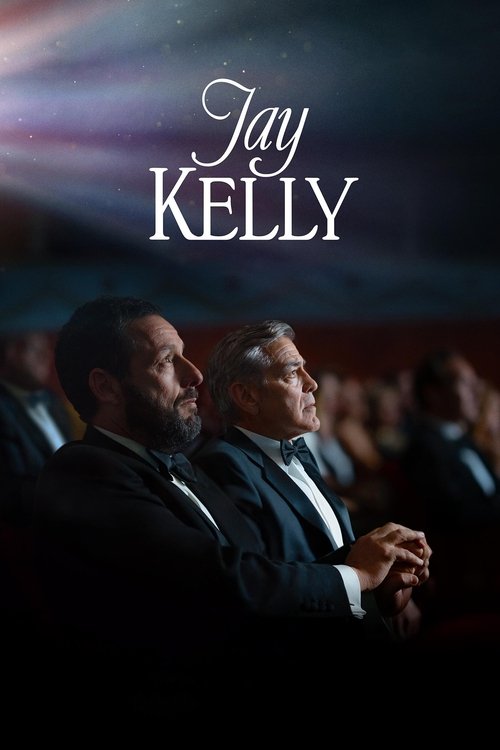
Jay Kelly
2025 · Noah Baumbach
For a reflective evening when you want to laugh and feel a lump in your throat in the same two hours — nostalgic, generous, easy to watch but with something on its mind. Comfort viewing that sneaks up on you.
What it's about
Jay Kelly is a beloved American movie star who walks off a soundstage mid-production and drifts across Europe toward a lifetime achievement award, trailed by Ron, the devoted manager who has organized three decades of his life. The trip becomes a reckoning: the roles he chose, the family he half-missed, and the question of what's left of a man who has spent his life being watched.
The experience
Bittersweet and often very funny — a warm, rueful dramedy that keeps sliding from showbiz comedy into something more melancholy about fame, fatherhood, and time. It has the loose, joyous feel of a road trip carrying real emotional cargo.
Performances
George Clooney plays the movie star as a knowing riff on his own screen persona, and Adam Sandler, in dramatic mode, gives the manager a devotion and quiet sadness that many found the heart of the film.
The craft
Baumbach, co-writing with Emily Mortimer, works in his signature register — fast, overlapping, emotionally precise dialogue — while opening up into a European travelogue with a large ensemble. It's his most openly valedictory film, a comedy built on the machinery of fame it's also mourning.
Why it matters
A Venice 2025 competition premiere and Baumbach's third Netflix feature, notable as the film that paired Clooney and Sandler and let each play against — and with — his own legend.
Snapshot
Jay Kelly is Noah Baumbach's movie-star picture about a movie star: George Clooney as an American screen icon who leaves a soundstage mid-production and drifts across Europe toward a lifetime achievement award, trailed by Adam Sandler as Ron, the manager who has organized three decades of his life. It premiered in competition at the 82nd Venice International Film Festival in the late summer of 2025, played the fall festival circuit, received the short theatrical window Netflix grants its awards titles, and arrived on the platform in December 2025.
The film is Baumbach's third feature for Netflix after Marriage Story (2019) and White Noise (2022), and his first written with Emily Mortimer, who shares the screenplay credit and appears in the ensemble. It is also the most openly valedictory film of his career — a comedy of professional embarrassment that keeps sliding, sometimes within a single scene, into a memory play about a man who converted his life into performances and cannot now find the original. Reception was sharply divided at Venice and stayed divided; the film's defenders and detractors largely agree on what it is, and disagree about whether a filmmaker of Baumbach's standing should have made it.
Industry & production
Jay Kelly sits inside the deal structure that has defined Baumbach's late career. After two decades of independent financing — IFC, Sony Pictures Classics, Scott Rudin's productions at Paramount Vantage and Fox Searchlight — Baumbach moved to Netflix with The Meyerowitz Stories (New and Selected) in 2017 and has stayed. The arrangement bought him a scale of production his subject matter had never previously justified: White Noise was an eighty-million-dollar adaptation of a novel long considered unfilmable, and Jay Kelly is a European-location star vehicle with a deep and expensive supporting cast. It also bought him a distribution model in which the theatrical run functions as an awards-qualifying gesture rather than a business.
David Heyman's Heyday Films produced, continuing the partnership that carried Marriage Story and White Noise. The casting is the film's most legible industrial fact. Clooney had not previously worked with Baumbach; Sandler had, memorably, in The Meyerowitz Stories, where Baumbach was among the first of the prestige directors to treat Sandler's clenched, wounded register as a serious instrument rather than a novelty. Laura Dern returns from Marriage Story, where she played an entertainment attorney and won an Academy Award for it, and is cast here in an adjacent function as Jay's publicist — a piece of self-aware reuse the film does not pretend is accidental. Josh Hamilton, who has been in Baumbach's films since Kicking and Screaming in 1995, appears again. Billy Crudup, Riley Keough, Stacy Keach, Jim Broadbent and Grace Edwards fill out an ensemble that is unusually large for a Baumbach picture and deployed in the manner of a repertory company passing through.
Production ranged across European locations and studio work, with the film's spine a rail journey toward an Italian festival tribute. That Clooney should have spent 2025 alternating between a Broadway run of Good Night, and Good Luck and a film about the exhaustion of movie stardom is a biographical coincidence, but it is the kind of coincidence that structures how the film was received: Clooney at sixty-four, playing an icon of a vanishing type, in a picture financed by the company that helped end the theatrical conditions that produced him.
Technology
Baumbach has kept faith with photochemical capture through the streaming period — Marriage Story and White Noise were both shot on 35mm and delivered into Netflix's 4K pipeline via scan and digital intermediate — and Jay Kelly, shot by Linus Sandgren, continues that practice. Sandgren is among the most committed celluloid cinematographers now working, having shot La La Land, First Man, No Time to Die and Babylon on film stock at a moment when the economics ran the other way; the grain, halation and rolloff of a 35mm negative are load-bearing in a film whose subject is the texture of an older kind of glamour.
The interesting technological question the film raises is not capture but the collision of formats of memory. Jay Kelly stages the past not as flashback footage in a degraded look but as continuous space — the present-tense camera moving into scenes from decades earlier, older and younger selves sharing a frame. Whether that is achieved through practical set construction and blocking, through invisible digital compositing, or through some negotiation of both is not a matter the public record documents in the detail one would want; fine-grained technical accounts of a film ten months old are thin, and I would rather note the gap than fill it. What can be said is that the effect is presented as theatrical rather than computational — the seams are meant to be felt as staging, not concealed as simulation, which is a choice with a long lineage and a specific meaning here.
The film also carries a quieter technological argument in its subject. Jay Kelly's fame was manufactured by a twentieth-century apparatus — studio publicity, magazine covers, the theatrical release as event — and is now metabolized by phone cameras, autograph hunters with resale markets, and a public that consumes him in fragments. Several of the film's most uncomfortable sequences turn on the small screen held up between the star and the person addressing him.
Technique
Cinematography
Sandgren's images are warmer and more classically composed than the handheld, close-pressed work Robbie Ryan brought to Marriage Story. The dominant strategy is isolation-in-crowd: Jay held in shallow focus while the surrounding entourage, fans and functionaries dissolve into soft shape and light. Interiors — hotel suites, first-class compartments, backstage corridors, the gilded auditorium of the tribute — are lit with a nostalgia that the script is simultaneously interrogating, so that the photography flatters the man while the writing audits him. The European locations are shot with an unembarrassed picture-postcard beauty that reads, correctly, as the view from inside a bubble: Jay's Europe is the Europe of car windows, terraces and arranged access.
Editing
The cutting belongs to the looser, more elastic school Baumbach moved toward after Jennifer Lame — who cut everything from Frances Ha through Marriage Story before decamping to Christopher Nolan's films — left the chair, and after White Noise was assembled by Matthew Hannam. I won't assert the credited editor of Jay Kelly from memory. The work itself is characterized by two rhythms held in tension: long dialogue scenes allowed to run in sustained two-shots and wides, in the manner of a filmed play, punctured by abrupt lateral moves into memory that arrive without the conventional signposting of a dissolve or a sound bridge. The film's comedy depends on the first rhythm and its grief on the second, and the friction between them is where viewers divided.
Mise-en-scène / staging
The organizing visual idea is that Jay is never alone and never accompanied. Frames are crowded with assistants, drivers, publicists, hotel staff and strangers, all oriented toward him, none in contact with him. Costume works as armor — Clooney's tailoring is immaculate and unvarying, a uniform of unbotheredness — and the film's cruelest staging strips that away in transit, in a dressing room, in the presence of a daughter who is not impressed. The memory sequences are staged as constructed spaces rather than recovered ones, closer to a theater's revolve than to a photographic past, which is the film's central formal claim: Jay's memories are productions he has directed, and their sets show.
Sound
Nicholas Britell composes, bringing to Baumbach a very different musical intelligence from Randy Newman's warm Americana on The Meyerowitz Stories and Marriage Story or Danny Elfman's manic scoring for White Noise. Britell's idiom — chamber-scale, harmonically restless, capable of turning a lush phrase slightly sour — suits a film about a man whose charm is real and insufficient. The sound design does structural work as well: the crowd roar, the shutter clatter, the ambient hum of a set between takes, and the specific silence of a luxury hotel room are all used to mark the gradient between Jay's public and private acoustics. Baumbach's habitual overlapping dialogue, inherited from the Nichols–Allen–Cassavetes line of American talk cinema, is present but calmer than in his acidic period.
Performance
Clooney gives a performance built on withholding, playing a man whose professional skill is the production of warmth and whose private failure is its absence — the film asks him to be charming in ways that curdle, and he is disciplined about not asking for sympathy. Sandler's Ron is the picture's emotional engine and, by broad critical consensus, its finest thing: a man who has subordinated his own life to the management of another's and who understands the bargain better than his client does. Dern plays the publicist as a professional realist. Crudup, as a figure from Jay's early years, delivers the film's prosecutorial scene — the accusation that a star's life is assembled from other people's — and it lands hard enough to reorganize everything after it. The ensemble around them is played in a lower key, which is appropriate: they are, structurally, staff.
Narrative & dramatic mode
The film runs on a picaresque journey chassis — a series of encounters along a route, each one a small trial — welded to a memory play. Its dramatic mode is comedy of embarrassment shading into elegy, with the honorary award functioning as a premature obituary that forces the protagonist to attempt a self-summary he is not equipped to give. There is no antagonist and no plot in the causal sense; the engine is accumulating exposure. Baumbach's characteristic tactic of letting a scene run past the point of social comfort is here applied not to a marriage or a family dinner but to the machinery of celebrity, where every interaction is already a transaction and the discomfort is structural rather than personal.
Genre & cycle
Jay Kelly belongs to the showbiz self-portrait, one of the most durable and most suspect genres in the medium: Chaplin's Limelight, Fellini's 8½, Truffaut's Day for Night, Fosse's All That Jazz, Allen's Stardust Memories. It belongs equally to the Hollywood-in-Europe strain — Minnelli's Two Weeks in Another Town, Godard's Contempt — in which the American film industry's self-image is examined by being displaced onto an older continent's ruins.
It also belongs to a contemporary cycle: the late-career star vehicle in which a famous face is cast to interrogate its own fame, running from Birdman through Once Upon a Time in Hollywood to The Unbearable Weight of Massive Talent. And it is a node in Baumbach's own cycle of reckonings — The Squid and the Whale, Margot at the Wedding, Greenberg, While We're Young, The Meyerowitz Stories, Marriage Story — all films about people whose self-narration has drifted from the evidence. What changes here is the subject's altitude and the film's temperature: earlier Baumbach would have punished this man; Jay Kelly forgives him, and the forgiveness is what the argument is about.
Authorship & method
Baumbach's authorship is verbal before it is visual: he writes long, socially precise scenes and casts actors who can play the subtext without underlining it. The screenplay credit with Emily Mortimer is the notable methodological fact of this production. Mortimer — an actor of thirty years' standing who co-created and co-wrote Doll & Em with Dolly Wells and adapted and directed The Pursuit of Love — brings a performer's inside knowledge of the industry the film anatomizes, and it is plausible to read the film's unusual sympathy for the people who work for the star as her contribution. It is the first Baumbach feature co-written with someone other than Greta Gerwig or Wes Anderson, and it follows his co-writing of Barbie (2023) with Gerwig, a credit that materially changed his industrial standing and, arguably, his access to a cast of this magnitude.
The collaborator roster is otherwise substantially refreshed: Sandgren rather than Ryan or Sam Levy behind the camera, Britell rather than Newman or Elfman at the piano. For a director whose signature had been consistency of team, Jay Kelly is an unusually reconstituted crew, and the film's smoother, more lush surface follows from that.
Movement / national cinema
The film is American independent cinema's studio-scale endpoint: a director formed by the 1990s Sundance-adjacent milieu, working in the New York talk-comedy lineage of Nichols and Allen, now making a nine-figure-adjacent picture for a streaming platform with movie stars in it. Its national identity is deliberately hybrid — an American film about the specific American invention of the movie star, filtered through Swedish and Italian art-cinema forms and shot largely on European ground. That hybridity is the film's method and also, for its critics, its liability: whether a Netflix star vehicle can inherit the moral seriousness of Wild Strawberries is precisely the question the film stakes itself on.
Era / period
Jay Kelly arrives at the end of a decade that dismantled the conditions of its protagonist's career. The mid-budget adult drama has largely left theaters; the star's ability to open a film has measurably weakened against franchise IP; the 2023 labor stoppages left the industry contracted and anxious; generative systems have introduced a live question about whether the human performer's face and voice remain scarce goods. The film does not editorialize about any of this, but its melancholy is unintelligible without it. Jay Kelly is a man whose profession was invented around 1915 and is being renegotiated in real time, and the film's award ceremony — an institution honoring a career while the industry that produced it reorganizes — is exactly the right setting for that.
Themes
Fame as self-erasure: the argument that a life spent producing an image leaves nothing behind the image. Work as the socially approved form of absence, with the film's fathers and daughters carrying the cost. The manager–client bond as the film's real marriage — more intimate, more sustained and more asymmetrical than any romantic relationship on screen, and the source of its most painful scene, in which the person who has given up his own life discovers what that was worth. The theft of other people's material: the accusation that stars are composites assembled from friends, teachers and rivals who did not consent. Memory as authored rather than retrieved. And mortality, arriving in the bureaucratic form of a tribute reel.
Reception, canon & influence
The Venice premiere produced the split that has followed the film since: warm response in the room, and a critical register that ranged from moved to actively irritated. The recurring charge is solipsism — that a film about how hard it is to be a beloved movie star, made by a well-resourced director with a movie star, is a closed loop, and that its late-arriving tenderness is unearned by the standards Baumbach himself set in The Squid and the Whale. The recurring defense is that the film knows this, that its subject is precisely the insufficiency of the apology it stages, and that Sandler's performance supplies a moral center outside the star's gravity. Praise for Sandler has been the one near-universal element of the response, and for Britell's score nearly as consistent. The film was positioned in the 2025–26 awards season; I'd rather point readers to the record than enumerate nominations and outcomes from memory.
Backward, the influences are unusually legible and mostly acknowledged by the film's own construction. Bergman's Wild Strawberries (1957) is the load-bearing model: an old man travels to receive an honorary distinction, and the journey opens onto staged memories in which he watches his younger self fail the people who loved him. Fellini's 8½ supplies the entourage-as-chorus and the fantasia logic; Chaplin's Limelight the melancholy of the performer outliving his moment; All That Jazz the self-audit as showbiz spectacle; Stardust Memories the resentful fan encounter and the star's suspicion that admiration is a form of appetite. Minnelli's Two Weeks in Another Town stands behind the American-star-adrift-in-Italy geography. Within Baumbach's own filmography, The Meyerowitz Stories is the direct precursor — the same interest in a man whose reputation and whose family are separate ledgers, and the same use of Sandler as the one who absorbs the damage.
Forward, it is far too early to speak of legacy. The film is ten months old as of this writing, and the honest position is that its influence has not yet had time to exist. What is worth tracking is narrower and more plausible: whether it consolidates the second phase of Sandler's dramatic career into something the industry treats as a default rather than an event; whether it marks the point at which Clooney's screen persona formally becomes an elegiac instrument; and whether it stands, in retrospect, as one of the films that recorded what the movie star meant at the moment the category stopped being self-evident. That last is the claim the film is making for itself, and only time and the archive can settle it.
A Deleuzian reading
A man is talking in a hotel corridor, mid-sentence, and then he is standing in a room from thirty years ago, at the edge of it, watching a younger version of himself.
The full Deleuzian reading of Jay Kelly →
Reception
Premiered at Venice 2025 to a much-reported ten-minute standing ovation and instant awards buzz, then landed on Netflix to a politely mixed reception — the quick consensus settled on 'minor Baumbach,' warm but slight.
How Jay Kelly was received, from release to now →
Influences: the films it descends from and the films it influenced
- Wild Strawberries (1957) — The load-bearing model for the film's memory grammar: an honoree's journey to receive a distinction opens directly onto memory as continuous, walkable space, the old man standing unaged inside the summer-house scene watching his younger self fail the people who loved him — staged without dissolves, optical cues or flashback punctuation, exactly as Baumbach handles Jay's past.
- 8½ (1963) — Supplies the entourage-as-chorus blocking — handlers, ex-wives, producers and supplicants pressed into a continuous moving crowd around a man who is alone in the center of it — and the fantasia cut made on a glance, with no grammatical warning that the register has changed.
- Limelight (1952) — Establishes the late-career star vehicle in which the star's own diminished drawing power is the material: Chaplin casts his real obsolescence as Calvero's, the form Clooney's withholding performance inhabits rather than merely resembles.
- All That Jazz (1979) — The self-audit staged as showbiz spectacle — the artist's moral accounting performed as a production number for an audience, with the cutting rhythm setting the confession directly against the applause that rewards it.
- Stardust Memories (1980) — Source of the tribute-retrospective frame and the resentful-fan encounter: admiration played as appetite, with handlers negotiating physical access to the star as though rationing a commodity.
- Two Weeks in Another Town (1962) — The American-star-adrift-in-Italy geography, using European production locations as the specific space in which a Hollywood career gets re-litigated by people who knew the earlier version of the man.
- The Meyerowitz Stories (New and Selected) (2017) — Direct precursor in method: Sandler cast as the family member who absorbs the damage without ever being given a speech about it, plus the overlapping-dialogue scene shape and the abrupt mid-sentence cut that ends a scene on an unfinished line.
- The Squid and the Whale (2005) — Baumbach's baseline technique of writing a self-serving man's charm at full working strength and letting the scene's social detail — not any authorial judgment — expose it; the standard against which Jay Kelly's late tenderness is argued about.
- Marriage Story (2019) — The device of a character's carefully prepared self-presentation — the read-aloud letter, the rehearsed apology — collapsing in front of the person it was written for, which is the exact mechanism of Jay's staged reconciliations.
- Punch-Drunk Love (2002) — The founding move of photographing Sandler's comic mask as a pathology: holding the camera on him in silence past the point where the joke would land, so the register drops out of comedy without the performer changing anything.
- Opening Night (1977) — Theatrical construction of the past as physical set: the performer's offstage self played inside the playing space and the remembered figure appearing bodily within it, rather than being cued by flashback grammar.
- Up in the Air (2009) — Calibrates Clooney's withholding as a professional instrument — charm performed as a service for strangers in transit — with an itinerary structure that supplies motion while guaranteeing the character never arrives anywhere.
- Babylon (2022) — Sandgren's other 35mm Hollywood self-portrait: the same handling of dense, swarming industry crowds in warm film grain while a single face is held on a narrow focal plane, the frame crowded and the subject isolated within it.
- First Man (2018) — Sandgren's shallow-focus close work on a deliberately withholding star, using grain and a razor-thin plane of focus to make the face the only legible information in an otherwise busy frame — the lens grammar Jay Kelly reuses on Clooney.
- Youth (2015) — Same premise-as-structure: an emissary arrives to press an honor on an elder artist who does not want it, and the film's excursions into staged fantasia become the mode in which he conducts his self-accounting.
- Uncut Gems (2019) — The other pole of Sandler's dramatic register — interruption and overlap tracked at maximum pressure, dialogue laid over itself continuously — establishing the range against which his quieter, absorbing work here reads.
- Moonlight (2016) — Britell's method of scoring withheld feeling: strings entering as a counter-voice that states what the performance is refusing to say, pitched as commentary on the character rather than reinforcement of his stated emotion.
- The Irishman (2019) — The late star vehicle that conscripts the audience's memory of the actor's own earlier screen work as the character's unrecoverable past, so the star's biography does load-bearing narrative work the script never has to state.
Similar films
- Marriage Story (2019) — influence & lineage
- The Squid and the Whale (2005) — influence & lineage
- Uncut Gems (2019) — influence & lineage
- Babylon (2022) — influence & lineage
- Blue Moon (2025) — same viewing thread
- Father Mother Sister Brother (2025) — same viewing thread
- Rental Family (2025) — same viewing thread
- Cha Cha Real Smooth (2022) — same viewing thread
All the films related to Jay Kelly →
Watch it with: curated runs of related films
- Funny Because It Aches — A run of tender, deadpan dramedies where love, grief, and the panic of becoming yourself all get metabolized through jokes — watch these when you want to laugh and cry in the same scene.