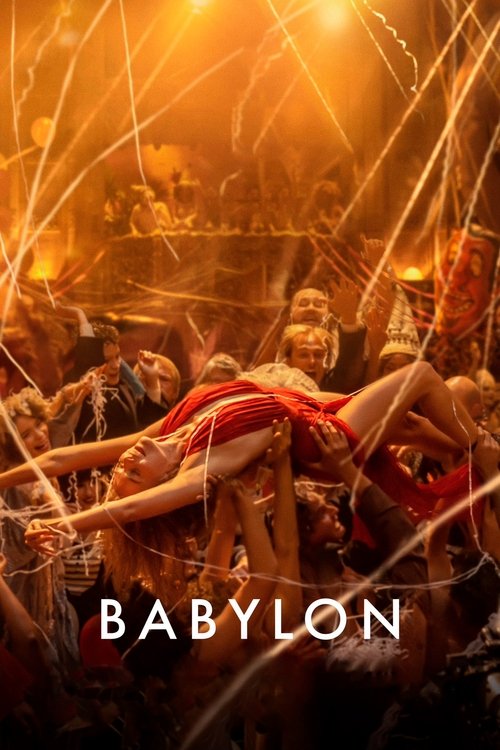
Babylon
2022 · Damien Chazelle
Babylon's spectacular flop became the era's favorite "ambitious failure" debate — maudit masterpiece or coke-fueled indulgence — a genuine Letterboxd litmus test.
For when you want maximalism — a big, loud, go-for-broke epic to surrender an evening to, not a tidy comfort watch. Choose it when you're up for a challenge and in love with movies about the movies.
What it's about
Late-1920s Hollywood, as silent film gives way to sound: an aging matinee idol feels the ground shifting under him, a wild young unknown claws her way to stardom, and an ambitious Mexican-American assistant rises through the studio ranks, their paths crossing at debauched parties and chaotic film sets. It's a rise-and-fall epic about the people the dream factory devours as it reinvents itself — three-plus hours of ambition, excess, and heartbreak.
The experience
Overwhelming by design: the first hour is a nonstop bacchanal that barely lets you breathe, and the film keeps swinging between riotous comedy, filth, and genuine melancholy. It's exhausting, dazzling, and unafraid to be too much — you come out feeling like you attended the party and the hangover both.
Performances
Margot Robbie is a live wire as the untamable ingénue Nellie LaRoy, all appetite and desperation, and Brad Pitt gives the fading idol Jack Conrad an elegant, wounded self-awareness that deepens as the film goes on.
The craft
Chazelle stages enormous single-sweep party sequences and film-set chaos with virtuoso energy, and Justin Hurwitz's brassy jazz score is one of the great recent soundtracks — the trumpet theme will follow you home. It's shot and cut like a fever, and it rewards the biggest screen and loudest speakers you can find.
Why it matters
One of the most expensive original studio gambles of its era, it flopped on release and immediately began gathering defenders — a love-it-or-hate-it portrait of Hollywood that's become a cult conversation piece about ambition and excess in filmmaking itself.
Snapshot
Babylon is Damien Chazelle's sprawling, deliberately overwhelming epic about Hollywood's traumatic passage from silent film to sound at the close of the 1920s. Running just over three hours, it interweaves several fictional careers — a fading matinee idol, a wildcat ingénue, an ambitious Mexican immigrant working his way up the studio ladder, a Black jazz trumpeter, and a Chinese-American cabaret performer — to stage the industry's convulsive self-reinvention as both bacchanal and slaughter. Chazelle conceived it as a companion and counterweight to his earlier, more romantic Hollywood musical La La Land: where that film mourned dreams gently, Babylon insists on the filth, cruelty, and human wreckage that the dream factory metabolizes into art. It arrived as one of the most expensive original studio pictures of its moment and, notably, as a commercial disappointment — a fact inseparable from its own subject, which is the indifference of an industry to the people it consumes. The film is at once a maximalist entertainment and an argument about cinema's endurance beyond any single life.
Industry & production
Babylon was produced and released by Paramount Pictures, the studio whose own lineage reaches back to the era the film depicts, and was mounted on a large budget for an original, R-rated, adult drama — reportedly in the range typical of a tentpole rather than a mid-size prestige picture. Chazelle wrote the screenplay over several years and developed it as his follow-up to First Man (2018); the project reunited him with the core creative team from La La Land. The ensemble was anchored by Brad Pitt and Margot Robbie as the two established stars, with Diego Calva cast as the audience's point-of-entry figure, Manny Torres. The supporting company included Jean Smart, Jovan Adepo, Li Jun Li, and Tobey Maguire, the last of whom also served as a producer.
The film's release, in the December 2022 awards corridor, met a divided press and weak turnout. Its commercial underperformance was widely reported at the time, and it became a frequently cited example of the difficulty of financing large-scale original filmmaking for adults in the contemporary studio system — an irony given that the movie is precisely about an industry devouring its own. In awards terms it received recognition principally in the craft categories, earning Academy Award nominations for its score, production design, and costume design; Justin Hurwitz's music was honored at the Golden Globes. (Readers should treat any more granular claim about specific grosses or ballots against primary sources, as accounts vary.)
Technology
The film is, at the level of story, a treatise on a technological rupture — the coming of synchronized sound — and Chazelle dramatizes that rupture as an assault on an entire way of working. The most celebrated set-piece stages the shooting of an early talkie: a stifling, sealed sound stage in which the camera is boxed to silence its motor, an actress must hit an unforgiving mark to stay within range of a hidden microphone, and take after take collapses over a cough, a light, a sneeze, or a fatal misstep. It is a near-comic, then tragic, anatomy of how sound recording in roughly 1929–1930 immobilized a cinema that had learned to move freely.
In its own making, Babylon was shot photochemically on 35mm film rather than digitally — a choice consonant with Chazelle's and cinematographer Linus Sandgren's preference for celluloid and with the film's argument for the physical medium's endurance. The picture's closing passage makes technology its explicit theme, hurtling through a montage of film history that gestures toward later transformations — color, widescreen, and the digital-era spectacle that Chazelle sets in dialogue with the silent birth he has just chronicled.
Technique
Cinematography
Linus Sandgren, Chazelle's Oscar-winning collaborator from La La Land, shoots Babylon as controlled delirium. The opening desert-mansion party is built from long, weaving, near-continuous camera movements that thread through a heaving crowd, treating the bacchanal as a single organism. The palette is warm, golden, and grimed with dust and sweat; the widescreen frame is packed edge to edge with incident. Sandgren repeatedly contrasts the free-roaming mobility of the silent-era exteriors — a camera that swoops across the desert as productions shoot in the open light — with the leaden confinement of the sound-stage sequence, where the image is nailed down. The cinematography is thus not merely beautiful but argumentative: it visualizes what sound took away and what it later gave back.
Editing
Tom Cross, who has cut every Chazelle feature since Whiplash and won the Academy Award for that film, edits Babylon at a relentless, percussive tempo keyed to Hurwitz's score. The party sequences are montage as intoxication — rapid, rhythmic, accumulative — while the sound-stage scene works by an agonizing accretion of failed takes, each restart resetting the tension. The film's most divisive editorial gesture is its finale: a rushing montage that collapses a century of cinema into a few minutes, cross-cutting the story's emotional climax with clips and pastiches spanning the medium's history. It is a maximalist bet — sentiment and film theory delivered as a single overwhelming cascade — and it divided viewers precisely along the line of whether Chazelle's sincerity earns its excess.
Mise-en-scène / staging
Production designer Florencia Martin and costume designer Mary Zophres (a longtime Coen brothers and Chazelle collaborator) build a Hollywood of teeming, tactile density — mansions, studio backlots, brothels, and an underground nightmare-world beneath Los Angeles. The staging favors overload: frames are crowded with bodies, animals, props, and simultaneous action, so that the viewer, like Manny, is perpetually trying to find the meaningful gesture within chaos. Zophres's costumes track the era's shift from flapper abandon toward the tighter grammar of the sound era. The film's grotesque late sequence — a descent into a subterranean labyrinth of vice presided over by a cadaverous underworld figure — pushes the mise-en-scène into gothic horror, literalizing the "Babylon" of the title as a hell beneath the dream.
Sound
Given its subject, sound is doubly foregrounded. Diegetically, the film obsesses over the microphone as an agent of terror and transformation. As a soundtrack, Babylon is carried by Justin Hurwitz's brass-driven, jazz-inflected score — the propulsive theme functions almost as a character, and the film's design lets music, dialogue, and the roar of crowds blur into a continuous sensory pressure. The contrast between the raucous live-jazz energy of the party scenes and the suffocating, controlled silence demanded by early sound recording is one of the film's organizing sonic ideas.
Performance
Performance is the film's beating heart and its most historically pointed subject, since it is about performers rendered obsolete. Margot Robbie's Nellie LaRoy is a whirlwind of instinctive, uncontainable energy — a portrait of the silent star as pure kinetic charisma who cannot be tamed by the new medium's demands. Brad Pitt's Jack Conrad plays the matinee idol confronting his own irrelevance with wounded self-awareness. Diego Calva's Manny grounds the film's dizziness in watchfulness and yearning. The ensemble is calibrated to a heightened, theatrical register that matches the film's operatic scale.
Narrative & dramatic mode
Structurally, Babylon is a multi-strand rise-and-fall epic organized around the ascent and collapse of intertwined careers across roughly a decade. Its dramatic mode is deliberately unstable, veering between raucous comedy, romance, tragedy, and horror — sometimes within a single sequence. Chazelle uses Manny as a connective consciousness, a striver whose love for Nellie and worship of the movies frames the whole. The film's shape is fundamentally elegiac: it builds toward the destruction of nearly everyone whose ambition it has celebrated, then reframes that destruction, in its coda, as the necessary compost from which cinema itself continues to grow. This tonal maximalism — the refusal to settle into one genre's rules — is both the film's signature and the crux of its critical controversy.
Genre & cycle
Babylon belongs to the enduring cycle of Hollywood-on-Hollywood films — movies about the movies — and specifically to the sub-tradition concerned with the silent-to-sound transition. Its most obvious ancestor and interlocutor is Singin' in the Rain (1952), which treated the same historical moment as buoyant musical comedy; Chazelle explicitly invokes that film, and the coming-of-sound folklore it popularized, only to darken it. The picture also draws on the tradition of the decadent-Hollywood exposé and the excess-and-downfall epic. Its scale, structure, and appetite for spectacle place it in a lineage of maximalist ensemble epics about American ambition, and its grotesque underworld detour borrows the grammar of horror to complicate the genre's usual nostalgia.
Authorship & method
Babylon is a near-total expression of Chazelle's authorship and of the repertory company he has built. His recurring preoccupation — the brutal cost exacted by artistic greatness, and the question of whether transcendence justifies the human damage it requires — runs from Whiplash through La La Land and First Man into this film, where it is projected onto an entire industry rather than a single artist. The key collaborators are the same throughout: composer Justin Hurwitz, Chazelle's college roommate and the musical author of all his features; editor Tom Cross, whose rhythmic cutting is inseparable from Chazelle's sense of tempo; and cinematographer Linus Sandgren, who shot La La Land and First Man and who gives Babylon its mobile, celluloid-warm eye. Costume designer Mary Zophres and, for this film, production designer Florencia Martin complete the craft architecture. Chazelle wrote the screenplay himself, making the film an authorial statement in the fullest sense — its ambitions, and its overreach, are entirely his.
Movement / national cinema
The film is a work of contemporary American studio cinema that is fundamentally about the origins of that same institution. It carries the sensibility of a certain strain of cinephile-directed American filmmaking — filmmakers who treat film history as living material and who make movies that are, in part, arguments about the medium. In this respect Babylon aligns Chazelle with a lineage of American directors for whom homage and historiography are creative methods, and it is best understood not through a national "movement" but through this cinephilic-auteur tradition operating inside — and straining against — the commercial studio system.
Era / period
The film is set principally in Hollywood between roughly the late 1920s and the early 1930s, with a coda leaping forward to 1952. Its period is defined by the single most disruptive technological and economic shift in the industry's early history: the arrival of synchronized sound, the reorganization of production it forced, and the careers it ended. Chazelle stages this against the backdrop of pre-Code excess — the permissiveness and scandal of an industry not yet disciplined by the Production Code — and the film's decadence is historically anchored in that brief window before enforced respectability descended.
Themes
At its center is the tension between transcendence and disposability: cinema outlives and redeems the individual, but the individuals who make it are used up and discarded. The film meditates on ambition and its costs, on the cruelty of an industry that manufactures immortality while destroying mortals, and on the immigrant and outsider striver — Manny, Sidney, Lady Fay — who is granted proximity to the dream but never full belonging. It reckons, sometimes uneasily, with the era's racism and exploitation, staging a jazz musician's humiliation and the marginalization of a Chinese-American performer as evidence of the machine's brutality. Above all it is about time and obsolescence — the terror of being made irrelevant by a new technology — resolved, or perhaps merely consoled, by the idea that to have contributed to cinema at all is to become part of something that never dies.
Reception, canon & influence
Critical reception was sharply divided, and this division is central to the film's identity. Admirers praised its ambition, energy, craft, and the conviction of its performances and score, reading its excess as a legitimate formal strategy for a film about excess. Detractors found it bloated, tonally incoherent, and enamored of its own vulgarity, and questioned whether its final plea for cinema's transcendence earned the sentiment. Coupled with its weak commercial performance, this reception made Babylon a talking point about the viability of large, original, adult filmmaking in the streaming era — the film's failure becoming, for many commentators, a grim echo of its own theme.
Influences on the film (backward): the picture draws on the mythology of Hollywood's silent-to-sound crisis and the real careers destroyed by it — most often associated with figures whose stardom did not survive the transition — and on the flamboyant tabloid legend of early-Hollywood scandal that Kenneth Anger's notorious Hollywood Babylon did so much to fix in the popular imagination. Nellie LaRoy has been widely read as evoking the "It girl" Clara Bow; Jack Conrad as inflected by the fates of silent leading men undone by sound; and other characters as glancing at real gossip columnists and marginalized performers of the period. Above all it converses with Singin' in the Rain, whose sunny version of the same history it deliberately answers.
Legacy (forward): because the film is recent and its commercial reputation troubled, its downstream influence is not yet settled, and it would be premature to claim a school or cycle descending from it. What can be said is that Babylon has entered the ongoing conversation as one of the defining test cases of the 2020s for whether the American studio system can still finance the original, large-scale, director-driven spectacle it depicts — a film whose fate has become part of its own argument about cinema, ambition, and disposability.
A Deleuzian reading
A sound stage, 1929.
The full Deleuzian reading of Babylon →
Reception
A notorious flop on release — roughly $80M budget, a fraction back at the box office, a C+ CinemaScore, and reviews calling it a bloated mess — it almost immediately became the internet's favorite 'they'll appreciate it in 20 years' cause, a reappraisal Babylon itself basically predicted. Barely a few years on, 'Babylon was right' is already a semi-ironic badge of cinephile honor.
How Babylon was received, from release to now →
How to watch Babylon: what to notice on a first viewing
- Watch the camera weave through the opening party without stopping. Linus Sandgren threads long, near-continuous takes through the crowd at the desert mansion, treating hundreds of bodies as one heaving organism. Nobody is a character yet. The frame is packed to its edges. Movement rather than dialogue is doing the introductions, and you are being trained to hunt for a face inside noise.
- Look at how much is happening at the edges of each frame. Florencia Martin and Mary Zophres crowd every shot with bodies, animals, props, and simultaneous action. Manny is usually the person inside the shot scanning all of it, trying to find the thing that matters. The density is a training exercise. You end up watching the way Manny watches, sorting signal out of chaos.
- Notice when the camera stops moving on the sound stage. It gets shut inside a padded box so the microphone cannot hear its motor turn. Actors hit marks they are not allowed to look down for. Takes fail on a cough, a lamp, a sneeze. Chazelle makes the photography carry the history. The camera does not describe a loss of freedom. It undergoes one.
- Listen for Hurwitz's brass theme returning across the whole film. Justin Hurwitz's propulsive jazz runs under parties, shoots, and arguments alike, loud enough to blur into the crowd noise. Then early sound recording demands total quiet, and the film takes the music away. The score behaves like a character with its own appetite. Notice which scenes it is not allowed into.
- Watch Robbie's body. She almost never holds still. Nellie cries on command, dances past exhaustion, and throws herself at whatever is in reach. Pitt plays Conrad the opposite way, wounded and controlled, a man reading his own timetable. One performer runs on instinct, the other on craft. The new technology has a preference, and you can see it arriving.
The whole guide to watching Babylon, with the keys for a rewatch →
Influences: the films it descends from and the films it influenced
- Singin' in the Rain (1952) — Babylon directly answers and darkens its silent-to-sound comedy, restaging the same on-set nightmare of hiding microphones and syncing a recording to a scene — the catastrophic Nellie sound-stage take is a deliberate grim inversion of the 'Dueling Cavalier' gag.
- Intolerance (1916) — The film borrows its title's Babylonian excess and its history-collapsing method — Griffith's colossal Babylon set and cross-cut montage across eras are the template for Chazelle's mountaintop bacchanals and time-spanning final reel.
- Sunset Boulevard (1950) — The silent-star-rendered-obsolete portrait and the gothic-decay iconography of faded Hollywood feed directly into Jack Conrad's arc and the film's staging/gothic-underworld register.
- The Day of the Locust (1975) — The grotesque Hollywood-underworld tableaux and the apocalyptic premiere-riot finale are the direct ancestor of Babylon's tactile-overload crowd scenes and its descent into the gothic underground snake-pit sequence.
- La Dolce Vita (1960) — Its episodic string of decadent nocturnal parties dissolving into emptiness supplies the structural rhythm of Babylon's set-piece hedonism, each revel escalating and curdling.
- 8½ (1963) — The reflexive cinema-about-cinema mode and the fantastical, self-mythologizing set pieces underwrite Babylon's status as an authorial statement staging the machinery of moviemaking itself.
- Goodfellas (1990) — The needle-drop montage that collapses years into minutes and the extended tracking-shot entrance are the exact grammar of Babylon's mobile long-take arrivals and its percussive rise-and-fall pacing.
- Boogie Nights (1997) — The roving Steadicam party opening and the empathetic ensemble portrait of an industry's transition (film-to-video there, silent-to-sound here) are the closest structural model for Chazelle's mobile-camera choreography and rise-and-fall ensemble.
- Nashville (1975) — The sprawling multi-protagonist industry mosaic with tonal shifts between farce and tragedy prefigures Babylon's tonal-maximalist juggling of a dozen intersecting careers.
- A Star Is Born (1954) — The studio-machine-chews-up-talent rise-and-fall template — one star ascending as another self-destructs through addiction and obsolescence — maps onto the Manny/Nellie/Jack triangle.
- Amadeus (1984) — Its structure of an ordinary witness watching vulgar genius flame out, plus its bawdy period maximalism, models Manny's outsider vantage and the film's transcendence-vs-disposability thesis.
- Whiplash (2014) — Establishes the Chazelle–Hurwitz–Tom Cross method of cutting image to musical tempo and the 'greatness demands human wreckage' premise that Babylon scales up from one drummer to a whole industry.
- Nouvelle Vague (2025) — A maximalist recreation of a film-industry epoch and its production chaos, the contemporary counter-pole to Linklater's intimate reconstruction of cinema being born.
- Jay Kelly (2025) — Sandgren's other 35mm Hollywood self-portrait: the same handling of dense, swarming industry crowds in warm film grain while a single face is held on a narrow focal plane, the frame crowded and the subject isolated within it.
Similar films
- La La Land (2016) — influence & lineage · same viewing thread
- The Artist (2011) — influence & lineage
- Once Upon a Time... in Hollywood (2019) — influence & lineage
- Singin' in the Rain (1952) — influence & lineage
- Whiplash (2014) — influence & lineage · same viewing thread
- Elvis (2022) — shared sensibility
- The Brutalist (2024) — shared sensibility
- Moulin Rouge! (2001) — shared sensibility
All the films related to Babylon →
Watch it with: curated runs of related films
- Burning to Be the Best — Watch these together for the shared fever of ambition — musicians, dancers and one table-tennis obsessive driving themselves past exhaustion toward a greatness that keeps costing more.