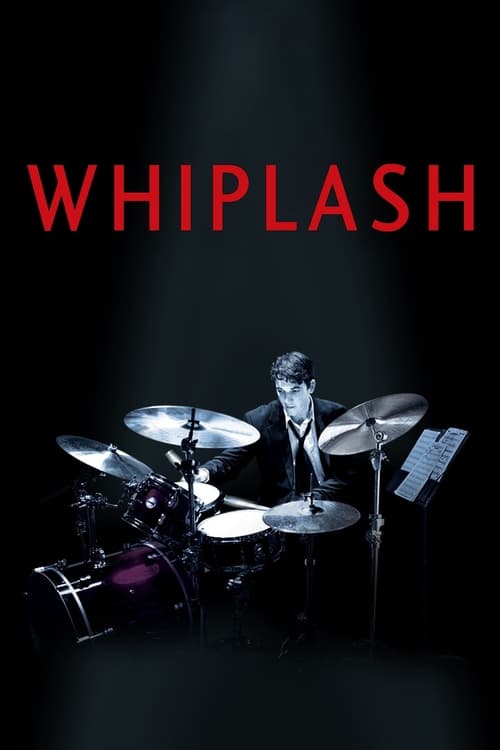
Whiplash
2014 · Damien Chazelle
Babylon's spectacular flop became the era's favorite "ambitious failure" debate — maudit masterpiece or coke-fueled indulgence — a genuine Letterboxd litmus test.
For when you want adrenaline without a single gunshot — a film that leaves you arguing about ambition on the walk to the kitchen. Intense but wildly watchable; a perfect pick when you want to feel your pulse.
What it's about
A nineteen-year-old drummer at a cutthroat New York conservatory gets pulled into the top jazz ensemble by its feared conductor — a man who hurls chairs, slurs and impossible tempos at his students in the name of greatness. What follows is a duel: the kid pushing himself past bleeding hands and every human relationship, the teacher always demanding more, and the open question of whether this is mentorship or abuse.
The experience
Ferociously tense — it plays less like a music movie than a boxing picture, cut to the rhythm of the drums, and the rehearsal scenes will have your shoulders up around your ears. Short, brutal, and exhilarating.
Performances
J.K. Simmons is terrifying and magnetic as Fletcher — a career-defining, Oscar-winning turn — and Miles Teller, drumming much of it himself, makes obsession physical: sweat, blisters, blood on the snare.
The craft
The editing is the star: rehearsals and performances cut like action sequences, whip-fast on cymbals, sticks and Simmons' eyes, and it won the Oscar for it. The sound mix makes every dropped beat land like a punch — worth good speakers turned up loud.
Why it matters
Made on a small budget from Chazelle's own short film, it became a sensation, launched his career, and reset expectations for how kinetic a drama about practice and performance could be.
Snapshot
Whiplash is a two-hander combat film disguised as a music drama: a nineteen-year-old jazz drummer, Andrew Neiman (Miles Teller), and his tyrannical conservatory conductor, Terence Fletcher (J.K. Simmons), locked in an escalating duel over what greatness costs. Damien Chazelle made it as his second feature at twenty-nine, drawing on his own adolescence in a competitive high-school jazz band where fear of the bandleader, he has said in interviews, eclipsed any pleasure in the music. The film is compact, abrasive, and ferociously edited — closer in rhythm to a heist thriller or a boxing picture than to the genteel rehearsal-room dramas it superficially resembles. Its central provocation, never resolved, is whether Fletcher's cruelty manufactures excellence or merely wreckage that happens to drum well. Released through Sony Pictures Classics after a triumphant Sundance premiere, it became one of the signal American independent successes of the decade and the launchpad for Chazelle's career.
Industry & production
Whiplash is a textbook case of the proof-of-concept short used to leverage a feature. Chazelle wrote the feature script first but, unable to finance it as an unproven director of a music film, carved an eighteen-minute section into a short, also titled Whiplash, with J.K. Simmons already as Fletcher and Johnny Simmons as the drummer. That short premiered at Sundance in January 2013, winning the short-film jury prize, and the resulting attention secured financing for the feature. The feature was shot the following autumn on a famously brief schedule — widely reported as roughly nineteen or twenty days — on a budget in the low single-digit millions. (Exact figures circulate at around $3.3 million; treat the precise number as approximate, as production budgets are rarely audited in public.)
The compressed shoot is inseparable from the film's aesthetic: there was no time for coverage-heavy indulgence, and the constraint forced the precision that became the picture's signature. Jason Blum's Blumhouse Productions and Bold Films were the principal production entities, with Right of Way Films and the producers Helen Estabrook, David Lancaster, and Michel Litvak among those credited. The film premiered at Sundance in January 2014, won both the Grand Jury Prize and the Audience Award in the U.S. Dramatic competition — a rare double — and was acquired by Sony Pictures Classics. Its awards run culminated at the 87th Academy Awards, where it won three Oscars: Best Supporting Actor for Simmons, Best Film Editing for Tom Cross, and Best Sound Mixing, plus a Best Picture nomination, an unusual feat for a film of its scale.
Technology
Whiplash was shot digitally, a choice that suited both the budget and the look. The cinematographer Sharone Meir worked largely with Arri Alexa cameras, and the digital workflow enabled the low-light, high-contrast interiors — amber practicals against deep shadow — that define the rehearsal spaces. Digital capture also tolerated the long, sweat-soaked takes of drumming without the reload interruptions of film, important on a schedule this tight. The production used real instruments and real playing where possible; the percussion is a mixture of Teller's own drumming (he had played as a teenager) and doubling, with the sound design later building the kit into something almost weaponized. The technological story here is less about novel apparatus than about how mature digital tools let a micro-budget film achieve a glossy, controlled surface that reads as far more expensive than it was.
Technique
Cinematography
Sharone Meir's photography is claustrophobic by design. The film lives in interiors — the Shaffer Conservatory band room, dorm corridors, a jazz club, a car — rendered in a palette of brass, sweat, and blood: warm amber highlights eaten by surrounding blackness. Fletcher is frequently isolated in hard pools of light or shot from slightly below to monumentalize his control; Andrew is pressed into tight frames that deny him air. The camera fetishizes physical detail — the cymbal's edge, the hi-hat, blistered hands, droplets of blood on the snare and the chart — in inserts that treat drumming as bodily violence. Crucially, the camera is not a neutral observer of music; it is keyed to power. When Fletcher conducts, the lens hunts his face and hands for the verdict; when Andrew plays, it watches for the moment he will fail.
Editing
Tom Cross's editing is the film's true protagonist and its most studied achievement. Cross cut to the music's rhythm rather than merely illustrating it, building the climactic and rehearsal sequences as percussive montages where shots land like accents on the beat. The famous "rushing or dragging" scene — Fletcher hurling a chair and a slur as he demands Andrew find the tempo — is constructed from accumulating short cuts that mimic the tightening of a snare. The final "Caravan" sequence is a near-wordless duet of image and sound, an extended crescendo edited with the logic of a drum solo: faster, tighter, more fragmented as it climbs. Cross has discussed cutting on the physical action of playing and on Fletcher's reactions to generate suspense from a contest with no body count. The Oscar for editing was not a courtesy; the film is, formally, an argument about rhythm conducted through the cut.
Mise-en-scène / staging
The band room is staged as an arena. Fletcher patrols the front; the players sit in ranks, instruments as both shields and liabilities. Chazelle blocks the ensemble so that humiliation is always public — the dread of being singled out in front of peers is the room's governing emotion. Costuming reinforces the hierarchy: Fletcher's tight black t-shirt and military bearing against the students' anonymous uniformity. Props carry enormous weight — the metronome, the chair, the blood-stained drum charts, the folder Fletcher slaps down. The recurring image of blood on white — hands, snare, sheet music — stages the film's thesis in a single motif: art extracted from the body as injury.
Sound
Sound is where Whiplash earns its title literally. The Oscar-winning mix foregrounds percussion as assault — the snap of the snare, the hiss and clack of the hi-hat, the squeal of a tightened cymbal — often pushed past naturalism into something visceral. Justin Hurwitz's score and the jazz standards ("Whiplash," "Caravan") are not background; they are the field of combat. The mix also weaponizes silence and the small sounds of intimidation: Fletcher's quiet, level voice before an explosion, the click of the metronome, the scrape of a chair. The contrast between near-silence and sudden percussive violence mirrors Fletcher's method of control through unpredictability.
Performance
The film is a duet of two performances pitched at opposite registers. J.K. Simmons plays Fletcher as a man of terrifying stillness who deploys cruelty with surgical timing, his charm and his sadism inseparable — a performance that resists caricature precisely because Fletcher is sometimes, maddeningly, persuasive. Miles Teller's Andrew is all coiled need and curdling ambition; Teller's actual drumming grounds the role in visible physical labor, the blistered hands and bleeding fingers belonging to a body genuinely at work. The two never settle into hero and villain; the discomfort of the film is that Andrew increasingly resembles his tormentor.
Narrative & dramatic mode
Whiplash runs on the structure of a sports film or a war film, not a music biopic: training, humiliation, setback, comeback, final test. It is essentially a series of escalating confrontations between two men, with everything else — Andrew's tentative romance with Nicole, his family dinners, his idolatry of Buddy Rich — instrumentalized to show his contracting humanity. The dramatic mode is intensive and unitary: few characters, few locations, relentless forward pressure. The screenplay withholds easy moral guidance. Fletcher's defining anecdote — the (possibly apocryphal) story that Charlie Parker became "Bird" because Jo Jones threw a cymbal at his head — functions as the film's central ideological statement and its trap, an argument the film both advances and quietly poisons. The ending is deliberately unresolved: Andrew's triumphant solo is also a surrender to Fletcher's worldview, an ecstatic victory that may be a moral defeat.
Genre & cycle
The film sits at the crossing of the music drama and the obsession-and-mastery thriller. Its closest generic kin are not other jazz films but pictures about the violence of perfectionism — boxing films, military training films, the artist-as-self-destroyer cycle. It belongs to a 2010s American current of films about ambition and its costs, and it reinvigorated the rehearsal-room drama by stripping out the genre's usual uplift. Against the inspirational-teacher tradition (Dead Poets Society, Mr. Holland's Opus), Whiplash is a deliberate inversion: the mentor as predator, the lesson as wound.
Authorship & method
Chazelle is the film's authorial center, and Whiplash is plainly autobiographical in its emotional architecture — the terror of the bandstand, the question of whether fear can be a teacher. He is a director preoccupied with the friction between artistic vocation and ordinary happiness, a theme he would carry into La La Land (2016) and First Man (2018) and Babylon (2022). Crucially, his early ambition was music before film, and his pictures think rhythmically; he conceives sequences musically and cuts to tempo.
The key collaborators are remarkably consistent across his career. Composer Justin Hurwitz, his Harvard roommate, scored Whiplash and every Chazelle feature since, supplying both the jazz idiom and the underlying tension. Editor Tom Cross turned the film into its defining formal statement and became Chazelle's regular cutter. Cinematographer Sharone Meir shaped the amber-and-shadow look. And J.K. Simmons, a veteran character actor, found in Fletcher the role of his career. The writing is Chazelle's own; the method — short-as-proof-of-concept, then a lightning-fast feature shoot — is itself part of the authorship, a young director using constraint as discipline.
Movement / national cinema
Whiplash is a product of the American independent system in its festival-driven, mid-2010s form: Sundance as kingmaker, a specialty distributor (Sony Pictures Classics) carrying a small film to the Oscars, and a calling-card aesthetic that demonstrates a director's command rather than a movement's politics. It is not affiliated with any school or collective; if it belongs to anything, it is to a loose contemporary tendency of technically virtuosic American indies that prize craft and intensity over naturalism. Its sensibility is also self-consciously cinephilic, steeped in classic Hollywood and in the mythology of mid-century American jazz.
Era / period
Made and set in the present of the early 2010s, the film is nonetheless oriented backward, toward a romanticized golden age of jazz — Charlie Parker, Buddy Rich, the bebop pantheon — that Fletcher invokes as a lost standard of greatness. This temporal doubling is thematically pointed: the characters chase an ideal located in a vanished era, and the film's anxiety about whether such greatness is still possible (or was ever worth its price) is a distinctly contemporary worry dressed in mid-century clothes. The conservatory setting also reflects a 2010s discourse about meritocracy, elite competition, and the psychic toll of striving.
Themes
The governing theme is the price of greatness — whether transcendent achievement requires, or merely excuses, cruelty and self-destruction. Around it cluster: the mentor-tormentor relationship and the seductions of abuse; perfectionism as a form of violence against the self; ambition that consumes ordinary life (dramatized in the dinner-table scene and the discarded romance). The film interrogates the cult of the genius and the comforting lie that suffering is the necessary fuel of art. It is studiedly ambivalent: it neither endorses Fletcher's brutality nor lets the audience feel safely superior to it, because the final solo delivers a genuine, visceral thrill that implicates the viewer in the very logic the film appears to critique. Blood, the metronome, and the cymbal-throwing legend recur as emblems of this central, unresolved bargain.
Reception, canon & influence
Whiplash was met with strong critical acclaim from its Sundance premiere onward, praised above all for the Simmons–Teller performances and Cross's editing, and it converted festival heat into a commercial success disproportionate to its budget and into three Academy Awards plus a Best Picture nomination. A minority of critics and musicians pushed back on its portrait of jazz pedagogy and its mythologizing of abuse — debate that the film's own ambiguity arguably invites rather than resolves.
Backward — the film draws on a deep lineage: the boxing and training-film tradition (Andrew as a fighter being broken down and rebuilt), the inspirational-teacher genre it inverts, and the cinephile's archive of jazz lore (the Parker/Jo Jones cymbal anecdote as both engine and motif). Chazelle's rhythmic, music-first conception of editing descends from a long tradition of cutting to sound, and the two-hander structure recalls chamber dramas of psychological domination.
Forward — its legacy is twofold. Industrially, it established Chazelle as a major filmmaker and validated the short-to-feature, festival-to-Oscars pathway for a generation of micro-budget directors. Aesthetically, it made percussive, music-synced editing a widely imitated technique and "rushing or dragging" a piece of pop-cultural shorthand for perfectionist tyranny. It reframed Simmons's career and consolidated the Chazelle–Hurwitz–Cross collaborative unit that would produce La La Land. More broadly, Whiplash became a fixture in conversations — inside and outside film culture — about mentorship, ambition, and the ethics of greatness, the rare small film that lodged a permanent question in the culture's vocabulary.
A Deleuzian reading
A drop of blood lands on a white drum chart, and Andrew keeps playing.
The full Deleuzian reading of Whiplash →
Reception
An instant Sundance sensation in 2014 — it won both the Grand Jury Prize and the Audience Award — and its stature has only compounded since, going from scrappy indie underdog to consensus modern classic of the 2010s.
How Whiplash was received, from release to now →
Influences: the films it descends from and the films it influenced
- Raging Bull (1980) — Thelma Schoonmaker's percussive, blow-by-blow ring editing and the training-film arc of a body systematically broken down and rebuilt — the rhythmic-cutting tradition Tom Cross drew from to make the kit a combat zone.
- Full Metal Jacket (1987) — Gunnery Sergeant Hartman's verbal annihilation of recruits inside an enclosed boot-camp arena is the direct template for Fletcher's pedagogy of humiliation as supposed instruction.
- The Red Shoes (1948) — Impresario Lermontov's demand for total self-sacrifice — affection conditional on perfection — establishes the price-of-greatness mentor whose mythology Whiplash both inherits and interrogates.
- All That Jazz (1979) — Performance editing cut precisely to the beat, fusing music and image, paired with the artist consuming himself in pursuit of the show — the cut-to-tempo lineage Whiplash sharpens.
- The Hustler (1961) — A two-hander of psychological domination between a gifted protégé and a manipulative master, dramatizing whether being broken builds 'character' — the chamber-drama spine of Andrew and Fletcher.
- Rocky (1976) — The training-montage-to-public-bout architecture in which the climactic performance proves the self rather than tallies a win — the sports-film structure Whiplash transposes to a drum solo.
- Amadeus (1984) — Ambition agonized against unreachable genius, with music as both subject and score — the obsessive's torment at his own ceiling that Whiplash channels into Andrew's drive.
- Black Swan (2010) — Claustrophobic, near-body-horror framing of a performer self-mutilating to satisfy a perfectionist director, working the same obsession-and-mastery thriller register.
- Inside Llewyn Davis (2013) — Chazelle adopts Llewyn Davis's structural ambivalence about whether extraordinary dedication to music is admirable or self-destructive, refusing the biopic's requirement that the audience celebrate the protagonist's sacrifice; the film does not adjudicate between its competing value systems, following the precedent Llewyn sets.
- The Wrestler (2008) — Reprises the body-in-extremis premise of an artist destroying his flesh for a performing ideal — bleeding hands instead of staple guns — with addiction-to-craft as the governing metaphor Randy embodies.
- Dead Poets Society (1989) — Adversarial descendant that inverts the inspirational mentor into a tyrant, directly interrogating the carpe-diem 'push them to greatness' pedagogy DPS romanticized and its lethal cost.
- Shine (1996) — Recasts Shine's tyrannical paternal figure as a sadistic mentor whose abuse both forges and nearly destroys the musical prodigy — the genius-and-suffering-through-domination theme inherited and intensified.
- La La Land (2016) — The same Chazelle–Hurwitz–Cross unit extends music-synced, cut-to-tempo editing and a jazz-purist's obsession into the musical form.
- First Man (2018) — Cross's subjective, sensation-first cutting and Hurwitz's score turn the cockpit into another claustrophobic arena of mastery under physical duress.
- Babylon (2022) — Percussive montage and the price-of-greatness theme scaled up to Hollywood, produced by the same authorial collaborative unit.
- Sound of Metal (2019) — A drummer's craft rendered through subjective sound design where percussion and abrupt silence become assault and isolation — extending Whiplash's sound-as-POV.
- TÁR (2022) — Relocates the maestro-as-tormentor and the ethics of abusive elite music pedagogy to the conducting world, inverting Fletcher's gender and prestige but keeping the power-and-greatness inquiry.
- The Menu (2022) — Chazelle's autocratic perfectionist whose pedagogy crosses into abuse — the conservatory-as-kitchen where the master's artistic standards systematically destroy the humanity of those beneath him — is the model for Slowik's chef-as-tyrant; The Menu's kitchen hierarchy and the destruction of the line cook descend directly from Whiplash's institutional-abuse grammar.
- Blue Giant (2023) — Cuts performance into visceral macro inserts of reeds, sticks, sweat and blistered hands to make jazz mastery feel physically punishing — the 'cost-of-greatness' cutting grammar Blue Giant inherits.
- Birdman (2014) — Antonio Sánchez's improvised solo-drum score drives the picture's pulse, scoring the terror of artistic worth with percussion exactly as Whiplash weaponizes the kit.
- Uncut Gems (2019) — Escalating cut-to-anxiety editing and oppressive sound repurpose music-synced assault as pure ambient dread, making ambition feel like a sustained panic attack.
- Marty Supreme (2025) — Drives the same pathology of ambition through abrasive percussive sound and an accelerating cross-cut edit that fuses cutting rhythm to the protagonist's rising panic.
- Baby Driver (2017) — Chazelle edits jazz performance sequences at beat-level precision, cutting between instruments and faces in exact synchrony with the musical pulse — applying the same music-locked editing method Baby Driver uses for action to interiority and psychological pressure.
- Joker (2019) — Chazelle and editor Tom Cross built the cutting rhythm entirely around bodily event — the drum stroke, the blood — rather than narrative beat; Phillips and editor Jeff Groth use the identical performance-governed rhythm, tracking Phoenix's involuntary laugh and physical eruptions as the primary temporal organizing principle rather than scene logic.
- Birdman or (The Unexpected Virtue of Ignorance) (2014) — Uses an aggressive jazz-drum pulse as the film's structural engine, the same percussion-driven momentum Antonio Sánchez supplies as Birdman's diegetic spine.
- 8 Mile (2002) — Cuts musical performance as combat — escalating, percussive editing that builds tension from a head-to-head duel — extending the battle-rhythm montage Rabinowitz and Kitson built for the final showdown.
- Hustle & Flow (2005) — Stages music-making as a single-interior pressure-cooker thriller, extending the recording-session-as-suspense device into percussive drama.
- Swing Girls (2004) — Tonal inverse but shared craft: big-band jazz mastery filmed as grueling physical labor with real playing, and the ensemble performance staged as a final-exam showcase.
- Short Term 12 (2013) — Shares the exact production craft path of expanding an award-winning proof-of-concept short into a feature with the concept and lead intact — the strategy that made Short Term 12 possible.
- Soul (2020) — Shares the commitment to jazz-performance fidelity as dramatic engine, where the technical truth of the playing — not just the notes — carries the scene.
- The First Slam Dunk (2022) — Percussive intercutting compresses a single climactic performance into taut near-real-time, syncing edit rhythm to sound impact — the tension-editing method Inoue applies to the closing possessions.
Similar films
- All That Jazz (1979) — influence & lineage · same viewing thread · often watched together
- La La Land (2016) — influence & lineage · same viewing thread
- Marty Supreme (2025) — influence & lineage · same viewing thread
- Babylon (2022) — influence & lineage · same viewing thread
- Black Swan (2010) — influence & lineage · same viewing thread
- TÁR (2022) — influence & lineage
- tick, tick... BOOM! (2021) — same viewing thread
- Blue Giant (2023) — same viewing thread
All the films related to Whiplash →
Watch it with: curated runs of related films
- Burning to Be the Best — Watch these together for the shared fever of ambition — musicians, dancers and one table-tennis obsessive driving themselves past exhaustion toward a greatness that keeps costing more.