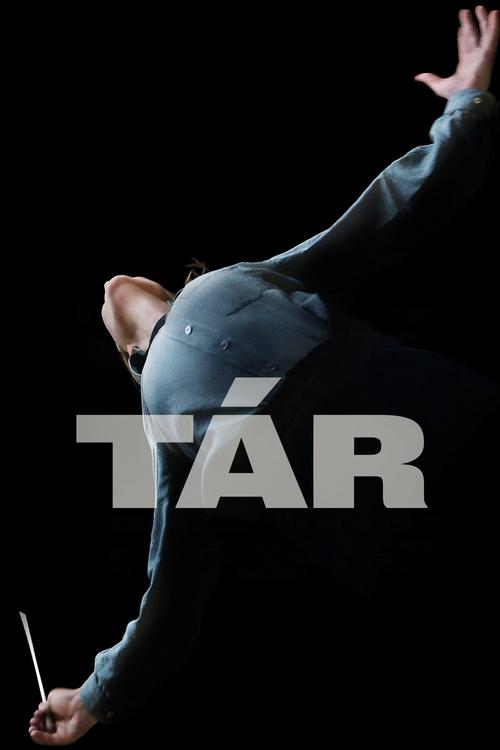
TÁR
2022 · Todd Field
Tár's Lydia Tár became so real people argued about her as an actual person — "cancel culture film" claims, Cate Blanchett discourse, and Marin Alsop's public objection. The film that launched a thousand seminar arguments.
When you want a film to chew on — something adult, ambiguous and conversation-starting rather than comforting. Best with your full attention and someone to argue with afterward.
What it's about
Lydia Tár is at the summit of classical music — the first woman to lead a major Berlin orchestra, famous, feared, preparing the recording that will crown her career. Then a former protégée's death and old accusations start to surface, and the machinery of prestige that built her begins, very quietly, to turn. It follows her through rehearsals, interviews, apartments and back channels as control slips.
The experience
Cold, precise and hypnotic — a slow-burn character study that plays like a thriller without ever raising its voice. It keeps you off balance about what actually happened, and it lingers; you'll be arguing with yourself about her for days.
Performances
Cate Blanchett is staggering: she conducts, speaks German, dominates rooms, and lets you watch a fortress personality crack by millimeters. It's a full-body impersonation of power itself.
The craft
Todd Field builds long, unbroken scenes — a lecture, an interview, a rehearsal — that play like live performance, and the sound design turns stray noises into instruments of dread. Shot largely in Berlin with a wintry, exacting elegance, it rewards good speakers as much as any concert film.
Why it matters
It became the movie of its moment about power, accountability and cancellation precisely because it refuses to settle the argument, and it marked Field's return after sixteen years as one of the major American directors.
Snapshot
Todd Field's TÁR is a psychological chamber drama in the outer garments of a conductor biopic — a portrait of power, complicity, and institutional collapse rendered through the formal registers of classical music performance. Cate Blanchett plays Lydia Tár, a fictional composite of the great mid-century conductors: the first woman to hold the chief conductorship of the Berlin Philharmonic, an EGOT, author, recording artist, and titan of the orchestral world, now preparing a landmark recording of Mahler's Fifth Symphony. The film chronicles her unraveling as a protégée's suicide and buried accusations begin to surface, but Field withholds almost all direct dramatization of wrongdoing, leaving the viewer in an epistemological position identical to that of Tár's accusers and defenders alike. Shot largely on location in Berlin, scrupulous about the hierarchies and rituals of orchestral culture, TÁR is Field's first film in sixteen years and his most ambitious work.
Industry & production
TÁR was produced by Focus Features and Field's production company, with Blanchett serving as producer alongside Field. The film emerged from a development in which Field wrote the screenplay specifically for Blanchett; the two had discussed the project over several years. Field has spoken about his decision to locate Tár within classical music as a way of examining a world that retains an insular mythology of exceptionalism — one insulated from broader cultural accountability until very recently.
The production shot extensively in Germany, principally Berlin, where institutional orchestral spaces lent the film its professional credibility. Field secured access to genuinely operational concert halls and rehearsal rooms, and Blanchett undertook extended preparation with working conductors, developing sufficient facility to sustain the illusion of fluency through extended close coverage. The degree of her preparation was widely noted; at least one early publicity item treating her as a genuine musician circulated before being corrected, a confusion that functions as an inadvertent advertisement for the film's project of authentic surface.
Sophie Kauer, a young professional cellist rather than an actress, was cast as the ambitious Olga — a piece of casting that deepens the film's blurring of document and fiction. The production also enlisted real orchestra musicians throughout, creating an environment in which the few professional actors are surrounded by people who actually perform the work being depicted.
TÁR opened at the Venice Film Festival in September 2022, where Blanchett received the Volpi Cup for Best Actress. It subsequently swept the major precursor awards for its lead performance and was nominated for six Academy Awards — Best Picture, Best Director, Best Actress, Best Original Screenplay, Best Cinematography, and Best Film Editing — winning none, as the 2023 ceremony was dominated by Everything Everywhere All at Once.
Technology
TÁR was shot digitally, with the tonal gradation and latitude of the ARRI Alexa family supporting the film's cool, desaturated palette. Cinematographer Florian Hoffmeister favored long unbroken takes — some running several minutes — demanding precise choreography between camera, performers, and the large ensemble crowd of the orchestra. Visual effects play no meaningful role; the film's technological investment lies in sound, where capturing live orchestral audio in real acoustic spaces required specialized equipment and close integration with the music department.
The digital intermediate was graded toward cool blues and grays, with the warmer interior of Tár's Berlin apartment serving as occasional counterpoint. Technology throughout is subordinated to the feel of a carefully observed document; the film does not announce its digital nature.
Technique
Cinematography
Hoffmeister's work in TÁR is among the most carefully organized prestige cinematography of the decade. His frames are controlled to the point of severity: Tár is frequently centered and dominant in wide, stable compositions that emphasize her command of space, while her psychological loosening is registered through gradual shifts — she begins to appear less anchored, more observed than observing. The opening sequence, a long interview conducted before a New Yorker Festival audience with real journalist Adam Gopnik, is shot with documentary directness that deliberately courts confusion about whether one is watching a real event or fiction. Blanchett inhabits the role so completely that the verisimilitude functions as a formal overture to the film's sustained inquiry into performance and authenticity.
The conducting scenes required particular choreographic planning: coverage reads as continuous while being assembled from precise angles, each respecting the protocol of the rehearsal room as semi-public professional space. The camera maintains the slight remove of an attentive observer, holding back from the close intimacy that would signal personal allegiance. As Tár's position deteriorates, Field and Hoffmeister begin to use longer focal lengths and shallower depth, compressing space in ways that register her narrowing world without underlining it.
Editing
Monika Willi edited TÁR. Willi is best known as Michael Haneke's primary editor — she cut The White Ribbon (2009) and Amour (2012), among other films — and her sensibility is audible in the film's rhythm. Like Haneke's work, TÁR builds dread through accumulation and through the systematic denial of cathartic release. Scenes run past conventional exit points; the film withholds reaction shots and explanatory cutaways that would conventionally instruct the audience in how to feel. Time is treated as a material with weight. Willi's edit does not rush toward revelation; it circles it.
The shaping of the opening interview is exemplary: material that might function as biographical exposition is assembled into something closer to character installation. The viewer absorbs Tár's vocabulary and the social protocols of her world so fully that subsequent violations of that world register with proportional force.
Mise-en-scène / staging
Field's staging throughout reflects theatrical precision. The apartment Tár shares with her partner Sharon is dressed with the cold geometry of someone who curates her environment as she curates a score — expensive, modern, controlled. The rehearsal hall is treated as a power theater, and Field stages Tár's physical relationship to her orchestra — her position, movement, and deployment of silence — as the continuous performance of authority.
Several scenes unfold without cuts, demanding exact physical choreography from the full cast. A conducting master-class sequence in which Tár demolishes a student's claim that his identity should exempt him from engaging with Bach is shot in a single extended take: Blanchett dominates the frame while the student retreats, and the staging converts an argument about canon and identity into spatial drama, with geography doing the work that editorial insistence would otherwise perform. The scene became one of the most discussed passages of the year, generating disagreement about whether Field endorses or merely dramatizes Tár's position.
Sound
Sound is the film's central formal register, and the sound design is accordingly among the most sophisticated in recent American cinema. The film's immersion in the acoustic culture of orchestral rehearsal — the specific timbre of an ensemble warming up, the micro-corrections of a conductor in mid-session, the difference between a concert hall and a practice room — is extensive and accurate. But sound also functions as an instrument of psychological suggestion: Tár begins to hear things — a child crying in the middle of the night somewhere in her apartment building, intrusive sounds that may be real or guilt-generated — and Field uses these incursions to externalize interior states that Blanchett is not permitted to explain aloud. A metronome recurs as a motif: the impartial measurement of time, indifferent to achievement and approaching like a judgment.
The film's sustained engagement with Mahler's Fifth is itself sonically loaded. The Adagietto — most famously appropriated by Visconti in Death in Venice (1971) — carries sediment of excess, beauty, and premonitory decline that TÁR neither italicizes nor abandons.
Performance
Blanchett's performance has been widely characterized as a career summit, and the characterization holds under scrutiny. She conducts, she speaks German, she inhabits the grandiose self-narration of Tár's public persona so completely that private erosions read as genuine revelation rather than scripted reversal. The performance is technically demanding in its musical dimensions but structurally more interesting in how Blanchett holds the film's fundamental ambiguity: Tár is neither clearly innocent nor clearly guilty, and Blanchett plays the unresolved space between those positions for the entire running time, without softening toward pathos or hardening toward villainy.
Nina Hoss, as Sharon — Tár's partner and the orchestra's concertmaster — brings a restraint formed across decades of German cinema and theater. Her withdrawal carries the weight of someone who has reached a private conclusion before being willing to voice it publicly. Noémie Merlant, as Francesca, Tár's assistant conductor, navigates a role that is largely reactive and largely illegible: we watch Francesca reading the situation and protecting herself, but the terms of her protection are never made explicit.
Narrative & dramatic mode
TÁR operates in the mode of the classical fall narrative — hubris, nemesis, catastrophe — but Field systematically disrupts the satisfactions that structure conventionally provides. The film unfolds in three phases: an extended establishment of Tár at the height of her powers; a middle section in which the past intrudes through emails, accumulating accusations, and the suicide of a former protégée whose history Tár appears to have helped erase; and a third-act collapse. But the alleged abuses are never dramatized. The film proceeds almost entirely by implication and inference: we observe the machinery of manipulation at work in the present — in Tár's management of Olga, in her treatment of Francesca — and extrapolate backward.
This structure places the viewer in epistemological discomfort. We know more than Tár's defenders and perhaps less than her accusers, and Field has resisted authorial interpretation, leaving the film's politics genuinely open. Whether TÁR sympathizes with, satirizes, or maintains analytical neutrality toward its subject became a major site of critical contestation.
Genre & cycle
TÁR belongs to a cycle of prestige character studies about exceptional figures whose power arrangements unravel in an era of institutional accountability. Journalistic treatments of the same cultural moment — Spotlight (2015), She Said (2022) — approach it through documentary modes; TÁR approaches it through the long tradition of the artist-portrait film, in which the question of greatness and the question of harm have historically been kept in separate compartments. The film's formal project is to refuse that separation without adjudicating it.
The film is also part of a smaller cycle engaging with classical music's institutional culture with unusual specificity — a world rarely examined in American cinema at this level of insider detail.
Authorship & method
Todd Field trained as an actor and appears in Eyes Wide Shut (1999) as Nick Nightingale, the pianist at the mysterious orgy — an association critics have noted in connection with the formal precision and slow-building dread Field brings to his own direction. His debut, In the Bedroom (2001), was nominated for five Academy Awards including Best Picture and established him as a filmmaker preoccupied with moral ambiguity, withheld catharsis, and the long weight of decisions. Little Children (2006), adapting Tom Perrotta's novel, continued the pattern: suburban performance, repression, and the gap between interior life and social surface.
The sixteen-year gap between Little Children and TÁR has invited considerable speculation; Field has been uncommunicative about the interval, and several announced projects did not reach production. TÁR reads as the consolidation of a precise artistic disposition. Field wrote the screenplay alone and directed from full creative control; the film bears no visible sign of studio interference or committee compromise.
Hoffmeister, whose prior work spanned European and American productions, found a significantly elevated profile with TÁR. Willi's presence as editor imported to the film a sensibility formed across some of the most controlled and formally demanding European art cinema of the preceding decade — an influence that is structural, not decorative.
Movement / national cinema
TÁR is an American production with European staging and a deliberately international cultural register. Its Berlin setting, German-speaking supporting cast, and editor's formation in Viennese art cinema locate it between American prestige filmmaking and the Central European art-film tradition. This hybridity is not incidental: the world of international orchestral culture is itself European in its institutional center of gravity while American in much of its contemporary recording industry, critical apparatus, and media coverage. Field's film inhabits that tension rather than resolving it.
Era / period
The film is entirely contemporary. It engages directly with the institutional reckonings of the late 2010s and early 2020s: the collapse of figures previously protected by institutional mythology, the role of digital records in surfacing what had been suppressed. Tár's fall is specifically a fall of the accountability era — emails cannot be controlled, the assistant who was pushed out has a paper trail, the dead protégée's history can be assembled from archived fragments. The film's climax involves the literal public surfacing of a video record: evidence that exists not because anyone compiled it to destroy her, but because digital life accumulates indiscriminately.
Themes
The relationship between exceptional art and exceptional power is the film's primary concern. TÁR asks whether the concentration of authority demanded by the conductor's role — the requirement that an orchestra submit to a single interpretive will — is structurally continuous with its abuse. Field does not answer the question. He does not argue that Tár's music is compromised because she is compromised, nor that she is exempt from judgment because the music is great.
Gender complicates the inquiry throughout. Tár is a woman who has ascended to a position historically monopolized by men and has internalized that position's grammar of authority. Her behavior toward subordinates mirrors what she was presumably subjected to on her own ascent; Field depicts her deploying a masculine syntax of power with perfect facility, which makes simple feminist identification or feminist critique both inadequate. The film is genuinely interested in what it means to have achieved equality by mastering the tools of domination.
Memory and guilt operate through the sound design and through past intrusions Tár cannot manage. The metronome, the deadline of the Mahler recording, the accumulating timestamp of digital evidence: time in this film is a hostile force that has been patient.
Reception, canon & influence
TÁR was among the most widely discussed films of 2022 and attracted sustained long-form critical engagement well beyond the awards season. Blanchett's performance was treated almost universally as a benchmark. The film's politics generated genuine disagreement: some critics found Field's refusal to indict Tár evasive or complicit with the logic it depicted; others argued that the withholding was precisely the formal point, and that demanding clear moral resolution would have converted a difficult film into a comfortable one. This disagreement has not settled.
Influences on TÁR are extensive and identifiable across several traditions. The Bergman chamber film — particularly Persona (1966) and The Silence (1963) — informs the film's interest in female psychology and blurred identity. Haneke's social thrillers, especially Caché (2005) and The White Ribbon (2009), contribute the implication of the viewer in the protagonist's guilt, the refusal of catharsis, and the Willi connection makes this influence doubly concrete. Kubrick — particularly Barry Lyndon (1975) and Eyes Wide Shut — is present in the formal control, the institutional ritual, and the sense of characters performing roles within systems that exceed them. Visconti's Death in Venice (1971) is an explicit intertext through the Mahler, and its portrait of an aging artist's aestheticized decline resonates throughout. The American fall narrative from Citizen Kane onward provides structural precedent for the retrospective assembly of a life from its ruins. Chantal Akerman's attention to duration, professional labor, and the body in institutional space is a less-cited but legible influence on the film's patient middle sections.
TÁR's forward influence remains early to assess, as the film is too recent for downstream effects to be fully legible in the record. Its standing as a performance benchmark — Blanchett's work will be referenced for years in discussions of screen acting — seems assured. The film's formal strategy of withholding direct evidence while allowing circumstantial accumulation may influence how subsequent filmmakers approach accountability narratives, offering an alternative to both the exonerating biopic and the denunciatory procedural. Its demonstration that a film about institutional abuse can maintain genuine ambiguity without dishonesty or false balance is the most challenging of its contributions — and the hardest to replicate.
A Deleuzian reading
A conductor's entire art is listening, and so the film does its quietest damage at night.
The full Deleuzian reading of TÁR →
Reception
Critics anointed it instantly — Venice ovations, a Volpi Cup for Blanchett, top of countless 2022 year-end lists — while general audiences handed it a C+ CinemaScore and walked out arguing. A few years on, the divisive chill has mostly settled into consensus: it's routinely cited as one of the defining films of the 2020s.
How TÁR was received, from release to now →
Influences: the films it descends from and the films it influenced
- Persona (1966) — Bergman's strategy of making a dominant woman's psychological unraveling legible through the increasingly destabilized presence of a younger woman provides TÁR's structural template for the Tár–Petra dynamic, and the formal refusal to resolve whose perception anchors the film is the direct inheritance Field applies to his own ambiguous POV slippages.
- Caché (2005) — Editor Monika Willi's formation under Haneke imports Caché's specific grammar of inserting footage the viewer cannot verify as objective or subjective — maintaining guilt as formally unresolvable — which is the same ambiguity engine that runs TÁR's accumulation of off-screen accusations without ever dramatizing the acts directly.
- The White Ribbon (2009) — Haneke's depiction of institutional abuse through a community of complicity — keeping the camera at an even, unblinking distance that refuses to authorize either victim or perpetrator — is the direct model for TÁR's refusal to stage the alleged events, making culpability a matter of atmospheric accumulation rather than dramatic revelation.
- Death in Venice (1971) — Visconti's use of Mahler's Adagietto as an ironic frame for an aging aesthete's self-destruction is TÁR's primary intertext: both films deploy classical music as simultaneously the medium of the protagonist's identity and the evidence of his aestheticized moral failure, and Field's Mahler-conducting conceit is a direct transposition of the Aschenbach figure.
- Barry Lyndon (1975) — Kubrick's formal strategy of staging the protagonist's social performance within visually perfect compositions that implicitly indict rather than celebrate him — the camera's beauty becoming a subtle accusatory gaze — is the visual-moral grammar Field applies to Tár's conducting and public appearances, where Hoffmeister's controlled framing works against the character's self-image.
- Citizen Kane (1941) — Welles's retrospective assembly of a titan's life through institutional traces, subordinate testimony, and documented peak moments — making the protagonist's self-conception visible only as an absence — provides the structural model for TÁR's opening New Yorker interview as the summit from which the film silently measures the fall that follows.
- Jeanne Dielman, 23 quai du Commerce, 1080 Bruxelles (1975) — Akerman's durational filming of female professional labor as character psychology — sustaining the camera on habitual competence long enough that disruption registers as moral rather than narrative event — informs TÁR's extended rehearsal and conducting sequences, which read Tár's authority through her bodily mastery before the mastery begins to fracture.
- Eyes Wide Shut (1999) — Field's direct formation as an actor under Kubrick — playing Nick Nightingale in this film — gave him firsthand exposure to Kubrick's method of deploying institutional ritual and architectural space to render professional identity as a performance sustained against mounting incoherence, the formal strategy that organizes TÁR's Berlin Philharmonic world.
- Phantom Thread (2017) — Both films stage the creative tyrant's authority through long-take dining and workspace sequences where the protagonist's dominance is expressed through blocking and spatial control rather than dialogue, and both sustain the formal question of whether the controlling genius's behavior constitutes aestheticized cruelty or legitimate rigor without resolving it.
- The Power of the Dog (2021) — Campion's use of shallow-focus psychological cinematography to withhold the protagonist's inner life while allowing it to accumulate in the background — reading pathology through what the camera refuses to show rather than what it reveals — is the same formal strategy Field uses to sustain Tár's ambiguity across the film's extended middle section.
- Whiplash (2014) — Chazelle established the music-world rehearsal room as a site of institutional power drama, using camera coverage of the student's straining body to make the mentor's authority spatial and physical; TÁR inherits this blocking grammar while inverting the perspective to follow the conductor, making the students' compliance and fear legible in the room's spatial geometry.
- Inside Llewyn Davis (2013) — Field extends Llewyn Davis's music-film-as-character-study-without-redemptive-arc model: a musician-protagonist whose relationship to their own talent is simultaneously their defining quality and their destruction, rendered through extended performance takes and a structural refusal to deliver the moral resolution the genre convention demands.
- The Zone of Interest (2023) — Glazer extends TÁR's Haneke-derived device of diegetic sound as the primary bearer of what cannot be shown: where Field uses off-screen voices, metronome intrusions, and unseen phone calls to externalize psychological pressure, Glazer uses the same off-screen acoustic grammar to make genocide audible within a domestic soundscape, pushing the technique of the withheld image to its moral extreme.
- Little Children (2006) — Field's own prior film establishes the gap between social performance and interior reality as his central formal concern, using omniscient ironic narration to close the distance that TÁR achieves through camera placement and editing rhythm alone — tracing the evolution from novelistic externalization toward pure cinematic implication.
- First Reformed (2017) — Schrader's deployment of a formally austere European art-film grammar — static framing, durational middle sections, withheld catharsis — to depict an American institution's moral collapse occupies the same American-European hybrid mode TÁR inhabits; both films use Bressonian restraint to sustain moral ambiguity that a conventionally structured narrative would resolve.
- Portrait of a Lady on Fire (2019) — Sciamma's sustained long takes as the primary vehicle for negotiating power between two women — making the dynamic visible in blocking and gaze rather than dialogue — shares TÁR's grammar of the single-take master scene as a space where authority is exercised, contested, and withdrawn without the scene announcing its own stakes.
- After the Hunt (2025) — The defining recent character study of abuse-of-power in an elite arts milieu built around an opaque, possibly-culpable protagonist whose guilt the film withholds and stages through institutional ritual.
- Conclave (2024) — Interior stillness performance — Blanchett, like Fiennes, playing an institution's most powerful representative under mounting pressure — observed in deep focus with deliberate pacing; long takes watching a character conduct institutional ritual while concealing interior collapse.
- Amadeus (1984) — Constructs a film around a conductor's interpretive authority, with music-as-characterization and the dramatized act of rehearsal/composition driving the drama.
- Aattam (2024) — The arts community adjudicating a powerful figure's alleged abuse through reputation and whisper rather than tribunal, dramatizing how creative institutions in the post-MeToo era metabolize accusation.
- The Beloved (2026) — The long unbroken dialogue scene (the Juilliard master class) lets the charismatic artist be brilliant and indefensible within the same take, refusing the cut that would let an audience choose a verdict.
Similar films
- After the Hunt (2025) — influence & lineage · same viewing thread
- The Power of the Dog (2021) — influence & lineage
- The Turin Horse (2011) — shared sensibility
- Last Tango in Paris (1972) — shared sensibility
- The Currents (2025) — shared sensibility
- Black Bag (2025) — shared sensibility
- I'm Not There (2007) — shared sensibility
- The Ice Tower (2025) — shared sensibility
All the films related to TÁR →
Watch it with: curated runs of related films
- Whose Word Counts — A run of contemporary prestige dramas where a single allegation cracks open a career and an institution — watch them near each other to see how differently each answers who we choose to believe.