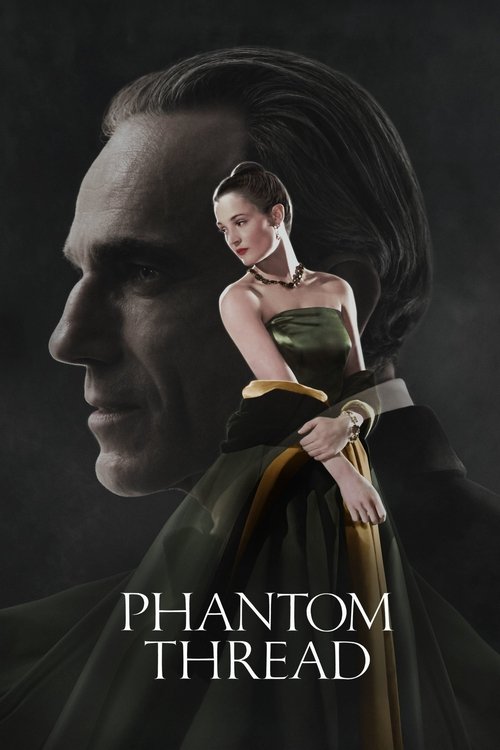
Phantom Thread
2017 · Paul Thomas Anderson
The critics' consensus "greatest living American director" finally made a commercial-scale film with One Battle After Another, instantly triggering debates about its politics, its reported $130M+ budget, and whether the best-reviewed film of 2025 could actually win Best Picture. PTA fandom is a Letterboxd personality type.
For a slow, luxurious evening when you want to sink into beauty and be surprised by how strange it gets — comfort food with a hidden hook.
What it's about
In 1950s London, dressmaker Reynolds Woodcock clothes countesses and heiresses from a townhouse run like a monastery, his routines guarded by his formidable sister Cyril. Then Alma, a young waitress, becomes his model and muse — and refuses to fade away like the companions before her. What follows is a courtship that turns into a quiet, escalating contest over who bends to whom.
The experience
Hushed, sumptuous and wickedly funny in ways that sneak up on you — a slow burn where a breakfast can feel like a duel. It soothes and unnerves at the same time.
Performances
Daniel Day-Lewis, in his announced final screen role, builds Reynolds out of a hundred fussy, precise details; Vicky Krieps matches him beat for beat, which is the film's real shock; Lesley Manville does devastating things with a raised eyebrow.
The craft
Jonny Greenwood's lush piano-and-strings score runs nearly wall to wall and carries half the storytelling, while the camera photographs fabric, breakfast trays and gaslit rooms with a fetishist's care. Gorgeous on a big screen and essential on good speakers.
Why it matters
It sent Day-Lewis into retirement on what many consider one of his finest performances, won the Oscar for its costumes, and confirmed Anderson's late turn toward intimate, needling chamber drama.
Snapshot
A slow-burning psychological drama set in the rarefied world of 1950s London haute couture, Phantom Thread follows Reynolds Woodcock (Daniel Day-Lewis), an exacting and obsessive dressmaker, and Alma (Vicky Krieps), the young woman who becomes his muse, model, and eventual adversary. Their relationship, mediated by Reynolds' imperious sister and business partner Cyril (Lesley Manville), curdles and reconstitutes itself around a shocking act of poisoning that inverts the film's power dynamics entirely. Intimate in scale yet operatic in feeling, the film is Paul Thomas Anderson's most concentrated character study — a chamber piece built from habit, ritual, and the quiet devastation of need. It marks Daniel Day-Lewis's announced final screen performance, lending it an elegiac weight that criticism has not been able to fully separate from the film's own themes of endings and surrender.
Industry & production
Phantom Thread was produced through Annapurna Pictures, the independent production company founded by Megan Ellison, which had already backed Anderson's The Master (2012) and Inherent Vice (2014). It was distributed by Focus Features in North America. The film was made with a relatively modest budget by the standards of major prestige productions, reflecting Anderson's preference — consolidated after There Will Be Blood — for a self-contained, artisanal filmmaking process.
Production took place in England, primarily in London and the Lake District, with the film's central atelier world constructed with the detailed collaboration of the costume design team led by Mark Bridges, who won the Academy Award for Best Costume Design for his work here. Bridges and Anderson researched the period houses of British couture — including the legacy of Norman Hartnell, Hardy Amies, and Charles James — to build the visual and material logic of Woodcock's world. Day-Lewis spent considerable time learning the craft of dressmaking in preparation, consistent with his well-documented approach to character immersion.
The film received six Academy Award nominations including Best Picture, Best Director, Best Actor (Day-Lewis), Best Supporting Actress (Manville), Best Original Score (Jonny Greenwood), and Best Costume Design, winning the latter.
Technology
Anderson shot Phantom Thread himself, operating the camera personally after a long creative partnership with cinematographer Robert Elswit, who had shot seven of his previous features. This represented a significant shift in method — Anderson moving toward a more intimate, physically proximate relationship with his subjects. The film was shot on 35mm film, preserving the grain and tonal warmth appropriate to its period setting and contributing to the organic, almost tactile quality of its images. The decision to work on film in an era of near-universal digital acquisition was not merely nostalgic; it imposes a discipline and commitment to the image that mirrors the dressmaking craft at the film's center. Working with a reduced crew, Anderson achieved an unusual closeness to his actors, particularly evident in the many tight, nearly documentary close-ups of hands, fabric, faces listening at breakfast tables.
Technique
Cinematography
Anderson's self-shot images are marked by restraint and precision — the film rejects the sweeping operatic camera movements of There Will Be Blood in favor of stillness, tightness, and a deliberate narrowing of the visual field. The frame is repeatedly constructed around doorways, mirrors, and the curved architecture of the Woodcock house, creating enclosure and surveillance. Alma is frequently filmed being watched — by Reynolds, by Cyril, by the staff — and the camera participates in this watching without editorializing it. Close-ups dominate: of hands working fabric, of faces registering slight injuries. The film's palette is warm and restricted, dominated by creams, taupes, deep reds, and the dusty greens of the English countryside. Natural light is favored in daylight interiors. The camera often lingers past the moment of dramatic resolution, sitting with characters in the aftermath of exchanges rather than cutting away — a Bressonian patience with duration.
Editing
Edited by Dylan Tichenor, Anderson's longtime collaborator (their partnership spans Boogie Nights, Magnolia, There Will Be Blood, and The Master), Phantom Thread moves at a measured, deliberate pace that initially appears to refuse conventional narrative propulsion. Tichenor's work here is invisible in the best sense — the film feels not cut but grown. Elliptical time passes between scenes without announcement. Scenes end before their social moment is fully resolved. The editing builds an atmosphere of controlled accumulation that mirrors Reynolds' own compulsive ordering of the world, so that when disorder enters — Alma's mushroom soup, Reynolds' fevers — the rupture is felt as a formal shock as much as a narrative one.
Mise-en-scène / staging
The Woodcock house and atelier operate as a pressure cooker of established ritual. Anderson's staging makes physical space carry psychological meaning: who enters the breakfast room first, who speaks, who is silenced, who sits at the table's head. The atelier itself is hierarchical — female workers moving in practiced choreography beneath Reynolds' governance. Anderson builds this world with such specificity that any deviation from its order (Alma buttering her toast too loudly, the asparagus scraped against a plate) becomes a form of transgression. The film's most effective staging involves proximity and distance between Reynolds and Alma — the way they orbit each other in rooms, touch and retreat, establish and violate domestic boundaries. The recurring image of the fitting — Reynolds kneeling before a woman to adjust a hemline — carries an almost sacramental weight, and its reversal in the film's final act is the narrative's moral argument made spatial.
Sound
The film's sound design is among its most remarked-upon technical achievements. Reynolds is established early as a man of pathological sensory sensitivity, and the sound mix exaggerates the diegetic world accordingly: the scrape of a knife on toast is amplified to an almost violent intrusion; the crinkle of a cellophane package becomes unbearable; the clatter of breakfast cutlery an assault. This heightened auditory environment places the viewer inside Reynolds' hypersensitivity, making Alma's early transgressions feel genuinely threatening to his equilibrium before we understand what she is. Jonny Greenwood's score — chamber-orchestral, romantic, more conventionally lyrical than his work on There Will Be Blood or The Master — weaves in and out of these diegetic textures, sometimes giving the household rituals a waltz-like formality that tips into the uncanny.
Performance
Vicky Krieps is the film's great revelation — a newcomer to Hollywood prestige production who holds her own against, and ultimately overwhelms, Daniel Day-Lewis's formidable presence. Her Alma is not passive or victimized; she is a woman learning a game and deciding to change its rules. Krieps plays intelligence and calculation beneath an exterior of apparent simplicity, and the film's entire argument rests on this ambiguity being sustained without recourse to obvious signaling. Day-Lewis's Reynolds is an act of immense technical precision — the posture, accent, the way he handles fabric, the register shifts between command and wounded boyishness — but it is finally in service of a character whose frailty Krieps' Alma knows better than he does. Lesley Manville brings an entire tradition of British stage performance to Cyril: controlled, devastatingly understated, every line delivered from a position of absolute certainty. Her silence often carries more than the dialogue.
Narrative & dramatic mode
Phantom Thread belongs to a tradition of psychological realism in which the central drama is not external action but the slow revelation of interior power relations. Its plot — dressmaker meets waitress, installs her in his life as muse, is gradually outmaneuvered and remade by her — could be summarized in a sentence, but the film's architecture is one of accumulation and subtle reversal. The poisoning plot, when it arrives, does not read as thriller but as a logical extension of the domestic war already waged in the film's first hour. Anderson is interested in the erotics of dependency — in how care and control, vulnerability and domination, become indistinguishable within an intimate relationship. The narrative resolves not in conventional terms of victory or defeat but in a kind of mutual binding: Reynolds asks, in his fever, to be married, and the film ends in a strange, suspended homeostasis that is neither triumph nor tragedy but something more disquieting.
Genre & cycle
The film operates most clearly within the tradition of the gothic romance — the brooding house, the controlling man, the young woman who must navigate or be destroyed by it — updated and inverted. Its ancestors are du Maurier's Rebecca and Hitchcock's adaptation, whose architectural psychology and housekeeper-as-guardian dynamic Anderson consciously cites in the figure of Cyril. But Anderson reverses the gothic's usual power arrangement: here the woman is not undone by the house; she learns to haunt it on her own terms. The film also participates in the mid-century prestige melodrama cycle — the tradition of Douglas Sirk and Max Ophüls, where the formal elegance of mise-en-scène is precisely the instrument of emotional repression, and where what cannot be said is expressed through decor, texture, and costume. Its closest American contemporary is the work of Todd Haynes, particularly Far from Heaven (2002) and Carol (2015), which similarly rehabilitate the period melodrama as a vehicle for analyzing desire and social constraint.
Authorship & method
Paul Thomas Anderson, writing and directing, works here in a register of compression unusual in his filmography — this is his most intimate, least sprawling film. Where There Will Be Blood and The Master moved across landscapes and decades, Phantom Thread is almost entirely interior. Anderson's script began from his own experience of illness and dependency, which grounds the film's emotional logic in something more personal than research. He has described the dressmaking world as a vehicle for exploring the artist's need for control and the inevitable disruption of love, though the record of his specific statements is not extensive enough to quote with confidence here.
Jonny Greenwood's score is central to the film's tonal identity, his fourth collaboration with Anderson after There Will Be Blood, The Master, and Inherent Vice. For Phantom Thread, Greenwood abandoned the dissonant, percussive textures of his earlier work with Anderson in favor of chamber music and romantic orchestration in the tradition of British mid-century composers — William Walton, Malcolm Arnold — appropriate to both the period and the film's operatic emotional terrain. The compositions carry genuine thematic development, functioning not as atmospheric wash but as an interior commentary on the characters' emotional states. Greenwood's score was nominated for the Academy Award for Best Original Score.
Mark Bridges as costume designer was not merely a period-accuracy technician but a creative collaborator whose garments function as character argument — Woodcock's dresses are the physical expression of his will, and the film's visual history of their construction and wearing is a moral diagram of the relationship.
Movement / national cinema
Phantom Thread occupies an unusual position: it is American independent cinema (Annapurna, PTA as auteur) set entirely within British cultural history, with a predominantly British cast and a production embedded in British period detail. It is not, strictly, a British film — though it benefits from British craft expertise in costume, production design, and performance. Its sensibility is transatlantic: Anderson brings an American art-cinema directness and formal ambition to material that draws on British literary and cinematic conventions (the gothic, the country house, the repressive drawing room drama). The film's relationship to the British national cinema tradition is thus one of informed, affectionate estrangement — an outsider's rigorous study of a particular world, not an indigenous expression of it. In this it resembles the work of certain American directors working in European genres: Stanley Kubrick's Barry Lyndon is a meaningful comparison in this regard, though the scale and temperature are entirely different.
Era / period
The 1950s setting is not incidental. Post-war Britain — austere, class-stratified, still rationed in its early years — produced a peculiar intensification of the haute couture world as a site of fantasy, luxury, and national prestige. The international dominance of Paris couture had been challenged; British designers like Hartnell and Amies dressed the royal family; fashion operated as a form of cultural recovery. Woodcock's clientele — aristocrats, socialites, European royalty — inhabits a world that is simultaneously real and already disappearing, its codes of dress and decorum giving way to the cultural upheavals of the coming decade. Anderson's period reconstruction acknowledges this twilight quality; the film's world is glamorous and suffocating in equal measure, a hothouse kept artificially alive by wealth and ritual against the cold modern world outside.
Themes
The film's central thematic concern is the negotiation of power within intimate relationships, specifically as mediated by artistic obsession and creative control. Reynolds' dressmaking is an expression of will over matter — he shapes, he constrains, he defines. His relationship to women is similarly structured: they are his material. Alma's counter-maneuver — poisoning as a form of care, manufactured vulnerability as the condition of authentic connection — proposes that real intimacy requires a surrender of control that the artist-narcissist cannot achieve voluntarily. The film thus becomes a study in the psychopathology of the creative temperament, sympathetic without being exculpatory.
Embedded within this is a sustained meditation on domesticity and its rituals — food, dress, morning routine, the regulation of household time — as both a site of comfort and of warfare. Reynolds' hypersensitivity is a refusal to be touched; Alma's cooking is an insistence on it. The title's reference to the practice of seamstresses concealing messages or tokens within garment linings — and Reynolds' own habit of hiding private phrases in the seams of dresses he makes for women he loves — literalizes the film's interest in concealment, intimacy, and the hidden lines of connection between people who cannot speak their need directly.
Reception, canon & influence
Critical reception was strong, with particular attention paid to Krieps' performance as the film's surprising center of gravity, and to Greenwood's score. Some critics found the film cold or deliberately withholding; others located its apparent fastidiousness as the precise formal correlative of its subject. Its reputation has consolidated in the years since release as one of Anderson's most formally controlled achievements, if not his most emotionally immediate.
The film's influences backward are clear: Hitchcock's Rebecca (1940) as the structuring gothic template; the Sirkian and Ophülsian melodrama tradition; the British literary culture of Daphne du Maurier and Henry James; the chamber psychological realism of Ingmar Bergman's late intimate films. Within Anderson's own filmography, it extends the portrait of the driven, obsessive, damaged American (or quasi-American) man that runs through There Will Be Blood and The Master, while narrowing the frame to something almost suffocatingly intimate.
Its forward influence is harder to assess given its relative recency. It has been frequently cited in discussions of films about creative obsession and the power dynamics of muse-artist relationships, and its inversion of the gothic's traditional gender logic — the woman who outmaneuvers rather than succumbs — has been noted as a meaningful contribution to the cycle. What is certain is that Day-Lewis's retirement gives the film an additional canonical weight: as a final statement from one of cinema's most consequential performers, it invites reading not only as a work in itself but as a retrospective on a career devoted, like Reynolds Woodcock, to precision, obsession, and the cultivation of an exacting art.
A Deleuzian reading
Begin with the toast.
The full Deleuzian reading of Phantom Thread →
Reception
Landed in 2017 as 'minor PTA' — admired, chilly, a costume-drama curio with six Oscar nods — but in the Letterboxd era it's climbed to something like consensus late-period masterpiece, endlessly rewatched and quoted.
How Phantom Thread was received, from release to now →
Influences: the films it descends from and the films it influenced
- Rebecca (1940) — Anderson inherits Hitchcock's domestic-gothic threshold architecture — doorways, staircases, and controlled interior rooms used as spatial maps of power — then inverts the gender logic so the woman learns to navigate, and ultimately command, the house designed to contain her.
- Vertigo (1958) — Hitchcock makes the male protagonist's compulsive redesign of a woman's physical appearance — clothing, hair, costume — the film's central dramatic action; Anderson inherits this structure wholesale, substituting dressmaking for makeover as the mechanism of psychological possession.
- All That Heaven Allows (1955) — Sirk's systematic use of mirror reflections, window framings, and architectural enclosure to externalize a character's entrapment within bourgeois domestic ideology is the direct formal precedent for Anderson's enclosure framing throughout the Woodcock household.
- Lola Montès (1955) — Ophüls's tracking camera traces women circumscribed by male spectacle-management who nonetheless persist as enigmatic excess the controlling frame cannot fully contain — the structural precedent for Alma's resistance to being cast as muse rather than subject.
- Pickpocket (1959) — Bresson's isolation of hands and repeated craft-gestures in tight enclosure frames, paired with heightened diegetic sound of objects and surfaces, establishes the formal vocabulary Anderson adopts for the dressmaking sequences as meditations on obsessive precision.
- Scenes from a Marriage (1973) — Bergman compresses marital power into behavioral accumulation — small domestic rituals becoming large psychic events without melodramatic incident — establishing the chamber drama logic Anderson adopts for the two-person psychological architecture of the Woodcock household.
- Barry Lyndon (1975) — Kubrick's deployment of patience — slow zoom, natural-light period compositions, long-held frames — as a formal moral argument establishes the model of period cinematography in which duration and light quality carry psychological meaning without editorial underlining; Anderson's 35mm discipline follows this method.
- Jeanne Dielman, 23, quai du Commerce, 1080 Bruxelles (1975) — Akerman's duration-based filming of domestic ritual — every housekeeping gesture observed in real time without editorial comment — is the formal precedent for Anderson's staging of Woodcock's morning routine as an accumulation of controlled behaviors that slowly reveals pathology.
- The Piano (1993) — Campion's gothic romance where a woman uses her artistic practice as an instrument of covert agency within a controlling domestic arrangement — the craft itself as power rather than submission — directly anticipates Anderson's inversion in which Alma's poisoning converts Woodcock's dressmaking dynamic against him.
- The Master (2012) — Anderson's own immediately preceding film establishes the obsessive male creative authority whose need for disciples is inseparable from a need for self-validation; Phantom Thread compresses The Master's sprawling power dynamics into a two-person domestic chamber at maximum formal and emotional intimacy.
- The Remains of the Day (1993) — Couples repression-under-constraint with craft obsession, the household ordered by ritual and self-denial, emotional subtext carried by silence and a restrained, near-continuous score.
- Girl with a Pearl Earring (2003) — Single-source window light over a master craftsman, with the tactile diegetic sound of fabric and craft standing in for an obsessive, near-silent interior life.
- Portrait of a Lady on Fire (2019) — Sciamma explicitly rewrites the male-artist/female-muse power dynamic using the same formal vocabulary of period enclosure, domestic interiors, and the politics of the gaze — reassigning the controlling look to the woman painter, extending Anderson's gender inversion into an explicitly structural feminist argument.
- Tár (2022) — Field's portrait of a controlling musical genius in a chamber orchestral world adopts the same formal coldness matched to artistic obsession — slow behavioral accumulation toward psychological revelation, an orchestral score functioning as interior commentary rather than atmospheric wash — in deliberate formal dialogue with Anderson's method.
- Good Boy (2026) — Anderson's late reversal, in which poisoning and nursing turn out to be a regimen both parties have consented to, is the acknowledged model for love staged as an unrecognisable practice, down to the breakfast table as the duelling ground.
- The Power of the Dog (2021) — Campion's gothic psychological inversion uses slow 35mm accumulation of behavioral detail building to a retroactive restructuring of all prior power readings — the same formal patience against contemporary editing norms, and the same structural move of concealing the woman's (here the man's) strategic agency until the final act.
- Spencer (2021) — Larraín renders ritualized domestic space as psychological prison through enclosure framing, surveillance architecture, and heightened diegesis of fabrics and cutlery — the woman's refusal of the costume literally prescribed for her by institutional authority mirrors Alma's refusal of Woodcock's design for her body and role.
- The Lighthouse (2019) — Eggers builds a two-person psychological chamber drama in a constrained aspect ratio using 35mm photography, heightened diegetic sound (mechanical rhythm deployed as structural scoring), and ritualized domestic repetition as the formal language of obsession and mutual control — sharing Anderson's Bressonian precision within enclosure.
- Joker (2019) — Mark Bridges, who designed costumes for Phantom Thread, did the same for Joker; his period-specific class-marking through clothing (the precision of Reynolds Woodcock's suits rhymes with Arthur's clown costume as class armor) operates identically in both films, and Greenwood's pre-production compositional method is the direct precedent Guðnadóttir cites.
- Letter from an Unknown Woman (1948) — PTA's long-take romanticism applied to obsessive love and a designed period world, with the gliding camera and leitmotif scoring turning couture interiors into the medium of desire.
- Inherent Vice (2014) — Shares the restrained-camera, 35mm photochemical aesthetic and a Greenwood score that braids original composition into the emotional weather rather than underscoring plot beats.
- Carol (2015) — Shares the Super-16 grain, period-restraint costuming and suppression-indirection performance style, channeling a coded mid-century love affair through couture and the architecture of repression.
- The Devil Wears Prada (2006) — Pushes costume-as-script to its art-cinema extreme, making garment construction the film's central language and the medium of a mentor-protégée power struggle — the same taste-as-power dynamic in couture-atelier form.
- The Taste of Things (2023) — Parallel study of love-through-labor and mortality staged around a master's craft and the ritual meals that sustain it, with understated performance and care expressed through the daily rituals of service and appetite.
- Topsy-Turvy (1999) — An atelier procedural in which the seamstresses' morning ascent of the staircase, the fittings and the hand-stitching carry more screen time than any creative epiphany — art as an industry with payroll, deadlines and difficult clients, exactly Leigh's Savoy.
Similar films
- The Master (2012) — influence & lineage · often watched together
- Vertigo (1958) — influence & lineage · often watched together
- Barry Lyndon (1975) — influence & lineage · often watched together
- Portrait of a Lady on Fire (2019) — influence & lineage · often watched together
- In the Mood for Love (2000) — often watched together
- We Live in Time (2024) — often watched together
- The Elephant Man (1980) — often watched together
- The Handmaiden (2016) — shared sensibility
All the films related to Phantom Thread →