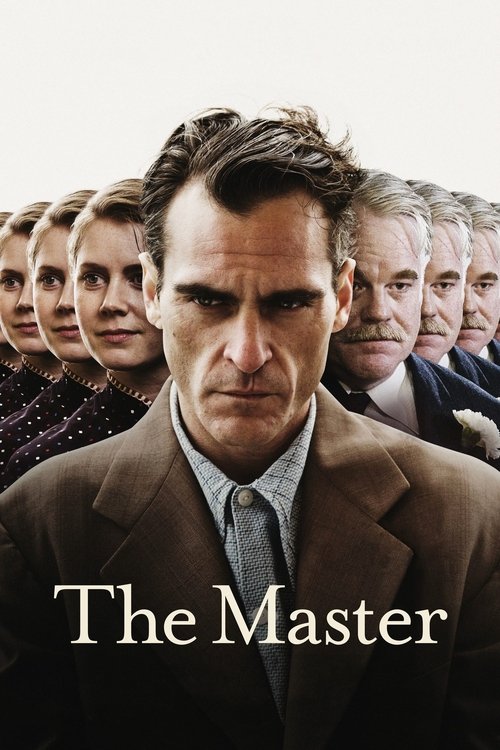
The Master
2012 · Paul Thomas Anderson
For when you want a film to chew on for days and you'd rather be fascinated than entertained. Bring patience — this is challenge, not comfort, and it pays out in scenes you'll never shake.
What it's about
After World War II, Freddie Quell — a Navy veteran running on moonshine, appetite, and untreated trauma — drifts until he stumbles onto the yacht of Lancaster Dodd, the magnetic founder of a new movement called The Cause. What follows is less a story about a cult than about the two men's strange, combustible bond: master and stray, each needing something from the other that neither can name.
The experience
Hypnotic and unresolved — it moves at its own stately pace, then erupts in scenes of almost unbearable intensity between its two leads. It doesn't hand you a verdict; it leaves you turning the relationship over long after it ends.
Performances
Joaquin Phoenix is frightening and pitiable as Freddie, his whole body torqued around some inner wound, while Philip Seymour Hoffman gives Dodd a warmth that keeps curdling into menace; their processing sessions together are acting duels of the highest order. Amy Adams is quietly steely as the true believer at Dodd's side.
The craft
Shot largely on 65mm, it has a depth and grain almost nothing modern matches — faces and postwar interiors rendered with portrait-like weight, worth seeking out on the biggest screen you can. Jonny Greenwood's uneasy score keeps the ground tilting under even the calm scenes.
Why it matters
It confirmed Paul Thomas Anderson as the major American director of his generation, took the directing prize and a shared acting award at Venice, and became a rallying point for keeping large-format film photography alive.
Snapshot
The Master is Paul Thomas Anderson's sixth feature, a postwar American character study built around the magnetic, unstable bond between Freddie Quell (Joaquin Phoenix), a Navy veteran wrecked by drink and inarticulate appetite, and Lancaster Dodd (Philip Seymour Hoffman), the silver-tongued founder of a movement called The Cause. Loosely shadowing the early years of L. Ron Hubbard and Dianetics, the film is less a chronicle of a cult than a study of dominance, devotion, and the impossibility of taming a feral man. It is famous as one of the first narrative features in decades shot largely on 65mm and exhibited in select cities in 70mm — a deliberate act of cinematic preservation-as-provocation. Premiering at Venice, where it took the Silver Lion for direction and a shared acting prize, it confirmed Anderson's standing as the most ambitious American auteur of his generation while dividing audiences with its elliptical, withholding structure. It is a film about a relationship that resolves nothing, and that refusal is its subject.
Industry & production
The Master sits at a pivotal moment in the financing of American art cinema. The picture was bankrolled by Megan Ellison's nascent Annapurna Pictures, the company whose patronage in the early 2010s underwrote a string of director-driven films that the major studios would no longer touch; The Master was among its founding statements. Reported budgets cluster around the low thirty-million-dollar range, though Anderson and his producers have not made precise figures a matter of public record, and I will not invent one. Distribution fell to The Weinstein Company, which platformed the film in 70mm in a handful of theaters before a wider 35mm and digital release.
The project's development is bound up with Anderson's previous film, There Will Be Blood (2007). Anderson had circled the material — postwar America, charismatic authority, a damaged man searching for a father — for years, and elements reportedly germinated alongside that earlier work before crystallizing into a distinct script. The shoot, in 2011, ranged across California and beyond, with locations standing in for the period's ships, sanatoriums, department stores, and desert. Crucially, this was the first Anderson feature not photographed by Robert Elswit, his collaborator since Hard Eight; Elswit's unavailability brought in the Romanian cinematographer Mihai Mălaimare Jr., previously known for late Francis Ford Coppola films. The commercial performance was modest — this was a difficult, austere film sold on prestige rather than spectacle — but its cultural footprint and awards presence far exceeded its returns.
Technology
The film's defining technological gesture is its use of large-format celluloid. The Master was shot predominantly on 65mm negative using Panavision's System 65 cameras, with portions captured on 35mm where the bulk and limitations of the large-format rigs were impractical. At a moment when the industry was completing its migration to digital capture and digital projection, Anderson's insistence on 65mm — and on 70mm release prints for premium engagements — was a conscious counter-current. The choice is counterintuitive: large-format photography is associated historically with landscape, scale, and spectacle (the Ben-Hur and 2001 tradition), yet Anderson and Mălaimare turned its enormous resolution and shallow focal planes inward, onto faces, skin, and the micro-weather of performance. The format renders close-ups with an almost uncanny dimensional clarity, isolating the actors against softened backgrounds. The film thus became a touchstone in the 2010s conversation about photochemical exhibition and the survival of large-format filmmaking, a lineage Anderson, Christopher Nolan, Quentin Tarantino, and a few others would continue to defend.
Technique
Cinematography
Mălaimare's photography is patient, frontal, and unusually still for a film about a man who cannot sit still. The 65mm frame is used for stately compositions — Dodd centered and commanding, Freddie hunched at the edges — and for the hypnotic close-up duels of the "processing" sequences. Color runs warm and saturated in interiors, with period-accurate textiles, dark wood, and lamplight; exteriors carry a postcard glow that flatters the early-1950s setting while quietly satirizing its optimism. The camera frequently holds at a respectful remove, then pushes into faces with a clarity that makes the viewer complicit in the films' interrogations. Where There Will Be Blood had been a film of derricks and horizons, The Master turns the same scrutiny on the human countenance.
Editing
Edited by Leslie Jones and Peter McNulty — again, a departure from Anderson's prior editor — the film is structured as a series of long-held scenes punctuated by abrupt ellipses. Time leaps without announcement; Freddie appears and disappears from Dodd's orbit; whole chapters of "treatment" pass in cuts that withhold cause and effect. The editing favors duration within scenes (the processing exchanges run far past conventional length) and compression between them, a rhythm that mirrors Freddie's own discontinuous consciousness. The result is a narrative that feels both glacial and elusive, denying the audience the satisfactions of progress or cure.
Mise-en-scène / staging
Production design by Jack Fisk and David Crank, with costumes by Mark Bridges, reconstructs the textures of postwar affluence — the department-store sheen, the borrowed yacht, the wood-paneled rooms where Dodd holds court. Anderson stages the central relationship as a series of confinements: ship cabins, jail cells, parlors, a desert. Bodies are arranged to dramatize power — Dodd upright and expansive, Freddie folded and torqued. The recurring motif of the beach, with its crude sand figure of a woman, bookends the film and externalizes Freddie's arrested, animal desire.
Sound
Jonny Greenwood's score — his second feature collaboration with Anderson after There Will Be Blood — is built from dissonant, anxious strings, percussive figures, and intervals that refuse resolution, scoring Freddie's interior agitation more than the plot. Against this, Anderson sets period recordings, most memorably Dodd's late, unaccompanied serenade of "(I'd Like to Get You on a) Slow Boat to China," a moment of tenderness that turns the master-disciple bond unmistakably intimate. The sound design foregrounds the wet, swallowing sounds of Freddie's homemade alcohol and the close grain of breath and voice in the processing scenes.
Performance
The film is, finally, an actors' film. Phoenix's Freddie is a feat of physical transformation: a hunched, lopsided posture, a pinched mouth, a slurred and combustible energy that reads as both comic and frightening. Hoffman counters with expansive warmth and sudden, cornered rage — Dodd is most revealing when challenged, his certainty curdling into bluster. Amy Adams, as Dodd's wife Peggy, supplies the film's coldest and most controlling presence, the true keeper of the doctrine. The three performances are conceived as a triangle of dominance, and their friction is the engine of the picture.
Narrative & dramatic mode
The Master operates in a deliberately anti-dramatic mode. It refuses the rise-and-fall arc of the conventional cult narrative — there is no exposé, no escape, no redemption. Instead it offers a study in repetition: Freddie is processed, rebels, returns, and is processed again, learning nothing and changing little. The dramatic question is not "will the cult be unmasked?" but "can this man be civilized, and at what cost to himself?" The answer is withheld. Anderson structures the film around set-piece encounters — the processing, the desert motorcycle game, the adjacent jail cells — that function less as plot than as variations on a theme of mastery and resistance. The ending, in which Freddie repeats Dodd's interrogation as a seduction, suggests that the only thing he has internalized is the form of control, not its content.
Genre & cycle
Nominally a drama, the film belongs to several overlapping traditions: the American character study, the prestige period film, and a small but potent cycle of movies about charismatic religious entrepreneurs — Elmer Gantry, the revival hucksterism of Anderson's own There Will Be Blood. It also sits within the postwar-trauma film, the lineage of works concerned with the returning veteran's failure to reintegrate. Within Anderson's filmography it forms a loose diptych with There Will Be Blood: two studies of dominant American men and the surrogate sons or rivals who orbit them, both shot in formats and registers of operatic seriousness.
Authorship & method
The Master is a fully authored work: Anderson wrote, directed, and co-produced it, and his fingerprints are on every department. His method here favored long takes that gave the actors room to discover scenes, and a willingness to let structure remain associative rather than mechanical. The key collaborators mark both continuity and rupture. Composer Jonny Greenwood deepened the partnership begun on There Will Be Blood, supplying a modernist score that would become a signature of Anderson's later work. Cinematographer Mihai Mălaimare Jr. stepped in for the absent Robert Elswit and helped realize the 65mm gamble. Editors Leslie Jones and Peter McNulty shaped the elliptical rhythm. Production designers Jack Fisk and David Crank and costume designer Mark Bridges built the period world. Above all, the film is a vehicle for Joaquin Phoenix and Philip Seymour Hoffman, whose collaboration with Anderson — Hoffman had appeared in nearly all of the director's earlier films — gives the central duet its lived-in charge. The Master would prove one of Hoffman's last major roles before his death in 2014.
Movement / national cinema
The film is a product of American auteur cinema in its early-twenty-first-century, independently financed form — the strain of ambitious, director-driven filmmaking that survived the studios' retreat from mid-budget adult drama by relocating to patrons like Annapurna. Anderson is routinely placed in a lineage of American maximalists descending from the New Hollywood of the 1970s — Altman, Scorsese, Kubrick — and The Master wears those debts openly in its formal control and its appetite for the national mythos. It is, specifically, a film about America: about self-invention, salesmanship, and the religions a restless country improvises for itself.
Era / period
Set in the years immediately following the Second World War, the film inhabits a precise historical moment — demobilization, the uneasy prosperity of the late 1940s and early 1950s, and the cultural ferment that produced new therapeutic and spiritual movements. Freddie's PTSD (then unnamed as such) and Dodd's "Cause" are two responses to the same postwar vacuum: one man cannot recover, the other sells recovery. Anderson reportedly steeped the production in period documentation, including John Huston's wartime documentary on traumatized veterans, Let There Be Light — a touchstone for Freddie's condition, though I note the precise extent of its use rests on Anderson's own accounts rather than a documented production record. The film's fidelity to period surfaces is total; its interest is in what the gleaming surfaces fail to heal.
Themes
The film's governing theme is mastery — over others and over the self. Dodd offers Freddie a doctrine of past lives and perfectibility; Freddie offers Dodd a wildness he cannot domesticate and perhaps secretly envies. Their bond shades between father and son, master and dog, lovers and rivals, never settling. Around this core cluster the film's other concerns: the animal versus the civilized man (Dodd repeatedly calls Freddie an animal, and the film keeps asking whether that is an insult or a fact); faith as a technology of control, with Peggy as its true enforcer; the unhealability of trauma; and the American compulsion to reinvent the self through belief. Sexuality runs beneath all of it — sublimated, displaced into the sand woman on the beach, the homemade liquor, the processing questions turned to seduction. The film finally suggests that some men cannot be saved, and that the desire to save them is itself a form of appetite.
Reception, canon & influence
The Master premiered at the Venice Film Festival, where Anderson won the Silver Lion for direction and Phoenix and Hoffman shared the Volpi Cup for best actor — an outcome shaped in part by festival rules limiting how many prizes a single film could take, which became a minor talking point at the time. It received three Academy Award nominations, for Phoenix (Best Actor), Hoffman (Best Supporting Actor), and Adams (Best Supporting Actress), winning none. Critical reception was passionate but genuinely split: admirers hailed it as a masterpiece of performance and form, a film whose withholding was its courage; detractors found it opaque and emotionally remote. That division has softened over time toward consensus admiration, and the film has steadily risen in critical estimation, frequently cited among the major American films of its decade.
The influences on the film are legible: There Will Be Blood's study of American dominance; the postwar trauma documentary tradition (Huston); the religious-charlatan drama; and the formal lineage of Kubrick and Altman in its compositional control and tonal opacity. Its legacy forward is twofold. Industrially, The Master became a rallying point for the defense of large-format and 70mm photochemical filmmaking, part of the argument that helped keep the format alive into the era of Nolan's and Tarantino's large-format releases. Artistically, it deepened the Anderson–Greenwood partnership that would define Inherent Vice and Phantom Thread, and it stands as a model for the contemporary American character study that prizes ambiguity over resolution. Within Anderson's own canon it is increasingly seen as a central work — the film where his interest shifted decisively from plot to the irreducible mystery of two faces locked in a struggle neither can win.
A Deleuzian reading
Start on the beach.
The full Deleuzian reading of The Master →
Reception
In 2012 it split audiences down the middle — rapturous Venice premiere (it took the Silver Lion), then baffled shrugs from moviegoers expecting a Scientology exposé and a shutout in the top Oscar categories. A decade on it routinely tops best-of-the-2010s polls and is many cinephiles' pick for PTA's masterpiece.
How The Master was received, from release to now →
Influences: the films it descends from and the films it influenced
- There Will Be Blood (2007) — Establishes the Anderson–Greenwood method The Master inherits — atonal, sawing string clusters used as psychological pressure rather than underscore — and the dominant-man/acolyte structure that The Master inverts into a stalemated two-hander.
- Barry Lyndon (1975) — Model for The Master's large-format pictorialism: frontal, centered, painterly period compositions held with cool tonal opacity, treating the widescreen frame as a tableau rather than a vehicle for coverage.
- The Shining (1980) — Source of the symmetrical frontal framing and dread-by-duration in confinement spaces — long static holds on a face inside a controlled interior that generate menace without dramatic incident.
- McCabe & Mrs. Miller (1971) — Bequeaths the associative, anti-dramatic structure and atmospheric tonal opacity — scenes that drift rather than build, dialogue mixed as overheard texture — that shapes The Master's elliptical rhythm.
- Let There Be Light (1946) — The postwar-trauma documentary whose psychiatric-processing and word-association interviews of returning veterans are the direct formal template for Dodd's 'processing' and Freddie's Rorschach-style interrogation sequences.
- A Face in the Crowd (1957) — Defines the American charismatic-charlatan study built on a volcanic, Method-driven lead performance — the magnetic demagogue whose authority is pure performed charisma, the lineage Hoffman's Dodd extends.
- Elmer Gantry (1960) — The revival-tent charlatan-religion drama: a showman-preacher selling conviction as spectacle, supplying the genre grammar of the charismatic faith-movement leader that The Master refracts through The Cause.
- Days of Heaven (1978) — Brings production designer Jack Fisk's method — period worlds built as weathered, lived-in physical environments shot for pictorial large-format depth — which Fisk carries directly into The Master's 1950 America.
- Hamlet (1996) — The last major dramatic feature shot in 65mm before The Master; its large-format precedent is exactly the photochemical practice Anderson consciously revived for intimate, non-spectacle subject matter.
- The Deer Hunter (1978) — Extends De Niro/Walken-style two-hander of a controlled center and a dissolving psyche, the damaged returning veteran studied through long behavioral takes.
- Far from Heaven (2002) — Extends the contemporary movement to shoot period drama on photochemical large-format film with precise mid-century color and design as historical authentication, the same commitment to material-era craft Lachman's 35mm work modeled.
- East of Eden (1955) — Phoenix's contorted, behaviorally extreme performance and the surrogate father-son rupture push the Method-as-externalized-conflict tradition Kazan mainstreamed to its furthest edge.
- Inherent Vice (2014) — Extends the Anderson–Greenwood–Phoenix partnership cemented here, carrying forward the associative, anti-dramatic drift and the use of Phoenix's slack physicality as the film's organizing instability.
- Phantom Thread (2017) — Deepens the same dominance-triangle two-hander inside a confined chamber world, with Greenwood's romantic-modernist score doing the emotional work the withheld narrative refuses.
- Dunkirk (2017) — Beneficiary of the large-format advocacy The Master anchored: 65mm/IMAX capture sustained as a living narrative format, keeping the photochemical large-format infrastructure alive into the late 2010s.
- First Man (2018) — Deliberate bifurcation between 65mm large-format photography for grand/public spaces and smaller-gauge stock for intimacy, establishing the precedent that Sandgren extended when assigning 16mm to cockpit and domestic sequences against 35mm institutional exteriors.
- The Hate U Give (2018) — Mihai Mălaimare Jr.'s controlled, art-cinema compositional palette here is the DP pedigree he imports to THUG's two-world Garden Heights/Williamson color separation.
- Good Boy (2026) — The processing scenes — a feral young man and a householder-therapist locked in a fixed two-shot while an invented curative discipline is repeated until it acquires authority — are the model for the film's session structure.
- The Hateful Eight (2015) — Part of the 70mm photochemical revival The Master rallied — an Ultra Panavision roadshow that, like The Master, deploys large-format width for confined, dialogue-bound interiors rather than landscape spectacle.
- The Lighthouse (2019) — The same two-men-locked-in-a-power-struggle that neither can win, staged in extreme confinement with anti-dramatic repetition and intimate held close-ups on warring faces.
- First Reformed (2017) — Frontal, static, austere composition and a charismatic-religion crisis told through withheld resolution — ambiguity prized over catharsis, the same refusal-of-closure that defines The Master's form.
- The Tree of Life (2011) — Contemporary large-format American art film built on elliptical, associative montage and Jack Fisk's design hand, prizing irreducible mystery over plot in the same register The Master adopts.
- The Dark Knight Rises (2012) — Anderson simultaneously championed large-format photochemical capture against industry digitization — Mihai Malaimare Jr. shot in 65mm — making the same artistic argument Nolan was making: that film grain and anamorphic lens behavior carry affective information digital sensors cannot reproduce, warranting theatrical exhibition in a format most cinemas had abandoned.
- One Battle After Another (2025) — 65mm long-take cinematography requiring actors to maintain full sustained arcs without editorial relief — the confrontation scenes between Phoenix and Hoffman recorded in single uninterrupted takes — establishes the performance-under-long-take methodology that OBAA applies to its father-daughter improvisational sequences.
- Shame (2011) — Built around a physically contorted, exposed lead performance watched in long, large-format takes that observe the body's compulsion without psychologizing it.
- The Brutalist (2024) — Large-format 65/70mm photography of a postwar-America drifter absorbed and deformed by a charismatic benefactor, built on a controlled, depleted central performance of suppressed damage.
- Eddington (2025) — The simmering, physically-coiled damaged-American-male performance Phoenix refined here — the controlled volatility Aster casts him for as the aggrieved sheriff.
- Capote (2005) — Builds on the Hoffman character-study mode Capote canonized — exposition stripped away, meaning carried by performed behavior in anamorphic long takes.
- The Iron Claw (2023) — Parallel study of a charismatic, controlling authority and the intimate system built around him, using chamber-drama intensity and physical performance rather than plot to render domination.
Similar films
- The Tree of Life (2011) — influence & lineage · often watched together
- Phantom Thread (2017) — influence & lineage · often watched together
- Inherent Vice (2014) — influence & lineage
- There Will Be Blood (2007) — influence & lineage
- The Lighthouse (2019) — influence & lineage
- The Shining (1980) — influence & lineage · often watched together
- Barry Lyndon (1975) — influence & lineage · often watched together
- The Hunt (2012) — often watched together
All the films related to The Master →