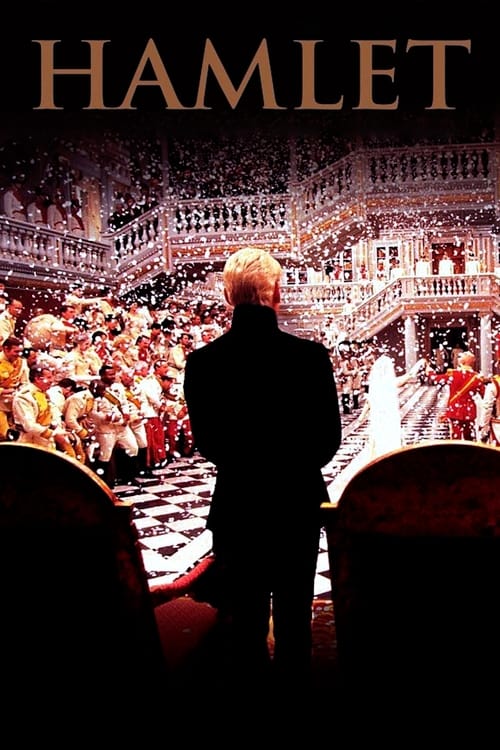
Hamlet
1996 · Kenneth Branagh
For when you want to give a whole evening to something monumental — the theater-lover's event watch, or the best possible way to finally experience the full play. A commitment, and a rewarding one.
What it's about
The Prince of Denmark comes home to find his father dead, his uncle on the throne, and his mother already remarried — to the uncle. When his father's ghost names the new king a murderer, Hamlet turns his grief into a dangerous game of feigned madness inside a glittering court, while a foreign army gathers at the borders. This is the complete play, every line intact, staged as a four-hour epic.
The experience
Grand, propulsive, and surprisingly swift for its length — Branagh plays the tragedy at full boil, with the intrigue of a political thriller and the scale of a war movie. It's the marathon version, but it moves.
Performances
Branagh delivers the role at ferocious pitch, tearing through the soliloquies with unusual clarity and speed, while Derek Jacobi makes Claudius genuinely formidable and Kate Winslet brings raw, wrenching feeling to Ophelia. The deep bench of famous faces in small roles is part of the spectacle.
The craft
Shot in 65mm — one of the last films of its era to be — it turns Elsinore into a snowbound nineteenth-century palace of mirrors and gilt, all long unbroken takes gliding through vast halls. The scale is the argument: Shakespeare mounted with the sweep of a Hollywood epic, and it rewards the biggest screen you can manage.
Why it matters
The first film ever to present Shakespeare's longest play uncut, it stands as the peak of Branagh's 1990s campaign to make Shakespeare popular cinema and remains the reference version for the complete text.
Snapshot
Kenneth Branagh's Hamlet is the first film to present Shakespeare's longest play in its entirety — a conflation of the Second Quarto and First Folio texts that runs to roughly four hours and leaves not a single line unspoken. It is the most extravagant gesture in Branagh's decade-long campaign to return Shakespeare to the popular cinema, and the most uncompromising: where his Henry V (1989) and Much Ado About Nothing (1993) had trimmed and popularized, Hamlet insists on totality, daring a mainstream audience to sit with the complete tragedy in a single epic span. Branagh relocates the action from a medieval Elsinore to a glittering nineteenth-century court — a snowbound palace of mirrors and gilt, suggestive of imperial Europe on the eve of dissolution — and stages it on the largest possible canvas, shot in 65mm to give the verse the visual scale of a Hollywood spectacle. He plays the Prince himself, surrounding the role with an ensemble that mixes classical British stage royalty (Derek Jacobi, Julie Christie, Richard Briers) with a deliberately startling roster of international film stars and cameo players (Kate Winslet, Jack Lemmon, Robin Williams, Billy Crystal, Charlton Heston, Gérard Depardieu). The result is at once a scholarly act of textual fidelity and a populist piece of showmanship, a film whose ambition — to be the definitive screen Hamlet — is inseparable from its excess. Critically admired more than commercially successful, it remains the benchmark for the complete-text approach and a singular monument in the history of Shakespeare on film.
Industry & production
Hamlet was produced by Castle Rock Entertainment and released through Columbia Pictures, with David Barron producing and Branagh's longtime collaborators drawn from the orbit of his former Renaissance Theatre Company. By 1996 Branagh had established himself, through Henry V and Much Ado About Nothing, as the most bankable Shakespearean filmmaker of his generation, and the commercial logic of those successes — accessible, star-driven, handsomely mounted Shakespeare — underwrote the studio's willingness to finance a four-hour adaptation of the complete text. That decision was, by any conventional measure, a considerable gamble: a full-length Hamlet had no theatrical precedent, and its running time sharply limited the number of daily screenings any cinema could schedule.
The production was mounted at Shepperton Studios outside London, where the principal interior — a vast hall lined with two-way mirrored doors — was constructed, with exteriors filmed at Blenheim Palace in Oxfordshire, whose baroque grandeur supplied the imposing façade of Branagh's imagined Elsinore. The shoot took place over the winter, the snowbound setting becoming integral to the film's visual scheme. To manage the commercial risk of the length, the production prepared a substantially shortened version (around two and a half hours) for territories and exhibitors unwilling to program the full cut; the complete four-hour version is, however, the film as Branagh conceived it and the one on which its reputation rests.
Casting was itself a production strategy. Branagh assembled a cast that juxtaposed seasoned classical actors with film celebrities in roles large and small, a method that generated publicity and reflected a genuine conviction that famous faces could draw a wider audience to Shakespeare. The stunt casting of comic and Hollywood stars in minor parts — Williams, Crystal, Lemmon, Heston, Depardieu, Richard Attenborough — was much remarked upon, sometimes admiringly and sometimes skeptically, and it remains one of the film's most discussed features.
Technology
The film's defining technical decision was Branagh's choice to shoot in 65mm, using large-format Panavision photography of a kind that had become rare in mainstream filmmaking by the mid-1990s. The format — associated historically with the roadshow epics of the 1950s and 1960s — was a pointed aesthetic and rhetorical choice: it lent the intimate, interior drama of Hamlet the sweep and resolution of an event picture, and it allowed Branagh to fill the wide frame with the architectural detail of Blenheim and the mirrored hall without sacrificing clarity. The large negative captures fine texture and depth across the broad ensemble compositions the film favors. In an era increasingly oriented toward smaller formats and the beginnings of digital postproduction, Hamlet's commitment to 65mm was a deliberate throwback, aligning the project with the tradition of cinema as grand spectacle. Beyond the format, the film makes no claim to technological novelty; its means are those of classical photochemical production deployed at maximum scale, in service of grandeur rather than innovation.
Technique
Cinematography
The cinematography is by Alex Thomson, a veteran British cameraman whose widescreen compositions exploit the 65mm frame for both breadth and the long, unbroken take. The film's most characteristic device is the extended Steadicam and tracking shot: the camera follows characters in sustained motion through the mirrored hall and the corridors of the palace, the moving long take substituting for the cut and allowing scenes of dialogue to unfold in continuous, theatrically charged real time. The mirrored set is central to this strategy — its reflective surfaces multiply the figures, complicate the spatial geometry, and supply the famous staging of "To be or not to be," delivered by Hamlet to his own reflection while Claudius and Polonius watch from behind the two-way glass. The palette is dominated by the cool brilliance of the white-and-gold interior and the snow beyond, a high-key splendor that contrasts pointedly with the rot at the play's moral center; the climactic descent into violence and the army's incursion break this gleaming order. Thomson's lighting keeps the broad ensemble legible within the wide frame, favoring an open, fully illuminated court over noirish shadow — a visual rhetoric of magnificence rather than gloom.
Editing
The editing, by Neil Farrell, faces the structural challenge peculiar to this Hamlet: sustaining momentum across a four-hour, complete-text adaptation in which no speech is cut. The film's rhythm is necessarily expansive, and the editing works with Thomson's long takes rather than against them, allowing the camera's movement to carry passages that a more conventional adaptation would have broken up or shortened. Where Branagh seeks to open out the verse, the editing intercuts the spoken text with illustrative visual material — flashbacks and dramatized images that render reported or remembered action on screen (the relationship of Hamlet and Ophelia, the slaying of Priam, the figure of Yorick), and, in the latter stages, the steady advance of Fortinbras's army toward Elsinore, cross-cut with the court's intrigues so that the external military threat presses in upon the domestic tragedy. This pictorialization of speech is one of the film's signature and most debated choices, an attempt to give cinematic body to language that the stage leaves to the imagination.
Mise-en-scène / staging
Branagh's staging transposes Elsinore to a richly imagined nineteenth-century court, and the production design by Tim Harvey, with costumes by Alexandra Byrne, builds a coherent world of military full dress, court finery, and imperial architecture — a Ruritanian Europe of monarchy and standing armies whose splendor is shadowed by the prospect of war. The mirrored state hall is the film's governing space and its controlling metaphor: a hall of surveillance and self-regard in which characters are forever watched, doubled, and spied upon, the play's pervasive theme of seeming-versus-being made architectural. The snowbound exteriors and the grandeur of Blenheim establish a court at once magnificent and brittle. Branagh's blocking favors expansive movement through these spaces, the actors traversing long sightlines that the wide frame and the tracking camera exploit. The period transposition is not merely decorative: by setting the play in an age of dynastic monarchy and modern armies, it sharpens the political dimension — the dynastic crisis, the menace of Fortinbras, the militarized state — that more austere stagings can leave muted.
Sound
The score is by Patrick Doyle, Branagh's regular composer since Henry V, whose full-blooded orchestral and choral writing matches the film's epic scale. Doyle's music underscores the tragedy with a romantic sweep consonant with the 65mm grandeur, swelling at the great set-pieces and lending the closing movements a funereal, elegiac weight; the score was among the film's Academy Award nominations. The sound design otherwise serves the primacy of the spoken text — the film is, above all, a vehicle for the complete verse, and its sound is organized to keep Shakespeare's language clear and forward across a large and varied cast of voices. The encroaching military threat is registered sonically as well as visually in the later passages, the noise of the approaching army intruding upon the court.
Performance
The performances span a wide stylistic range, by design. Branagh's own Hamlet is athletic, voluble, and extroverted — a Prince of restless energy and rhetorical command rather than introspective paralysis, his delivery rapid and muscular. Derek Jacobi, himself a celebrated stage Hamlet, plays Claudius as a smooth and plausible statesman whose guilt surfaces only in private; the casting carries a generational resonance, the older Hamlet now the usurping king. Julie Christie's Gertrude is sympathetic and sensual, Kate Winslet's Ophelia — filmed shortly before her international stardom — affecting in her descent into madness, and Richard Briers's Polonius more substantial and less purely comic than the part often allows. Among the supporting and cameo players the registers diverge sharply: Charlton Heston's Player King is widely regarded as one of the film's finest passages, his grand classical manner perfectly suited to the role, while the comic stunt casting — Robin Williams as Osric, Billy Crystal as the gravedigger, Jack Lemmon as Marcellus — drew mixed responses, some finding it enlivening and others distracting. The unevenness is real and is part of the film's character: a deliberate collision of acting traditions held together by Branagh's conviction that Shakespeare can accommodate them all.
Narrative & dramatic mode
The film's dramatic mode is revenge tragedy presented without abridgement, and its fidelity to the complete text is its defining narrative fact. By restoring every scene and subplot — the full political frame of the Norwegian threat, the complete Polonius household, the uncut soliloquies and exchanges — Branagh recovers dimensions of the play that performance tradition routinely cuts, particularly the geopolitical context that frames the private tragedy of the Danish court within a larger drama of states and successions. The decision to dramatize reported and remembered events as inserted images pushes the film toward a more literal, illustrated narration than the stage permits, externalizing the play's interiority. The four-hour span allows the tragedy to develop at full breadth, building the machinery of surveillance, feigned madness, and delayed revenge toward the mass catastrophe of the close, which Branagh stages as a near-operatic convergence of poisoning, swordplay, and military invasion — the dying Hamlet's Denmark passing, in the final image, into Fortinbras's hands.
Genre & cycle
Hamlet belongs to the cycle of mainstream Shakespeare adaptations that flourished in the late 1980s and 1990s, a revival in which Branagh was the central figure. It follows his own Henry V and Much Ado About Nothing and stands alongside contemporaneous Shakespeare films — Franco Zeffirelli's Hamlet (1990) with Mel Gibson, Oliver Parker's Othello (1995, with Branagh as Iago), Baz Luhrmann's Romeo + Juliet (1996), and Branagh's later Love's Labour's Lost (2000) — that together constituted a commercial renaissance for the filmed Bard. Within that cycle, Branagh's Hamlet occupies the maximalist extreme: where Luhrmann radically modernized and compressed, Branagh expanded to completeness, and where Zeffirelli had cut the play to a brisk two hours, Branagh restored every line. It also belongs to the long lineage of screen Hamlets — Laurence Olivier's Oscar-winning 1948 version foremost among them — against which any new adaptation is inevitably measured; Branagh's complete-text epic defines itself explicitly against Olivier's heavily cut, psychologically inward, black-and-white interpretation.
Authorship & method
The film is unmistakably an auteur project, the fullest expression of Branagh's method as actor-director and of his governing belief that Shakespeare belongs in the popular cinema. As adapter, director, and star, Branagh controls the conception at every level, and the complete-text decision is the purest statement of his Shakespearean credo: reverence for the integrity of the language wedded to an aggressively cinematic and star-driven mode of presentation. His method draws on the ensemble culture of his Renaissance Theatre Company and on the collaborators who recur across his films — composer Patrick Doyle above all, whose romantic scoring is integral to the Branagh house style, and production designer Tim Harvey, who realized the mirrored court. Cinematographer Alex Thomson supplied the large-format long takes that distinguish the film visually, and costume designer Alexandra Byrne the nineteenth-century splendor. Branagh's authorship is also evident in the casting philosophy — the mixing of classical actors and film stars — which is at once a populist outreach and a personal conviction about Shakespeare's universality. That same year his affection for the play surfaced obliquely in In the Bleak Midwinter (also released as A Midwinter's Tale), the modest black-and-white comedy he wrote and directed about a ramshackle provincial staging of Hamlet — a companion piece that throws the epic ambition of the feature into relief.
Movement / national cinema
Hamlet is a flagship of the 1990s revival of British Shakespearean cinema, an Anglo-American hybrid financed by a Hollywood studio but realized with British talent, locations, and theatrical tradition. It belongs to a distinctively British line of prestige literary and heritage filmmaking, drawing on the nation's deep reservoir of classically trained stage actors and its centuries-old proprietary relationship with Shakespeare, while depending on American studio capital and the international star system for its scale and reach. Branagh's career exemplifies this transatlantic condition: a Northern Irish-born, British-trained stage actor operating as a Hollywood-financed director-star, mediating between the Royal Shakespeare and Olivier traditions on one side and the commercial imperatives of the American studio on the other. The film stands as perhaps the most ambitious single product of that meeting, the British Shakespearean inheritance mounted with the full resources of Hollywood spectacle.
Era / period
Released at the end of 1996, the film arrived at the high-water mark of the decade's Shakespeare boom and shares its moment with Luhrmann's radically contemporary Romeo + Juliet — the two films representing opposite poles of how the 1990s sought to make Shakespeare cinematically vital. Its nineteenth-century setting locates the drama in an age of dynastic empire and standing armies, a choice that foregrounds the play's politics of succession and war for a modern audience. The film's confidence in the commercial viability of a four-hour, complete-text Shakespeare reflects the particular optimism of its moment, when Branagh's prior successes had seemed to prove an appetite for accessible classical cinema. Its comparatively modest commercial performance, set against its critical esteem, also marks the period's limits: the very completeness that secured its scholarly standing constrained its reach in the marketplace.
Themes
The film foregrounds the play's enduring themes while inflecting them through its specific staging. Surveillance and the gap between seeming and being are made literal in the hall of two-way mirrors, where to watch and be watched, to spy and dissemble, is the court's condition — the mirror that returns Hamlet his own image during "To be or not to be" externalizing the play's interrogation of self-knowledge and self-division. The corruption beneath splendor is dramatized in the contrast between the gleaming white-and-gold court and the moral rot it conceals — the "something rotten" festering within magnificence. The transposition to an age of empire sharpens the political themes of legitimacy, succession, and the relation between the health of the ruler and the health of the state, with the looming army of Fortinbras pressing the question of who shall inherit a poisoned kingdom. Running through all of it are the play's perennial concerns — the obligation and paralysis of revenge, the proximity of madness and feigned madness, mortality and the leveling of death (the graveyard, Yorick's skull), and the corrosive effects of deceit within a family and a court. Branagh's expansive, illustrated approach tends to make these themes explicit and external where other treatments leave them implicit, a choice consonant with his populist aim of clarity.
Reception, canon & influence
Hamlet was received with substantial critical respect, widely admired for its ambition, its textual completeness, and the visual splendor of its 65mm staging, even as some reviewers questioned the four-hour length, the literalizing flashbacks, and the more incongruous celebrity cameos. It earned four Academy Award nominations — for Branagh's adapted screenplay, Patrick Doyle's score, Tim Harvey's art direction, and Alexandra Byrne's costumes — though it won none, and its commercial returns were modest relative to its scale and the prominence of its cast. The critical consensus has settled on it as a flawed but monumental achievement: the definitive complete-text Hamlet on film, indispensable for its fidelity even where its choices divide opinion.
Influences on the film run backward to the long tradition of screen Shakespeare, and above all to Laurence Olivier's 1948 Hamlet, against whose abridged, interior, monochrome interpretation Branagh defined his expansive, complete, full-color epic; to Branagh's own preceding Shakespeare films and the Renaissance Theatre ensemble method behind them; and, in its format and grandeur, to the roadshow tradition of large-format Hollywood spectacle. The nineteenth-century transposition draws on a stage practice of period reimagining well established in modern Shakespearean theater.
Its influence forward lies chiefly in cementing the viability and prestige of the complete-text approach: Branagh's Hamlet stands as the reference point — and often the assigned text — for the proposition that the full play can live on screen, a touchstone in classrooms and in the scholarship of Shakespeare on film. Within Branagh's own career it marked both the apex and a turning point of his Shakespeare cycle, after which his lighter Love's Labour's Lost (2000) found a cooler reception and his Shakespearean output became more occasional. For several of its players — Kate Winslet on the verge of stardom, the classical actors confirmed in their stature — it remains a notable credit. More broadly, it endures as the most complete and most lavish Hamlet the cinema has produced, a film whose very excess guarantees its lasting place in the canon of Shakespearean film.
A Deleuzian reading
Start on the knife and the glass.
The full Deleuzian reading of Hamlet →
Reception
Dismissed by some in 1996 as Branagh's four-hour folly — it barely made back a fraction of its budget — it's since been re-embraced as the definitive full-text Hamlet on film, with its 70mm photography now a major draw at repertory screenings.
How Hamlet was received, from release to now →
Influences: the films it descends from and the films it influenced
- Hamlet (1948) — The deep-focus, monochrome, heavily-cut interior 'Hamlet' whose brooding Freudian abridgement and prowling tracking camera Branagh consciously inverts into a complete-text, high-key, full-color 65mm epic.
- Henry V (1944) — Established the model of the actor-director turning a Shakespeare text into Technicolor roadshow spectacle, the populist-prestige template Branagh adopts and inflates.
- Henry V (1989) — Branagh's own debut applied the Renaissance Theatre ensemble method to film and introduced Patrick Doyle's surging orchestral scoring (the 'Non Nobis' build), the house style carried directly into Hamlet.
- Much Ado About Nothing (1993) — Codified Branagh's casting philosophy of blending RSC-trained classical actors with Hollywood stars for popular reach, the same stunt-casting logic later filling Hamlet's cameo roster.
- Hamlet (1964) — Demonstrated 'Hamlet' as large-scale architectural spectacle with a monumental commissioned symphonic score (Shostakovich), the prestige-scale precedent for Branagh's epic Elsinore and Doyle score.
- Othello (1951) — The auteur actor-director Shakespeare film as personal authorship, where staging and camera become an extension of the star's reading — the model of total control Branagh assumes as adapter-director-lead.
- The Lady from Shanghai (1947) — Its climactic hall-of-mirrors set is the cinematic forebear of Branagh's two-way mirrored court, where doubled reflections literalize the 'seeming-versus-being' theme during 'To be or not to be.'
- Lawrence of Arabia (1962) — The large-format (65/70mm) roadshow epic whose wide-gauge grandeur, overture, and intermission architecture Branagh revives to give a four-hour play the scale of a Hollywood spectacle.
- Doctor Zhivago (1965) — Lean's romantic period epic paired sweeping large-format imagery with a lush recurring Jarre theme, the exact fusion of 19th-century visual splendor and wall-to-wall romantic scoring Branagh and Doyle reproduce.
- Titus (1999) — Extends the lavish period-transposition strategy — relocating a Shakespeare tragedy into an eclectic designed era of costume and architecture — as the engine of cinematic spectacle, following Branagh's 19th-century reframing.
- Hamlet (2000) — A corporate-Manhattan modern-dress 'Hamlet' that defines itself against Branagh's maximalist completeness with radical compression and surveillance-video soliloquies — the anti-thesis only possible after Branagh set the complete-text benchmark.
- Love's Labour's Lost (2000) — Branagh's own follow-up pushed the populist-Shakespeare project further into a 1930s Hollywood-musical transposition, the next (cooler-received) experiment in his star-driven cinematic-Shakespeare method.
- The Hateful Eight (2015) — Revives the 65/70mm roadshow presentation — overture, intermission, large-gauge format applied to a dialogue-dense chamber drama — the same movement-reviving gambit Branagh staged for Hamlet two decades earlier.
- The Master (2012) — The last major dramatic feature shot in 65mm before The Master; its large-format precedent is exactly the photochemical practice Anderson consciously revived for intimate, non-spectacle subject matter.
- Cinderella (2015) — Branagh's large-format (65/70mm) prestige method — the mirrored-hall grand interiors, deep-focus symmetry, and belief that classical construction plus spectacle is its own argument — is the staging grammar of Cinderella's palace.
- Hamlet (1990) — The immediately preceding screen 'Hamlet' that cast a bankable film star (Mel Gibson) in a briskly cut text — the populist, abridged version against which Branagh stakes his complete-text, classically-grounded riposte.
- A Midwinter's Tale (1995) — Branagh's same-period black-and-white comedy about a shoestring provincial 'Hamlet' staging — a deliberate small-scale companion whose modesty foregrounds the feature's epic ambition by inversion.
- Romeo + Juliet (1996) — The other pole of the 1990s Shakespeare revival: same impulse to make Shakespeare mass-market cinema, but via radical cutting, period-transposition to Verona Beach, and MTV montage rather than Branagh's textual fidelity.
- The Merchant of Venice (2004) — The maximalist peak of the same prestige cycle — uncut text, lavish period design, marquee ensemble — against which Radford's leaner, single-performance-driven entry defines itself.
Similar films
- Hamlet (1948) — influence & lineage · same viewing thread · often watched together
- Othello (1951) — influence & lineage · same viewing thread · often watched together
- Henry V (1989) — influence & lineage · same viewing thread
- Hamlet (1964) — influence & lineage · same viewing thread
- Titus (1999) — influence & lineage · same viewing thread
- Lawrence of Arabia (1962) — influence & lineage
- Ran (1985) — same viewing thread · often watched together
- Macbeth (1971) — same viewing thread · often watched together
All the films related to Hamlet →
Watch it with: curated runs of related films
- Shakespeare's Kings and Killers — Watch these near each other and the same machinery keeps turning in new tongues — the murdered king, the usurped crown, the prophecy and the ambition that curdles into slaughter — as Olivier, Welles, Kurosawa, Polanski and Branagh each bend Shakespeare to the screen.