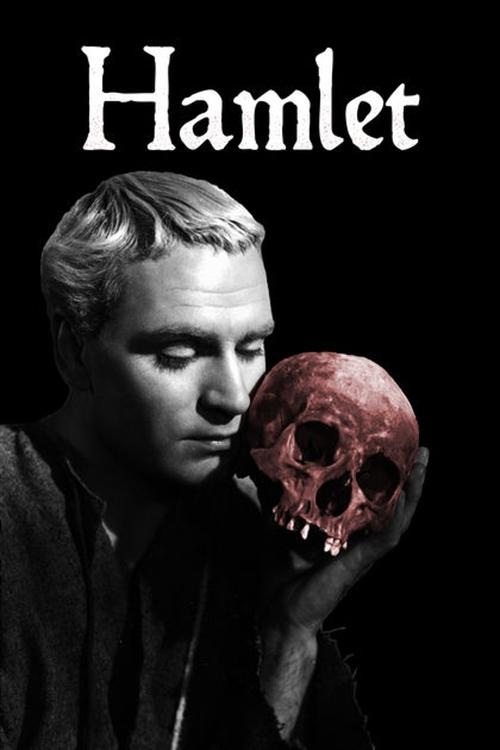
Hamlet
1948 · Laurence Olivier
For a serious, lights-off evening when you want to sink into something grand and melancholy — the cinematic equivalent of the best seat at a great tragedy. A rewarding challenge rather than an easy watch.
What it's about
A prince comes home to find his father dead, his uncle on the throne, and his mother already remarried to the man — and then his father's ghost tells him it was murder. Shakespeare's great tragedy of grief, doubt, and delayed revenge, staged inside a vast, fog-wrapped castle that feels as haunted as the man wandering it.
The experience
Brooding and hypnotic — the camera prowls Elsinore's empty stairways and corridors so the whole film feels like moving through someone's troubled mind. It's slow-burning by design, but the verse lands with startling clarity and the atmosphere gets under your skin.
Performances
Laurence Olivier directs himself in the title role and pulls off both jobs at once — a Hamlet of coiled intelligence and sudden, dangerous energy that won him the Best Actor Oscar for a performance under his own direction.
The craft
Shot in deep-focus black and white, with a depopulated, expressionist Elsinore of bare stone and fog that turns the play inward — this isn't filmed theater, it's the play reimagined for the camera. The gliding camerawork and cavernous sound reward a dark room and full attention.
Why it matters
The first non-Hollywood film ever to win Best Picture, it set the template for how Shakespeare could live on screen and defined the prestige literary adaptation for a generation.
Snapshot
Laurence Olivier's Hamlet is the second of his three Shakespeare features and the one that most fully translated the canonical English stage tradition into a self-consciously cinematic idiom. Made for Two Cities Films within J. Arthur Rank's postwar production empire, it followed the patriotic Technicolor pageant of Henry V (1944) with a deliberately opposite gesture: a black-and-white interior tragedy shot in a depopulated, fog-bound Elsinore that owes as much to expressionist Gothic and to the deep-focus experiments of the early 1940s as to Shakespeare's text. The film became the first British production — and the first non-Hollywood film — to win the Academy Award for Best Picture, and it earned Olivier the Best Actor Oscar for a performance he also directed, a rare double that has shaped its reputation ever since. It is remembered today as much for what it cuts and reframes as for what it preserves: roughly half the play is gone, the text is reorganized around a psychoanalytic reading of the Prince's paralysis, and the soliloquies migrate inward as voiceover. The result is at once a monument of mid-century literary prestige and a genuinely strange, austere film.
Industry & production
Hamlet was produced by Two Cities Films and released in 1948 through the Rank Organisation, with Eagle-Lion handling distribution; Olivier produced as well as directed and starred. It emerged from a specific moment in British cinema: the immediate postwar years when Rank was funding ambitious, internationally minded prestige pictures intended to compete with Hollywood on quality rather than volume. Henry V had proved that Shakespeare could be commercially and critically viable on screen, and Hamlet was conceived as the prestige follow-up — though shot far more cheaply and in monochrome, partly a reflection of postwar austerity and partly an aesthetic choice.
The production was built almost entirely on soundstages at Denham Studios, where Roger Furse's vast, largely abstract Elsinore was constructed: a maze of arches, staircases, and empty corridors rather than a literal castle. The film's accolades concentrated in exactly the craft areas where this studio-bound design showed: alongside Best Picture and Best Actor, it won the Academy Awards for Art Direction (Black-and-White), credited to Roger K. Furse with set decoration by Carmen Dillon, and for Costume Design (Black-and-White), credited to Furse. Jean Simmons, as Ophelia, received a Best Supporting Actress nomination, and Olivier was nominated as director. Internationally the film took the Golden Lion at the 1948 Venice Film Festival. Beyond these well-documented honors, granular production records — budgets, shooting-schedule specifics, day-to-day on-set accounts — are comparatively thin in the popular literature, and I won't reconstruct figures that aren't firmly established.
Technology
The film was shot on black-and-white stock in the standard Academy aspect ratio, a conscious renunciation of the Technicolor that had defined Henry V. The technological story here is less about novel apparatus than about the disciplined exploitation of existing tools: very deep depth of field, achieved through hard lighting and stopped-down lenses, so that foreground and far background remain simultaneously legible; and an unusually mobile camera, mounted on cranes and dollies to glide through Furse's continuous sets. This places Hamlet in dialogue with the deep-focus, long-take vocabulary that Gregg Toland, Orson Welles, and William Wyler had recently pushed to prominence; Olivier and his cinematographer adapted that grammar to a Gothic interior rather than a newspaper magnate's mansion. The soundtrack relied on conventional postwar optical recording, but it was used inventively — particularly in the layering of spoken voiceover over live-action images for the soliloquies, which demanded careful synchronization of an actor's interior "thought" voice with his silent on-screen face.
Technique
Cinematography
Desmond Dickinson photographed the film, and his work is central to its identity. The camera is famously restless: it tracks through arches and up staircases, prowls the battlements, and repeatedly returns to the empty throne and the winding stone of Elsinore, treating the architecture itself as an expression of Hamlet's mind. Deep focus keeps distant figures and looming foreground objects in simultaneous clarity, and the lighting is high-contrast and sculptural, carving faces out of darkness in a manner closer to film noir and to German expressionist Gothic than to the bright pageantry of the earlier Shakespeare film. Recurrent compositional motifs — long perspectival corridors, the sea crashing below the ramparts, the camera craning over the assembled court — give the film a brooding spatial logic in which characters are dwarfed by stone and shadow.
Editing
Helga Cranston edited the film, and the cutting is notably restrained for its era. Olivier favored extended takes and elaborate camera movement over montage, so that scenes often play out in long, choreographed unbroken shots in which the camera, rather than the cut, supplies the dramatic emphasis. This produces a deliberately stagey-yet-fluid rhythm: the editing tends to punctuate rather than drive, reserving sharper cutting for moments of shock such as the ghost's appearances or the climactic duel. The overall effect is of a film that prefers to move through space continuously, mimicking the spectator's wandering attention within Elsinore.
Mise-en-scène / staging
The staging is the film's most discussed achievement. Furse's Elsinore is an abstraction — sparsely furnished, near-deserted, more dreamscape than fortress — and Olivier blocks the action to exploit its verticality and emptiness. Crucial choices register as interpretation: the prominence of Gertrude's curtained bed, lit and framed to underscore the production's Oedipal reading; the placement of "To be or not to be" on the windswept battlements above a churning sea; the use of fog, depth, and isolating space to render Hamlet perpetually alone even within the court. The decision to strip the world of incidental population concentrates attention on the central family triangle and intensifies the sense of a poisoned, claustrophobic household.
Sound
William Walton's score — his second for an Olivier Shakespeare film after Henry V — supplies much of the film's emotional architecture, from the ominous orchestral writing around the ghost to the surging accompaniment of the finale. The most distinctive sound strategy, however, is the treatment of the soliloquies as interior monologue: in several cases the actor's lips are still while we hear his thoughts in voiceover, a technique that frames the speeches as private reflection rather than public address. Diegetic sound is used sparingly and pointedly — footsteps echoing through stone, the boom of the sea, the heartbeat-like effects associated with the ghost — reinforcing the film's atmosphere of isolation.
Performance
Olivier's Hamlet, hair dyed blond, is athletic, melancholic, and ironic by turns, a star turn that nonetheless subordinates itself to the film's psychological thesis. The supporting ensemble is drawn from the strongest British stage talent of the period: Basil Sydney's Claudius, Eileen Herlie's Gertrude (an actor much younger than the play implies, casting that sharpens the Oedipal charge between mother and son), Felix Aylmer's Polonius, Norman Wooland's Horatio, Terence Morgan's Laertes, and Stanley Holloway's gravedigger. Jean Simmons's Ophelia — fragile, luminous, and genuinely young — anchors the tragedy's pathos and earned the film's lone acting nomination beyond Olivier. Smaller roles feature performers who would become significant in their own right, including Peter Cushing as Osric and Anthony Quayle as Marcellus.
Narrative & dramatic mode
Dramatically, the film is a tragedy of paralysis, and it announces that thesis at the outset with Olivier's spoken prologue framing the story as "the tragedy of a man who could not make up his mind." That framing licenses the film's heavy textual surgery. The running text is cut to roughly half the play; entire strands are excised, most consequentially the Rosencrantz-and-Guildenstern subplot and the political-military frame of Fortinbras, which removes Hamlet's external world and turns the play inward toward a domestic, psychological chamber drama. The voiceover soliloquies reinforce this interiorization, positioning the camera and the audience inside Hamlet's consciousness. What remains is a tightly focused study of indecision, grief, sexual disgust, and revenge deferred, organized so that the family — Hamlet, his mother, his uncle-stepfather — occupies the dramatic center almost to the exclusion of the larger Danish state.
Genre & cycle
The film belongs to two overlapping cycles. First, it is part of the mid-century prestige literary adaptation, the genre of the "quality" film in which canonical literature is brought to the screen with conspicuous craft and cultural ambition. Second, and more specifically, it is a key entry in Olivier's own Shakespeare cycle — bracketed by Henry V before it and Richard III (1955) after — which together constituted a sustained postwar British project to claim Shakespeare for cinema. Tonally, however, Hamlet leans on the visual codes of Gothic melodrama and the contemporary noir/expressionist current, distinguishing it sharply from the heraldic, theatrically-framed pageant of Henry V.
Authorship & method
The dossier's clearest authorial signature is Olivier's triple role as producer, director, and star, which gave him unusual control over interpretation. His method here is interventionist and thesis-driven: he treats Shakespeare's text as raw material to be cut, rearranged, and psychologized rather than reverently transcribed. The film's Freudian inflection is widely traced to the psychoanalytic reading of Hamlet associated with Ernest Jones, whose Oedipal interpretation had informed Olivier's earlier stage Hamlet (notably the 1937 Old Vic production directed by Tyrone Guthrie); the film makes that reading explicit through casting and staging. Olivier's key collaborators recur as a near-repertory unit from Henry V: composer William Walton, whose scores lend both films their symphonic gravity, and designer Roger Furse, whose production and costume design here shape the entire visual world. Cinematographer Desmond Dickinson supplied the deep-focus, mobile-camera look, and editor Helga Cranston the long-take rhythm. The authorship is thus genuinely collaborative beneath a strong directorial-star vision.
Movement / national cinema
Hamlet is a landmark of British national cinema in its postwar prime. It exemplifies the Rank-era ambition to produce internationally competitive prestige films rooted in distinctly British cultural capital — chiefly Shakespeare and the English theatrical tradition out of which Olivier and his cast came. At the same time, it absorbs international influences: the deep-focus realism of contemporary American cinema and the chiaroscuro of European expressionism. Its Best Picture win and Venice Golden Lion marked a high point for British cinema's global standing, and it stands alongside the work of figures like Carol Reed and David Lean as evidence of the period's confidence and craft.
Era / period
The film is firmly of the late 1940s — a product of postwar austerity, of a Britain rebuilding and asserting cultural prestige, and of a cinema briefly emboldened to challenge Hollywood. Its monochrome economy, its studio-bound abstraction, and its inward, psychological reading of a canonical text all read as products of that moment, when the heroic public mode of wartime cinema (embodied in Henry V) gave way to more introspective, shadowed, and pessimistic registers. The Freudian framing, too, reflects the mid-century cultural ascendancy of psychoanalysis.
Themes
The dominant themes are indecision and the paralysis of will; grief and mourning, dramatized through Hamlet's inability to move past his father's death; and a charged, near-incestuous preoccupation with the mother, made central by the film's Oedipal staging. Around these cluster the play's enduring concerns: the corruption of the state figured as disease and poison; appearance versus reality and the theatricality of court life; madness, real and feigned, embodied above all in Ophelia's disintegration; and mortality, concentrated in the graveyard sequence and the omnipresence of death. The film's architecture — empty, echoing, shadowed — converts these themes into space, so that Elsinore itself becomes an image of a sick and haunted mind.
Reception, canon & influence
On release the film was a critical and institutional triumph, crowned by four Academy Awards including Best Picture and Best Actor and by the Golden Lion at Venice; its prestige was immediate and international. Critical opinion was not uniform — then and since, some scholars and Shakespeareans have objected to the scale of the textual cuts, to the loss of the play's political dimension, and to the reductiveness of the Oedipal thesis, while others praise the boldness and cinematic intelligence of those very choices. That debate has kept the film alive as a touchstone rather than a museum piece.
Looking backward, the film draws on several lines of influence: Olivier's own stage Hamlet and the Old Vic/Guthrie tradition behind it; Ernest Jones's psychoanalytic criticism; the German expressionist Gothic of shadowed castles and sculptural light; and the contemporaneous deep-focus, long-take cinematography associated with Welles and Toland. Looking forward, Hamlet became the reference point against which subsequent screen Hamlets defined themselves. It demonstrated that Shakespeare could be both award-winning prestige cinema and formally adventurous, helping legitimize the literary film adaptation as a serious mode. Later filmmakers engaged it directly or implicitly — Grigori Kozintsev's expansive Soviet Hamlet (1964), Franco Zeffirelli's more naturalistic version (1990), and especially Kenneth Branagh's full-text Hamlet (1996), conceived in part as an answer to Olivier's radical compression. More broadly, Olivier's triple achievement as producer-director-star of an Oscar-winning Shakespeare film set a template for the actor-auteur's literary adaptation that has echoed through decades of prestige filmmaking. Whatever one makes of its liberties with the text, the film's place in the canon — as the first British and first non-Hollywood Best Picture, and as the most influential mid-century screen Shakespeare — is secure.
A Deleuzian reading
Watch his face on the battlements.
The full Deleuzian reading of Hamlet →
Reception
A triumph in 1948 — it became the first non-American film to win the Best Picture Oscar — but its reputation has settled from 'definitive' to 'a definitive Hamlet of its era': still admired, though later Hamlets (Branagh's full-text 1996 version especially) turned it into a point of comparison rather than the last word.
How Hamlet was received, from release to now →
Influences: the films it descends from and the films it influenced
- Henry V (1944) — Establishes Olivier's producer-director-star method and the near-repertory unit — Walton's symphonic score and Furse's designed visual world — that Hamlet inherits wholesale and turns inward.
- Citizen Kane (1941) — Toland's ceilinged deep-focus and uninterrupted long takes through architectural space are the direct cinematographic model for Dickinson's mobile deep-focus prowl of Elsinore.
- Wuthering Heights (1939) — Gregg Toland's deep-focus Gothic-romantic photography of brooding interiors, married to Olivier's own shadowed leading-man performance, prefigures Hamlet's look and casting.
- The Magnificent Ambersons (1942) — Long-take camera gliding through deep, layered domestic architecture as a way of staging psychological entrapment, a technique Hamlet applies to the staircases and corridors of Elsinore.
- Rebecca (1940) — A restlessly mobile camera roaming a vast, half-empty Gothic house as externalized obsession — Manderley anticipates the abstract, depopulated Elsinore as a projection of a haunted mind.
- The Cabinet of Dr. Caligari (1920) — German Expressionism's abstract, non-realist architecture and distorted painted space supply the model for staging Elsinore as a psychological set rather than a literal castle.
- Nosferatu (1922) — Expressionist chiaroscuro and sculptural shadow-light Gothic — the shadowed staircase and looming silhouette — feed Hamlet's high-contrast lighting of corridors and the Ghost.
- Richard III (1955) — Extends Olivier's thesis-driven textual compression and his signature direct-to-camera soliloquy delivery, now built around the audience-complicit aside rather than interiorized voiceover.
- Throne of Blood (1957) — Reconceives Shakespeare through atmospheric compression and a fog-bound, near-abstract castle, pursuing Olivier's strategy of replacing text with visual-spatial expression of dread.
- The Bad Sleep Well (1960) — Transposes Hamlet's plot of paralyzed revenge into a corporate Elsinore, inheriting Olivier's interpretive license to recast the play as a study of a son consumed by his father's death.
- Hamlet (1964) — A direct response that answers Olivier's claustrophobic studio interiorization with expansive stone-and-sea landscape and a Shostakovich score, defining itself against the 1948 template.
- Hamlet (1990) — A naturalistic riposte that nonetheless preserves Olivier's Oedipal thesis through casting and the closet-scene staging of Gibson and Close, inheriting the Jones-derived reading.
- Hamlet (1996) — Conceived as the full-text rebuttal to Olivier's radical compression, while replicating his producer-director-star actor-auteur model for the prestige Shakespeare film.
- Hamlet (2000) — Carries forward the interiorization of the soliloquy as private voiceover and internal monologue, updating Olivier's device of thought-as-voiceover for a media-saturated modern Elsinore.
- Henry V (1989) — Its deep-focus monochrome chiaroscuro and prowling long-take camera through stone interiors establish the actor-director-adaptor authorship template Branagh consciously assumes.
- Becket (1964) — The prototype 'filmed play' whose authority rests on a single star actor's command of verse rather than distinctly filmic invention — exactly the basis on which Becket was both praised and faulted.
- Haider (2014) — Established the noir, Oedipally charged mother-son axis of Hamlet that Haider inherits in the Ghazala–Haider relationship and Tabu's interiorized performance.
- Macbeth (1971) — Olivier's technique of delivering soliloquy as interior-monologue voiceover over a still, listening face is precisely the device Polanski adopts for 'Is this a dagger' and 'Tomorrow and tomorrow.'
- Macbeth (1948) — Same-year expressionist Shakespeare built on radically abstract studio sets and interior-monologue voiceover for soliloquies, a parallel solution to filming inward thought.
- Ivan the Terrible (1944) — Theatrical-sculptural staging with raking expressionist shadow and cavernous abstract sets, treating a royal court as a stylized arena of psychological menace.
- Chimes at Midnight (1965) — Actor-auteur Shakespeare that aggressively cuts and rearranges the texts into a new dramatic whole, sharing Olivier's view of the plays as raw material to be reshaped cinematically.
- Oliver Twist (1948) — Roger Furse's forced-perspective Elsinore and Desmond Dickinson's deep-focus chiaroscuro, shot on neighboring British stages the same year, share the conviction that scale and light must be authored in a built space rather than discovered on location.
Similar films
- Hamlet (1964) — influence & lineage · same viewing thread · often watched together
- Hamlet (1996) — influence & lineage · same viewing thread · often watched together
- Chimes at Midnight (1965) — influence & lineage · same viewing thread · often watched together
- Throne of Blood (1957) — influence & lineage · same viewing thread
- Rebecca (1940) — influence & lineage · often watched together
- Macbeth (1948) — influence & lineage
- Citizen Kane (1941) — influence & lineage
- Ran (1985) — same viewing thread · often watched together
All the films related to Hamlet →
Watch it with: curated runs of related films
- Shakespeare's Kings and Killers — Watch these near each other and the same machinery keeps turning in new tongues — the murdered king, the usurped crown, the prophecy and the ambition that curdles into slaughter — as Olivier, Welles, Kurosawa, Polanski and Branagh each bend Shakespeare to the screen.