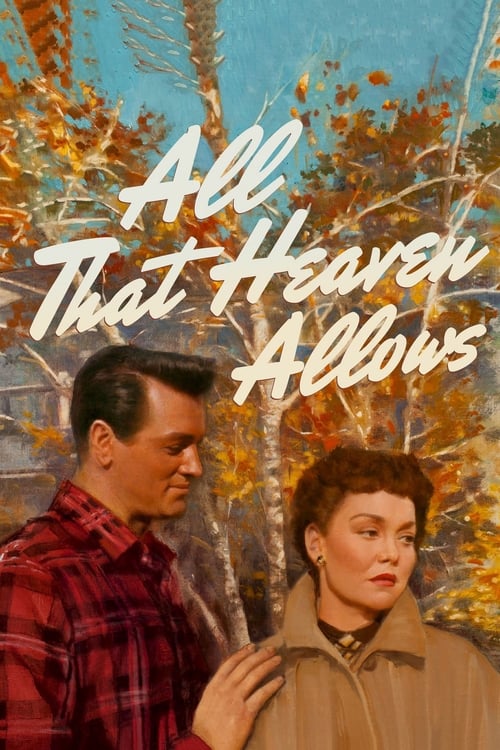
All That Heaven Allows
1955 · Douglas Sirk
For a rainy afternoon when you want a gorgeous old-Hollywood romance you can also chew on — it works as a pure weepie and as something sharper and sadder. Comfort viewing with a hidden edge.
What it's about
Cary Scott, a well-off widow in a picture-perfect New England town, falls in love with Ron Kirby — her gardener, younger, and happily indifferent to the country-club world she lives in. Her grown children and her social circle close ranks against the match, and Cary has to choose between the man and the respectable, comfortable cage everyone insists is her life. A love story that's really about what a town will do to a woman who wants something of her own.
The experience
Lush and swooning on the surface, quietly devastating underneath — it moves at a gentle pace but lands its blows with precision. You feel the ache of every disapproving glance, and the ending leaves a lump in your throat either way you read it.
Performances
Jane Wyman carries the film with a restrained, wounded grace, and Rock Hudson's easy warmth makes you understand exactly what she's risking everything for.
The craft
Douglas Sirk turns Technicolor into commentary: autumn golds, icy blues, and mirror shots that frame Cary inside her own beautiful prison. The production design makes ordinary objects — a television set, a picture window — do the emotional talking. It's ravishing on a big screen, one of the most gorgeously colored films of its decade.
Why it matters
The film that came to define Hollywood melodrama as smuggled social criticism, and a touchstone that later generations of filmmakers have openly remade, quoted, and studied. Its stock has only risen since 1955.
Snapshot
All That Heaven Allows is the film that has come, more than any other, to stand for the Hollywood melodrama as a form of coded social criticism. On its surface it is a Technicolor weepie from Universal-International: Cary Scott, a comfortable widow in a New England commuter town, falls in love with Ron Kirby, her younger gardener, and is punished for it by her grown children and her country-club set. Beneath that surface — and the gap between surface and substance is the film's whole subject — Douglas Sirk constructs a precise, faintly cruel anatomy of postwar American conformity, in which the very objects that promise comfort (the home, the television set, the new car, the propriety of "what people will say") become the instruments of a woman's imprisonment. Reunion of the Jane Wyman–Rock Hudson pairing and the Sirk–Ross Hunter partnership that had made Magnificent Obsession a hit the year before, it was made cheaply and quickly as commercial product. It has since become a cornerstone of auteur and genre study, the acknowledged ancestor of Fassbinder's Ali: Fear Eats the Soul and Todd Haynes's Far from Heaven, and the standard classroom example of how style can speak against story.
Industry & production
The film was produced at Universal-International by Ross Hunter, the studio's specialist in glossy, female-targeted "women's pictures," and directed by Douglas Sirk, then under contract and at the height of his commercial usefulness to the studio. It was conceived explicitly as a follow-up to Magnificent Obsession (1954), the surprise hit that had restored Hudson to leading-man status and given Wyman another vehicle in the maternal-melodrama mode; reuniting the two stars under the same producer-director team was a straightforward studio calculation to repeat a success. Universal in this period ran an efficient assembly-line operation, and Sirk worked within tight schedules and modest budgets, using contract personnel, standing sets, and the studio's Technicolor resources. The screenplay was credited to Peg Fenwick, working from a story by Edna L. and Harry Lee. The production is a good example of mid-1950s studio economics: a relatively inexpensive picture, built around proven stars and a reliable genre, designed to turn a dependable profit rather than to win prestige. Precise budget and box-office figures are not something I can state reliably here, but the film performed well enough within the Hunter melodrama cycle to keep that cycle going through Written on the Wind (1956), The Tarnished Angels (1957), and Imitation of Life (1959).
Technology
All That Heaven Allows was shot in three-strip-era Technicolor (by the mid-1950s, using Eastmancolor negative with Technicolor processing and dye-transfer printing), and color is not incidental but central to its meaning — the saturated palette is the film's primary expressive tool. It was made in the standard Academy ratio rather than in the new widescreen formats then sweeping the industry; CinemaScope and the various competing widescreen systems were transforming the look of A-pictures, but this mid-budget melodrama retained the more intimate, framed-window proportions that suit its domestic-interior subject. The film also makes the consumer technology of its own moment into a dramatic object: the television set offered to Cary as a Christmas substitute for companionship is treated as a piece of period hardware whose novelty and promise the film regards with open irony.
Technique
Cinematography
The photography is by Russell Metty, the Universal contract cinematographer who shot several of Sirk's key films and would later light Spartacus. Metty's work here is the engine of the film's style. Interiors are bathed in pools of artificial color — autumnal oranges and reds, cold blues and lavenders, sickly greens — that have no naturalistic justification and instead register emotional and social states directly. Light is thrown across faces and walls in expressive, theatrical patterns; characters are repeatedly photographed through doorways, windows, banisters, and branches so that the architecture of the bourgeois home becomes a system of bars and frames. The most analyzed single image is the reflection of Cary's face trapped in the dark screen of the new television set, a composition that states the film's thesis in one shot. Metty's camera is generally measured and composed rather than mobile, favoring the held, painterly frame over kinetic movement.
Editing
The cutting, by Frank Gross, is in the classical continuity manner — unobtrusive, scene-driven, subordinate to performance and composition. The film does not call attention to its editing; its meanings are carried in the image and the staging rather than in montage. The rhythm is deliberate, giving the long held compositions room to register, and reserving its emphases for the symbolic insert (the television, the deer, Walden) rather than for accelerated cutting.
Mise-en-scène / staging
This is the level on which the film does most of its work, and the level on which Sirk's reputation rests. Every interior is densely dressed and meaningfully arranged: mirrors that double and fracture characters, picture windows that frame nature as something seen but not entered, staircases that organize the household hierarchy. The art direction (Alexander Golitzen with the Universal team) and set decoration turn the Scott home into a museum of bourgeois respectability, against which Ron's converted old mill — rustic, warm, associated with Thoreau and self-sufficiency — is posed as the alternative. Objects carry argument: the broken Wedgwood teapot that Ron mends, the copy of Thoreau's Walden that articulates his philosophy of principled withdrawal, and above all the television set, which a salesman presents as company and "life's parade" at the touch of a switch and which the film exposes as a coffin for a lonely woman. The recurring deer, appearing at the window in the final shot, is the film's most openly symbolic staging gesture — nature reconciled, but framed and held at a remove.
Sound
The score is by Frank Skinner, a Universal house composer, and it works in the lush, emphatic idiom of the studio melodrama, underlining emotional peaks with full romantic orchestration and recurring themes. Some commentators have heard the music's very lushness as part of the film's irony, swelling so insistently that it presses on the spectator and exposes the machinery of feeling. The film draws on the symbolic use of natural sound and the contrast between the silence of the empty house and the world outside.
Performance
Jane Wyman's Cary is a study in restraint and suppressed feeling: a woman trained to compose her face and manage her desires, whose performance is built from controlled gesture and the small surrender of composure. Rock Hudson's Ron is, by design, more emblem than psychological portrait — the natural man, the embodiment of an alternative set of values — and Hudson plays him with an open, untroubled solidity that the film deploys as much for its iconographic value as for characterization. The supporting cast sharpens the social satire: Agnes Moorehead as Cary's worldly friend Sara, Conrad Nagel as the safe, sexless suitor Harvey, and Gloria Talbott and William Reynolds as the grown children whose self-interested moralism is the cruelest force in the film. The acting style throughout is heightened and frontal in keeping with the melodrama's theatrical roots.
Narrative & dramatic mode
The film is a domestic melodrama in the strict sense: a drama of the home, of family and community, in which the obstacles to happiness are not villains but social codes, internalized expectations, and the disapproval of one's own people. Its plot is deliberately schematic — love, opposition, renunciation, illness, reconciliation — and Sirk does not disguise the contrivance; the famous near-fatal accident that forces the ending, and the deer-at-the-window resolution, are openly the conventions of the genre. What distinguishes the film is the tension Sirk builds between this conventional, even sentimental, narrative machinery and a visual and tonal treatment that holds it at an ironic distance. The "happy ending" is widely read as anything but — Cary wins her gardener only after he is broken and bedridden, her freedom arriving as another form of caretaking. The mode is thus double: a weepie that delivers the emotional goods while quietly indicting the world that made them necessary.
Genre & cycle
All That Heaven Allows sits at the center of the 1950s Hollywood family melodrama, the cycle of Technicolor "women's pictures" produced for a largely female audience and concerned with romance, domesticity, class, and sacrifice. Within that cycle it belongs specifically to the Sirk–Hunter group of Universal melodramas, of which it is the purest and most schematic instance — Magnificent Obsession preceded it, Written on the Wind, The Tarnished Angels, and Imitation of Life followed. The cycle as a whole has been retrospectively reclassified by critics under the heading of the "sophisticated" or "subversive" melodrama, and this film is the prime exhibit for the argument that the genre's apparent conservatism conceals a critique of the society it depicts.
Authorship & method
Douglas Sirk — born Hans Detlef Sierck in Hamburg in 1897 — came to Hollywood with a background in Weimar theater and in German cinema at UFA, having left Germany in the late 1930s. That European, theatrically trained, intellectually formed sensibility is the key to the standard account of his method: working inside the constraints of the studio melodrama, Sirk is understood to have used color, framing, mirrors, and ironic counterpoint to comment on the very stories he was telling, smuggling social critique past the commercial requirements of the form. Sirk himself, in the influential book-length interview Sirk on Sirk (conducted by Jon Halliday, 1971), articulated a sophisticated theory of his own practice — his interest in irony, in the trap of the happy ending, in the gap between what a film says and what it shows — and that self-account did much to shape how the films are read. His key collaborators recur across the cycle: producer Ross Hunter, who supplied the gloss and the commercial frame; cinematographer Russell Metty, who realized the expressive color and light; and composer Frank Skinner. The screenplay by Peg Fenwick is, by the auteurist account, raw material transformed by direction; how much of the film's irony was authored in the script versus the staging is genuinely difficult to apportion from the historical record, and most criticism credits the realized film to Sirk.
Movement / national cinema
The film is a product of the classical Hollywood studio system at its late maturity, but it is routinely read through the lens of its director's European formation — the expressionist lighting and the Brechtian-flavored distancing that critics find in his American work are traced back to his German theatrical and UFA roots. It thus sits at a crossroads between Hollywood genre filmmaking and a transplanted European modernist sensibility. Its later canonization owes much to French and British criticism: the Cahiers du cinéma auteurists, then British critics around the journal Screen in the 1970s, took Sirk seriously when American reviewers had not.
Era / period
All That Heaven Allows is one of the great documents of mid-1950s American suburban culture, and it is impossible to separate from its moment. It addresses, with unusual directness for its time, the postwar cult of domesticity, the policing of women's sexuality and independence, the pressures of conformity and "what the neighbors think," consumer abundance as a substitute for fulfillment, and the loneliness of the widowed woman in a couples' world. The television set, the country club, the station wagon, and the manicured small town are the period's own self-image, which the film turns back on itself as critique.
Themes
The film's central theme is the conflict between individual desire and social conformity — the cost a woman pays for stepping outside her assigned class and role. Around this it organizes a cluster of concerns: class division and snobbery; the policing of female sexuality and the special contempt reserved for an older woman's desire; the family as an instrument of repression, with the grown children enforcing the very codes that imprison their mother; the hollowness of consumer comfort, condensed in the television set; and, against all this, a Thoreauvian ideal of authentic life lived close to nature and apart from society, embodied in Ron and his circle. Nature and the natural — the deer, the mill, the changing seasons, Walden — are posed throughout as the alternative to a deadened social world, though the film's framing keeps that alternative tantalizingly behind glass.
Reception, canon & influence
On release the film was received as what it was made to be — a successful, well-crafted entry in a popular but critically disdained genre. Contemporary American reviewers largely treated Sirk's melodramas as glossy commercial product rather than as serious cinema, and Sirk's reputation in the United States remained low through the end of his Hollywood career.
The reappraisal came from elsewhere. The French Cahiers du cinéma critics admired Sirk during the auteurist 1950s and 60s; the decisive shift came in the late 1960s and 1970s, when the publication of Sirk on Sirk, the advocacy of Andrew Sarris, and especially the British critical work gathered around Screen recast Sirk as a major ironist whose melodramas critiqued bourgeois America from within. Rainer Werner Fassbinder's 1971 essay on six of Sirk's films was a landmark in this reclamation and a direct bridge to the films' creative legacy.
The influences on the film run backward to Sirk's own German theatrical and cinematic formation and to the literary inheritance it openly invokes — Thoreau's Walden as the philosophical counterweight to suburban conformity — and to the established conventions of the Hollywood woman's picture that Sirk inherited and bent.
Its legacy is large and unusually traceable. Fassbinder reworked its premise — the socially scandalous love across a divide of class and age — into Ali: Fear Eats the Soul (1974), among the most direct and celebrated of all homages. Todd Haynes's Far from Heaven (2002) is a meticulous reconstruction of the Sirkian melodrama, drawing extensively on this film's look, palette, and themes while extending its critique to race and sexuality. Pedro Almodóvar's intense, color-saturated melodramas, and the broader serious reconsideration of melodrama in film studies, owe a clear debt to the Sirk reappraisal of which this film is the centerpiece. Today All That Heaven Allows is firmly canonical — a fixture of film curricula, a touchstone for genre and auteur theory alike, and the film most often cited to demonstrate that a Hollywood entertainment can be, at the same time, a precise act of social criticism.
A Deleuzian reading
The salesman wheels it in like a gift of life itself.
The full Deleuzian reading of All That Heaven Allows →
Reception
In 1955 it was filed away as a glossy 'women's weepie' and largely ignored by serious critics; the 1970s Sirk reappraisal — driven by Cahiers du cinéma, academic melodrama studies, and Fassbinder's open adoration — flipped it into one of the most admired American films of its decade.
How All That Heaven Allows was received, from release to now →
Influences: the films it descends from and the films it influenced
- Stella Dallas (1937) — Founding template of the Hollywood woman's-picture maternal-sacrifice melodrama whose convention of the heroine renouncing happiness for social propriety — and the famous window/glass-barrier finale where she watches a life she cannot enter — is exactly the genre grammar Sirk inherited and bent.
- Now, Voyager (1942) — Codified the studio woman's picture's use of a Max Steiner lush-romantic leitmotif score and suppressed-restraint female performance under repression, the melodramatic sound-and-emotion architecture Frank Skinner's scoring and Jane Wyman's containment extend.
- Letter from an Unknown Woman (1948) — Fellow European-émigré director's mobile, framing-through-staircases-and-windows mise-en-scène that traps the woman inside ornate bourgeois interiors as a visual indictment of the milieu — the spatial entrapment Sirk crystallizes in his window and barrier framings.
- Leave Her to Heaven (1945) — Stahl directed the 1934 Imitation of Life and Magnificent Obsession that Sirk remade; this Technicolor melodrama pioneered using saturated three-strip color expressively rather than decoratively in domestic drama, the very palette-as-emotion strategy Russell Metty radicalizes.
- The Magnificent Ambersons (1942) — Sirk inherited the Wellesian grammar of the domestic interior as a social power structure — deep-focus compositions in which class pressure is encoded as architecture, the confined frame trapping characters within visible mechanisms of confinement — extending Ambersons' spatial power blocking into the suburban melodrama register.
- Black Narcissus (1947) — Russell Metty's Technicolor and Sirk's compositional strategy — saturated color, reflective surfaces, windows as psychological frames — directly extends the Powell-Pressburger method of using domestic production design and color as social-psychological notation in women's melodrama.
- A Place in the Sun (1951) — Sirk extends Stevens's class-geometry staging — the practice of placing characters at different planes and heights within the frame to externalize social hierarchy as spatial arrangement — and inherits the tactic of deploying romantic visual excess as social critique rather than endorsement.
- Ali: Fear Eats the Soul (1974) — Direct acknowledged remake transposing the scandalous-love-across-class-and-age premise, reusing the doorway/banister framing-through-barriers and the device of staging characters hemmed in by judging onlookers as overt Brechtian distancing.
- Far from Heaven (2002) — Meticulous reconstruction of this film's exact autumnal Technicolor palette, Metty-style colored lighting and Elmer Bernstein's Skinner-pastiche score, extending the suburban-conformity critique to race and homosexuality.
- Carol (2015) — Haynes's reflection-shot and framing-through-glass-and-rain-streaked-windows grammar, with suppressed-restraint performance and period color design, applies the Sirkian visual-entrapment language to forbidden 1950s desire.
- Women on the Verge of a Nervous Breakdown (1988) — Almodóvar's color-saturated melodrama with theatrically artificial décor and symbolic-object staging openly inherits the Sirk reappraisal's lesson that heightened artifice and irony can carry serious feeling.
- All About My Mother (1999) — Built explicitly on the maternal woman's-picture tradition Sirk anatomized, recycling its emotional excess and self-aware melodramatic structure while foregrounding the genre's constructedness.
- In the Mood for Love (2000) — Christopher Doyle's framing-through-doorways-and-mirrors and lush repeated-leitmotif score render suppressed restraint and unspoken desire through Sirkian mise-en-scène of barriers and reflective surfaces.
- The Marriage of Maria Braun (1979) — Sirk's systematic use of architectural deep-focus entrapment—doors, windows, and television screens framing Cary within domestic space to make patriarchal constraint visually legible—is the compositional template Ballhaus deploys throughout Maria Braun, transposed from critique of American bourgeois conformity to West German economic miracle complicity.
- Blue Velvet (1986) — Lynch inherits Sirk's technique of weaponizing saturated Technicolor against the values it depicts: picture-perfect bourgeois surfaces rendered so beautifully that their artificiality becomes visible as ideology, the visual pleasure indicting the world it celebrates.
- Phantom Thread (2017) — Sirk's systematic use of mirror reflections, window framings, and architectural enclosure to externalize a character's entrapment within bourgeois domestic ideology is the direct formal precedent for Anderson's enclosure framing throughout the Woodcock household.
- Brokeback Mountain (2005) — Established the prestige marriage-melodrama of socially forbidden desire crushed by conformity, the genre grammar Brokeback transposes onto two men.
- Safe (1995) — The affluent-suburban women's melodrama whose excessive mise-en-scène indicts the home it depicts — the genre substrate Haynes coldly dismantles rather than fulfills.
- The Bitter Tears of Petra von Kant (1972) — The explicit model Fassbinder championed: melodrama as social critique, with the heroine framed and imprisoned through window panes, mirrors and décor so that bourgeois furnishing becomes a cage.
- Magnificent Obsession (1954) — Sirk's immediately preceding Ross Hunter/Russell Metty/Rock Hudson–Jane Wyman production that established the team's glossy Technicolor melodrama formula and the iconographic Hudson-Wyman pairing this film reuses and refines.
- Written on the Wind (1956) — Companion Sirk melodrama deploying the same arsenal of symbolic objects, mirror compositions and ironic color-coded décor (autumnal reds/blues) to expose the rot beneath bourgeois wealth, with Metty's expressive lighting at its most baroque.
- Imitation of Life (1959) — Sirk's culminating melodrama that perfects the ironic-undercutting happy/funeral ending and the staircase-and-mirror staging of social hierarchy, the same Brechtian-distancing technique of letting the image contradict the story's consolations.
- All I Desire (1953) — Earlier Sirk woman's picture rehearsing the schematic small-town-conformity-versus-desire structure and the deliberately false, too-neat reconciliation ending he would weaponize as irony.
- Brief Encounter (1945) — Contemporaneous study of renounced love and middle-class respectability built on suppressed-restraint performance and a surging romantic score, sharing the woman's-picture conviction that repression registered in close-up is the genre's true subject.
- There's Always Tomorrow (1956) — Sirk's black-and-white companion piece reusing the suburban-entrapment theme and symbolic-object staging (the toy robot) to dramatize desire suffocated by family conformity, proving the critique was structural not merely chromatic.
- Rebel Without a Cause (1955) — A parallel 1955 color domestic melodrama weaponizing decor and saturated palette to indict suburban conformity and family suffocation — the same Eisenhower critique through mise-en-scène.
- The Hours (2002) — Source of the technique whereby a coded, world-specific color palette and over-lit domestic mise-en-scène externalize a woman's repression — McGarvey color-keys Laura Brown's 1950s strand on exactly this Sirkian logic.
- Volver (2006) — Sirk's coding of emotion through saturated reds and blues as visual signposts is the direct ancestor of Volver's 'saturated-reds' palette used to key desire, blood and shame.
- Tea and Sympathy (1956) — Contemporary use of saturated Technicolor and hostile small-town interiors as ironic subtext, indicting conformity's cruelty toward a nonconforming outsider.
- The Man Without a Past (2002) — Sirk's use of hyper-saturated, artificial color and hard studio lighting to ennoble a socially-mismatched romance is the melodramatic palette Kaurismäki reroutes onto a container-dwelling welder and a Salvation Army worker.
- I Only Want You to Love Me (1976) — The template Fassbinder studied for framing lovers behind windows, banisters and doorframes so that domestic architecture literally cages desire — the threshold-as-prison compositions run straight into this film.
Similar films
- Far from Heaven (2002) — influence & lineage
- Imitation of Life (1959) — influence & lineage
- Written on the Wind (1956) — influence & lineage
- Leave Her to Heaven (1945) — influence & lineage
- Carol (2015) — influence & lineage
- Brief Encounter (1945) — influence & lineage
- The Ghost and Mrs. Muir (1947) — shared sensibility
- Rear Window (1954) — shared sensibility
All the films related to All That Heaven Allows →