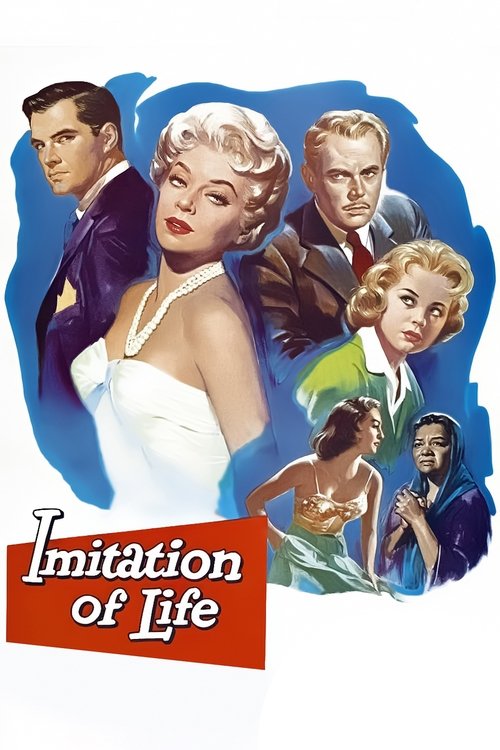
Imitation of Life
1959 · Douglas Sirk
For when you need a good cry and want it delivered in Technicolor gowns — but also when you want a film that gives you plenty to argue about afterward, because its take on race, motherhood, and ambition cuts deeper than the tears. Comfort-food surface, challenging center.
What it's about
A chance meeting on a crowded beach binds two single mothers: a white widow with Broadway ambitions and a Black woman who becomes her live-in housekeeper and closest companion. Over a decade, the film follows both households — the actress's climb to stardom at the cost of her daughter's affection, and the housekeeper's deeper heartbreak as her light-skinned daughter rejects her to pass for white. It's a glossy Hollywood melodrama with a knife inside it.
The experience
Sumptuous, emotionally maximal, and increasingly wrenching — it plays as lush 1950s soap opera while quietly indicting everything its glamorous surface celebrates. Bring tissues: the final stretch is one of the great engineered cries in American movies, and it earns it.
Performances
Juanita Moore and Susan Kohner, both Oscar-nominated as the mother and the daughter who denies her, give the film its soul — Moore's dignity and grief anchor everything. Lana Turner's brittle glamour as the ambitious actress works precisely because the film lets you question her.
The craft
Sirk stages emotion through décor: mirrors, staircases, and saturated color do as much storytelling as the script, turning a weepie into a portrait of American surfaces and what they hide. The famous funeral finale, with Mahalia Jackson singing, is staged with overwhelming scale and remains a landmark of melodramatic craft.
Why it matters
Sirk's final Hollywood film was a massive hit dismissed as soap opera, then rediscovered as one of the most subversive studio films ever made — a founding text for reading melodrama as social critique. Its influence runs through generations of filmmakers who learned that style itself can carry irony and protest.
Snapshot
Imitation of Life is Douglas Sirk's last Hollywood film and the culminating work of the lush, ironic melodramas he made at Universal-International in the 1950s. Produced by Ross Hunter and adapted from Fannie Hurst's 1933 novel — itself already filmed by John M. Stahl in 1934 — the picture braids two mother-daughter stories: Lora Meredith (Lana Turner), a widowed white actress climbing toward Broadway stardom, and Annie Johnson (Juanita Moore), the Black woman who becomes her housekeeper and de facto co-parent, whose light-skinned daughter Sarah Jane (Susan Kohner) passes for white and repudiates her mother in the process. Across roughly a decade of story time, the film sets Lora's professional ascent and emotional neglect of her daughter Susie (Sandra Dee) against Annie's quieter tragedy, resolving in one of the most celebrated funeral sequences in American cinema. Beneath its glossy surface — Technicolor gowns, jewels, a plush suburban idyll — the film mounts a corrosive critique of American success, maternal self-sacrifice, and the racial and class hierarchies that the "imitation" of the title names. It was a major commercial success and, over the decades, has become a touchstone of melodrama studies, feminist and queer film theory, and scholarship on race and passing.
Industry & production
The film was made at Universal-International, the studio where Sirk had spent the decade under contract, and it was shepherded by producer Ross Hunter, whose specialty was glossy, women-centered pictures pitched to a female audience. Hunter and Sirk had already collaborated on the profitable Magnificent Obsession (1954), All That Heaven Allows (1955), and others; Imitation of Life extended that partnership and its house style of high-key glamour, expensive production values, and unapologetic emotional appeal. The property carried built-in commercial logic: Hurst's novel was a proven bestseller, and Stahl's 1934 version — nominated for the Best Picture Oscar — had established the title's box-office pedigree. Remaking it in color, with contemporary stars, was a calculated bet on a durable "woman's picture" formula.
Casting reflected studio strategy. Lana Turner, whose career had recently been shadowed by the 1958 killing of her lover Johnny Stompanato by her daughter Cheryl Crane — a scandal saturating the press at the time of release — was cast as the ambitious actress-mother, a role whose off-screen resonances were impossible for contemporary audiences to ignore. The commercial success of the film is frequently credited with reviving Turner's career, and reporting from the period indicates she took a percentage arrangement on the profits, an unusually favorable deal for a star at that moment. Sandra Dee and John Gavin were rising Universal contract players; Juanita Moore was an established but underused Black actress, and Susan Kohner a young performer of mixed Mexican-Jewish heritage cast as the passing Sarah Jane. The screenplay was credited to Eleanore Griffin and Allan Scott, who substantially altered Hurst's plot — most notably jettisoning the novel's pancake-empire business premise in favor of Lora's theatrical career.
Technology
Imitation of Life was shot in color and released in a standard 1.85:1 widescreen format rather than one of the era's anamorphic processes such as CinemaScope. The choice matters: where CinemaScope's wide frame encouraged horizontal spread, the more contained ratio let Sirk and his cinematographer compose in depth, stacking figures within doorways, mirrors, and staircases. The film exploited the fully mature color technology of the late 1950s — saturated, controllable, and by then a studio norm rather than a novelty — to build the artificial, hyper-designed palette that is central to its meaning. Color here is not decorative realism but a rhetorical instrument: the "imitation" of the title is literalized in surfaces that look almost too rich to be true. In broad technological terms the film is a product of the classical studio apparatus at its most refined; it does not showcase experimental equipment so much as the polished orchestration of established tools.
Technique
Cinematography
The cinematography is by Russell Metty, Sirk's frequent collaborator (and later the Oscar-winning photographer of Spartacus). Metty's work is essential to the film's double register — glamour that curdles into entrapment. Interiors are keyed with pools of colored light and reflective surfaces; characters are repeatedly framed through banisters, windows, and mirrors that fracture and box them. The famous visual motif of the staircase in Lora's home organizes several key scenes, using verticality to map emotional and racial hierarchy within the household. Metty's compositions favor deep space and layered planes, so that a figure in the foreground is often commented upon by another glimpsed behind glass or in a doorway. The result is a surface of extravagant beauty that simultaneously communicates confinement — the signature Sirkian irony achieved largely through the camera.
Editing
The film was cut by Milton Carruth, a veteran Universal editor. The editing is classical and unobtrusive in the Hollywood continuity tradition, prioritizing performance, star close-ups, and emotional legibility over conspicuous montage. Its most discussed structural feature is the film's long arc across years, which the editing manages through elisions that jump the two daughters from childhood to young adulthood and compress Lora's career rise into a series of markers of increasing wealth. The pacing builds deliberately toward the extended funeral sequence, whose measured rhythm — the procession, the church, Mahalia Jackson's performance, Sarah Jane's arrival — gives the finale its cumulative devastating weight.
Mise-en-scène / staging
Mise-en-scène is where Sirk's authorship is most legible and most studied. The film's meaning lives in its décor: the accumulation of luxury objects in Lora's home, the ornate staircase, the profusion of flowers, the color-coordinated costumes that signal status and mood. Sirk repeatedly stages emotional scenes so that the environment ironizes the dialogue — a character professes happiness while the frame, crowded with expensive things, reads as a gilded cage. Objects carry thematic freight: mirrors and reflective surfaces recur around Sarah Jane, whose life is organized around a false image; the visual splendor of Lora's success is set against the modesty of Annie's world. Sirk's staging is famously "distanced" — critics describe it as holding the melodrama at an ironic remove even as it delivers full emotional force, so that the audience both weeps and perceives the social critique embedded in the design.
Sound
The score is by Frank Skinner, a Universal staff composer, and the film is anchored by its title song, "Imitation of Life," with music by Sammy Fain and lyrics by Paul Francis Webster, heard prominently over the credits. The single most powerful use of sound is diegetic: gospel legend Mahalia Jackson's performance of "Trouble of the World" during Annie's funeral, an unadorned musical passage that provides the film's emotional and moral summit. The contrast between Skinner's plush orchestral underscore for the white world of glamour and the spiritual gravity of the funeral music quietly reinforces the film's racial structure.
Performance
The performances operate in the heightened melodramatic register the material demands, but with important gradations. Lana Turner plays Lora in a mode of brittle, self-absorbed glamour that many critics read as knowingly hollow — the star performing stardom. Juanita Moore gives Annie a restrained, dignified interiority that became the film's moral center; Susan Kohner's Sarah Jane is volatile and anguished, her self-loathing dramatized in scenes of confrontation and flight. Sandra Dee and John Gavin fill the more conventional ingénue and leading-man functions. Both Moore and Kohner received Academy Award nominations for Best Supporting Actress — the film's principal awards recognition — and their scenes together, particularly Sarah Jane's rejections of her mother, are routinely cited as the emotional core of the picture.
Narrative & dramatic mode
Structurally the film is a parallel-lives melodrama, cross-cutting two mother-daughter relationships that mirror and comment on each other. Lora's arc is one of worldly ascent purchased at the cost of intimacy: she gains fame and wealth but neglects Susie, eventually competing with her own daughter for the same man. Annie's arc is one of unwavering maternal devotion that goes tragically unreturned: she gives everything to Sarah Jane, who can only accept it by denying her. The dramatic mode is the classical "woman's picture" — organized around domestic space, maternal sacrifice, and emotional excess — but Sirk inflects it with irony so pervasive that scholars debate whether the film endorses or subverts its own tearjerker mechanics. The narrative withholds conventional catharsis where it counts: Sarah Jane's reconciliation comes only at the coffin, too late, converting the melodramatic "happy ending" into an indictment.
Genre & cycle
The film belongs to the domestic melodrama or "woman's film," and more specifically to the cycle of glossy Ross Hunter–produced, Sirk-directed melodramas at Universal in the 1950s. Within that cycle it is the grandest and darkest, folding the studio's house glamour together with a "passing narrative" — a distinct tradition in American film and literature concerned with light-skinned Black characters crossing the color line, of which Stahl's 1934 Imitation of Life and Pinky (1949) are notable predecessors. It thus sits at the intersection of two cycles: the maternal melodrama and the racial "problem picture." Its release near the end of the studio system and the classical melodrama's dominance gives it a valedictory quality; it is often positioned as a culmination of the form just before 1960s cinema reshaped Hollywood.
Authorship & method
Douglas Sirk — born Hans Detlef Sierck in Germany, a veteran of Weimar theater and Ufa cinema before emigrating — is the authorial signature that transformed the film's reputation. Sirk's method fused a European intellectual's ironic distance with total command of Hollywood's glamour machinery, using color, décor, and framing to smuggle social critique inside commercial melodrama. He retired from Hollywood filmmaking after this picture, making it a deliberate and much-analyzed capstone. His key collaborators recur across his Universal work: producer Ross Hunter, whose taste for opulence supplied the surfaces Sirk ironized; cinematographer Russell Metty, who realized the layered, mirror-strewn visual style; composer Frank Skinner, providing the lush underscore; and editor Milton Carruth. The screenplay by Eleanore Griffin and Allan Scott reworked Hurst's novel and Stahl's earlier film. Crucially, Sirk's authorship was retroactively constructed: at the time of release he was regarded as a skilled studio craftsman, and only later critical reappraisal recast the films as personal, subversive works — making "Sirk" as much a critical achievement as a directorial one.
Movement / national cinema
The film is a product of classical Hollywood, but its authorship carries a transnational charge. Sirk's German background — his roots in Weimar theater and Expressionist-influenced Ufa filmmaking — is frequently invoked to explain the film's stylized, distanced quality, its distrust of surfaces, and its formal irony, qualities not native to the mainstream American melodrama. In this sense the film sits at a meeting point of European émigré sensibility and American studio genre. Its later canonization owed much to non-American critics and movements: French and British writers, and above all the German New Cinema, claimed Sirk as a model, so that his reputation was substantially built outside the national cinema that produced the films.
Era / period
Made in 1959, the film stands at the threshold between the classical studio era and its dissolution, and it registers the anxieties of postwar American prosperity — the pursuit of success, the suburban dream, the commodification of identity. It appeared amid the early civil rights era, and its passing narrative engaged, however obliquely, with contemporary racial tensions at a moment when Hollywood was cautiously beginning to address race. The film does not name specific political events, but its portrait of a Black woman's structural marginalization and her daughter's desperate flight from Blackness spoke to its historical moment; scholars have long debated whether it advances or merely dramatizes the era's racial contradictions. As a period artifact it captures late-1950s consumer glamour precisely in order to expose the emptiness beneath it.
Themes
The governing theme is announced in the title: imitation — the substitution of appearance for authentic life. Lora's stardom is an imitation of fulfillment; Sarah Jane's whiteness is an imitation of an identity; the film's very surfaces are imitations of happiness. Intertwined with this is the critique of the American success myth, which the film shows corroding maternal and human bonds. Motherhood and maternal sacrifice form the emotional spine, staged in two contrasting keys — the self-absorbed mother who neglects and the devoted mother who is rejected. Race and passing supply the tragic engine: the film exposes how a society organized by color forces Sarah Jane to choose between her mother and her survival. Class, materialism, and the alienating power of commodities recur throughout the mise-en-scène. Underlying all of these is the theme of performance and role-playing — an actress who cannot stop acting, a daughter performing a false self — which lends the film its reflexive, self-critical dimension.
Reception, canon & influence
On release, Imitation of Life was a substantial commercial hit and is widely credited with restoring Lana Turner's box-office standing, though contemporary critical opinion was mixed, with reviewers often treating it as effective but overwrought "women's picture" fare. Its most concrete industry recognition was the pair of Best Supporting Actress Oscar nominations for Juanita Moore and Susan Kohner. Its lasting stature, however, came from later reassessment.
Influences on the film (backward): It descends directly from Fannie Hurst's 1933 novel and John M. Stahl's 1934 adaptation, against which it is invariably compared; from the broader tradition of the "woman's picture" and maternal melodrama; and from the American passing narrative in fiction and film. Sirk's own European theatrical and Ufa formation, and the visual language of his earlier Universal melodramas, shaped its style.
Legacy (forward): The film became a foundational text in the critical rehabilitation of melodrama and of Sirk himself, driven from the 1970s onward by film theory that read genre "against the grain" for its ideological tensions. Its most direct artistic heir is Rainer Werner Fassbinder, who openly revered Sirk and channeled his melodramatic irony into films such as Ali: Fear Eats the Soul (1974); the influence extends to later directors working in Sirkian modes, most explicitly Todd Haynes, whose Far from Heaven (2002) is a self-conscious homage to the Sirk-Hunter cycle. The funeral finale and Mahalia Jackson's performance are frequently cited and homaged in later cinema and criticism. The film remains central to scholarship on maternal melodrama, feminist and queer film theory, and race and passing in American cinema, and Juanita Moore's performance has been reclaimed as a landmark of Black screen acting constrained by its era's limited roles. Few 1950s melodramas have generated a comparable body of academic and artistic response, and its reputation now far exceeds its middling initial reviews.
A Deleuzian reading
Watch how often Sirk films Sarah Jane through something.
The full Deleuzian reading of Imitation of Life →
Reception
Critics in 1959 waved it off as a glossy soap opera even as it became one of Universal's biggest hits ever — then the 1970s reappraisal (Fassbinder's adoring essays, feminist film theory) recast Sirk as a secret ironist, and it's now studied as one of Hollywood's great melodramas.
How Imitation of Life was received, from release to now →
How to watch Imitation of Life: what to notice on a first viewing
- Watch Sarah Jane framed through glass, mirrors, and doorways. Metty repeatedly shoots her behind banisters, reflective surfaces, and window frames, boxing her rather than showing her simply standing in a room. The camera treats her as an image she is constantly manufacturing, not a person simply standing there.
- Notice the staircase that organizes Lora's house. Sirk stages several key scenes around this staircase, using its height to map emotional and racial hierarchy within the household. The architecture itself tells you who has standing in this house and who does not.
- Watch how many expensive objects fill Lora's rooms. Flowers, jewels, and color-coordinated gowns accumulate steadily as her career rises, crowding every frame she appears in. The luxury surrounding her reads as confinement dressed up as success.
- Listen for how plush Skinner's orchestral score stays around Lora. Skinner's lush underscore swells under Lora's career and social life, sweetening nearly every scene she is in. The polished score is part of the glamour the film is also examining.
- Watch how tightly Juanita Moore holds her restraint as Annie. Moore plays Annie with quiet dignity throughout, never raising her voice to compete with Turner's more brittle, performed glamour. Her stillness becomes the emotional anchor the film's more theatrical performances orbit around.
The whole guide to watching Imitation of Life, with the keys for a rewatch →
Influences: the films it descends from and the films it influenced
- Imitation of Life (1934) — The direct source adaptation of Fannie Hurst — Sirk inherits its parallel-mothers structure and the daughter's-passing plot but replaces Stahl's understated realism with layered mirror framing and ironic color, a deliberate stylistic rebuttal cinephiles compare shot-for-shot.
- Stella Dallas (1937) — Codified the maternal-melodrama device of the self-abnegating mother who watches her child's social ascent from behind glass or across a threshold — the outside-looking-in framing Sirk reprises when Annie is excluded from Sarah Jane's white world.
- Mildred Pierce (1945) — Established the ungrateful-daughter-versus-sacrificing-mother axis and the staircase as a class-ascension stage — Sirk restages that staircase motif and the daughter who repudiates her mother's love as the price of upward mobility.
- Pinky (1949) — A studio-era passing narrative that put the light-skinned Black woman 'passing' for white at a film's center — the same racial-passing plot engine Sirk inherits and radicalizes through Sarah Jane's rejection of Annie.
- Now, Voyager (1942) — The template 'woman's picture' of emotional transformation scored wall-to-wall with a lush symphonic underscore — the Frank Skinner-style continuous romantic scoring that saturates Imitation's affect belongs to this Warner/Max Steiner lineage.
- Ali: Fear Eats the Soul (1974) — Fassbinder's avowed Sirk homage transposes All That Heaven Allows into a story of German racism, borrowing Sirk's doorway-and-frame-within-frame blocking and distancing tableaux to expose social prejudice as staged spectacle.
- The Bitter Tears of Petra von Kant (1972) — Extends Sirk's method of trapping women inside decorative, mirror-laden interiors and stylized poses, turning melodramatic artifice into a critique of emotional and class power exactly as Imitation frames its heroines within their glossy surfaces.
- Far from Heaven (2002) — A self-conscious reconstruction of the Sirk–Hunter cycle down to Elmer Bernstein's pastiche of Frank Skinner's scoring, autumnal Technicolor palettes, and Metty-style mirror compositions — the most explicit formal homage to Imitation's craft.
- Carol (2015) — Deploys Sirkian rain-streaked-window and reflection framing and repressed-desire-through-décor to encode a forbidden relationship, applying Imitation's technique of letting objects and glass speak what the era's characters cannot.
- In the Mood for Love (2000) — Inherits Sirk's saturated color, mirror-doubling, and framing-through-doorways to render repressed longing as pure surface — the melodramatic mise-en-scène of thwarted feeling that Imitation pioneered without dialogue.
- All About My Mother (1999) — Almodóvar's maternal-melodrama of grief and performed identity openly reworks the Sirkian woman's picture, using theatrical artifice and vivid color-blocked interiors to ennoble the sacrificing-mother figure Imitation canonized.
- Passing (2021) — Returns to the American passing narrative Imitation dramatized, using mirror reflections and framing to visualize a divided racial self — the same formal problem of the surface-versus-interior identity that Sarah Jane embodies.
- The Marriage of Maria Braun (1979) — Sirk's deployment of the women's picture as a vehicle for systemic social critique—using private catastrophe and spectacular female suffering to expose American racial and class hypocrisy—is the genre model Fassbinder explicitly adapts, substituting West German postwar guilt and transactional complicity for Sirk's American targets.
- Toy Story 2 (1999) — The maternal-abandonment melodrama and saturated emotional crescendo behind Jessie's flashback — montage and music compressing a lifetime of being loved and discarded.
- Mommy (2014) — Sirk's unembarrassed maternal melodrama, wringing operatic feeling from mother-child sacrifice through heightened color and emotional excess, is the classical mode Dolan revives against arthouse irony.
- Alice Doesn't Live Here Anymore (1974) — The lush self-supporting-single-mother maternal melodrama whose glossy studio mise-en-scène the prologue knowingly invokes and ironizes.
- The Color Purple (1985) — The maternal/racial melodrama's emotional crescendos, swelled by diegetic music and unashamed sentiment, model the woman's-melodrama register Spielberg pushes toward operatic catharsis.
- Magnificent Obsession (1954) — Launched the Sirk–Ross Hunter–Russell Metty Universal unit whose glossy Technicolor surfaces Sirk learned to ironize; the same producer-cinematographer method engineers Imitation's opulent-yet-hollow interiors.
- All That Heaven Allows (1955) — Perfects Metty's reflective-surface style — the woman trapped in a mirror or a television screen — the exact device Sirk deploys to frame Lora and Annie as images imprisoned by their own performed identities.
- Written on the Wind (1956) — The apex of Sirk's deep-space composition and color-coded décor, where saturated hues and cluttered foregrounds carry the moral subtext; Imitation extends this ironic mise-en-scène to a story of race and success.
- The Tarnished Angels (1957) — Sirk's late CinemaScope experiment in émigré-expressionist chiaroscuro and doomed spectacle, part of the same authorial cycle whose deep-focus staging and ironic distance culminate in Imitation as his Hollywood capstone.
- Volver (2006) — The template for unashamed mother–daughter tearjerking in saturated Technicolor, where emotional truth is carried by melodramatic excess rather than apologized for — Volver's tonal license.
- The Joy Luck Club (1993) — The mother-daughter melodrama of assimilation and inherited shame, weaponizing lush score and heightened sentiment as structure — the Sirkian maternal-weepie DNA underlying the film's braided grief.
- I Only Want You to Love Me (1976) — Its equation of maternal/romantic love with economic transaction, staged as glossy melodrama, is the direct model for the film's thesis that in postwar society love and money have become indistinguishable.
Similar films
- All That Heaven Allows (1955) — influence & lineage
- Written on the Wind (1956) — influence & lineage
- Far from Heaven (2002) — influence & lineage
- Mildred Pierce (1945) — influence & lineage
- Sunset Boulevard (1950) — shared sensibility
- Some Like It Hot (1959) — shared sensibility
- The Color Purple (1985) — shared sensibility
- Double Indemnity (1944) — shared sensibility