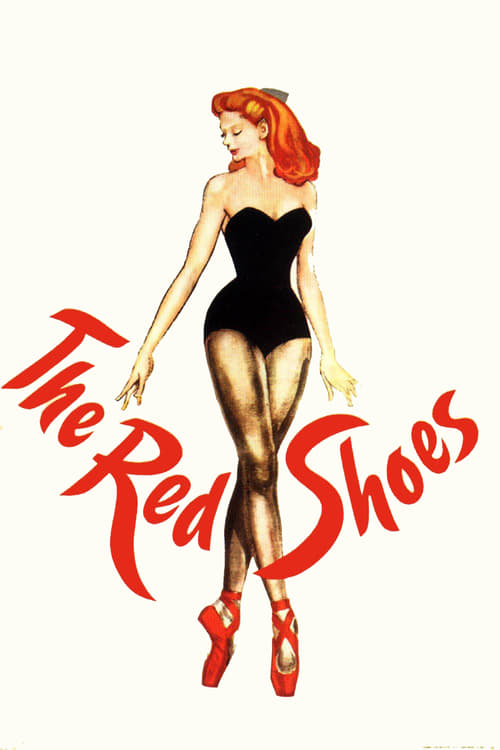
The Red Shoes
1948 · Michael Powell
For a night when you want to be swept away by beauty — and are willing to let the beauty cost something. A film for anyone who has ever loved their work a little too much.
What it's about
A gifted young ballerina, Victoria Page, is discovered by Boris Lermontov, the imperious impresario of an international ballet company, who molds her into a star. When she falls in love with Julian Craster, the company's brilliant young composer, Lermontov — convinced a dancer cannot serve both love and art — sets out to force a choice. At the story's center is a full ballet based on the fairy tale of red shoes that won't stop dancing, performed as her make-or-break debut.
The experience
Rapturous and then quietly frightening — it seduces you with backstage glamour and Technicolor splendor before revealing the obsession underneath. The seventeen-minute ballet sequence is genuinely transporting, the kind of thing you sit forward for.
Performances
Anton Walbrook's Lermontov is one of cinema's great monsters of taste — elegant, wounding, magnetic. Moira Shearer, a real ballerina in her first film role, dances the lead herself, which gives every performance scene an authenticity no double could fake.
The craft
Powell and Pressburger shot it in Technicolor so saturated it feels feverish, and the central ballet dissolves stage space into pure imagination — sets melt, newspapers become dance partners, the theater's walls stop mattering. It is one of the most gorgeous color films ever made and demands the biggest screen you can find.
Why it matters
Generations of dancers and filmmakers name it as the film that set them on their path; it made the backstage ballet picture a serious art form and remains the definitive movie about the price of devoting a life to art.
Snapshot
The Red Shoes is the central film of the Archers — the production partnership of Michael Powell and Emeric Pressburger — and one of the most influential works ever made about the cost of art. Adapting the armature of Hans Christian Andersen's fairy tale, in which a girl who covets a pair of red shoes is condemned to dance until she dies, the film transposes the parable into the world of an international ballet company. Victoria Page (Moira Shearer), a young dancer, is taken up by the imperious impresario Boris Lermontov (Anton Walbrook), who shapes her into a star; she falls in love with the company's young composer Julian Craster (Marius Goring); and Lermontov, who believes a dancer cannot serve both love and art, forces a choice that destroys her. At its center is the seventeen-minute "Ballet of the Red Shoes," a danced film-within-a-film that abandons theatrical realism for pure cinematic fantasy. Released in 1948 in Technicolor, the film was initially received with British critical reserve but became an enormous and durable success, particularly in the United States, and has since been claimed by filmmakers from Martin Scorsese to Brian De Palma as a foundational influence. It is at once a backstage melodrama, a Gesamtkunstwerk fusing dance, music, design and cinema, and a meditation on whether total devotion to art is a vocation or a death sentence.
Industry & production
The Red Shoes originated more than a decade before it was made. Alexander Korda had commissioned a script from Pressburger in the 1930s, reportedly as a vehicle for his wife Merle Oberon, but the project lapsed; when Powell and Pressburger acquired it, they rebuilt it around the idea of a real dancer rather than an actress miming. The film was produced under the Archers' arrangement with J. Arthur Rank, through Independent Producers, which gave Powell and Pressburger a degree of creative autonomy unusual in the British industry. That autonomy generated friction: Rank's managing executive John Davis is widely reported to have regarded the film as extravagant and uncommercial, and the relationship between the Archers and Rank deteriorated around it — The Red Shoes effectively marked the end of their most fruitful period under Rank's umbrella.
The casting strategy was itself a production gamble. Rather than hire a star and double her dancing, Powell and Pressburger cast Moira Shearer, a ballerina of Sadler's Wells (the company that became the Royal Ballet), in her first film role; she was reluctant, fearing the effect on her stage career. The company was filled with genuine dance figures: Léonide Massine, the great Ballets Russes dancer-choreographer, plays the shoemaker Grischa Ljubov and contributed choreography; Robert Helpmann, the Sadler's Wells star, choreographed and appears as the principal dancer Ivan Boleslawsky; Ludmilla Tchérina, a Monte Carlo ballerina, plays Boronskaja. This embedding of authentic ballet personnel within a fictional company gave the film a texture of professional reality that conventional casting could not have produced. Anton Walbrook, the Austrian émigré who had already given the Archers one of their finest performances in The Life and Death of Colonel Blimp, anchored the drama as Lermontov.
Technology
The film's defining technical instrument is three-strip Technicolor, the dye-transfer process that the Archers had already exploited in A Matter of Life and Death (1946) and Black Narcissus (1947). The Red Shoes pushes the saturated palette of the process to expressive extremes, particularly in the central ballet, where color is freed from any obligation to naturalism. Technicolor in this period required bulky cameras, intense lighting, and the supervision of the Technicolor company's own color consultants; the Archers' cinematographer Jack Cardiff had become the leading British artist of the format, and his control of it here is total. The ballet sequence also depends on the era's optical and in-camera trickery — superimpositions, dissolves, glass shots and matte work, slow motion and undercranking, and a famous moment in which a newspaper blowing across the stage transforms into a dancing figure — effects assembled from the standard toolkit of 1940s production but combined with unusual ambition. The film thus belongs to a moment when Technicolor's chemical capacity for intense, controlled hue met a creative team willing to treat color as a primary dramatic material rather than a recording fidelity.
Technique
Cinematography
Jack Cardiff's photography is among the most celebrated in color cinema. In the "real-world" passages — the rehearsal rooms, the dressing rooms, the Riviera villa — Cardiff and Powell deploy a vivid but legible palette, with Walbrook's Lermontov often isolated in cool, controlled lighting that reinforces his austerity. In the central ballet the camera abandons the proscenium entirely: it moves with and around the dancers, descends and rises, and intercuts spaces that could never coexist on a real stage. Cardiff uses color symbolically and emotionally, most insistently the red of the shoes themselves, which recur as a visual leitmotif. The film's surfaces — fabrics, flowers, painted backdrops, skin — are rendered with the lush tactility that made Cardiff's Technicolor work a benchmark; his contribution sits alongside his Oscar-winning Black Narcissus as the high point of British color cinematography.
Editing
Reginald Mills's editing is structurally decisive, above all in the ballet, where the cut becomes the engine of fantasy. The sequence was constructed so that image and Brian Easdale's pre-recorded score are locked together, with the dancing choreographed and shot to match the music and then assembled to produce transformations impossible on stage. Editing here does not merely record a performance; it creates space, collapses geography, and dramatizes Vicky's psychological dissolution as the boundary between the ballet's story and her own breaks down. Throughout the film, Mills's cutting modulates between the measured rhythms of the backstage drama and the accelerating momentum of the dance, and the final sequence — Vicky's death on the railway line, intercut with the company performing the ballet around an empty spotlight — depends entirely on editorial juxtaposition for its devastating effect.
Mise-en-scène / staging
The film's visual world was designed by Hein Heckroth, the German-born art director, with Arthur Lawson; Heckroth's contribution included extensive design paintings and gouaches that mapped the ballet before it was shot. The mise-en-scène moves between the relatively naturalistic European theatrical milieu and the frankly painterly, dreamlike sets of the Red Shoes ballet, where backdrops, props and lighting are stylized into expressionist tableaux. Powell's staging consistently uses architecture and blocking to express power: Lermontov framed at a height or behind a desk, Vicky positioned as an object of his shaping attention. The contrast between the disciplined geometry of the company's world and the surging, distorted dreamscape of the ballet is the film's central formal opposition, and Heckroth's design makes it legible. The work earned the film an Academy Award for Art Direction.
Sound
Brian Easdale's score is integral rather than accompanying. The "Ballet of the Red Shoes" is a fully composed orchestral piece, recorded — under the baton of Sir Thomas Beecham conducting the Royal Philharmonic, by the film's own account — before shooting, so that the choreography and camera could be built to the music. Easdale won the Academy Award for the score (shared, in the music categories of the period, with Beecham's musical direction credited in some accounts; the recorded Oscar was Easdale's for Best Music, Scoring of a Dramatic or Comedy Picture). The film's sound design also makes dramatic use of silence and of diegetic theatrical sound, and the synchronization of pre-recorded music to image set a model for how dance could be filmed. The result is a work in which music is not underscoring an action but generating it.
Performance
The performances balance trained actors and trained dancers. Anton Walbrook gives Lermontov a controlled, near-monastic intensity — his cruelty is never crude but proceeds from genuine, frightening conviction about the supremacy of art; his delivery of the company's creed and his reaction to Vicky's death are among the film's most quoted moments. Moira Shearer, a dancer first, carries the dramatic burden of the protagonist with a freshness that suited the role of an ingénue being formed; her dancing, naturally, is the real article. Marius Goring plays Julian as ardent and somewhat callow, deliberately less commanding than Lermontov, which sharpens the film's refusal to make the romantic choice an easy one. The supporting ensemble of real dancers — Massine, Helpmann, Tchérina — lends the company scenes an authenticity of gesture and milieu that no amount of coaching could fake.
Narrative & dramatic mode
The film operates in the mode of tragic melodrama, but its architecture is unusually rigorous. Andersen's fairy tale is not merely a source but a structural mirror: the ballet Vicky dances tells, in compressed allegory, the fate the film will enact upon her. The central conflict is a triangle, but not a conventional romantic one — it is a contest between two forms of devotion, Julian's love and Lermontov's art, with Vicky as the contested ground. Lermontov's famous demand, that a dancer who depends on "the doubtful comforts of human love" can never be a great artist, is the film's thesis and its trap. The drama proceeds toward an ending that is both melodramatic and mythic: Vicky, torn between the man and the impresario, throws herself from a balcony into the path of a train, and the red shoes — as in the fairy tale — seem to carry her to her death against her will. The film's willingness to let allegory override psychological realism, to let the fairy tale claim its heroine, is what lifts it above backstage romance.
Genre & cycle
The Red Shoes belongs to the backstage drama — the genre of the show-must-go-on, of artistic ambition and sacrifice — but it stands at the head of a more specific cycle: the serious film about the making of art, and especially about dance and performance as vocations that consume their practitioners. It is the most important ancestor of a lineage of "ballet films" and, more broadly, of films about the destructive cost of artistic perfection. Within the Archers' own work it forms a loose trilogy of art-and-obsession with Black Narcissus (faith and repression) and the later The Tales of Hoffmann (1951), the Archers' subsequent "composed film" that pushed the integration of opera, dance and cinema even further. The film also participates in the British prestige cinema of the late 1940s, but its frank embrace of fantasy and color set it apart from the dominant realist current of the period.
Authorship & method
The Red Shoes is the signature achievement of "The Archers," the writing-directing-producing partnership of Michael Powell and Emeric Pressburger, who shared a combined "written, produced and directed by" credit across their films. In practice Pressburger was the principal architect of story and script and Powell the principal director on the floor, but their authorship was genuinely collaborative and resists separation. The film exemplifies their method: a literate, emotionally extravagant script realized through an unusual openness to the contributions of specialist collaborators, who were treated as co-authors of the film's world.
Chief among these was cinematographer Jack Cardiff, whose Technicolor artistry defined the film's look; production designer Hein Heckroth, who conceived the ballet's visual language in paint before it was filmed; composer Brian Easdale, whose pre-recorded score made the central sequence possible; and editor Reginald Mills, who assembled the impossible geography of the dance. The choreography of Robert Helpmann and Léonide Massine brought authentic balletic invention into the heart of the film. Powell's later memoirs framed The Red Shoes as the fullest expression of the Archers' belief that cinema could absorb the other arts without subordinating them — a conviction that distinguishes their cinema from the more restrained mainstream of British filmmaking.
Movement / national cinema
The film belongs to British cinema but sits athwart its dominant traditions. Where the prestige of postwar British film was associated with Ealing realism, the documentary-influenced social picture, and David Lean's literary adaptations, the Archers pursued a flamboyant, anti-realist, Continental sensibility — color, fantasy, opera, melodrama, emotional excess. This orientation owed much to the European émigré culture within the production: Pressburger was a Hungarian émigré, Walbrook and Heckroth were refugees from the German-speaking world, and the ballet itself drew on the Russian-rooted tradition of Diaghilev's Ballets Russes (Massine and the very idea of the touring international company descend directly from it). The Red Shoes is thus a British film made by a deliberately cosmopolitan, partly émigré sensibility, and its richness comes in large part from that hybridity. Its reputation has risen steadily since the period when British critical orthodoxy, suspicious of the Archers' extravagance, undervalued them.
Era / period
Made in 1947 and released in 1948, the film is a product of the immediate postwar moment — austerity Britain, rationing, a film industry both ambitious and financially strained, and a Rank Organisation attempting and failing to compete with Hollywood. Its lavishness reads partly as a defiance of that austerity: a Technicolor fantasy of European glamour, Riviera villas and Parisian theaters made in a gray, rebuilding country. The film also belongs to the high tide of three-strip Technicolor and of the prestige "composed film," before television and the economic pressures of the 1950s reshaped both ambitions. Its commercial life extended well beyond its moment: reportedly a modest success in Britain at first, it became a long-running attraction in the United States, where its account of art and Europe found a large and lasting audience.
Themes
The film's governing theme is the conflict between love and art — Lermontov's conviction that great artistry demands the renunciation of ordinary human happiness, and the question of whether that conviction is wisdom or monstrous self-justification. The film does not finally resolve the question; it lets Lermontov be both right and destructive. Bound to this is the theme of vocation as possession: the red shoes that will not stop dancing figure art as a compulsion that overrides the self, a gift indistinguishable from a curse. The Andersen tale supplies a moral-religious undertow — desire, punishment, the impossibility of taking the magical shoes off — that the film secularizes into a parable of the artist's life. Surrounding these are subsidiary motifs: the impresario as creator and tyrant, the company as a surrogate family and a machine, the woman as both artist and object of male shaping, and performance as a space where the fictional and the real fatally merge. The final image — the company dancing the ballet around an empty spotlight where the star should be — distills the film's sense that art continues over the bodies it consumes.
Reception, canon & influence
Critical reception in Britain was initially cool and divided; some reviewers found the film overwrought or resented its departure from realist seriousness, and the Rank organization's discomfort did not help its domestic standing. Its triumph came elsewhere and over time: it ran for long engagements in the United States, won Academy Awards for Hein Heckroth's art direction and Brian Easdale's score (and received further nominations, including Best Picture), and gradually established itself as a classic. Critical opinion has since reversed almost entirely; the Archers' reputation, championed from the 1970s onward by critics and by Martin Scorsese, has elevated The Red Shoes to a settled place in the canon of great films.
Looking backward, the film draws on Hans Christian Andersen's 1845 fairy tale; on the legend and structure of Diaghilev's Ballets Russes, with Lermontov widely read as inflected by Diaghilev himself; on the German Expressionist and émigré visual culture that Heckroth and Walbrook carried; and on the Archers' own developing experiments with color and fantasy in A Matter of Life and Death and Black Narcissus.
Looking forward, its influence is exceptionally broad and well-documented. The Archers immediately extended its "composed film" method into The Tales of Hoffmann (1951). Martin Scorsese has repeatedly named it among his formative films and oversaw its celebrated digital restoration; its DNA is visible in his own films about performance and obsession, and Michael Powell's late-career rehabilitation owed much to Scorsese's advocacy. The film's vision of dance and self-destruction stands directly behind Darren Aronofsky's Black Swan (2010), which reworks its central premise of a dancer consumed by a role. Its fusion of color, music and movement, and its image of art as beautiful compulsion, echo through the work of directors as varied as Brian De Palma and the makers of modern dance and music cinema. More diffusely, The Red Shoes helped license the idea that a popular film could be an unembarrassed total artwork — that melodrama, fantasy and the high arts could be fused on screen without apology — and that license remains one of its most enduring bequests.
A Deleuzian reading
Watch the scrap of newspaper.
The full Deleuzian reading of The Red Shoes →
Reception
Rank's executives were so baffled by it they gave it barely any push in Britain — then it exploded in America, running over two years at a single New York cinema and becoming one of the biggest British hits ever in the US. Today it's fixture-of-the-canon material: a perennial 'greatest British film ever' contender and a restoration-era crown jewel.
How The Red Shoes was received, from release to now →
Influences: the films it descends from and the films it influenced
- The Thief of Bagdad (1940) — Powell's own apprenticeship in building a fully artificial Technicolor fantasy world through matte work, optical effects and saturated palettes, the spectacle-craft he later turned inward toward the ballet.
- The Wizard of Oz (1939) — Deploys three-strip Technicolor dramaturgically — drab sepia reality giving way to saturated fantasy — the symbolic use of color-as-threshold that the Archers refined into the red shoes themselves.
- Das Cabinet des Dr. Caligari (1920) — German Expressionist painted distortion and stylized tableaux, the émigré visual grammar that Hein Heckroth and Anton Walbrook carried directly into the ballet's hand-painted, anti-realist design.
- Fantasia (1940) — Establishes the 'composed film' principle — image cut and choreographed to a pre-recorded musical track — the exact method Brian Easdale's pre-scored ballet sequence depends upon.
- Becky Sharp (1935) — The first three-strip Technicolor feature, which pioneered orchestrating blocks of color toward an emotional crescendo (its red-cloaked Waterloo panic), the expressive-color logic the Archers inherited.
- A Matter of Life and Death (1946) — Jack Cardiff's Technicolor and the Archers' fantasy color-transitions were worked out here first — the calibrated slide between worlds that primes the ballet's leap into impossible space.
- Black Narcissus (1947) — Cardiff's studio-bound expressive Technicolor renders psychological hysteria through color and matte-built artificial landscape — the same painterly, controlled-light craft transposed from convent to theater.
- Children of Paradise (1945) — Extends the backstage-performance film in which the staged art and the performers' offstage lives fatally mirror and consume one another — Baptiste's mime/love doubling writ as ballet.
- The Life and Death of Colonel Blimp (1943) — Extends Technicolor into pure emotional expressionism on Junge-designed sets, treating color and design as the primary narrative instrument in the Archers manner Blimp pioneered.
- The Tales of Hoffmann (1951) — The Archers immediately extended The Red Shoes' pre-recorded 'composed film' method into a fully through-danced, through-sung opera-film built entirely to a pre-laid score.
- An American in Paris (1951) — Climaxes in an extended, self-contained painterly ballet staged on overtly artificial sets — the art-film-within-the-film as autonomous set-piece, modeled on the Red Shoes ballet.
- Singin' in the Rain (1952) — The 'Broadway Melody' dream-ballet abandons narrative space for impossible studio geography choreographed to pre-recorded music — the Archers' montage-of-impossible-space applied to the MGM musical.
- Peeping Tom (1960) — Powell's later anatomy of the artist's lethal compulsion, rendered in lurid expressive color — the cost-of-perfection theme turned voyeuristic and self-implicating.
- The Phantom of the Paradise (1974) — De Palma's music-driven Gesamtkunstwerk of artistic obsession and a Svengali impresario consuming his performer, scored as operatic backstage melodrama in saturated color.
- Suspiria (1977) — Argento explicitly imitates three-strip Technicolor's saturated reds and blues inside a sinister ballet academy, using color as autonomous expressive terror rather than realism.
- New York, New York (1977) — Scorsese's deliberately studio-bound, artificially designed backstage music melodrama — his open homage to the Archers' anti-realism and art-versus-love conflict between two performers.
- All That Jazz (1979) — Renders a performer's self-destruction through subjective fantasy musical numbers, fusing the backstage melodrama with the dancer-consumed-by-his-art premise.
- Black Swan (2010) — Directly reworks The Red Shoes' core premise — a ballerina annihilated by total identification with her role — collapsing the film-within-a-film boundary between performance and self.
- The Ice Tower (2025) — The film-within-a-film of a performer consumed by her role, staged inside backstage spectacle and studio magic — the template for the Ice Tower's bewitching icon and its theater of illusion.
- The Testament of Ann Lee (2025) — Photographs choreography as the dramatic climax itself — the extended dance as the film's emotional and formal engine — rather than as decorative interlude.
- Vertigo (1958) — Jack Cardiff's Technicolor expressionism, where saturated otherworldly color functions as a direct index of obsessive interior states rather than decoration, establishes color-as-psychological-register in the mode Burks extends with Vertigo's green-coded haunting sequences.
- La Belle et la Bête (1946) — Treats fairy-tale fantasy as a total poetic art-object, the artist-as-magician staging dream-logic transformations — a continental parallel to the Archers' unembarrassed Gesamtkunstwerk.
- Lola Montès (1955) — A near-contemporary treatment of the performing woman consumed by the apparatus of art, built on the show-within-the-show and the body displayed for an audience that owns it.
- Memories of Matsuko (2006) — Three-strip Technicolor pushed past realism and a woman destroyed by her own performed devotion, where the fantasy ballet sequence externalizes her doom as pure stylized spectacle.
- The Queen of Spades (1949) — Walbrook's other 1948 monomaniac: the same performance grammar of glacial courtesy cracking into fanatic appetite, staged in doorways and on staircases where Hein Heckroth's décor externalizes obsession exactly as Oliver Messel's does for Dickinson.
Similar films
- Suspiria (1977) — influence & lineage · same viewing thread · often watched together
- Beauty and the Beast (1946) — influence & lineage · often watched together
- Fantasia (1940) — influence & lineage · often watched together
- A Matter of Life and Death (1946) — influence & lineage
- Black Swan (2010) — influence & lineage
- Black Narcissus (1947) — influence & lineage
- Peeping Tom (1960) — influence & lineage
- The Cabinet of Dr. Caligari (1920) — influence & lineage · often watched together
All the films related to The Red Shoes →
Watch it with: curated runs of related films
- Drunk on Design — Watch these together for the rush of maximalist, color-drenched cinema where a woman is made, remade, or consumed by an art form — ballet, fashion, gothic desire — and the production design does half the storytelling.