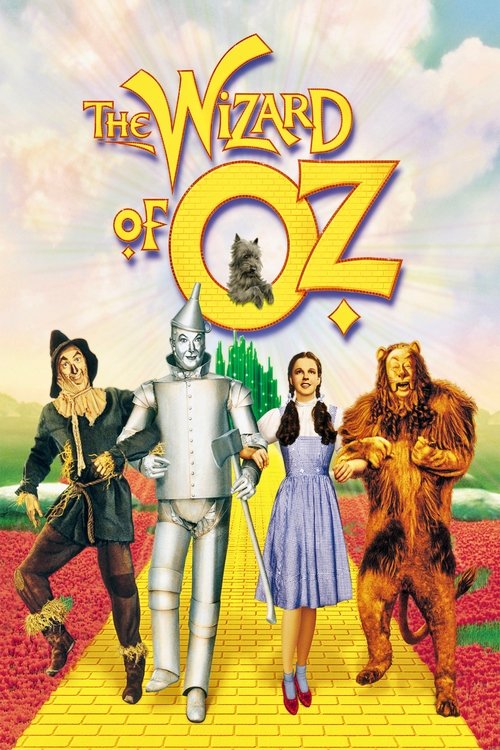
The Wizard of Oz
1939 · Victor Fleming
The definitive family movie night and one of the great comfort watches — for when you want wonder, songs you already half-know, and to feel like a kid again.
What it's about
A Kansas farm girl and her dog are swept up by a tornado and dropped into the Technicolor land of Oz, where the only way home is to follow the yellow brick road to a mysterious Wizard. Along the way she picks up a scarecrow who wants a brain, a tin man who wants a heart and a lion who wants courage — while a vengeful witch tracks her every step.
The experience
Pure enchantment with a real spine of menace — the songs and candy-colored sets cast a spell, but the witch and her flying monkeys still deliver an honest shiver. It's brisk, funny and openhearted, and it works on you at any age.
Performances
Judy Garland's utterly sincere Dorothy holds the fantasy together — her 'Over the Rainbow' remains one of the most affecting moments ever put on film — and Margaret Hamilton's cackling witch has terrified generations for good reason.
The craft
The switch from sepia Kansas to full-blown Technicolor Oz is still one of cinema's great reveals, and everything around it — the tornado effect, the sets, the makeup, the songbook — shows Hollywood's biggest studio spending without limit. It's a spectacle that genuinely rewards the biggest, brightest screen you can find.
Why it matters
Decades of television broadcasts made it one of the most-watched films in history, and its characters, lines and ruby slippers became permanent cultural shorthand.
Snapshot
The Wizard of Oz is among the most-watched motion pictures in history, an MGM prestige fantasy adapted from L. Frank Baum's 1900 novel The Wonderful Wizard of Oz. It is remembered less as a single auteur's statement than as a triumph of studio system craft: a film passed through multiple directors, rewritten by a committee of writers, and assembled by the most resource-rich studio of Hollywood's classical era. Its enduring fame rests on a handful of indelible elements — the transition from sepia Kansas to Technicolor Oz, Judy Garland's performance and her rendition of "Over the Rainbow," and a gallery of character archetypes (Scarecrow, Tin Man, Cowardly Lion, the Wicked Witch) that have become cultural shorthand. Though it performed only modestly relative to its considerable cost on first release, its later television exposure transformed it into a generational ritual and a canonical text of American popular cinema.
Industry & production
The film was produced by Metro-Goldwyn-Mayer under the supervision of Mervyn LeRoy, with Arthur Freed serving as an uncredited associate producer; Freed, who would later head MGM's celebrated musical unit, was an early and persistent advocate for the project and for casting Garland. The production is a textbook case of the studio system's collaborative, sometimes chaotic, division of labor. Victor Fleming receives sole directing credit, but he was not the only director to work on the picture: Richard Thorpe shot early footage that was discarded, George Cukor served briefly in a consulting capacity and is credited by film historians with crucial decisions about Garland's appearance and performance (toning down an artificial, glamorized look in favor of a more natural Dorothy), and King Vidor directed portions of the black-and-white Kansas sequences after Fleming left to take over Gone with the Wind. This relay of directors was characteristic of MGM's producer-driven model, in which continuity was maintained by the studio and its department heads rather than by a single controlling director.
The screenplay is credited to Noel Langley, Florence Ryerson, and Edgar Allan Woolf, though numerous other writers contributed during development — a typical pattern of accretive studio rewriting. The production was expensive and protracted, and the film is widely reported not to have turned a profit on its initial release, recouping its costs only through later reissues and, decisively, television. Casting lore around the film is extensive and partly legendary; the most reliably documented points are Garland's casting as Dorothy and the substantial physical toll the production took on its performers, including Margaret Hamilton, who was burned during a special-effects mishap involving the Witch's fiery exit from Munchkinland.
Technology
The Wizard of Oz is one of the signal showcases of three-strip Technicolor, the dye-transfer color process that MGM deployed here at the height of its mid-century capability. The film's most famous formal gesture — Dorothy stepping from a sepia-toned Kansas farmhouse into the saturated color of Oz — is a direct dramatization of the technology itself, turning a production resource into a narrative threshold. (The Kansas sequences were rendered in sepia tone rather than pure black-and-white for much of the print, reinforcing the contrast with Oz's chromatic abundance.) Three-strip Technicolor demanded enormous light levels, generating punishing heat on set, and required the specialized supervision of the Technicolor company, whose color consultants (associated with Natalie Kalmus's department) were a standard, contractually mandated presence on such productions.
The film also leaned heavily on the era's practical and optical effects: matte paintings and miniatures for the Emerald City and surrounding landscapes, wirework and pyrotechnics for the Witch and her flying monkeys, and elaborate makeup and costuming — most notoriously the Tin Man's metallic makeup, whose original aluminum-powder formulation reportedly sickened the first actor cast in the role, Buddy Ebsen, leading to his replacement by Jack Haley. These technologies were not incidental; the film's reputation rests substantially on the visible craft and expense of its illusions.
Technique
Cinematography
The cinematography is credited to Harold Rosson, working within the demanding constraints of three-strip Technicolor. The visual strategy is built on contrast and spectacle: the muted, naturalistic flatness of Kansas against the storybook luminosity of Oz, where sets, costumes, and lighting are coordinated for maximum chromatic impact. The camera work is generally classical and legible — staging the action clearly, foregrounding the performers and the production design — rather than expressive in a showy, mobile sense. The most celebrated single image, the doorway reveal of Technicolor Oz, depends on precise control of exposure and color, and stands as one of the most analyzed transitions in American cinema.
Editing
Blanche Sewell is credited as editor. The film's editing serves the through-line of a tightly structured journey narrative: it moves Dorothy efficiently from episode to episode along the yellow brick road, accommodating the production-number rhythm of a musical while maintaining narrative momentum. Given the film's troubled, multi-director production, the editing also performed a unifying function, knitting footage shot under different hands into a coherent whole — a reminder that in the studio system, continuity of style was often achieved in post-production and through department heads as much as on set.
Mise-en-scène / staging
Production design is central to the film's identity. The art direction (under Cedric Gibbons's MGM department, with William A. Horning among those credited) constructs Oz as a self-consciously artificial storybook world — the spiraling yellow brick road, the green-glowing Emerald City, the witch's gothic castle, the poppy field — each a discrete, theatrically staged tableau. Adrian's costume design and the elaborate character makeup are inseparable from the staging: the Scarecrow, Tin Man, and Lion are designed to read instantly as types, their silhouettes and palettes calibrated for a fantastical register. The staging is frankly theatrical, embracing rather than disguising its constructed quality, which is part of why the film reads as a fable rather than a realist fantasy.
Sound
The film is fundamentally a musical, and its soundtrack is among its most enduring achievements. The songs, with music by Harold Arlen and lyrics by E. Y. "Yip" Harburg, are integrated into the narrative as expressions of character and longing — "Over the Rainbow" as Dorothy's yearning, "We're Off to See the Wizard" as the propulsive march of the quest, "If I Only Had a Brain" and its companions as the supporting characters' self-definitions. Herbert Stothart's underscoring weaves the song themes through the dramatic action, a sophisticated use of leitmotif that binds the episodic structure together. The sound design also contributes to the fantasy's texture, from the tornado to the Witch's cackle, though it is the songs that carry the film's emotional and cultural weight.
Performance
Performance style in The Wizard of Oz is heightened and broadly legible, suited to fable and to a family audience. Judy Garland anchors the film with a performance balancing wide-eyed sincerity and genuine vocal-emotional depth; her Dorothy is the still center around which the more exaggerated grotesques revolve. Ray Bolger (Scarecrow), Jack Haley (Tin Man), and Bert Lahr (Cowardly Lion) bring a vaudevillian, physical-comedy tradition to their roles — Lahr's Lion in particular trades on a theatrical, music-hall bigness. Margaret Hamilton's Wicked Witch is a model of economical menace, her angular makeup and sharp delivery making her one of cinema's most recognizable villains. Frank Morgan plays multiple roles, including the Wizard, with a blustering, benign duplicity appropriate to the story's eventual unmasking of authority.
Narrative & dramatic mode
The film operates in the mode of the quest fable, structured as a journey toward a goal that is ultimately revealed to be internal. Its dramatic engine is the framing device of a dream: Dorothy, dissatisfied and feeling unloved in Kansas, is transported by a tornado to Oz, where the people in her life reappear transfigured as allegorical figures. The "there's no place like home" resolution returns her to a Kansas now valued rather than escaped, framing the entire Oz adventure as a psychological passage toward acceptance. (This dream framing is a notable departure from Baum's novel, in which Oz is presented as a real place — a change that gives the film a more closed, parable-like shape.) The episodic structure — a series of encounters and obstacles along a road — is unified by the companions' shared quest, each seeking a quality (brains, heart, courage) they in fact already possess, a moral pattern that gives the film its gentle didactic core.
Genre & cycle
The Wizard of Oz sits at the intersection of the fantasy film, the family picture, and the integrated musical. It belongs to a late-1930s cycle of lavish, effects-driven studio fantasies and prestige literary adaptations aimed at broad audiences. As a musical, it predates and in some respects anticipates the achievements of MGM's Freed Unit, with which Arthur Freed would soon define the postwar Hollywood musical; the integration of song into character and narrative here looks forward to that tradition rather than treating numbers as detachable spectacle. As a fantasy, it is a foundational reference point for the genre's American development, establishing conventions — the portal to another world, the misfit-fellowship quest, the journey home — that countless later films would inherit.
Authorship & method
Authorship of The Wizard of Oz is best understood as institutional rather than individual. Victor Fleming, a versatile MGM contract director associated with robust, professional craftsmanship (and, in the same year, Gone with the Wind), provided the steady hand that carried the film through completion, but the work bears the imprint of many: the discarded contributions of Richard Thorpe, the corrective interventions of George Cukor, the Kansas sequences attributed to King Vidor, and above all the producing vision of Mervyn LeRoy and Arthur Freed. The decisive creative collaborators are arguably the songwriters Harold Arlen and E. Y. Harburg, whose score gives the film its emotional architecture; the cinematographer Harold Rosson, who realized the Technicolor spectacle; the editor Blanche Sewell, who unified disparate footage; the music director Herbert Stothart; and the writing team led by Noel Langley. The method on display is the classical Hollywood studio at full stretch — specialized departments, interchangeable directors, and producer oversight combining to manufacture a unified entertainment whose authorship is distributed across the studio apparatus.
Movement / national cinema
The film is a quintessential product of classical Hollywood and specifically of MGM, the studio that prided itself on glossy, high-production-value entertainment ("more stars than there are in heaven"). It exemplifies the studio system's vertically integrated mode of production at its zenith, in the years just before the industry's postwar transformations and the 1948 antitrust decree that would unwind the major studios' control. As American national cinema, it represents Hollywood's confident address to a mass family audience and its capacity to absorb a homegrown literary property — Baum's distinctly American fairy tale — into a polished, exportable entertainment.
Era / period
Released in 1939, the film belongs to what is often celebrated as Hollywood's annus mirabilis, a year of extraordinary studio output. It arrived at the end of the Depression decade, and critics have long read its yearning for "somewhere over the rainbow" and its ultimate affirmation of home against that historical backdrop, though such readings are interpretive rather than documented authorial intent. Technologically and industrially it sits at a high point of the three-strip Technicolor era and of the mature studio system, just before the disruptions of the Second World War and the structural upheavals of the late 1940s.
Themes
The film's central themes are home, belonging, and the discovery that what one seeks is already within reach. The companions' quest for brains, heart, and courage dramatizes a humane moral psychology: virtue is a matter of recognizing capacities one already has. The dream framework adds a theme of maturation and reconciliation — Dorothy must journey away in order to value home, transforming restlessness into acceptance. Authority is treated with gentle skepticism: the Wizard is exposed as "the man behind the curtain," a humbug whose power is theatrical illusion, and the film's heroes ultimately rely on themselves rather than on the great and powerful figure they sought. Around these run motifs of fear and courage, friendship and loyalty, and the contrast between the drab, dutiful real world and the dangerous enchantments of fantasy.
Reception, canon & influence
On its 1939 release the film was generally well received critically and recognized at the Academy Awards, where it won for its score and for "Over the Rainbow" as best song, among other recognitions; Garland received a special juvenile award associated with her work that year. Commercially, however, its large budget meant it did not show a profit on first release, recovering financially only through subsequent reissues. Its transformation into a cultural institution came primarily through television: annual broadcasts beginning in the latter half of the twentieth century made the film a shared ritual for successive generations of American children, embedding its images and songs deeply in popular memory.
Backward, the film draws on L. Frank Baum's 1900 novel and the broader tradition of literary fairy tale and fantasy, as well as the vaudeville and music-hall performance traditions its supporting players embodied and the conventions of the Hollywood prestige musical and fantasy then taking shape. Forward, its influence is vast and diffuse. It established a durable template for the portal fantasy and the fellowship quest, and its iconography — the ruby slippers, the yellow brick road, the curtain-hidden wizard, "there's no place like home" — became proverbial, endlessly quoted, parodied, and reinterpreted. It has generated an extensive afterlife of adaptations, reimaginings, and homages across stage and screen, and it remains a fixture on canonical lists of great American films and a perennial object of scholarly and popular analysis. Its standing today rests not on its original commercial performance but on the rare completeness with which a studio-system entertainment became a permanent part of the culture's imaginative vocabulary.
A Deleuzian reading
Open the door.
The full Deleuzian reading of The Wizard of Oz →
Reception
It earned raves in 1939 but its enormous budget meant it barely broke even on first release — it was the annual TV broadcasts starting in 1956 that turned it into a generational ritual and, per the Library of Congress, the most-watched film in history.
How The Wizard of Oz was received, from release to now →
Influences: the films it descends from and the films it influenced
- Snow White and the Seven Dwarfs (1937) — Established the feature-length integrated fairy-tale musical in which character-specific songs carry narrative and emotion rather than pausing for spectacle — the song-as-storytelling architecture Oz adopts wholesale.
- Becky Sharp (1935) — First feature shot in full three-strip Technicolor; its deliberate dramatic color design (the red-caped ballroom climax) pioneered the expressive palette planning Oz's Technicolor spectacle directly extends.
- The Broadway Melody (1929) — MGM's first all-talking musical built the studio's integrated song-and-dance production apparatus — specialized music, dance, and recording departments — that the Freed/LeRoy machine deployed on Oz.
- A Trip to the Moon (1902) — Codified the painted theatrical-storybook set and in-camera trick effect as the grammar of fantasy cinema, the tradition of frankly constructed unreal worlds Oz's stylized Munchkinland and Emerald City inherit.
- The Thief of Bagdad (1924) — Monumental fairy-tale set design and large-scale effects spectacle around a single magical quest established the studio template for immersive fantasy world-building that Oz scales up in color.
- 42nd Street (1933) — Codified the Hollywood musical number as a discrete production set-piece; Oz refines this inheritance by binding the numbers ('We're Off to See the Wizard') into the forward motion of the plot.
- Naughty Marietta (1935) — MGM operetta whose Herbert Stothart scoring practice — recurring melodic motifs threaded through dialogue scenes — is the leitmotif underscoring method Stothart reuses to unify Oz.
- Meet Me in St. Louis (1944) — Reunites Garland with the Freed Unit and Technicolor to build an integrated musical of home-and-belonging on Oz's principle that songs supply the emotional architecture of domestic longing.
- A Matter of Life and Death (1946) — Inverts Oz's signature device — pairing monochrome and Technicolor to divide two worlds — making the color/black-and-white boundary itself a metaphysical threshold.
- The Red Shoes (1948) — Pushes Oz's use of Technicolor as psychological force into the extended fantasy ballet, where saturated color and a dream-logic interlude externalize a heroine's inner state.
- An American in Paris (1951) — Extends Arthur Freed's integrated-musical method into the climactic dream-ballet, the same producer's vision of song and movement as narrative that shaped Oz.
- Willy Wonka & the Chocolate Factory (1971) — An ordinary child crosses a threshold into a fantastical bounded world with integrated songs ('Pure Imagination'), reprising Oz's portal-fantasy-musical structure and its wonder-on-arrival reveal.
- Pleasantville (1998) — Directly descends from the sepia-to-color transition, using a monochrome world that blooms into color to mark transformation and the threshold between the mundane and the heightened.
- Star Wars (1977) — Builds its fellowship-quest spine on Oz's template — a naive protagonist gathering a band of complementary companions on a journey toward a hidden authority — a mythic-journey debt Lucas openly acknowledged.
- Spirited Away (2001) — A girl swept from the ordinary world into a portal fantasy realm, questing through episodic encounters to find her way home — Oz's dream-frame quest fable transposed.
- Pan's Labyrinth (2006) — Inherits Oz's dream-frame ambiguity — a child's fantasy world left deliberately undecidable as real or imagined — and its quest-of-tasks structure within that frame.
- Brazil (1985) — Gilliam explicitly inverts this film's dual-world color grammar: where Fleming codes gray as drab reality and warm Technicolor as liberatory fantasy, Brazil reverses the polarity, making Sam's dream sequences golden and expansive only to reveal the escape as the state's most efficient control mechanism — the seductiveness of the dream encodes its danger.
- The Empire Strikes Back (1980) — The wizard-mentor fantasy template — a diminutive, eccentric figure in an alien environment who trains the hero through cryptic instruction, then withholds the revelation that reframes his mission — structures Yoda's entire narrative and staging function on Dagobah.
- Poor Things (2023) — Robbie Ryan and Lanthimos's monochrome-to-color cinematographic arc — using desaturation that yields progressively to full color saturation as Bella's consciousness expands — is a direct formal quotation of Fleming's sepia-to-Technicolor transition as grammar for a protagonist's entry into a larger world.
- Gone with the Wind (1939) — Fleming's same-year Technicolor prestige epic, sharing his robust continuity craftsmanship and the studio system's full-stretch color-spectacle apparatus and multi-director salvage method.
- The Adventures of Robin Hood (1938) — Contemporary three-strip Technicolor adventure that demonstrated the saturated, high-key 'glorious Technicolor' legibility — bright primaries, no atmospheric haze — Oz pursues in the same studio color idiom.
- The Lorax (2012) — The urtext for palette-as-narrative — drab framed 'real' world versus saturated wonder world — the device the Lorax literalizes in plastic Thneedville's candy colors versus the ashen, denuded outer wasteland.
- The Thief of Bagdad (1940) — The parallel experiment in treating three-strip Technicolor as a designed dramatic register rather than reproduction, with a Kalmus-supervised palette keyed differently per sequence so color marks a shift in narrative reality.
Similar films
- Meet Me in St. Louis (1944) — influence & lineage
- Willy Wonka & the Chocolate Factory (1971) — influence & lineage
- Gone with the Wind (1939) — influence & lineage
- The Adventures of Robin Hood (1938) — influence & lineage
- Pan's Labyrinth (2006) — influence & lineage
- The Wiz (1978) — shared sensibility
- Alice in Wonderland (1951) — shared sensibility
- Wicked: For Good (2025) — shared sensibility
All the films related to The Wizard of Oz →