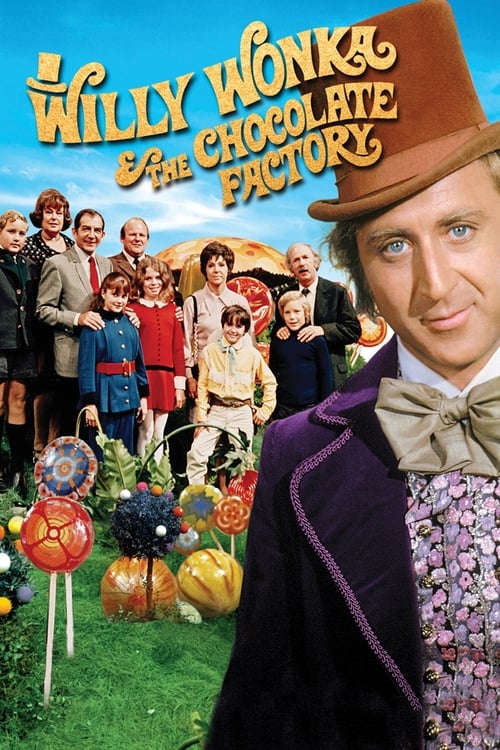
Willy Wonka & the Chocolate Factory
1971 · Mel Stuart
For family movie night or a nostalgic evening when you want pure imagination with a little bite — comfort viewing that never goes soft.
What it's about
Charlie Bucket is a poor, decent kid who dreams of finding one of five golden tickets hidden in chocolate bars — each one granting a tour of Willy Wonka's sealed, legendary candy factory and a lifetime supply of sweets. Inside, Wonka leads Charlie and four spectacularly bratty children through a wonderland of edible rivers and impossible rooms where misbehavior has consequences.
The experience
Bright, funny, and slyly sinister — a candy-colored musical with a genuine streak of menace, including one boat ride that has unnerved children for fifty years. It's cozy and strange in the same breath.
Performances
Gene Wilder's Wonka is one of the great screen creations: warm, cutting, and unreadable from moment to moment, so you're never quite sure whether he's a saint or something more dangerous. His first entrance alone is a masterclass in misdirection.
The craft
The factory sets are hand-built confections — a chocolate river, a room you can eat — and the songs, led by 'Pure Imagination,' have become standards. The famous tunnel sequence swerves into genuine psychedelia, a jolt of darkness few family films would risk.
Why it matters
A flop-turned-institution: television reruns made it a rite of childhood across generations, and Wilder's Wonka remains a permanent fixture of pop culture.
Snapshot
A color-drenched moral fable drawn from Roald Dahl's 1964 novel Charlie and the Chocolate Factory, in which impoverished boy Charlie Bucket wins a golden ticket admitting him to the sealed world of candymaker Willy Wonka's factory, where four ethically deficient children are dispatched one by one while Charlie survives to inherit the enterprise. The film is remembered above all for Gene Wilder's chameleonic central performance — by turns warmly paternal, cryptically menacing, and genuinely strange — and for a mid-film tunnel sequence of startling psychedelic violence. Though it underperformed on initial release, television syndication transformed it into a childhood institution across the English-speaking world, and its cultural half-life has proved exceptional: the film has outlasted the promotional venture that financed it, the novel adaptation that displaced it, and several cycles of nostalgic revival.
Industry & production
Willy Wonka & the Chocolate Factory was produced by David L. Wolper Productions in an unusual arrangement that saw the Quaker Oats Company co-finance the picture as a tie-in vehicle for a chocolate bar the company planned to market under the Wonka name. This commercial origin shaped the project in visible ways: the title was changed from Dahl's Charlie and the Chocolate Factory to foreground the "Wonka" brand, a decision that reportedly irritated Dahl, who felt it displaced his child protagonist. Production designer Harper Goff — veteran of Disney's 20,000 Leagues Under the Sea (1954) — was brought in to realize the factory interior, constructing the celebrated chocolate-room set at Bavaria Film Studios in Munich, where the bulk of principal photography took place. Choosing a West German studio kept the budget manageable and made available European craft crews with experience in large-scale fantasy construction. The candy bar itself, launched alongside the film, was a commercial failure and was swiftly discontinued; the film, by contrast, endured.
Dahl wrote the screenplay himself, adapting his own novel, but grew deeply dissatisfied with what was shot. His chief objection was the expansion of the Slugworth subplot — transformed in the film from background detail into a test of Charlie's moral character — which he felt distorted the book's structure and softened the satirical edge. Dahl's displeasure was permanent enough that he refused to authorize any sequel using his material, and he publicly declined to endorse the finished film. The friction between Dahl's instincts as a mordant children's author and the studio's requirement for warmth and brand-friendly uplift runs as a visible seam through the finished picture.
The casting of Gene Wilder as Wonka was not straightforward. Wilder agreed to accept the role on the condition — which he stated was non-negotiable — that Wonka make his first entrance with an apparent limp, then suddenly abandon it entirely, with no explanation offered. Wilder's stated rationale was that this opening gesture should signal to audiences that nothing Wonka does or says can be entirely trusted: that the character operates by his own internal logic immune to outside verification. The condition was accepted and the scene plays as described.
Peter Ostrum, a twelve-year-old with no prior acting experience, was cast as Charlie Bucket after an open talent search. He never appeared in another film.
Technology
The film's most technically ambitious achievement is the chocolate room set: a large-scale practical construction in which the edible landscape — the giant mushrooms, the candy flowers, the chocolate river — was fabricated from real or near-real foodstuffs where possible, though the brown liquid in the river was not, in fact, chocolate. The waterfall mechanism required considerable engineering to ensure safe operation around child performers. Harper Goff's design vocabulary drew on Edwardian confectionery illustration and Victorian industrial architecture simultaneously, producing interiors that feel simultaneously inviting and vaguely threatening — an effect that reinforces the film's tonal instability.
The tunnel sequence represents the film's most distinctive technical gesture. A boat carrying the tour group moves through an increasingly dark corridor while rapid-cut photographic inserts — a centipede, a worm crawling across an eye, a chicken decapitation, indistinct swarming imagery — are intercut with and superimposed over close-ups of Wonka's face as he recites an incantatory poem. The technique is less psychedelia in the Kubrick sense than a low-budget exploitation of the optical printer and the associative possibilities of fast cutting, but its effect on child audiences proved genuinely disturbing and remains the sequence most discussed in retrospective critical accounts of the film. Cinematographer Arthur Ibbetson's work in the tunnel favoured close framing and high contrast, stripping away the warm palatability of the chocolate room and replacing it with something approaching horror.
Technique
Cinematography
Arthur Ibbetson, a British cinematographer with credits including The Angry Silence (1960) and Anne of the Thousand Days (1969), shot the film in Technicolor at Bavaria Studios. His key decision — presumably made in collaboration with Stuart and Goff — was the deliberate visual bifurcation between the world outside the factory and the world within. The film's opening passages in the gray-brown town are desaturated and somewhat flat in their lighting, emphasizing poverty and restriction; the moment Charlie enters the chocolate room, the palette erupts. This transition is a fairly explicit homage to the shift from sepia to Technicolor in The Wizard of Oz (1939), and the film courts the comparison throughout. Inside the factory, Ibbetson favours saturated primaries and a slightly heightened exposure that keeps candy surfaces glistening. The tunnel sequence deliberately departs from both registers, using darkness and disorienting close-ups to suggest that the factory has a psychological interior more complicated than its confected exterior.
Editing
The editing by David Saxon maintains a brisk pace through the factory tour, calibrated to the rhythm of the musical sequences while keeping the gathering dread of each child's elimination from tipping into outright darkness. The Oompa Loompa musical interludes function as formal punctuation, pausing the narrative to deliver moral commentary — a structure borrowed directly from the stage musical tradition and from Dahl's own use of rhyming censure in the novel. The tunnel sequence is the editing's showcase: a rapid-fire associative montage whose internal logic is deliberately obscure, functioning more as dream-sequence than scene.
Mise-en-scène / staging
Stuart's staging throughout the factory interior prioritizes spectacle and spatial wonder over dramatic intimacy, which reflects his documentary background: he frames for discovery and revelation rather than psychological depth. The chocolate room is introduced with a long-held wide shot that allows Ibbetson's color design and Goff's construction to register before dialogue intervenes. Wonka's movement through his own factory has a quality of proprietary performance — he behaves as though giving a show, often slightly ahead of the group, turning back with information whose relevance is delayed or never explained. Stuart and Wilder use this staging to make Wonka's relation to space itself a characterization device: he belongs to the factory in ways the visitors cannot access.
Sound
The score is divided between Leslie Bricusse and Anthony Newley, who composed the original songs, and Walter Scharf, who wrote the orchestral underscore. Bricusse and Newley's songs range in register from the determinedly cheerful ("I've Got a Golden Ticket") to the philosophically wistful: "Pure Imagination," delivered by Wilder in the chocolate room, became the film's signature piece and has accumulated an extensive afterlife in advertising, television, and cover versions. The Oompa Loompa songs use a pastiche of vaudeville and music-hall forms to deliver their moral payload, a tonal decision that amplifies their satirical edge without quite resolving the comedy-horror balance. The tunnel sequence uses music strategically: the Wonka boat theme warps and degrades as the sequence progresses, so that the formal dissolution of the image track is mirrored by the dissolution of familiar musical material.
"The Candy Man," though not performed by Wilder in the film — it opens with a candy-shop shopkeeper — was covered by Sammy Davis Jr., whose version reached number one on the American pop charts in 1972, demonstrating the film's cultural penetration even amid lukewarm box office performance.
Performance
Wilder's Wonka is the film's central critical object and its most extensively discussed element. The performance is built on irresolvable contradiction: genuine warmth and the suggestion of genuine menace coexist without either canceling the other. Wilder can shift mid-sentence from apparent delight to apparent threat, and the audience is never positioned with enough certainty to adjudicate between them. This quality — which the limping entrance is designed to initiate — gives the character a philosophical opacity unusual in a family film. Wilder himself described the performance in later interviews as drawing on a view of Wonka as someone who has been hurt, who tests people because trust has cost him something.
Jack Albertson as Grandpa Joe provides warmth and moral legibility in counterpoint to Wilder's opacity. Peter Ostrum's Charlie is notably restrained for a child performance in a film of this period: he observes more than he reacts, which gives his moral journey a quiet credibility. The five children are each required to embody a specific vice — gluttony, avarice, vanity, television passivity — with the stylization appropriate to a morality play rather than realistic drama.
Narrative & dramatic mode
The film operates as a secular morality play in the fairytale tradition: a virtuous child of humble origin is tested against representatives of various sins, each of whom is eliminated by a punishment specifically calibrated to their particular excess. The structure is Dahl's, drawn from a tradition that includes both Grimm's tales and the Victorian cautionary verse of Heinrich Hoffmann's Struwwelpeter. Dahl's innovation in the novel — and the film preserves it — is to make the punishments meted out by an ambiguously complicit adult authority figure, so that the moral machinery of the tale has a distinctly uncomfortable operator. The Slugworth subplot adds a second moral test layered over the primary one: Charlie must resist temptation not only by surviving the factory but by declining to betray Wonka's trust even when offered material reward for doing so.
The narrative's resolution — Charlie inherits the factory — reads simultaneously as a fairy tale's conventional elevation of the deserving poor and as a darker fantasy about talent and industry passing to uncorrupted hands. The film's final scene, lifting Charlie and Grandpa Joe into the sky above the city in the Wonkavator, departs significantly from the novel and from Dahl's own screenplay draft, and the shift toward unambiguous uplift was among the changes that most dissatisfied Dahl.
Genre & cycle
Willy Wonka occupies a specific mid-century niche: the Hollywood family fantasy musical, a genre whose canonical examples run from The Wizard of Oz (1939) through Mary Poppins (1964) and toward such later entries as Bedknobs and Broomsticks (1971), released the same year. The film shares with Mary Poppins the structure of a magical authority figure initiating children into a hidden world with moral stakes, and with The Wizard of Oz the color-transition grammar and the child protagonist surrounded by symbolic adult archetypes. What distinguishes it generically is Dahl's retained satirical acid: where the Disney comparators soften their moral frameworks into sentiment, Willy Wonka keeps a harder edge, particularly in the Oompa Loompa sequences, whose mock-cheerful didacticism is discomfiting in ways the film never fully resolves.
Authorship & method
Mel Stuart's background was in documentary filmmaking, primarily with David Wolper's production company, for which he made numerous prestige documentary features throughout the 1960s. Willy Wonka was his first major fiction feature and remains his most significant credit. His documentary instincts — a preference for observational framing, a trust in found performance — are visible in some of the film's quieter moments, particularly in the scenes of Charlie's poverty-stricken home life, which have a modestly naturalistic texture that sharpens the fantasy contrast of the factory sequences. Stuart's collaborators — Ibbetson, Goff, Scharf, Bricusse and Newley — were more experienced in the fiction feature form, and it is plausible to attribute the film's visual and musical coherence significantly to their craft.
The tension between Stuart's direction and Wilder's intensely self-designed performance is the film's productive creative friction. Wilder effectively co-authored the Wonka characterization through his preconditions and his evident improvisatory latitude; the character as it appears on screen is as much Wilder's creation as Stuart's. Dahl's contribution, though filtered through revisions he resented, remains foundational: the moral architecture, the tonal ambivalence, and the dark comic spirit all originate in the novel.
Harper Goff's production design merits particular emphasis. His background in Disney's live-action fantasy division gave him expertise in building practical sets that had to sustain close inspection and tactile interaction from child performers — an exacting requirement that the chocolate room fully meets.
Movement / national cinema
The film is an American production in its financing, casting, and target audience, but it was made almost entirely in West Germany with European craft crews, a logistics-driven choice that nonetheless gave it a visual quality slightly at odds with contemporary Hollywood family entertainment. The Munich studio settings have a faint Central European institutional heaviness — the factory corridors, the elevator shafts, the testing rooms — that inflects the candy-coloured surfaces with something institutional and slightly foreboding. This is neither intentional national cinema nor deliberate aesthetic program, but it has a real effect on the film's atmosphere.
The literary source is firmly British — Dahl was a Welsh-born author working in an English tradition of darkly comedic children's literature — and the screenplay, though Americanised in certain respects, retains the British satirical register of Dahl's original. The film is consequently a somewhat unusual hybrid: American genre ambitions, British literary sensibility, and German production infrastructure.
Era / period
The film arrives in 1971 within a specific cultural moment: the tail end of the 1960s counterculture's influence on mainstream cinema, when psychedelic visual language had percolated into family entertainment and the boundaries of acceptable content in children's media were briefly and somewhat chaotically expanded. The tunnel sequence is the most acute expression of this context: it would likely not have been made in 1961 or 1981. The early 1970s also saw the loosening of the family film's tonal conventions in the wake of Easy Rider (1969) and the general adult-oriented turn in American cinema — a loosening that let films like Willy Wonka retain some of the source material's menace rather than processing it out entirely.
Themes
The film's primary thematic axis is the moral economy of desire: what happens to people who want the wrong things in the wrong ways. Each eliminated child embodies a failure of appetite regulation — literal gluttony, acquisitive gluttony, competitive vanity, passive consumption — while Charlie's poverty is represented as a kind of enforced purity that has preserved his capacity for genuine wonder rather than entitled expectation. This is a conservative moral framework in one reading, and a critique of consumerism in another; Dahl's satirical intent foregrounds the second, while the film's promotional context — itself a consumerist exercise — complicates both.
Trust, deception, and testing recur throughout. Wonka's world is explicitly one in which appearances cannot be relied upon and promises have hidden clauses. The Slugworth test externalizes this theme: Charlie is deceived in order to be tested, which raises a question the film does not quite confront about whether benign manipulation constitutes a form of care or a form of betrayal. The factory as space of transformative experience — simultaneously workshop, theme park, and moral gauntlet — sits in the tradition of the enchanted threshold space in which normal ethical rules are suspended and the visitor is revealed.
Reception, canon & influence
Critical reception on initial release was mixed to positive, with reviewers frequently singling out Wilder's performance while disagreeing about the film's tonal consistency. It was not a significant box office success in its 1971 theatrical run. Its subsequent canonization was driven almost entirely by television broadcast: repeated airing throughout the 1970s and 1980s, particularly around holidays, established the film as a generational touchstone for audiences who encountered it in childhood.
Influences on the film are legible across several registers. The Wizard of Oz (1939) is the most direct structural ancestor, both in its color-shift grammar and in its basic narrative of a child transported from a gray quotidian world into a vivid fantastical one with moral stakes. Lewis Carroll's Alice's Adventures in Wonderland (1865) provides the deeper template: an enclosed impossible world governed by its own arbitrary logic, a child protagonist who must navigate adult authority figures whose benevolence is ambiguous, and the dream-logic of spatial and physical impossibility as a form of philosophical provocation. The Victorian cautionary verse tradition — Hoffmann's Struwwelpeter, Belloc's Cautionary Tales — informs the Oompa Loompa sequences directly. American musical theater, particularly the work of Bricusse and Newley themselves (whose Stop the World – I Want to Get Off ran on Broadway in 1962), shapes the film's musical dramaturgy.
Legacy and influence forward are considerable. Tim Burton has cited the film as a formative childhood influence, and his 2005 adaptation of the Dahl novel — Charlie and the Chocolate Factory with Johnny Depp — explicitly positions itself in dialogue with Stuart's version, while arriving at a very different characterization of Wonka and a more faithful reproduction of the novel's structure. The 2005 film's critical and commercial reception was shaped significantly by how audiences measured it against the 1971 version, demonstrating the earlier film's canonical weight. The 2023 prequel Wonka, directed by Paul King with Timothée Chalamet, continues the franchise while drawing more on the musical's conventions.
"Pure Imagination" has become one of the most recognizable pieces of music from any family film of its era, deployed across advertising, television drama, and popular music covers for over five decades. Its function — a slow, earnest articulation of the value of inner life against material limitation — captures something of the film's genuine emotional ambition beneath its promotional origins. Wilder's performance has entered the broader cultural lexicon of complex, ambiguously motivated screen authority figures; the character is referenced or pastiched with unusual frequency in subsequent popular culture, typically to evoke the feeling of power wielded according to hidden rules. The film's abiding cultural position is all the more remarkable given the commercial context of its production: it was made, in part, to sell a candy bar that no longer exists.
A Deleuzian reading
He limps out of the factory gate leaning on a cane, one leg dragging, and the waiting crowd goes quiet with sympathy.
The full Deleuzian reading of Willy Wonka & the Chocolate Factory →
Reception
A modest box-office performer in 1971 that Roald Dahl himself disowned, it slowly became a beloved classic through endless TV airings and home video, eventually landing in the National Film Registry in 2014.
How Willy Wonka & the Chocolate Factory was received, from release to now →
Influences: the films it descends from and the films it influenced
- The Wizard of Oz (1939) — Ibbetson and Stuart explicitly reprise Fleming's gray-to-Technicolor threshold device — desaturated drab exterior surrendering to erupting saturated color at the fantasy boundary — as the film's primary visual metaphor, the technique functioning as a moral portal rather than a location change.
- The Bank Dick (1940) — W.C. Fields's self-designed screen persona — surface bonhomie curdling into contempt within a single line reading, warmth and menace remaining genuinely irresolvable — establishes the vaudeville-derived performance mode Wilder consciously inherits, in which the actor's authority over characterization exceeds the script's.
- The 5,000 Fingers of Dr. T (1953) — The only prior Hollywood production to place a child protagonist inside a surrealist adult's hermetically sealed domain governed by arbitrary rules; production designer Rudolph Sternad's candy-colored large-scale practical sets — built at full scale rather than optically composited — directly prefigure Harper Goff's chocolate-room construction philosophy.
- Mary Poppins (1964) — The Sherman Brothers establish the family-fantasy-musical grammar in which songs function as moral punctuation rather than entertainment interludes — lyrics embedding the film's ethical code within performed number — a structural logic Newley and Bricusse directly inherit for the Wonka score's deployment of 'Pure Imagination' as creed rather than show-stopper.
- Un Chien Andalou (1929) — The tunnel sequence's rapid-cut shock inserts — centipede, eye-crawl, chicken decapitation — deploy Buñuel's surrealist associative montage grammar, intercutting clinically photographed disturbing imagery against a reciting figure to produce psychological unease without delivering narrative information.
- Chitty Chitty Bang Bang (1968) — Hughes's large-scale practical fantasy construction — the Vulgarian interiors built at full scale at Pinewood — and the benevolent inventor's hermetically sealed private domain as architectural test-space for child moral worth establish the immediate template Goff and Stuart follow for the factory's interior logic and its doubled danger-and-delight atmosphere.
- Time Bandits (1981) — Gilliam inherits both the tunnel sequence's rapid-cut nightmare-imagery grammar and the irresolvable-contradiction authority figure — the Supreme Being is simultaneously benevolent and catastrophically indifferent — scaling Wonka's single-performance ambiguity into a full narrative and cosmological architecture.
- Pee-wee's Big Adventure (1985) — Paul Reubens constructed Pee-wee Herman through years of stage performance before the film, then pre-specified the character's costume and internal logic as a condition of his participation — directly inheriting Wilder's methodology of the self-designed character whose performer-authority over the role exceeds the director's.
- Beetlejuice (1988) — Keaton self-designs Beetlejuice outside the script's authority — pre-specifying tics, costume, and a vaudevillian rhythm the narrative cannot fully contain — directly inheriting Wilder's condition that the self-designed character must signal to the audience he operates by his own untranslatable internal rules.
- Edward Scissorhands (1990) — Burton and Stefan Czapsky directly reprise the color-saturation bifurcation as moral geography — gray suburban flatness vs. the saturated gothic castle — with the outsider fantasy figure inhabiting a hermetically sealed practical-set domain, extending Goff's full-scale construction philosophy into suburban gothic.
- Matilda (1996) — DeVito adapts another Dahl source using the same vice-embodiment punitive logic — each villain's physiology and staging externalizes their specific moral deficit — and preserves Dahl's secular morality play in which the narrative machinery itself administers justice without supernatural intercession.
- The Truman Show (1998) — Weir extends Wonka's totalized manufactured-world architecture into allegory, and Christof's irresolvable contradiction — loving father and commercial exploiter simultaneously — directly inherits the structural tension the Quaker Oats co-financing embedded in the 1971 film between genuine creative vision and brand-vehicle instrumentalization.
- Charlie and the Chocolate Factory (2005) — Burton and Philippe Rousselot reprise every structural craft element — gray-to-saturated bifurcation, five-test morality play, self-designed eccentric authority — but resolve Wonka's irresolvable contradiction into legible Freudian backstory, inverting the formal gesture that made the original's performance mode distinctive by making it explicable.
- Hugo (2011) — Scorsese and Robert Richardson reprise the sealed self-sufficient world governed by an ambiguous authority figure with an invented child moral center; the practical full-scale automaton and clock-tower interior construction is a direct descendant of Goff's philosophy of building the fantastical environment at real scale rather than relying on optical compositing to simulate presence.
- Wonka (2023) — Supplies the 'Pure Imagination' melodic motif that Wonka literally reprises, and models the melancholic-candy-fable tonal register plus the character-introducing solo number that Wonka's songbook answers to.
- Yellow Submarine (1968) — Dunning deploys music-as-primary-cut-structure — editing rhythm determined entirely by the musical phrase, each song triggering a suite of non-narrative imagery — within the same British pop-psychedelia cultural moment, establishing the grammar the tunnel sequence inherits for its incantatory associative-montage architecture divorced from story causation.
Similar films
- The Wizard of Oz (1939) — influence & lineage
- Mary Poppins (1964) — influence & lineage
- Time Bandits (1981) — influence & lineage
- Edward Scissorhands (1990) — influence & lineage
- Wonka (2023) — shared sensibility
- Alice in Wonderland (1951) — shared sensibility
- The Kid (1921) — shared sensibility
- Scrooge (1951) — shared sensibility
All the films related to Willy Wonka & the Chocolate Factory →