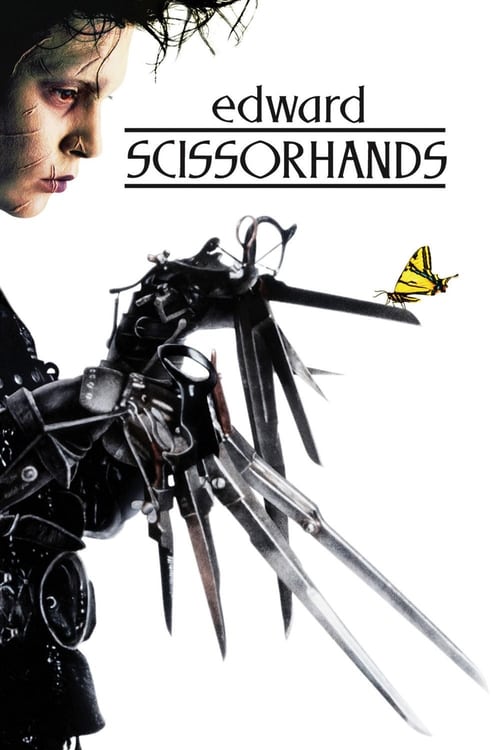
Edward Scissorhands
1990 · Tim Burton
For when you feel like the odd one out and want a film that understands — or for a wintry night in when you want to be enchanted and don't mind crying a little. Comfort viewing with a bruise in it.
What it's about
An inventor dies before finishing his creation, leaving behind a gentle artificial young man with scissor blades where his hands should be. A kindly Avon lady finds Edward alone in the Gothic mansion above town and brings him home to her pastel suburb, where the neighbors first adopt him as a novelty — he sculpts hedges, cuts hair, transforms everything he touches — and where he falls quietly in love with the daughter of the family sheltering him.
The experience
A bittersweet fairy tale that's funny and candy-colored on the surface and genuinely sad underneath — it moves like a storybook, and by the end it lands somewhere between wonder and heartbreak. Few films are this whimsical and this melancholy at once.
Performances
Johnny Depp says almost nothing and breaks your heart anyway — the whole performance lives in his eyes and flinching, careful hands. Dianne Wiest radiates decency as the Avon lady who takes him in, and Winona Ryder gives the love story its tenderness.
The craft
The production design is the star attraction: a looming Gothic castle on a hill above rows of mint-and-peach tract houses, topiary animals, ice sculptures, and Danny Elfman's soaring choral score, one of the loveliest ever written for a fantasy. It's a film built from images you'll keep — worth seeing big and loud if you can.
Why it matters
The film that made Tim Burton's sensibility a brand and began his long collaboration with Johnny Depp, turning Depp from teen idol into character actor; its lonely-outsider iconography has been echoed, costumed, and homaged ever since.
Snapshot
Edward Scissorhands is Tim Burton's fourth feature and the first that was unmistakably, personally his — a modern fairy tale about a gentle artificial man left unfinished, his hands a set of shears, who is brought down from a Gothic mansion on the hill into the manicured cul-de-sacs of pastel suburbia. Made for 20th Century Fox after the runaway commercial success of Batman (1989) gave Burton the leverage to mount a deeply idiosyncratic passion project, the film fuses the iconography of Universal horror (the lonely monster, the castle, the torch-bearing mob) with the lacquered surfaces of 1950s-and-1960s American suburban comedy. It marks the beginning of Burton's career-defining collaboration with Johnny Depp, whose nearly silent, white-faced performance reframed him from teen-idol to character actor, and it deepened Burton's working partnership with composer Danny Elfman, who has called the score among his most personal. The film is at once a Frankenstein riff, a Christmas tale, an outsider parable, and a melancholy romance, and its enduring cultural footprint rests on the central image — a black-clad figure with blades for fingers, tender and dangerous in the same gesture.
Industry & production
The film's production history is closely tied to Burton's rising studio capital. After Pee-wee's Big Adventure (1985) and Beetlejuice (1988) established him as a commercially viable stylist, the enormous success of Batman in 1989 made Burton a bankable director able to command an unusual personal project at a major studio. Edward Scissorhands was produced and released by 20th Century Fox; Burton produced alongside Denise Di Novi, who became a recurring producing partner during this period.
The screenplay is credited to Caroline Thompson, working from a story by Burton and Thompson. The conceit originated in a drawing Burton has described from his own adolescence in suburban Burbank — a figure who wants to touch and connect but whose hands injure whatever they reach for, an image he has tied to feelings of isolation and the difficulty of expression. Thompson, then a novelist, was brought in to shape that image into a narrative, and she has been widely credited with grounding the fable in emotional and structural coherence.
Casting was consequential. A number of established stars were reportedly considered or interested in the lead, but Burton chose Johnny Depp, then known primarily for the television series 21 Jump Street; the role redirected Depp's career toward eccentric, transformation-heavy parts and inaugurated a collaboration that would run through Ed Wood, Sleepy Hollow, Charlie and the Chocolate Factory, Corpse Bride, Sweeney Todd, and Dark Shadows. Winona Ryder, who had worked with Burton on Beetlejuice, played Kim. Dianne Wiest played the Avon saleswoman Peg, who brings Edward home; Alan Arkin, Anthony Michael Hall, and Kathy Baker filled out the suburban ensemble. Vincent Price — a touchstone of Burton's childhood cinephilia and the subject of his early short Vincent — played the Inventor in what proved to be one of his final screen roles, lending the film a direct line back to the Gothic horror tradition it reworks.
Principal photography took place largely in Florida, where a real suburban subdivision near Tampa (in the Lutz/Land O' Lakes area) was repainted in pastels to create the artificial neighborhood. This use of an actual tract development, redressed rather than built, is central to the film's effect.
Technology
Edward Scissorhands is notable for how little it relies on the optical and digital trickery that defined Burton's Batman. The scissor-hands themselves were practical: articulated prosthetic appliances designed by the makeup and effects team (Stan Winston's studio executed Edward's makeup and the hand apparatus, with Winston also appearing briefly on screen). The blades were real-looking mechanical constructions that Depp learned to manipulate, and the topiary and ice sculptures Edward carves were produced practically as set pieces and props rather than as visual effects. The film thus belongs to the last moment of a largely pre-digital studio fantasy filmmaking, where wonder is achieved through prosthetics, art direction, and in-camera staging. The artificial snow that falls over the suburb in the film's framing winter scenes is likewise a practical, atmospheric effect tied thematically to Edward's ice carving.
Technique
Cinematography
Stefan Czapsky shot the film (he would reunite with Burton on Batman Returns and Ed Wood). The visual design hinges on a deliberate chromatic split: the suburb is rendered in saturated, candy-colored pastels — mint, peach, lavender, butter yellow — under flat, bright daylight, while the Inventor's mansion on the hill is a desaturated Gothic world of shadow, blue-gray stone, and verticals. The contrast does the film's thematic work optically, separating the world of conformist surfaces from the world of melancholy interiority, and Edward, in his black leather and pale scarred face, is a visual intrusion into both. The camera tends toward symmetry and storybook framing in the suburb, emphasizing the regimented sameness of the houses and the choreographed exodus of identical cars each morning.
Editing
Richard Halsey edited the film. The cutting supports a fable's rhythm: episodic, gently paced movements as Edward is discovered, domesticated, celebrated, and then turned upon. The structure is bracketed by a framing device — an elderly woman telling a granddaughter the story of why it snows — which the editing uses to establish the film as recounted legend, lending its abrupt tonal shift from comedy to tragedy the inevitability of a told tale.
Mise-en-scène / staging
Production designer Bo Welch (a frequent Burton collaborator of this era) is arguably the film's decisive craftsman after Burton himself. The suburb is staged as a closed, stylized system — a grid of nearly identical houses in a tight palette, each with its own busybody routine — against which the verticality and decay of the Inventor's castle reads as the repository of imagination and death. Costume design by Colleen Atwood (another long-running Burton partner) reinforces the scheme, dressing the neighborhood women in bright coordinated outfits and Edward in his buckled, fetishistic black. The topiary animals Edward sculpts, the elaborate hairstyles he gives the neighborhood, and the climactic angel ice sculpture are all staged as eruptions of the marvelous into the mundane.
Sound
Danny Elfman's score is foundational to the film's identity. Built around wordless choir, celesta, music-box textures, and a soaring main theme, it codes the film as fairy tale and supplies the wonder and pathos that Edward, nearly mute, cannot voice himself. Elfman has repeatedly named it among his favorite and most personal scores. The sound design otherwise leans on the snicking, metallic motion of the blades — a recurring aural signature that keeps the threat of the hands present even in tender scenes.
Performance
Depp's performance is the film's centerpiece and a study in restraint: working with very little dialogue, heavy makeup, and constrained hands, he builds Edward through posture, hesitation, and a wide-eyed, wounded gaze, drawing on silent-film expressivity and physical comedy. Critics have linked the performance to Chaplin and to Boris Karloff's Frankenstein monster — the inarticulate innocent whose body is both the source of his art and his alienation. Around him, the ensemble plays in a broader, satirical register: Wiest's relentless maternal kindness, Baker's predatory neighbor, Hall's brutish boyfriend Jim, and Ryder's Kim, who moves from fear to love. Vincent Price's brief, warm turn as the Inventor anchors the film's emotional and historical lineage.
Narrative & dramatic mode
The film operates in the mode of the literary fairy tale rather than realist drama. Its framing device — a grandmother's bedtime story explaining the origin of snow — announces it as myth, and its plot follows fairy-tale logic: a creature from a liminal place is brought into a community, is briefly embraced for his gifts, is scapegoated when fear and jealousy curdle, and is finally exiled back to his castle, his love rendered impossible by his nature. The dramatic engine is the gap between Edward's inner gentleness and his outward danger; every act of intimacy carries the risk of harm, so that the romance is structured around touch that cannot be safely given. The tone moves deliberately from suburban comedy of manners into tragedy, a tonal modulation the framing device prepares the audience to accept.
Genre & cycle
Edward Scissorhands is a hybrid: a Gothic fantasy and modern fairy tale crossed with suburban satire and melodrama. It belongs to a cycle of late-1980s and early-1990s American films that turned a critical, stylized eye on suburbia (alongside, in different keys, the work of David Lynch and the suburban-anxiety pictures of the era), and it sits squarely within Burton's own emerging cycle of outsider parables — films sympathetic to the misunderstood monster, the freak, the misfit artist. It is also, structurally and seasonally, a Christmas film, building to a snow-bound winter climax and an origin myth for snow. Its most direct genre ancestor is the Universal Frankenstein tradition, which it both quotes and inverts.
Authorship & method
The film is the clearest early statement of Burton's authorial signature: sympathy for the monster, fascination with the misfit artist, a Gothic-meets-kitsch visual sensibility, and a recurring split between drab or conformist "normal" worlds and shadowed realms of imagination. Burton has framed Edward as among his most autobiographical creations, an avatar for the isolation and creative inarticulacy he felt growing up in Burbank.
The authorship is, characteristically, collaborative around a strong central vision. Caroline Thompson translated Burton's image into a workable screenplay and emotional architecture. Danny Elfman, scoring his fourth Burton film, provided the musical voice the protagonist lacks; their partnership is one of the most sustained director-composer collaborations in modern American cinema. Cinematographer Stefan Czapsky, production designer Bo Welch, and costume designer Colleen Atwood realized the chromatic and spatial split between suburb and castle. Editor Richard Halsey shaped the fable's measured rhythm. And the casting of Vincent Price as the Inventor functions almost as a thesis statement of method: Burton importing the icons of his own cinephile childhood directly into his work, much as he had paid tribute to Price in his 1982 short Vincent.
Movement / national cinema
The film is mainstream American studio cinema, made within the Hollywood system at the height of Burton's post-Batman clout. It does not belong to a formal movement, but it is a key text in what might be called the New Hollywood Gothic or the auteur-fantasy strain of late-twentieth-century American filmmaking — directors granted, on the strength of blockbuster success, the latitude to pursue personal, stylized visions inside the studio apparatus. Its deepest stylistic debts are to American German-influenced Gothic horror (Universal's monster films, themselves shaped by German Expressionism) and to a self-consciously Americana suburbia, making it a distinctly American synthesis of imported Gothic and homegrown kitsch.
Era / period
Released in December 1990, the film arrives at the threshold of the 1990s and the closing of the practical-effects era of studio fantasy. It reflects a Reagan-and-Bush-era suburban prosperity rendered as both comic idyll and conformist cage, and it channels a period anxiety about sameness and exclusion beneath cheerful surfaces. Industrially, it captures a specific moment — a director cashing the creative check earned by a tentpole hit — that the increasingly franchise-driven 1990s and 2000s would make rarer.
Themes
The governing theme is the outsider: the gentle, creative being whom a community first exploits, then fears, then casts out. Closely bound to it is the danger of touch and the tragedy of an artist whose very instrument of creation is also a weapon — Edward can sculpt hedges and hair and ice into beauty, but he cannot embrace without wounding. The film interrogates conformity and the violence beneath suburban niceness, showing how quickly admiration turns to suspicion and a mob forms. It is a meditation on creativity and incompleteness — Edward is unfinished, and his art is the overflow of what he cannot otherwise express. Romantic impossibility runs through it: love that cannot be consummated because intimacy is literally dangerous, resolved only in memory and myth. And it is, finally, a story about storytelling itself — the snow Edward carves becomes a legend a grandmother passes on, so that the outsider, exiled in life, is preserved in collective memory.
Reception, canon & influence
Edward Scissorhands was met with strong, if not unanimous, critical praise on release and has grown steadily in stature into one of Burton's most beloved and canonical films. Critics singled out Burton's visual imagination, Elfman's score, and especially Depp's tender, near-silent performance, which reset his career. The film earned recognition during awards season — including an Academy Award nomination for makeup — and is now widely regarded as the purest distillation of Burton's sensibility before his style hardened into self-imitation in later decades. (I should note that specific box-office figures and the full slate of award outcomes are not something I can cite precisely here without risking error.)
Backward, the film's influences are legible and openly acknowledged: the Universal Frankenstein films and the figure of the sympathetic monster; the Gothic horror tradition embodied by Vincent Price, imported in person; fairy-tale structure in the Grimm and Andersen lineage (the snow myth especially recalls Andersen's seasonal fables); silent-film physical performance, Chaplin among its touchstones; and the stylized suburbia that other American filmmakers were also anatomizing at the time. Burton's own earlier work — the short Vincent, Beetlejuice, and the Gothic-comic sensibility he had been developing — feeds directly into it.
Forward, its legacy is substantial. The central image of Edward — pale, scarred, black-clad, blade-fingered — became an enduring icon, widely referenced, costumed, and parodied, and helped crystallize a popular Gothic-romantic aesthetic that resonated through fashion and youth subculture. It established the Burton-Depp partnership that shaped both careers, and confirmed the Burton-Elfman scoring relationship as one of the defining director-composer collaborations of the era. The film is a foundational text for later sympathetic-monster and misfit-romance stories, and its template — the gentle outsider loved and feared by an ordinary community, narrated as legend — recurs across subsequent fantasy cinema. Within Burton's filmography it remains the benchmark against which his later, more uneven Gothic fantasies are measured, and a reference point critics return to whenever they ask what his cinema, at its most sincere, was about.
A Deleuzian reading
Start with the snow.
The full Deleuzian reading of Edward Scissorhands →
Reception
Not a flop-to-classic story — it was warmly received and a hit in 1990 — but it's since been promoted from 'charming fairy tale' to the consensus Burton masterpiece, the film every ranking of his career puts at or near the top.
How Edward Scissorhands was received, from release to now →
Influences: the films it descends from and the films it influenced
- Frankenstein (1931) — Edward is built on the Universal sympathetic-monster template — the lurching, inarticulate creation whose maker dies and leaves him defenseless — and Burton restages the laboratory-creation iconography inside the castle.
- Bride of Frankenstein (1935) — Supplies the tonal blend of pathos and gothic camp and the specific beat of the gentle monster who learns tenderness only to be mobbed by torch-bearing townsfolk.
- The Cabinet of Dr. Caligari (1920) — The pale, black-clad somnambulist Cesare and the painted angular shadow-sets are direct models for Edward's makeup, silhouette, and the expressionist geometry of the castle interior.
- Nosferatu (1922) — Edward's clawed-fingered silhouette and uncanny waxen pallor borrow the Expressionist vampire's elongated-hand iconography as visual shorthand for menace fused with melancholy.
- City Lights (1931) — The near-silent performance carries all emotion through face and pantomime gesture rather than dialogue, descending from Chaplin's tender, inarticulate outsider.
- La Belle et la Bête (1946) — Provides the fairy-tale architecture of a monstrous figure loved despite his form, the enchanted castle as living space, and in-camera practical magic over explanation.
- House of Wax (1953) — Vincent Price's disfigured-artist horror persona is imported wholesale as method when Burton casts Price himself as the Inventor — a casting choice that is a thesis on his cinephilia.
- Vincent (1982) — Burton's own Price-tribute short first fixes the monochrome gothic-kitsch aesthetic and the misunderstood-misfit-artist figure that Edward fully realizes.
- Beetlejuice (1988) — Establishes the Burton–Elfman scoring partnership and the drab-conformist-world-versus-fantastical-realm visual split that Edward refines into pastel suburb against shadowed castle.
- Willy Wonka & the Chocolate Factory (1971) — Burton and Stefan Czapsky directly reprise the color-saturation bifurcation as moral geography — gray suburban flatness vs. the saturated gothic castle — with the outsider fantasy figure inhabiting a hermetically sealed practical-set domain, extending Goff's full-scale construction philosophy into suburban gothic.
- The Elephant Man (1980) — Burton extends the freak-show-cycle structure — prosthetic outsider accepted, instrumentalised, then expelled by a community that initially performs charity — into American suburban gothic; Depp's negotiation of blade-prosthetics to convey tenderness descends directly from Hurt's method of projecting emotion through physical constraint, substituting scissors for tumorous mass.
- E.T. the Extra-Terrestrial (1982) — Transplants the gentle, misunderstood outsider into the pastel suburban-domestic cul-de-sac, mining the same melodrama of a fragile non-human's bond with a child and inevitable parting.
- Big Fish (2003) — Extends Edward's framing device of an outsider's life recounted as fireside legend, narrated retrospectively by a witness who turns biography into myth.
- Pan's Labyrinth (2006) — Carries forward the practical-effects fairy tale that grafts Grimm/Andersen structure onto a sympathetic creature, treating the fable's logic as literally real.
- The Shape of Water (2017) — Builds a misfit-monster romance directly on Edward's danger-of-touch and the mute, gentle outsider loved by an ordinary woman and feared by the community.
- Corpse Bride (2005) — Extends the pale gothic-romantic protagonist and the Burton–Elfman practice of using the score as the voice for an emotionally articulate but socially voiceless figure.
- A.I. Artificial Intelligence (2001) — An artificial being engineered to love yet rejected by ordinary people, structured explicitly as a Pinocchio/Andersen fairy tale — Edward's premise in a science-fiction key.
- Warm Bodies (2013) — A sympathetic-monster romance descended straight from the gentle-creature-loved-and-feared template, narrated from the inarticulate outsider's longing point of view.
- Harry Potter and the Prisoner of Azkaban (2004) — Burton's gothic fairy tale legitimized the dark-fantasy blockbuster built around a lonely outsider, seeding the melancholic-monster register Azkaban gives Lupin, Sirius and the Dementors.
- But I'm a Cheerleader (2000) — The pastel suburban tract-home palette used to satirize normative conformity, with an outsider marked as 'unnatural,' is the visual grammar Babbit adapts for her conversion-camp setting.
- Alice in Wonderland (2010) — Founds the Burton–Elfman–Depp method — the melancholic pale-eccentric outsider and Elfman's leitmotif-driven fairy-tale scoring — that the Hatter and this soundtrack extend.
- Miss Peregrine's Home for Peculiar Children (2016) — Establishes the Burton macabre-cute misfit fable plus Colleen Atwood's silhouette-driven costume language that Peregrine inherits wholesale (minus Elfman's score).
- Barbie (2023) — Establishes the pastel, high-key suburban soundstage as a fable set — candy-colored uniform houses and heightened production design used to frame an outsider's arrival.
- Dracula (2025) — Danny Elfman's tragic-outsider scoring idiom here — choral, music-box romanticism attached to a wounded, estranged protagonist — is the same authorial voice Elfman brings to Dracula's tone.
- Blue Velvet (1986) — Anatomizes the manicured American suburb as an uncanny stage, its candy-colored conformist surface hiding the grotesque — the same stylized-suburbia critique Burton pursues.
- Frankenstein (2025) — Sibling gothic of a gentle, hand-made being abandoned by his inventor-father, whose costume and silhouette ennoble the outcast — the sympathetic-creation iconography del Toro shares.
- Sweeney Todd: The Demon Barber of Fleet Street (2007) — Burton's own bladed-outsider prototype with Depp — pale, scissor-fingered gothic romantic — whose costume-as-character silhouette and expressionist suburban-gothic design directly prefigure the razor-wielding barber.
- Beetlejuice Beetlejuice (2024) — The Burton-Elfman storybook-gothic dialectic — pastel suburbia set against a looming gothic manor, scored with a music-box celesta motif — is the authorial signature the sequel returns to after Burton's larger studio assignments.
- Lisa Frankenstein (2024) — The wordless, gentle, artificial-man love object set against a pastel-saturated suburbia is the closest visual and performance ancestor for Sprouse's mute creature and the gothic-pastel look.
Similar films
- Blue Velvet (1986) — influence & lineage · often watched together
- Big Fish (2003) — influence & lineage
- Beetlejuice (1988) — influence & lineage
- Corpse Bride (2005) — influence & lineage
- The Cabinet of Dr. Caligari (1920) — influence & lineage · often watched together
- Guillermo del Toro's Pinocchio (2022) — often watched together
- The Shining (1980) — often watched together
- What's Eating Gilbert Grape (1993) — often watched together
All the films related to Edward Scissorhands →