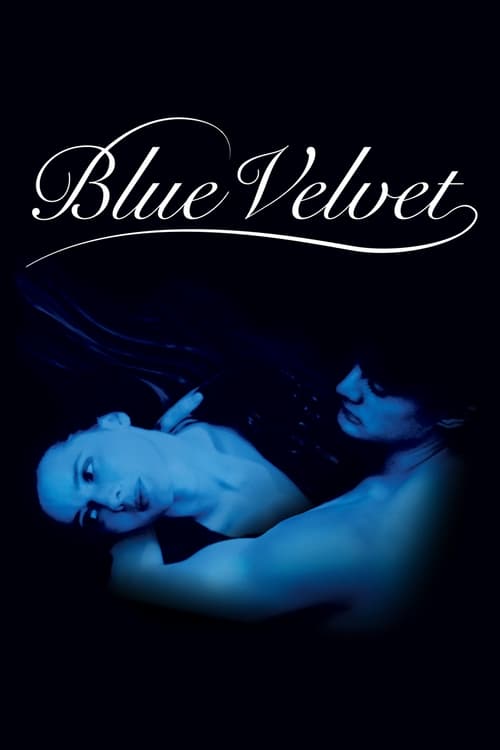
Blue Velvet
1986 · David Lynch
His January 2025 death was a global grief event that revealed how central he'd become to young cinephile identity; "Fix your hearts or die" and the daily weather reports became memorial memes. The reference point for everything called "Lynchian."
For when you want to be genuinely disturbed rather than jump-scared — a film that gets under your skin and stays there. This is a challenge, not comfort viewing; save it for a night when you're ready to be shaken.
What it's about
A clean-cut college kid home in a picket-fence lumber town finds a severed human ear in a field, and instead of leaving it to the police he starts digging. The trail leads to a wounded nightclub singer trapped by a volatile criminal, and to a hidden world of menace running right underneath the town's sunny lawns and white fences. What begins as amateur detective work becomes something much more dangerous: he doesn't just observe this world, he gets pulled inside it.
The experience
Dreamlike and deeply unsettling — it moves with the slow pull of a nightmare you can't wake from, swinging between soap-opera innocence and scenes of raw menace that leave you holding your breath. It's seductive and frightening at once, and it lingers for days.
Performances
Dennis Hopper's gas-huffing criminal is one of the most terrifying villains ever put on screen — pure unpredictable menace. Isabella Rossellini gives a fearless, wounded performance as the singer, and Kyle MacLachlan's wide-eyed curiosity makes the descent feel like ours.
The craft
Every frame is composed like a picture postcard hiding something awful — saturated reds and blues, roses against white fences, then the camera burrowing into the dark. The sound design and Angelo Badalamenti's lush, sinister score do half the frightening; the title song and 'In Dreams' will never sound innocent to you again. Rewards a dark room and good speakers.
Why it matters
It redefined what American movies could say about small-town life, launched the Lynch-Badalamenti-MacLachlan collaboration that led to Twin Peaks, and its fingerprints are on decades of films and TV about the darkness under suburbia.
Snapshot
Blue Velvet is the film in which David Lynch found his definitive register: a waking dream that holds the prettiest surfaces of postwar American life up to the light until the rot shows through. Beginning with a severed ear lying in a field of Lumberton, North Carolina, and following young Jeffrey Beaumont through a labyrinth of voyeurism, sexual violence, and operatic criminal menace, the film synthesizes noir, melodrama, and surrealist hallucination into something that had no precise precedent. Commercially modest on release, it immediately entered critical debate as either an irresponsible provocation or an American masterwork — and its influence widened steadily over the following decades, reshaping what American cinema thought suburban life was permitted to mean.
Industry & production
The film's unusual degree of creative freedom traces directly to the failure of Lynch's previous feature. After the expensive and critically dismantled Dune (1984), producer Dino De Laurentiis offered Lynch a comparatively small budget — reported at approximately six million dollars — with the explicit understanding that Lynch would have final cut and no studio interference, provided he stayed on budget. Lynch accepted and delivered the film on those terms. This arrangement, rare for a filmmaker of Lynch's profile, resulted in one of the few mid-decade Hollywood-adjacent pictures made without the conventional mechanisms of script development, test screenings, or studio note cycles.
Principal photography was conducted largely in and around Wilmington, North Carolina — the same production infrastructure that would later anchor the De Laurentiis studio lot. The fictional town of Lumberton is never geographically placed, but the choice of Wilmington gave Lynch actual suburban streets, bungalows, and industrial edges rather than backlot construction. The production operated on a modest scale that suited the material: a small crew working in close quarters, which appears to have contributed to the film's hermetically pressurized atmosphere. Casting drew from both established Hollywood figures (Dennis Hopper, whose career was then in a difficult passage) and Lynch regulars (Kyle MacLachlan, who had starred in Dune). Isabella Rossellini — daughter of Ingrid Bergman and Roberto Rossellini, and at the time primarily known as a model and spokesperson — was cast against any obvious commercial logic, a decision that concentrated the film's tensions between beauty, suffering, and the male gaze into a single presence.
Technology
Blue Velvet was shot on 35mm by Frederick Elmes, utilizing a widescreen 2.35:1 aspect ratio that gave the frame both the grandeur of classical Hollywood and the capacity to isolate figures in threatening negative space. The film was cut on flatbed in the conventional editorial practice of the period. No significant technical novelties are on record; the force of the image came from control of light, color, and lens choice rather than from equipment innovation.
The color palette deserves mention as a technological choice with aesthetic consequence. The suburban daylight sequences — white picket fences, red roses, the saturated emerald of a lawn hose running — recall the amplified Technicolor of 1950s domestic melodrama. Against this, Dorothy Vallens's apartment and the nightclub sequences drop into deep, crushing shadow. This opposition was deliberate and represents a disciplined use of stock, lighting ratios, and color temperature to reinforce the film's central dialectic between surface America and whatever lies beneath.
Technique
Cinematography
Elmes, who had photographed Eraserhead (1977) alongside Herbert Cardwell, brought an expressive fluency to Blue Velvet's very different visual demands. The film's most programmatic cinematographic gesture is the opening: from extreme close-up on red roses and white picket fence, the camera slowly descends through the lawn's surface into a roiling colony of insects beneath — a literal and figurative plunge from the decorative into the subterranean. This descent is executed with a macro lens and visible artificial light, and it establishes the film's entire spatial and moral grammar in under two minutes.
Subsequently, the cinematography tracks Jeffrey's psychological state: daylight exteriors are crisp and Rockwellian; the closet sequence in Dorothy's apartment, in which Jeffrey watches Frank Booth's assault, is shot in restricted angles that simulate entrapment and complicity. Close-up is used with precision — Frank's face in extremity, Dorothy's expression during performance — always implicating the camera, and by extension the spectator, in an act of surveillance.
Editing
Duwayne Dunham's editing is formally legible by conventional standards while being tonally dissonant within scenes. The film does not use experimental montage; what unsettles is the abruptness of tonal transition — a sequence of suburban contentment cut against terror without the buffering cues that genre cinema typically supplies. The transition from Sandy and Jeffrey's innocent evening to the savagery of Frank Booth's world is compressed rather than extended, so the viewer is constantly inhabiting both registers simultaneously. The closing montage, which returns to the roses and the robin, has been read both as sincere and as deeply ironic depending on what editing rhythm one brings to it — Dunham holds this ambiguity without resolving it.
Mise-en-scène / staging
Lynch's staging decisions are theatrical in the best sense: architecturally precise, yet capable of tipping into the dreamlike without warning. Dorothy's apartment is a masterwork of domestic claustrophobia — dark woodwork, heavy drapery, a worn sofa — an environment that reads as both realistic and slightly wrong in its dimensions, as if the set had been built at 95% scale. Frank Booth's staging, particularly in the "In Dreams" sequence, exemplifies Lynch's method: Dean Stockwell's Ben lip-syncs to Roy Orbison's song holding a work light as a makeshift microphone, in a tableau of exquisite, menacing absurdity, while Frank watches in ambiguous ecstasy. The staging refuses to signal whether this is comedy, horror, or ceremony — it is all three at once, in a room that feels simultaneously backstage and sacred.
The film's settings form a consistent symbolic geography: above-ground Lumberton (Sandy's world, daylight, normality) versus subterranean Lumberton (Dorothy's world, night, desire and violence). Jeffrey physically moves between them, and the mise-en-scène ensures the viewer always knows which plane of reality they are inhabiting.
Sound
Alan Splet, Lynch's sound designer since Eraserhead, crafted a sonic environment for Blue Velvet that is at least as significant as its cinematography. Splet built an ambient underworld of industrial hum, insect noise, and subsonic pressure that runs continuously beneath the film's surface, most explicitly during the ear-in-the-field sequence. The contrast between diegetic silence (the suburban exterior) and this sustained sonic unease enacts in acoustic terms what the opening macro shot does visually: there is always something wrong beneath the ordinary.
The film's deployment of popular song is equally considered. Bobby Vinton's recording of "Blue Velvet" (1963) frames the film's opening and closing with an ache of lost innocence that is simultaneously genuine and hollow — the song functions as cultural artifact, as emotional target, and as ironic commentary on the world it supposedly describes. Roy Orbison's "In Dreams" is weaponized similarly: a vocal performance of extraordinary longing turned into an instrument of psychological coercion. Lynch and Splet's treatment of these recordings — naturalistic in placement but loaded in context — would prove enormously influential on subsequent filmmakers' use of period pop music as tonal counterpoint.
Performance
Dennis Hopper's Frank Booth is among the most operatic villain performances in American cinema: unpredictable, physically volatile, and structured around an infantile terror that Lynch and Hopper apparently located in the character's psychology without making it explicit. Hopper, by multiple accounts, brought significant personal investment to the role. Whatever the private circumstances, the result is a performance that never settles into caricature — Frank is frightening precisely because his behavior has the internal consistency of genuine psychosis rather than genre convention.
Isabella Rossellini's Dorothy Vallens is a more complex and more contested achievement. She plays a woman in maximum exposure — psychic, physical, emotional — and the critical controversy around her performance often displaced onto her what was actually a structured argument in the screenplay about victimhood, desire, and the voyeur's complicity. Lynch has spoken of working with actors through images and emotional states rather than psychological motivation, and Rossellini's performance has the quality of a figure who exists fully in the physical world but is also somehow legible as a symbol.
Kyle MacLachlan's Jeffrey occupies the film's moral center as an ambiguous surrogate for the audience: curious, drawn toward transgression, not entirely innocent in his witnessing. Laura Dern's Sandy provides the film's moral commentary, a voice of light that the film takes seriously rather than condescends to.
Narrative & dramatic mode
Blue Velvet deploys the structure of the detective-initiation narrative — an innocent enters a dangerous world, follows a clue, solves a mystery — but systematically degrades the genre's epistemological promise. Jeffrey discovers who kidnapped Dorothy's son and husband fairly early; what the investigation uncovers is not a puzzle but a condition: the world is constituted by violence, desire, and concealment, and understanding this does not grant power over it. The narrative mode is closer to Bildungsroman than to procedural — or to a dream in which following the logic to its end leaves you no closer to waking.
Lynch has described the film as drawn from obsessive images — a severed ear, a woman in trouble, a man entering a room he should not — and the structure shows this origin in its episodic, image-driven progression rather than in tightly causal plotting. Scenes arrive with the inevitability of dreamwork; transitions between them are often elliptical.
Genre & cycle
Blue Velvet arrives at the intersection of neo-noir and what critics subsequently called suburban Gothic — a mode of American filmmaking that treats the postwar domestic landscape as a site of concealed pathology rather than achieved innocence. Its noir inheritance includes the femme fatale (Dorothy), the criminal underworld, the investigative male protagonist, and the city's replacement by a provincial setting that turns out to be equally corrupted. Its departures from genre orthodoxy include the surrealist imagery, the fairy-tale structuring, and its refusal of the noir resolution in which the investigator achieves mastery over the darkness he has uncovered.
The film belongs to a cluster of mid-1980s American films that excavated suburban and small-town mythology — Smooth Talk (1985), River's Edge (1986), Something Wild (1986) — but it is the most radical in formal terms and the most explicitly dreamlike.
Authorship & method
Lynch wrote the screenplay alone, working from materials that had accumulated over years: images, obsessions, and an attraction to the tension between the beautiful and the horrifying that would define all his subsequent work. His method on set was to communicate through images and analogies rather than through character psychology or narrative logic — he wanted actors and crew to inhabit a sensory world rather than decode a script.
Frederick Elmes's contribution, as a cinematographer with an art-house background (he also photographed several John Cassavetes films), was to translate Lynch's imagistic vision into workable, technically consistent images without imposing a style that would neutralize Lynch's idiosyncrasy.
Angelo Badalamenti's score was his first collaboration with Lynch — a partnership that would continue through Twin Peaks, Wild at Heart, Mulholland Dr., and beyond. The Blue Velvet score is marked by slow jazz textures, modal harmonics, and a kind of gorgeous unease that would become the signature sound of Lynch's world. Badalamenti has described their working method as Lynch describing a mood or scene verbally or with gesture while Badalamenti improvised at the piano until Lynch confirmed the emotional register.
Alan Splet died in 1994, and it is difficult to overstate his role in the films he worked on with Lynch: sound was never incidental to Lynch's cinema but structural, and Splet's craft made possible the atmospheric coherence of Eraserhead through Blue Velvet.
Movement / national cinema
Blue Velvet occupies an anomalous position within American cinema: financed by an independent European-American producer, distributed by De Laurentiis Entertainment Group, it exists at the margins of the Hollywood system rather than within the emerging American independent infrastructure associated with Sundance. Lynch was neither a Hollywood journeyman nor a low-budget independent; he was a singular auteur working in the interstices of commercial and art cinema. Internationally, the film was received within the art-cinema context — a continuator, in some readings, of European surrealist and modernist filmmaking traditions applied to American material.
Era / period
Blue Velvet was released into Reagan-era America, and many critics have read it as an implicit critique of the Reagan mythology: the America of restored innocence, traditional values, and surface optimism concealing economic inequality, domestic violence, and psychic coercion. Lynch has consistently resisted openly political readings of his work, but the historical specificity is difficult to suppress. The film's idealized small-town imagery — derived partly from Lynch's own childhood in various American towns, partly from the cultural iconography of the 1950s — places it within a broader 1980s cultural conversation about what American normality was performing and what it was masking.
Themes
The film's central dialectic — the idyllic surface over the violent abyss — organizes its major thematic concerns. Voyeurism is explicitly foregrounded: Jeffrey watches from a closet, and the film positions the spectator in equivalent complicity; the pleasure of looking is inseparable from the ethics of what is seen. Sexuality, violence, and power are bound together in Frank Booth's characterization without being exoticized — the film treats their connection as symptomatic of something systemic rather than merely individual.
The uncanny — Freud's unheimlich, the familiar rendered strange — runs through the film's visual grammar. Lumberton is recognizable but slightly off; its beauty is operatic in a way that signals unreliability. The ear in the field is the film's signature uncanny object: at once an anatomical fact and an impossible threshold, a door into a world beneath the suburban real.
The film also interrogates American masculine identity: Jeffrey is drawn to transgression, participates in violence, and must integrate this knowledge of himself into whatever he becomes. The closing sequence — which returns to the roses, the robin, and Sandy's smile — offers redemption but cannot quite close the gap the film has opened.
Reception, canon & influence
On release, Blue Velvet divided critical opinion sharply. Lynch received an Academy Award nomination for Best Director — losing to Oliver Stone for Platoon — which marked the film's formal recognition by the mainstream industry even as it puzzled or offended many reviewers. Roger Ebert wrote a notably negative assessment, objecting in particular to what he characterized as the film's exploitative treatment of Isabella Rossellini; he later revisited the film and included it in his Great Movies series, a reversal that itself became part of the film's critical history. Pauline Kael and other critics championed it. The record of this split reception is well established, even if the specific language of individual reviews should be verified in primary sources rather than cited from memory.
By the 1990s, critical consensus had moved substantially toward the film. It appears on most authoritative canonical lists — Sight & Sound polls, the National Film Registry (which selected it for preservation in 2015), and the extended critical literature on American cinema's defining works. It is now routinely taught as a central text of American film of the 1980s.
Influences on Blue Velvet include: classical Hollywood noir (the femme fatale and the corrupted investigator); Douglas Sirk's 1950s melodramas, particularly All That Heaven Allows (1955) and Written on the Wind (1956), which Lynch has acknowledged as formative in their use of saturated color and bourgeois artificiality; Alfred Hitchcock, particularly the voyeuristic architecture of Rear Window (1954) and the obsessive male gaze of Vertigo (1958); the American Surrealist underground, including Kenneth Anger; and the European surrealist tradition running through Buñuel. Edward Hopper's paintings have been cited by critics, if not always by Lynch directly, as an antecedent for the film's rendering of American space as simultaneously familiar and alien.
The film's forward influence has been broad and traceable. Lynch's own Twin Peaks (1990) — the television series that brought his sensibility to a mass audience — is the direct continuation of Blue Velvet's world, featuring Kyle MacLachlan, Badalamenti's score, and the same dialectic between Pacific Northwest small-town normality and subterranean violence. Sam Mendes's American Beauty (1999) and Todd Haynes's Far from Heaven (2002) both work within the suburban Gothic mode that Blue Velvet definitively established, the latter explicitly in dialogue with Sirk. The film's treatment of popular song as emotional counterpoint was noted by Quentin Tarantino among others as a formative influence. More diffusely, the film recalibrated American cinema's sense of what suburban and small-town settings were permitted to contain — a permission that has been exercised by filmmakers across the subsequent four decades.
A Deleuzian reading
The lawn is too green.
The full Deleuzian reading of Blue Velvet →
Reception
One of the most divisive releases of 1986 — Roger Ebert's furious one-star pan (he felt Lynch degraded Isabella Rossellini) sparked an on-air feud, even as Lynch landed a Best Director Oscar nomination. Today it's near-universally ranked among the greatest American films of the 1980s and the skeleton key to everything 'Lynchian.'
How Blue Velvet was received, from release to now →
Influences: the films it descends from and the films it influenced
- Rear Window (1954) — Lynch maps Hitchcock's grammar of the fixed voyeuristic position and obstructed sightline directly: Jeffrey watching Frank from inside the closet inherits exactly the restricted surveillance angle that implicates the viewer in the violation they observe, not merely witness.
- Vertigo (1958) — Hitchcock's degradation of the detective-protagonist into a complicit voyeur obsessed with the woman he is supposedly protecting is the template for Jeffrey's initiation: the detective-narrative as cover story for desire, the investigator morally destroyed by what he looks at.
- Peeping Tom (1960) — Powell's formal conceit — the camera itself as the voyeur's weapon, making the viewer complicit in the violence of looking — is the direct precedent for Lynch's closet sequence, where the surveillance angle forces audience complicity in the degradation being committed on-screen.
- All That Heaven Allows (1955) — Lynch inherits Sirk's technique of weaponizing saturated Technicolor against the values it depicts: picture-perfect bourgeois surfaces rendered so beautifully that their artificiality becomes visible as ideology, the visual pleasure indicting the world it celebrates.
- Written on the Wind (1956) — Sirk's expressionist color-coding — lurid reds and yellows designating psychological corruption beneath a family mansion's façade — is the formal precedent for Lynch's deployment of velvet textures and saturated props to mark Frank's underworld as the American interior made visible.
- Scorpio Rising (1963) — Anger's practice of cutting period pop songs against transgressive and violent imagery to produce ironic tonal dissonance is the specific craft source for Lynch's use of 'In Dreams' and 'Blue Velvet' as Frank Booth's anthems — the innocence of the song weaponized against what it accompanies.
- Un Chien Andalou (1929) — The severed eye opening Buñuel's film establishes the surrealist grammar of bodily violation as dream-portal that Lynch literalizes with the severed ear: a wound in the world's surface that opens into a narrative organized by unconscious association rather than causal logic.
- Eraserhead (1977) — Alan Splet's layered subsonic industrial drone — developed across Eraserhead's five-year production — is carried forward directly into Blue Velvet's ambient sound bed, establishing the physical unease that persists beneath Lumberton's images of apparent tranquility.
- Marnie (1964) — Lynch extends Marnie's backward-revelation structure — surface normality peeled to expose a sexual trauma origin scene — and its color filtration grammar for subjective psychological states, while making the ethical ambiguity of the male surveillance-framing gaze explicit rather than leaving it as subtext.
- Psycho (1960) — Lynch deploys Psycho's voyeurism apparatus as the film's structural principle — Jeffrey hidden in the closet watching, the camera descending through a severed ear into a psychosexual underworld — while the MacGuffin dissolves in significance once the noir-gothic architecture beneath suburban normality is exposed, completing the identification-rupture Hitchcock initiated.
- The Elephant Man (1980) — Lynch extends The Elephant Man's reflexive voyeurism — the film's awareness of its own audience paying to look at Merrick — into suburban neo-noir: Jeffrey's hidden-closet spectatorship directly inherits the ethical discomfort Lynch generates when respectable London society crowds around Merrick's hospital bed, implicating the viewer in the gaze the film simultaneously critiques.
- Blow Out (1981) — Inherits the diegetic sensory-evidence structure and deep-space staging of concealed violence; Lynch's compositions placing foreground domesticity against sharply focused background menace develop the split-diopter spatial logic into full-blown American Gothic expressionism.
- Wild at Heart (1990) — Lynch and Badalamenti's second collaboration extends Blue Velvet's pop-as-counterpoint device: Elvis songs deployed against road-movie violence in the same tonal-dissonance mode, cementing period pop as emotional weaponry as a Lynch formal signature rather than a one-time effect.
- Twin Peaks: Fire Walk with Me (1992) — The direct formal continuation of Blue Velvet's grammar: Badalamenti's modal jazz score and the Pacific Northwest suburban Gothic topology carry forward intact, with MacLachlan again playing the detective-initiate descending from surface normality into violent underground knowledge.
- Pulp Fiction (1994) — Tarantino, who cited Lynch as a direct influence, deploys surf rock and soul songs as tonal counterpoints against on-screen violence — extending the pop-as-emotional-dissonance device Lynch crystallized in Blue Velvet's use of 'In Dreams' during Frank's assault on Dorothy.
- Lost Highway (1997) — Lynch pushes Blue Velvet's dream-logic detective narrative to its structural limit: a neo-noir mystery whose protagonist literally transforms into a different identity mid-film, Badalamenti's score persisting as the suburban Gothic's stable exterior dissolves into pure nightmare.
- American Beauty (1999) — Mendes directly adopts Blue Velvet's macro-beauty-in-rot aesthetic: the slow-motion rose petals and plastic bag as close-up sublimity function as heirs to Lumberton's garden-and-insects opening, redeploying Lynch's grammar of suburban beauty as the surface of concealed corruption.
- Mulholland Drive (2001) — The fullest realization of Blue Velvet's image-driven dream-logic system: Badalamenti's score, a detective-initiation plot dissolved into surrealist fugue, and a voyeur-complicity dynamic in which the protagonist watches her double perform — surveillance turned inward as self-destruction.
- The Love That Remains (2025) — The Lynch-inflected admission of the uncanny into bourgeois domestic realism — a fantastical or dreamlike image allowed to sit unexplained beside the everyday, which Pálmason cites as license for his surreal interludes.
- American Psycho (2000) — Lynch's method of deploying diegetic pop songs as dissonant counterpoint to horrific action — Roy Orbison, Bobby Vinton — and extreme close-ups of consumer surfaces as apertures into violence beneath are structural principles American Psycho inherits wholesale.
- Creepy (2016) — The formal technique of making suburban imagery — lawns, fences, neighborly exchange — into horror's frame rather than its contrast; the investigative protagonist drawn toward the violence he studies prefigures Takakura's criminological blindness as a mode of self-implication.
- Weapons (2025) — Suburban geography excavated as a screen concealing organized violence beneath legible normality; de-dramatized horror imagery withholds conventional generic fear signals while dread escalates structurally — the primary American-horror grammar Weapons inherits.
- The Ice Storm (1997) — Frederick Elmes' cinematography of rot beneath placid suburban surfaces — the same DP's hyper-exact, estranged surface that gives The Ice Storm its glassy menace.
- Synecdoche, New York (2008) — Elmes again — his lush-yet-clinical naturalism that lets the uncanny erupt without stylistic flagging, the deadpan observational register Kaufman recruits to keep a fantastical conceit literal.
- Far from Heaven (2002) — Haynes explicitly revives the Sirkian formal system that Blue Velvet also draws from — saturated 1950s palette, bourgeois melodrama as ideological critique, suburban surface as concealment — making the two films siblings in a shared Sirkian inheritance applied to American suburban rot from opposite temporal directions.
- Jacob's Ladder (1990) — Alan Splet's sound design contaminates the suburban surface with industrial undertones that make ordinary environments feel violated, while Lynch's staging of incremental domestic horror — the normal made monstrous by small degrees rather than outright fantastic intrusion — runs as a direct parallel to Lyne's incremental distortion strategy.
- The City of Lost Children (1995) — Angelo Badalamenti's dread-laced, lullaby-melancholic scoring — first defined for Lynch — is imported here to convert grotesque imagery into oneiric fairy-tale mood, the same composer applying the same method.
- Edward Scissorhands (1990) — Anatomizes the manicured American suburb as an uncanny stage, its candy-colored conformist surface hiding the grotesque — the same stylized-suburbia critique Burton pursues.
- Gozu (2003) — The provincial-ordinary-surface-concealing-perversion structure and the affectless small-town staging that Miike transposes onto liminal Nagoya, where mundane diners and inns become portals to the uncanny.
- It Follows (2015) — Lynch's excavation of menace beneath placid Americana — the dream-logic undertow and uncanny suburban surface that Mitchell cites as his atmosphere's source.
- Something Wild (1986) — Same-year sibling that stages pop records as diegetic psychic events ('In Dreams') and builds its second half around a charismatic sadist who abducts the protagonist into his own genre — Frank Booth and Ray Sinclair are the same structural device.
Similar films
- Lost Highway (1997) — influence & lineage · same viewing thread · often watched together
- Twin Peaks: Fire Walk with Me (1992) — influence & lineage · same viewing thread
- Eraserhead (1977) — influence & lineage · often watched together
- Vertigo (1958) — influence & lineage · often watched together
- Mulholland Drive (2001) — influence & lineage
- Wild at Heart (1990) — influence & lineage
- Rear Window (1954) — influence & lineage
- The Elephant Man (1980) — often watched together
All the films related to Blue Velvet →
Watch it with: curated runs of related films
- The Killer You Can't Look Away From — A run of murder mysteries where obsession — the witness's, the investigator's, the killer's own — curdles into pure style, from the gloved-hand giallo that invented the look to the modern heirs still working the vein.