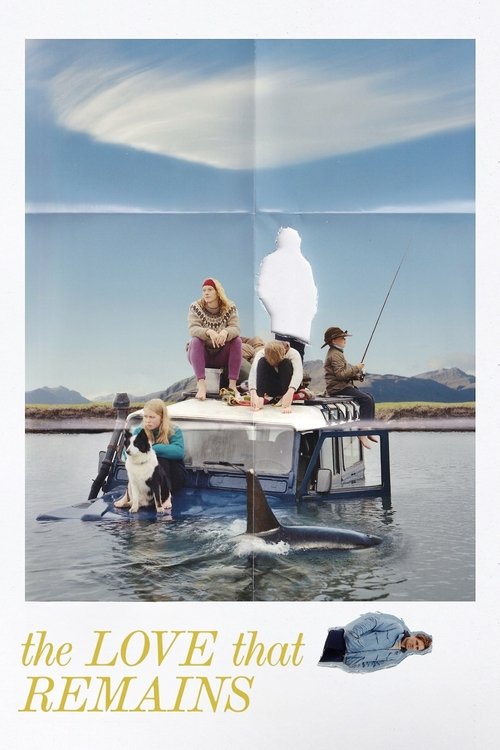
The Love That Remains
2025 · Hlynur Pálmason
For when you want to feel something real about family and faded love without being put through the wringer — tender enough for a cozy night, honest enough to sting a little. Comfort with a lump in the throat.
What it's about
Anna, a visual artist, and Magnús, who works long stretches at sea, have already separated when the film begins — but with three kids, a house and a shared routine, love doesn't end so much as change shape. Across one full Icelandic year of pickups, dinners, quarrels and small ceremonies, the film watches a family figure out what remains when a marriage is over.
The experience
Bittersweet in the truest sense: playful, often laugh-out-loud funny, then suddenly piercing, with flashes of deadpan absurdity breaking through the domestic realism. It feels lived-in rather than plotted, and it sneaks up on you.
Performances
The family ensemble is remarkably natural — the three children are played by Pálmason's own kids, and their unforced ease with the adult leads makes the household feel genuinely, sometimes painfully real.
The craft
Pálmason shot the film himself, and it shows: the rotating Icelandic seasons become the story's clock, with images of weather, animals and light doing as much emotional work as the dialogue. Filmed over a long stretch so time visibly passes, it's gorgeous on a big screen without ever feeling posed.
Why it matters
A deliberate turn from the historical epic of his previous work toward the intimate and autobiographical, it confirmed Pálmason as one of Nordic cinema's essential directors and one of its warmest.
Snapshot
The Love That Remains (Icelandic: Ástin sem eftir er) is Hlynur Pálmason's fourth feature, a 109-minute comedy-drama tracing one year in the dissolution of an Icelandic marriage. Anna, a visual artist, and Magnús, who works at sea, have already separated as the film opens; what remains is the slow, seasonal negotiation of a shared life — three children, a home, a routine of pickups and dinners and quarrels — conducted across the rotating Icelandic year. Premiered in the Cannes Premiere section on 18 May 2025, it marks a deliberate turn for Pálmason away from the historical epic of Godland (2022) toward the domestic and the autobiographical: the three children are played by his own (Ída Mekkín, Þorgils and Grímur Hlynsdóttir/Hlynsson), and Pálmason photographed the film himself. It is at once his most intimate work and his most formally relaxed, folding absurdist and fantastical interludes — a visiting knight, an oversized rooster, a scarecrow that ages into armor across the seasons — into an otherwise grounded study of love after love. Iceland selected it as its submission for the 98th Academy Awards; it was not nominated. The film is too recent for a settled critical position, but its early reception was strongly favorable.
Industry & production
The film is a five-country European co-production — Iceland, Denmark, France, Finland and Sweden — assembled through the kind of regional-fund and broadcaster architecture that sustains Nordic art cinema. The companies of record include Pálmason's own STILL VIVID, the Danish house Snowglobe, Finland's Aamu Film Company, Sweden's HOBAB, the regional fund Film i Väst, and Arte France Cinéma; producers credited include Anton Máni Svansson (Pálmason's long-standing Icelandic producer), Katrin Pors (Snowglobe) and Rémi Burah. This is essentially the same financing ecology that backed Godland and A White, White Day, in which Icelandic creative leadership is leveraged across Danish, French and Scandinavian co-production money and the Arte broadcast pipeline.
What distinguishes the production is less its financing than its calendar. Pálmason works on a clock unusual for narrative cinema: he shoots in widely spaced blocks across an actual calendar year (and, for some elements, across years), allowing real seasonal change and real organic transformation to register on screen rather than be simulated. Reviewers noted that one strand — the children constructing a scarecrow that gradually "becomes" an armored knight — was filmed roughly two years before the bulk of the shoot, so that the object's weathering is genuine. This method imposes obvious production constraints (continuity of cast, of weather, of a non-professional child ensemble growing visibly older) and is feasible largely because the principal performers include the director's own family and because the production is built around his property and landscape in eastern Iceland. The financial footprint is small by international standards; reported theatrical box office was modest (on the order of a few hundred thousand dollars), consistent with a subtitled auteur drama released through festival and arthouse channels following its August 2025 Icelandic opening.
Technology
Pálmason continues to shoot photochemically: The Love That Remains was originated on 35mm film and composed, as with Godland, in the near-square Academy ratio (1.37:1). The choice is not nostalgic affectation but a working principle. Film stock's response to natural light, its grain and its handling of the long Icelandic dusk are integral to a project organized around weather and time; the boxy frame concentrates attention on figures within landscape and on the vertical facts of sky, wall and standing person rather than the horizontal sweep a widescreen format would invite. The seasonal, time-lapse-inflected approach — capturing decay, growth and the turning year as literal photographic record — is closer to the logic of long-exposure or interval photography than to conventional coverage, and depends on the stability of a fixed format and location over many months. The technological story here is therefore one of restraint and durability rather than novelty: no apparent reliance on digital capture, virtual production or heavy post-visual effects, with the fantastical elements (the knight, the rooster) staged as far as possible in-camera as practical, faintly handmade apparitions.
Technique
Cinematography
The most consequential craft decision is that Pálmason served as his own cinematographer — a notable break from his collaborations with Maria von Hausswolff, who shot Winter Brothers, A White, White Day and Godland. Critics singled out the "expansive sense of composition," describing images that operate simultaneously as domestic observation and as free-standing visual metaphor or "abstract enigma." The Academy frame is used for frontal, often static or slowly developing compositions in which characters are held within doorways, fields and weather; the camera tends to watch rather than chase. Natural light and the extreme seasonal range of Icelandic daylight do much of the expressive work, and the self-shooting gives the film an unmediated, diaristic relation between author and image — the director literally framing his own children and his own land.
Editing
The film was cut by Julius Krebs Damsbo, Pálmason's regular editor (also responsible for Godland). The central editorial problem is structural rather than rhythmic: the film is built as a chain of discrete, seasonally dated episodes — vignettes of family life punctuated by surreal interludes — and the editing must make a year cohere out of fragments shot months or years apart. The cutting favors duration and the held moment over compression, letting scenes breathe to the point of awkwardness or comedy, and intercutting the realist throughline with the fantastical departures so that the latter erupt without warning. Several critics felt the assembly's tonal swings were the film's chief risk, with the surreal inserts reading as more opaque than the quotidian material around them.
Mise-en-scène / staging
Pálmason stages the everyday with a deadpan precision that tips readily into absurdity: meals, school runs, an art studio, a half-built structure in a field. Objects accrue meaning through recurrence and transformation — the scarecrow-knight being the clearest instance, an element of production design that is also a unit of narrative time. The home and the surrounding eastern-Icelandic terrain function as a single continuous set, and the staging repeatedly places small human figures against large, indifferent natural fields, a compositional habit carried over from Godland and A White, White Day.
Sound
The original score is by Harry Hunt — a new collaborator, replacing Edmund Finnis, who scored both A White, White Day and Godland. The detailed record on the film's sound design is still thin given its recency, but the work sits within Pálmason's established sonic temperament: sparing music, considerable weight given to wind, sea, animals and domestic ambient sound, and silence used as a dramatic register. The presence of animals (notably the dog Panda) and the seafaring and rural settings imply a soundtrack textured by the non-human environment.
Performance
Saga Garðarsdóttir and Sverrir Guðnason anchor the film as Anna and Magnús, praised for conveying the "weary sadness of separation" without melodrama — a register of exhausted tenderness rather than acrimony. The decisive performance choice, though, is the casting of Pálmason's own children (Ída Mekkín, Þorgils and Grímur), who had already appeared in his short Nest (2022); their evident ease before their father's camera was credited with much of the film's intimacy and unforced naturalism. The ensemble also draws on Pálmason's recurring company, including Ingvar E. Sigurðsson, the lead of A White, White Day. A further, much-noted "performance" is canine: the dog Panda won the Palm Dog at Cannes 2025.
Narrative & dramatic mode
The film's dramatic mode is the episodic chronicle rather than the plotted arc. There is no inciting separation to dramatize — the break has happened — and no reconciliation engine driving toward a resolution. Instead the film accumulates a year of small scenes, observing how affection, irritation, habit and grief coexist once a marriage has formally ended but its emotional infrastructure has not. Into this realist register Pálmason inserts frank departures into fantasy and dream — the knight who visits Magnús, the monstrous rooster, a sequence of drifting at sea — which function as externalized psychic states or unstable metaphors rather than plot events. The result is a hybrid: a "slice of life" structured by the calendar and the weather, with the seasons themselves supplying the sense of progression that conventional narrative causality would otherwise provide. Reviewers broadly agreed that the film's quotidian observation lands more powerfully than its surreal excursions, which some found gestural.
Genre & cycle
Nominally a comedy-drama (some listings add "family"), the film leans toward tender drama shaded with dry, absurdist humor — what one critic glossed as a "Lynchian strangeness" and "wily humor." It belongs to the well-populated cycle of the post-separation / conscious-uncoupling family film, but resists that cycle's usual therapeutic shape; it has more in common with the contemplative European art film of landscape and duration than with the relationship dramedy. Within Pálmason's own output it represents a generic and tonal pivot: where Godland was a colonial-era period epic and Winter Brothers and A White, White Day were charged with masculine violence and grief, The Love That Remains is comparatively gentle, comic and present-day — a domestic chamber piece scaled to a landscape.
Authorship & method
The film is among the most thoroughly authored in contemporary cinema: Pálmason wrote, directed, photographed and (with his family as cast and his land as location) effectively domesticated the entire production. Two collaborator facts define its authorship. First, the cinematography is his own, a departure from the Pálmason–von Hausswolff partnership that shaped the look of his prior features; this hands the film's image-making wholly to the director and deepens its diaristic quality. Second, the score passes from Edmund Finnis to Harry Hunt, while editor Julius Krebs Damsbo provides continuity with Godland. The method — protracted, seasonally distributed shooting that records real change over real time; the recurring use of his children and of Ingvar E. Sigurðsson; the patient staging of human figures within elemental landscape; the willingness to let absurd and fantastical images sit unexplained beside the everyday — is by now a recognizable signature. The Love That Remains applies that signature to autobiographical, domestic material, which makes it read as a personal summa even as it is the lightest of his films.
Movement / national cinema
The film is a flagship instance of contemporary Icelandic art cinema, the small but internationally visible wave associated with directors such as Benedikt Erlingsson, Grímur Hákonarson and Rúnar Rúnarsson, in which a dry national humor, an unsentimental treatment of landscape and weather, and modestly scaled human stories are leveraged onto the festival circuit through Nordic and French co-production. Pálmason, Danish-trained (a graduate of the National Film School of Denmark) and based between Denmark and Iceland, embodies the cross-border character of this cinema; his films are Icelandic in language, location and sensibility but Scandinavian-French in their financing and craft personnel. The Love That Remains sits squarely in that tradition while pushing its landscape-and-weather aesthetic toward the domestic and the comic.
Era / period
Released in 2025, the film is contemporary in both setting and concerns, and it arrives at a moment when slow, photochemically shot, festival-oriented auteur cinema occupies an increasingly defended niche against streaming-era production norms. Its 35mm origination, Academy framing and year-long shoot read as a considered position within that mid-2020s landscape: an argument for cinema made on the timescale of life rather than of schedules. The film's themes — separation, co-parenting, the persistence of love past its institutional form — are likewise of their moment, addressed without the period or genre distancing of Pálmason's earlier work.
Themes
The governing theme is the title's: what survives the end of a love — the residue of intimacy, obligation and tenderness that does not dissolve when a marriage does. Around it cluster Pálmason's persistent preoccupations: time and transformation, rendered literally through the turning seasons and the weathering scarecrow-knight; the entanglement of the human and the natural, with landscape, animals and weather as co-actors in the drama; family, childhood and the texture of domestic routine, here drawn directly from the director's own household; and grief in a quieter key than the acute loss of A White, White Day — the diffuse mourning of a relationship that continues in altered form. The surreal interludes extend a further theme: the porousness of the everyday to dream, fear and imagination, the sense that ordinary domestic life is shadowed by figures (a knight, a monster) that give shape to its anxieties.
Reception, canon & influence
Early critical reception was warm to enthusiastic. The film drew a notably high positive tally on aggregators (Rotten Tomatoes recorded unanimous early positive reviews from a small sample) and praise from major trade critics, who singled out Pálmason's compositional command, the unaffected performances of his children, and the film's emotional honesty, while registering reservations about the surreal sequences as "opaque rather than illuminating." Its festival run — Cannes Premiere, then Toronto and New York, with a Special Mention at Film Fest Gent — and the Palm Dog for Panda gave it a strong circuit profile, and Iceland's selection of it for the Academy Awards (it advanced no further than submission) confirmed its standing as a flagship national release.
The influences on the film are legible. Backward, it draws on the tradition of the European art film of duration and landscape, on the deadpan-absurdist strain of Nordic cinema, and on a Lynch-inflected willingness to admit the uncanny into domestic realism; within Pálmason's own corpus it extends the elemental, time-based method of Godland and A White, White Day into autobiographical territory, and grows directly out of his short Nest, which first cast his children. Its legacy forward cannot yet be assessed — the film is barely a year old at this writing, and any claim about what it shaped would be speculation. What can be said is that it consolidates Pálmason's standing as one of the defining Icelandic auteurs of his generation and offers a conspicuous model of a viable, deeply personal cinema built on slow, seasonal, self-photographed, family-centered production — a model whose wider influence will only become visible with time.
Sources consulted for grounding include the film's Wikipedia entry, the Cannes Festival listing, and The Hollywood Reporter review; where the documentary record is genuinely thin — particularly on sound design and on forward influence — that is noted in the text rather than filled by conjecture.
A Deleuzian reading
Start with the scarecrow.
The full Deleuzian reading of The Love That Remains →
Reception
It premiered at Cannes 2025 to near-unanimous warmth (a 100% Rotten Tomatoes score) and became Iceland's Oscar entry — Pálmason's third — only to miss the nomination, instantly filing it under 'the Academy got it wrong' for his fans.
How The Love That Remains was received, from release to now →
How to watch The Love That Remains: what to notice on a first viewing
- Watch the scarecrow in the field from scene to scene. The children build a plain scarecrow early on, and across the film it weathers, rusts, and slowly becomes something closer to a knight in armor. Real weathering on a prop is proof the film is not performing time passing; it is actually letting it pass.
- Notice how long the camera stays on a meal or school run. Editor Julius Krebs Damsbo lets ordinary domestic scenes run past the point where the plot needs them, sometimes long enough to turn awkward or funny. Holding a shot after the story is done with it makes you feel duration itself, not just what happens in it.
- Watch how Anna and Magnús stand near each other. Garðarsdóttir and Guðnason play exhausted tenderness through posture and small physical habits more than through dialogue, waiting and shifting weight in shared rooms. When there is nothing left to do about the marriage, the body carries what the plot no longer can.
- Watch how the daylight itself changes scene to scene. Pálmason shoots on natural light across Iceland's extreme seasonal range, so summer's long glow and winter's short gray light do real expressive work. The light is the calendar. You can feel the year turning without a single date on screen.
- Notice how often the camera holds still and waits. Pálmason, shooting himself in the boxy Academy frame, favors static or slowly developing shots that stand people up against doorways, fields and weather rather than chasing them. A camera that waits instead of chasing lets you watch a life instead of following a plot.
The whole guide to watching The Love That Remains, with the keys for a rewatch →
Influences: the films it descends from and the films it influenced
- A White, White Day (2019) — Establishes Pálmason's method of staging Ingvar E. Sigurðsson as a grieving figure dwarfed by Icelandic weather, plus the time-lapsed house-in-landscape prologue that records real seasonal change — the durational technique The Love That Remains inherits wholesale.
- Godland (2022) — Supplies the direct formal toolkit: boxy Academy ratio with rounded photochemical corners, protracted seasonal shooting that lets landscape decay and rot on camera, and editor Julius Krebs Damsbo, who carries that cutting rhythm forward into this film.
- Nest (2022) — The fixed-frame short that first cast Pálmason's own children and watched a tree-house built and weathered across a year of static single setups — the literal seed of the autobiographical, kids-as-non-professionals casting and locked-off frontal frame.
- Songs from the Second Floor (2000) — Defines the deadpan-absurdist tableau Pálmason borrows: a static, frontal, wide composition held long enough for an absurd event to intrude on banal domestic space without the camera reacting or explaining.
- The Sacrifice (1986) — Models the elemental long take in which a house, a tree and human figures are filmed against weather over extended duration, the unbroken shot itself carrying spiritual and temporal weight rather than narrative information.
- Jeanne Dielman, 23 quai du Commerce (1975) — Originates the episodic-chronicle structure of domestic real-time: frontal, eye-level static framing of household routine across discrete day-units, letting accumulated duration rather than plot generate meaning.
- Blue Velvet (1986) — The Lynch-inflected admission of the uncanny into bourgeois domestic realism — a fantastical or dreamlike image allowed to sit unexplained beside the everyday, which Pálmason cites as license for his surreal interludes.
- Children of Nature (1991) — The founding Icelandic art-film template of aged figures walking out into elemental landscape, fusing folkloric/fantastical departure with deadpan realism and a national-cinema attention to terrain.
- Fanny and Alexander (1982) — The Nordic autobiographical-domestic summa told as an episodic family chronicle through a child's vantage, mixing tactile household realism with frankly fantastical apparitions left unrationalized.
- The Tree of Life (2011) — Shares the autobiographical-turn rendered as natural-light, episodic memory-vignettes of childhood, where domestic family fragments are intercut with elemental cosmic imagery rather than driven by causal plot.
- Roma (2018) — Parallel case of total directorial authorship as self-photography — the director acting as his own DP to mine personal/family memory, with composed static and laterally-tracking long takes treating the household as landscape.
- Le Quattro Volte (2010) — Builds an episodic, nearly wordless chronicle from distant static frames of human and animal figures in landscape across the seasons, with sparing environmental sound and natural light — the same observational-comic durational register.
- A Pigeon Sat on a Branch Reflecting on Existence (2014) — Extends the same deadpan-absurdist craft: meticulously composed static frontal tableaux where melancholy comedy emerges from figures held motionless in a flatly-lit, theatrically deep frame.
- Lamb (2021) — Contemporary Icelandic realist-fantastical hybrid that, like Pálmason, plants a single uncanny element into patient, naturalistically-shot rural family life and stages humans as small figures against vast, weather-bound terrain.
- The Turin Horse (2011) — The slow-cinema limit-case of long-take duration and figures-in-landscape under relentless weather, where the camera's patience with elemental endurance, not event, structures the film.
- Honeyland (2019) — Demonstrates the same long-horizon, seasonally-distributed shooting recording real change over real time, with natural light and figures set against austere landscape blurring documentary observation and composed fiction.
Similar films
- Godland (2022) — influence & lineage
- Fallen Leaves (2023) — same viewing thread
- Sore: A Wife from the Future (2025) — same viewing thread
- Falling in Love Like in Movies (2023) — same viewing thread
- Lost in Starlight (2025) — same viewing thread
- Sentimental Value (2025) — shared sensibility
- Touch (2024) — shared sensibility
- Blue Heron (2026) — shared sensibility
All the films related to The Love That Remains →
Watch it with: curated runs of related films
- Love Among the Lonely — Watch these when you want love written for grown-ups — drifting, grieving, self-destructing people who find or keep each other with no fanfare — and want to feel a deadpan Helsinki karaoke bar and a warm Jakarta romance answer each other.