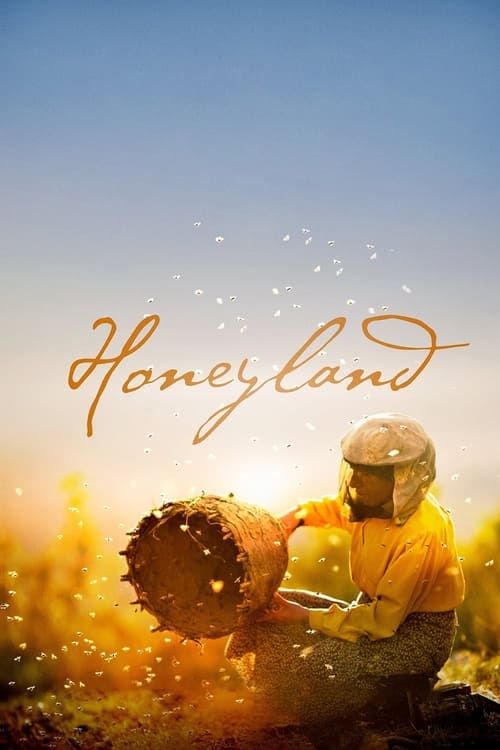
Honeyland
2019 · Ljubomir Stefanov
For when you want something real and beautiful that asks nothing of you but attention — a film to watch slowly, maybe alone, when the news cycle has worn you down and you want to remember what balance looks like.
What it's about
In a ruined stone village in the North Macedonian uplands, Hatidze Muratova — the last in a line of wild beekeepers — tends cliff-side hives by an ancient rule: take half the honey, leave half for the bees. She lives alone with her bedridden mother until a sprawling nomadic family parks their trailer next door and, seeing what her honey sells for, tries beekeeping at commercial scale. This is a documentary, filmed over three years, that plays like a fable.
The experience
Quiet, golden-lit, and slowly devastating — it has the patience of the landscape itself, then tightens into real dramatic conflict you can't believe a camera was there to catch. You come out moved, a little heartbroken, and strangely calmed.
Performances
Hatidze isn't acting — and that's the miracle. Her humor, her tenderness with her mother, and her open-hearted way with the neighbor children give the film a central figure more vivid than most written characters.
The craft
Shot over roughly three years and cut down from hundreds of hours, it's edited so cleanly it plays like scripted drama — setup, escalation, consequence — without a single interview or line of narration. The camerawork finds candlelit interiors and honey-colored ridgelines that genuinely reward the biggest screen you have.
Why it matters
It made history as the first film ever Oscar-nominated for both Best Documentary and Best International Feature, and became the modern benchmark for observational documentaries that earn the shape of fiction.
Snapshot
A feature-length observational documentary filmed over approximately three years in the remote uplands of North Macedonia, Honeyland follows Hatidze Muratova — an aging beekeeper living in a crumbling stone settlement with her bedridden mother, Nazife — as she practices a centuries-old method of wild beekeeping governed by a single cardinal rule: take half the honey, leave half for the bees. The film's dramatic arc crystallizes when a large, chaotic nomadic family, the Hussein Sams, pitches camp beside her and attempts commercial beekeeping with ruinous consequences. What begins as an ethnographic portrait of a vanishing practice accretes into something stranger and more resonant: a tragedy of the commons rendered in the grammar of fiction film. Honeyland became the first documentary ever to receive Academy Award nominations in both Best Documentary Feature and Best International Feature Film at the 92nd ceremony (2020), a recognition that registered the film's hybrid identity — the way its structure and emotional register blur the boundary between recorded life and classical drama.
Industry & production
Honeyland originated as a commissioned nature-and-environment segment for a Macedonian television series on ecological threats, a modest institutional brief that the co-directors rapidly outgrew when they discovered Hatidze. The film was produced by Apolo Media (North Macedonia) in association with Trice Films, on a budget that, by the standards of international feature documentary, was extremely small. Funding came partly through the Macedonian Film Agency and co-production support from regional European sources; the protracted shoot — roughly three years of periodic returns to the site — meant that the production had to sustain an unusually long relationship with a single subject in a single location.
Hatidze was not cast; she was found. The production's founding gesture — the decision to abandon the original nature-television brief and build an entire feature around this woman — required, above all, an ethical and logistical negotiation. Directors Stefanov and Kotevska, along with cinematographers Fejmi Daut and Samir Ljuma, spent considerable time at the location before sustained filming began, establishing the trust without which the film's extraordinary intimacy would have been impossible. The arrival of the Hussein Sam family — parents, seven or eight children, and a herd of cattle — provided the film's antagonist force, though the family themselves were not recruited adversarially; they were already present in the landscape, and the filmmakers recognized the dramatic potential of their proximity to Hatidze.
The film premiered at the Sundance Film Festival in January 2019, where it won the Grand Jury Prize and the Special Jury Award for Impact for Change in the World Cinema Documentary competition. US theatrical distribution was handled by Neon. The dual Academy Award nominations represented a watershed for North Macedonian cinema internationally and for the documentary form itself.
Technology
Honeyland was shot on digital cinema cameras; the specific models have not been widely publicized in the scholarly press, and the production has not foregrounded its equipment choices in the way that some contemporary documentary projects do. What the technology enables is clear from the image: the cameras were capable of high-quality performance in extremely low light — the film's firelit and candle-lit interior scenes, which give certain sequences an almost Flemish-painterly quality, suggest sensors with latitude well beyond what was available to the Direct Cinema generation. Handheld and shoulder-mounted operation predominates. No drones, stabilized rigs, or conspicuous aerial photography intrude on the film's observational register; the visual grammar deliberately refuses the spectacular overhead aesthetics that have become ubiquitous in nature documentary since the BBC's landmark wildlife productions.
Technique
Cinematography
Fejmi Daut and Samir Ljuma share cinematography credit — a double-operator arrangement suited to the logistical complexity of covering an unpredictable, multi-subject environment over years. The visual approach is rooted in the observational tradition but is distinguished by exceptional tonal range: the camera moves between intimate macro-scale attention to bees, honeycomb, and Hatidze's hands — images that almost merge the documentary gaze with natural-history filmmaking — and wide landscape compositions that situate the settlement in a landscape of dramatic, desiccated enormity. Interiors are often lit only by fire or by the thin light entering through small apertures, producing a warmth that is also a form of enclosure; the world outside Hatidze's home is vast and threatening, the world inside reduced to the circle of flame and the face of her mother.
A recurring tension in the cinematography is between proximity and ethics. Several of the film's most remarkable passages — Hatidze handling a wild hive high on a cliff face, or the wordless exchange between mother and daughter in the dark — raise questions about the degree of pre-arrangement or compositional guidance that the filmmakers brought to bear. The directors have acknowledged that some scenes were partially reconstructed or filmed across multiple takes; this places Honeyland within a long documentary tradition of negotiated staging, rather than pure fly-on-the-wall capture, though the film does not announce this to its audience.
Editing
Editor Atanas Georgiev shaped what must have been several hundred hours of footage into an 87-minute narrative of exceptional propulsive clarity. The editorial achievement is architectural: Georgiev constructs a recognizable three-act dramatic rhythm — the establishment of Hatidze's isolated world, the disruption introduced by the Hussein Sams, and the ecological and emotional collapse that follows — from material that had no predetermined story shape when it was photographed. Transitions between scenes are frequently elliptical; seasons pass in a cut, or Nazife's condition worsens between one scene and the next with no intervening explanation. This compression mimics the way time is experienced in isolated, repetitive labor. The editing also manages the film's two tonal registers simultaneously: moments of gentle comedy (Hatidze's droll negotiations in the Skopje market, her patient translations of her mother's ancient utterances) are placed in deliberate counterpoint with passages of unmediated grief.
Mise-en-scène / staging
The spatial design of the film is determined almost entirely by found conditions: the crumbling stone house, the cliff-face hives, the Hussein Sam camp with its tents, children, and cattle. Yet Stefanov and Kotevska demonstrate a clear compositional intelligence in how they frame the boundary between these two worlds. The fence — partial, improvised, insufficient — that separates Hatidze's territory from the Hussein Sam encampment becomes a recurring visual motif, a literal and metaphorical property. The film understands that the physical arrangement of bodies in space carries argument: Hatidze's deliberateness and stillness with the bees is consistently counterposed against the noisy, sprawling disorder of the family next door.
Sound
The sound design foregrounds the texture of the natural environment — bees, wind, cattle, the creak of the dilapidated house — in a way that, paradoxically, begins to feel like scored music. The hum of the hive acquires an almost leitmotif function, its character shifting from the benevolent thrumming of a healthy colony to something rawer and more threatening as the Hussein Sam disruptions take hold. The score — reportedly composed by the Macedonian band Foltin, though documentation in the English-language press on this point is thinner than one would wish — is restrained and folk-inflected, used sparingly so as not to override the documentary's claim to the unmediated real. Silence is deployed with equal care: the moments when Nazife ceases her near-constant audible presence are among the film's most devastating.
Performance
The film's central ethical and aesthetic question is whether Hatidze Muratova is a "performer" in any meaningful sense. She is not an actor; she did not audition or rehearse; she was filmed in and around her actual life. Yet the camera's sustained attention to her face, the editorial shaping of her arc, and the film's final emotional catharsis all depend on her possessing, in front of the lens, something indistinguishable from screen presence. Her relationship with the camera evolves across the film — from occasional self-consciousness toward a kind of sovereign naturalism — and her scenes of grief, joy, and wry resignation have the weight of performance in the deepest sense. The Hussein Sam family are equally unmediated, though their large numbers and constant motion give them a collective, almost choral role rather than individualised characterization. Nazife — heard more than seen, often only a voice from the dark corner where she lies — functions almost as a figure from ancient drama: the oracle who knows what is coming.
Narrative & dramatic mode
Honeyland belongs to a mode that critics have variously termed "hybrid documentary," "dramatic documentary," or, in the Griersonian tradition, simply "creative treatment of actuality." Its narrative architecture is so legible — protagonist with a governing philosophy, external antagonist who violates that philosophy, crisis, loss, ambiguous survival — that it could be mapped onto the schema of classical tragedy without significant distortion. The "take half, leave half" rule operates simultaneously as practical apiculture, philosophical credo, and dramatic Chekhov's gun: the audience understands from its first articulation that the rule will be broken, and by whom, and with what consequences. This teleological clarity, achieved without apparent contrivance in the filming, is the film's primary formal achievement.
Genre & cycle
The film sits at the intersection of several documentary traditions: the ethnographic documentary (after Flaherty), the observational or Direct Cinema mode (Wiseman, the Maysles), and the increasingly prominent genre of environmental or ecological documentary. What distinguishes it within that last category is its refusal of the expository or advocacy registers that dominate environmentalist nonfiction filmmaking: there is no narration, no expert testimony, no rhetorical address to the audience. The ecological argument is entirely dramatized; the viewer draws the lesson without being instructed to. This aligns the film more with certain European auteur documentaries — Wang Bing's long observational works, Sergei Loznitsa's early ethnographic films — than with the polished advocacy documentary dominant in American theatrical distribution.
Authorship & method
The film has two directors whose contributions are not separately documented in the public record: Ljubomir Stefanov, who comes from an environmentalist-documentary background, and Tamara Kotevska, then a younger filmmaker. The precise division of labor between them during the shoot and in post-production has not been the subject of detailed published interviews in English. What is clear is that the collaboration was genuine and sustained over years; both are credited on all prints and in all awards submissions.
Fejmi Daut and Samir Ljuma brought the cinematographic intelligence. Atanas Georgiev, as editor, is arguably the third auteur of the piece: the narrative shape that made the film's festival and awards success possible was built in the editing room, not found whole in the footage.
The composer Foltin contributed a score that — where deployed — integrates Macedonian folk tonalities with contemporary minimalist film-music idioms, though the score's relative sparseness means it is less defining than the sound design.
Movement / national cinema
Honeyland emerged from a North Macedonian film industry of modest size and limited international visibility. Macedonia (which formally became the Republic of North Macedonia in February 2019, the same year the film premiered) has a state film agency and a tradition of festival-circulated art cinema, but very few Macedonian films had achieved the distribution reach of Honeyland prior to its release. The film's extraordinary awards trajectory — Sundance, the Academy Awards — placed Macedonian cinema on the international map in a way that no previous domestic production had managed, and it did so with a film set in a region, filmed in a language (Macedonian, with some Turkish), and centered on a subject (wild beekeeping) that had essentially zero prior international cultural profile.
The film participates in a broader Balkan and Eastern European documentary tradition of patient, humanist observation of lives on the margins of modernity — a tradition with roots in Yugoslav documentary cinema and inflected by the influence of Romanian New Wave aesthetics (patient duration, refusal of sentimentality, moral weight placed on the act of looking) that have radiated across the region since the mid-2000s.
Era / period
Honeyland arrived in 2019 in a documentary landscape shaped by the rise of streaming, the expansion of the Academy's international documentary category, and a renewed international appetite for environmental and ecological nonfiction following the global surge in climate-change discourse. The film is a product of its moment in that its ecological themes resonated widely, yet it is also formally counter to the dominant modes of its era: it offers no information graphics, no celebrity narrator, no explicit call to action. In this sense it belongs as much to a long European art-documentary tradition as to the 2019 moment.
Themes
The rule — "take half, leave half" — is the film's thematic engine. It encodes an ethics of restraint, reciprocity, and ecological balance that the narrative then tests to destruction. The Hussein Sam patriarch's abandonment of this principle is not presented as villainy in any simple sense; he is feeding many children and responding to market incentives, as humans do. The film's tragic structure demands that we understand his logic even as we watch its consequences unfold. This nuance extends the film's ecological argument into an argument about capitalism: the collapse is driven by the dynamics of extraction and scale, and the individual family is as much a symptom as a cause.
Alongside the ecological, the film is a sustained meditation on solitude and care. Hatidze has never married; her life has been shaped by the need to tend her mother. The relationship between the two women — intimate, sometimes irritable, suffused with the weight of decades — is observed with a delicacy that prevents it from being sentimentalized. When Nazife dies, the film's emotional center relocates from the ecological to the personal, and the final image of Hatidze alone in the landscape carries both registers simultaneously.
Displacement and dispossession are present but never over-argued. Hatidze's way of life is being lost; the film does not claim this loss is simply imposed from outside, but it insists that something irreplaceable — a knowledge, a relationship with a landscape, an ethics practiced in the body — is ending.
Reception, canon & influence
Critical reception was overwhelmingly positive. The film received near-universal praise for its cinematography, its subject, and the improbable dramatic coherence of its found narrative. The dual Academy Award nomination was both a critical and an institutional landmark; no documentary had previously achieved it, and the recognition foregrounded ongoing debates about categorical boundaries within the Academy's own classification system.
Influences on the film (backward): The observational documentary tradition that runs from Robert Flaherty's Nanook of the North (1922) — itself controversial for its staged elements — through the American Direct Cinema of the Maysles brothers and Frederick Wiseman is an obvious forebear. Werner Herzog's nature documentaries, particularly Grizzly Man (2005) and the broader tradition of his philosophical nature filmmaking, share Honeyland's willingness to find morality plays embedded in the natural world. The long-take, silence-heavy mode of Wang Bing's documentary work (Tie Xi Qu: West of the Tracks, 2003) provides a formal precedent for patient observation that does not require narrative manipulation. Closer geographically, the Romanian New Wave's influence on Balkan filmmaking — its distrust of sentimentality, its attention to duration, its moral seriousness — can be felt in the film's refusal of easy affect.
Legacy and forward influence: The film's most concrete legacy is institutional: it opened Macedonian cinema to international attention and demonstrated that an observational documentary from a small European nation could compete at the highest level of the global film circuit. Whether it has directly shaped subsequent documentary practice is harder to document at this distance; the record here is genuinely thin, and any claim of specific directorial influence would require more evidence than currently exists in the scholarly literature. What is less doubtful is that Honeyland has entered the teaching canon of contemporary documentary practice as a primary example of how classical dramatic structure can be achieved without the apparatus of fiction — through editorial intelligence applied to years of observational footage, in the hands of filmmakers willing to wait for the world to become a story.
A Deleuzian reading
She goes up the cliff alone.
The full Deleuzian reading of Honeyland →
Reception
It arrived as a Sundance sensation in 2019 — sweeping three awards there — and its stature has only grown since: it now sits comfortably on best-documentaries-of-the-century lists as one of the decade's great non-fiction crossovers.
How Honeyland was received, from release to now →
Influences: the films it descends from and the films it influenced
- Nanook of the North (1922) — Flaherty's deliberate direction of authentic traditional practices — walrus hunt, igloo construction — for the camera establishes the negotiated-reconstruction template that Honeyland applies to Hatidze's beekeeping: activity that is genuinely real but whose performance is shaped by the filmmakers' sustained presence.
- Grey Gardens (1975) — The Maysles' simultaneous two-camera setup — Albert operating picture, David handling sound — capturing the Beales without a larger crew models the dual-operator intimacy that Daut and Ljuma deploy to cover Hatidze's daily life from multiple angles simultaneously across three years of access.
- Harlan County, USA (1976) — Kopple's assembly of direct cinema footage — accumulated over years with non-professional subjects — into a classical dramatic arc of confrontation, crisis, and resolution around a labor dispute establishes the template for applying three-act narrative structure to actuality material without sacrificing observational integrity.
- Être et Avoir (2002) — Philibert constructs a pedagogical year in a single-room French village school into dramatic shape entirely through editorial selection of non-professional subjects in their authentic working environment, demonstrating the same strategy Georgiev employs in Honeyland: classical narrative form achieved without the apparatus of fiction.
- Tie Xi Qu: West of the Tracks (2003) — Wang Bing's reduction of 300+ hours of footage to a shaped narrative of industrial decline — years compressed into representative gestures of quotidian labor and decay — establishes the elliptical compression through which Georgiev builds Honeyland's three-act structure from similarly vast observational material.
- Grizzly Man (2005) — Herzog's editorial construction of Treadwell's self-shot footage into a morality play in which individual disruption of ecological balance ends in tragedy directly models Honeyland's structure, where the Hussein family's overcollection precipitates Hatidze's collapse — a found tragedy assembled from material that did not arrive as a story.
- 4 Months, 3 Weeks and 2 Days (2007) — Mungiu's unsentimental, duration-respecting refusal of expository affect — moral weight conveyed through staging and held duration rather than score or commentary — transmits the Romanian New Wave's formal ethics into the Balkan region, where Honeyland absorbs them as an anti-sentimentality constraint on its observational practice.
- Sweetgrass (2009) — Castaing-Taylor and Barbash's non-interventionist recording of Montana sheepherders' final season before industrial ranching ends the tradition establishes the observational-ethnographic vanishing-practice documentary mode — the dying pastoral skill filmed without sentimentalization — that structures Honeyland's engagement with Hatidze's beekeeping.
- Leviathan (2012) — The Sensory Ethnography Lab's use of multiple small cameras mounted on bodies and rigging to capture extreme close-ups and wide seascape within the same observational register models the macro-to-landscape range Daut and Ljuma achieve in Honeyland, where the frame moves between bee cells and mountain panoramas without changing mode.
- Pompei: Below the Clouds (2025) — Carries forward the festival-legitimized observational mode Rosi helped canonize — years of immersion, no voiceover, non-professional subject, ecological precarity composed as patient image — meaning emerging from the cut alone.
- Hukkle (2002) — Near-wordless rural observation fusing macro nature attention (bees, hives) with folk-cultural texture, sustaining drama through patient creaturely close-up rather than dialogue.
- All That Breathes (2022) — Sen deploys the same combination of macro-to-landscape cinematography — extreme close-ups of kite anatomy against wide urban skylines — and tragedy-of-the-commons narrative structure, in which individual devotion to a dying ecological practice is outpaced by environmental collapse, that defines Honeyland's formal and thematic grammar.
- Fire of Love (2022) — Editor Erin Casper and director Dosa assemble decades of archival observational footage into a three-act romantic tragedy, constructing narrative shape from material that arrived without a predetermined story — a direct extension of Georgiev's editorial auteurism in Honeyland, where classical drama is built retrospectively from years of footage through the editor's structural intelligence.
- Collective (2019) — Nanau builds a classical investigative three-act narrative — discovery, escalation, institutional consequence — entirely from observational access footage without narration, working within the same Balkan documentary tradition as Honeyland: editorial intelligence constructs dramatic shape from actuality material accumulated over sustained access.
- Gunda (2020) — Kossakovsky eliminates all music in favor of ambient sound as the sole narrative and emotional carrier, while deploying extreme macro-to-landscape cinematography of farm animals in their habitat, extending Honeyland's ambient-leitmotif strategy — folk score restrained to near-absence — to its logical zero-score limit.
- Notturno (2020) — Rosi's ethnographic observation of civilian life in borderland communities uses low-available-light cinematography to achieve painterly interior images without artificial illumination, sharing Honeyland's cinematographic mode of making quotidian intimacy luminous within the same non-interventionist, non-narrated ethnographic register.
- The Love That Remains (2025) — Demonstrates the same long-horizon, seasonally-distributed shooting recording real change over real time, with natural light and figures set against austere landscape blurring documentary observation and composed fiction.
- Landscape in the Mist (1988) — Transposes the leached Balkan landscape, sparse diegetic sound, and elliptical observational patience onto the same frontier geography, sustaining the regional contemplative idiom Angelopoulos defined.
- The Velvet Queen (2021) — Extends observational auteur nature-documentary through patient long-lens embedding with a solitary figure in a remote landscape, letting an ecological elegy emerge without expository narration.
Similar films
- Grizzly Man (2005) — influence & lineage
- The Metamorphosis of Birds (2021) — shared sensibility
- No Other Land (2024) — shared sensibility
- Nomadland (2021) — shared sensibility
- 20,000 Species of Bees (2023) — shared sensibility
- The Oldest Person in the World (2026) — shared sensibility
- Bugonia (2025) — shared sensibility
- This Is Not a Burial, It's a Resurrection (2020) — shared sensibility