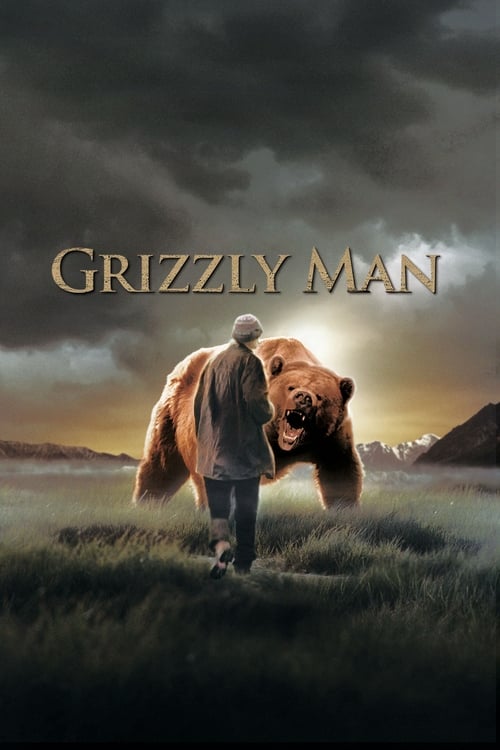
Grizzly Man
2005 · Werner Herzog
For when you want a true story that doubles as a philosophical gut-punch — a film to argue about afterward. Absorbing rather than grim, but it asks something of you.
What it's about
Timothy Treadwell spent thirteen summers living unarmed among the grizzly bears of an Alaskan national park, filming himself as their self-appointed protector — until, in 2003, a bear killed him and his companion. Werner Herzog builds the film from roughly a hundred hours of Treadwell's own footage, layering his own narration and interviews over it to ask who this man really was and what he was actually looking for out there.
The experience
Mesmerizing and deeply unsettling — you're watching a real man's dream and his delusion in the same frame, often within the same shot. It's funny, tender, and dread-soaked at once, and the argument between Treadwell's romanticism and Herzog's bleaker view keeps you off balance to the end.
The craft
The craft is in the excavation: Herzog curates Treadwell's video diaries into a portrait the man never intended, and his dry, accented narration openly debates his subject's worldview — a documentary where the director's disagreement is part of the text. Richard Thompson's guitar score gives the Alaskan footage a lonesome beauty.
Why it matters
One of the most acclaimed documentaries of the 2000s, it cemented Herzog's late-career fame as a documentarian and became the reference point for films that interrogate their subject's own footage rather than simply presenting it.
Snapshot
Grizzly Man is Werner Herzog's documentary portrait of Timothy Treadwell, the self-styled bear protector who spent thirteen summers living unarmed among the grizzlies of Katmai National Park on the Alaska Peninsula, and who in October 2003 was killed and partially consumed by one of them, along with his companion Amie Huguenard. The film's defining formal gambit is that it is built substantially from Treadwell's own footage — roughly one hundred hours of video he shot during his final five summers — which Herzog excavates, curates, and sets against his own interviews and unmistakable first-person narration. The result is two films braided into one: Treadwell's ecstatic, sentimental self-romance, and Herzog's cooler counter-reading of nature as indifference and chaos. It is at once a biographical documentary, an essay on the limits of human empathy projected onto the wild, and a meditation on the camera as both witness and accomplice. Widely regarded as one of Herzog's finest works and a landmark of twenty-first-century nonfiction, it became, for many viewers, the entry point into his philosophy of nature and of cinema.
Industry & production
The film emerged from the Discovery-aligned documentary apparatus of the early 2000s. It was produced by Erik Nelson's company (Real Big Production / Discovery Docs) in association with Lions Gate Films, which handled theatrical distribution following the film's premiere at the Sundance Film Festival in January 2005. The crucial production event preceded any conventional shoot: Treadwell's archive of tapes had to be obtained. Jewel Palovak, Treadwell's former partner and the co-founder with him of the bear-advocacy organization Grizzly People, was the custodian of much of this material, and her cooperation — she appears in the film and is credited as a producer — was central to the project's existence. Herzog has described being handed the footage and recognizing immediately that Treadwell was not merely a wildlife videographer but, inadvertently, a filmmaker with an eye for staging, performance, and the accidental sublime.
This is a film whose "production" is therefore largely a matter of archival access and editorial construction, supplemented by a relatively modest contemporary shoot: Herzog's interviews with the people in Treadwell's orbit — Palovak; the pilot Willy Fulton, who discovered the remains; the coroner Franc Fallico; friends, an ex-girlfriend, a Native Alaskan museum curator, and others — plus some on-location material in Alaska. The economics were those of a mid-budget American documentary of the period, leveraging an existing archive rather than financing an expensive expedition, which is part of why the film was both feasible and unusually rich in primary footage.
Technology
Grizzly Man is, technologically, a document of the consumer-video moment. Treadwell's footage was captured on handheld camcorders of the late 1990s and early 2000s — lightweight prosumer video cameras that one person could carry, mount, and operate alone in the field. This technology is not incidental to the film; it is its subject and its medium. The portability and low cost of camcorder video are precisely what allowed a man with no crew to accumulate a hundred hours of intimate, self-directed footage in the wilderness, and the aesthetic of that footage — its immediacy, its grain, its occasional flares and focus hunts — is inseparable from the technology that produced it. Herzog's own added material (interviews and landscape) was shot by his cinematographer Peter Zeitlinger; I would not want to overstate the exact capture formats without certainty, but the contemporary footage carries the more composed, deliberate look of a professional documentary shoot set against the rawer texture of the source tapes.
The film's most discussed technological artifact is an absence of image: the camera that recorded Treadwell and Huguenard's deaths was running with its lens cap on, capturing roughly six minutes of audio of the attack but no picture. The existence of this audio — and Herzog's decision, filmed, to listen to it through headphones while Palovak watches him, and then to advise her never to listen to it and to destroy it — turns a technical accident into one of the film's ethical and emotional fulcrums.
Technique
Cinematography
There are two visual registers. Treadwell's cinematography is the more astonishing for being unintentional in the auteurist sense: he frames himself in the foreground with bears grazing behind him, holds long takes as foxes wander into frame, and repeatedly stages himself against open tundra and sky. Herzog draws attention to moments where the footage achieves an unscripted poetry — wind moving through grass, a bear's slow passage — that no director could have planned and that Treadwell, by sheer persistence and presence, captured. Herzog explicitly valorizes these as the work of an artist. Zeitlinger's contemporary photography supplies the counterweight: steadier, more classically composed Alaskan landscapes and clean interview setups, against which Treadwell's restless handheld energy reads all the more clearly.
Editing
The film was cut by Joe Bini, Herzog's long-standing editor and one of the key creative architects of the project. The editorial challenge — distilling a hundred hours of often repetitive solo video into a shapely ninety-minute narrative — is enormous, and the film's intelligence lies substantially in its selection and juxtaposition. Bini and Herzog intercut Treadwell's footage with interviews, allowing the dead man to seem to converse across time with those who survived him, and they preserve moments most documentarians would trim: Treadwell's profane rants, his retakes, his breakdowns, the dead-air pauses. The editing repeatedly lets shots run past their "useful" length so that something stranger emerges, a hallmark of Herzog's belief in the "ecstatic truth" that lives beyond the merely informational.
Mise-en-scène / staging
Because so much of the film is found footage, its mise-en-scène is largely Treadwell's own self-staging — and the film is acutely aware of this. Herzog treats Treadwell as a performer directing his own wilderness, complete with costume (the bandanna, the close-cropped hair), recurring "characters" (named bears and foxes), and an implied audience. The contemporary interviews, by contrast, are composed with Herzog's characteristic frontal stillness, subjects placed in charged environments — a coroner gesturing emphatically over his findings, Palovak holding Treadwell's watch.
Sound
Sound is one of the film's deepest concerns. Beyond the unheard death audio, the film foregrounds the ambient sound of Treadwell's tapes — wind, water, the breathing of animals — and Herzog's own heavily accented, ruminative voice-over, which has become almost as famous as the film itself. The music (discussed below) is woven through as an atmospheric, improvised drift rather than conventional underscoring.
Performance
The central "performance" is Treadwell's, posthumous and unwitting, ranging from tender baby-talk with foxes to manic, expletive-laden tirades against the Park Service and the world. Herzog's reading of this performance — admiring its theatrical force while diagnosing its delusion — is itself a kind of performance, the narrator as character. Among the interviewees, the coroner Franc Fallico's heightened, almost operatic manner stands out, the sort of real person whose excess Herzog famously prizes.
Narrative & dramatic mode
The film is structured less as a chronological biography than as an investigation and an argument. We know from early on how the story ends; the suspense is interpretive rather than factual. Herzog organizes the material around a central tension — Treadwell's self-image as protector and friend of the bears versus the evidence, including his own death, that the bears neither knew nor cared. The dramatic mode is the essay-documentary: a first-person narrator openly disagreeing with his subject, advancing a worldview, and refusing the pretense of neutral observation. This is documentary as authored interpretation, and the film's tension between Treadwell's romanticism and Herzog's pessimism is the engine that drives it.
Genre & cycle
Grizzly Man sits at the intersection of several documentary modes: wildlife film (which it both uses and critiques), biographical portrait, and the personal/essayistic documentary associated with figures like Chris Marker and with Herzog's own nonfiction. It belongs to the early-2000s wave of theatrical documentaries that reached crossover audiences, and within Herzog's career it forms part of an informal cycle of films about driven, obsessive men who pit themselves against an indifferent natural world — kin to Fitzcarraldo and Aguirre on the fiction side and to later nonfiction like Encounters at the End of the World. It is also, pointedly, an anti-wildlife-film: it weaponizes the conventions of cuddly nature television to dismantle them.
Authorship & method
The film is unmistakably Herzog's, and it advances his signature themes: the hostility of nature, the thin membrane between civilization and chaos, the "ecstatic truth" he distinguishes from the "accountant's truth" of fact. His method here is curatorial and confrontational — he inserts himself as narrator and on-screen listener, openly stating where he and Treadwell part ways ("I believe the common denominator of the universe is not harmony, but chaos, hostility, and murder," he says, against Treadwell's vision of benign wilderness). Yet the film is also a profoundly collaborative artifact. Joe Bini's editing shaped the hundred hours into argument and rhythm. Peter Zeitlinger provided the contemporary cinematography. Producer Erik Nelson secured and organized the project, and Jewel Palovak's stewardship of the archive made it possible. The music was composed and performed by the British guitarist and songwriter Richard Thompson, working in an improvised studio session (produced/supervised by Henry Kaiser, a frequent Herzog collaborator on Antarctic and music projects), generating a loose, melancholy, largely instrumental score responsive to the footage rather than imposed upon it. And, most unusually, the film shares authorship with its dead subject: Treadwell is its principal cinematographer and performer, and Herzog repeatedly credits him as a filmmaker, making Grizzly Man a rare case of co-authorship across the line of death.
Movement / national cinema
Herzog is a foundational figure of the New German Cinema of the 1960s–70s, alongside Fassbinder, Wenders, and Kluge, and Grizzly Man carries that lineage's seriousness about cinema as a vehicle for metaphysical inquiry. But by 2005 Herzog was effectively a transnational and substantially Americanized filmmaker: the film is an American production, in English, about an American subject, made within the U.S. documentary industry. It is best understood as German art-cinema sensibility operating inside American nonfiction — a meeting that gives the film both its philosophical reach and its accessibility.
Era / period
The film is a creature of the mid-2000s in several senses. It captures the cusp moment when cheap consumer video had made solitary, sustained self-documentation possible but before the smartphone and social media universalized it — Treadwell is in some ways a premonition of the self-broadcasting individual to come. It also belongs to the early-2000s theatrical-documentary boom, when nonfiction films found unusually large audiences and critical prestige. And it reflects a period of heightened cultural attention to environmentalism and to the ethics of human intervention in wild ecosystems, debates the film complicates rather than flatters.
Themes
The film's great theme is the gulf between human projection and natural reality — Treadwell's need to be loved by the bears, and nature's blank refusal to return the gaze. From this flow its other concerns: the danger and seduction of sentimentalizing the wild; the camera as a tool of self-creation and self-deception; the boundary between sanity and a sustaining delusion; the relationship between performance and identity; mortality and the will to leave a record. Herzog also turns the film into a reflection on cinema itself — on what footage can and cannot show, on the ethics of looking, and on the idea that an obsessive amateur, by living his vision absolutely, might produce images no professional could. Treadwell's loneliness and his flight from human society into an animal Eden give the film a melancholy that complicates its philosophical argument with genuine grief.
Reception, canon & influence
Grizzly Man was met with strong critical acclaim on its 2005 release, frequently cited at year's end as among the best films of the year and as one of Herzog's strongest works, fiction or nonfiction. It won numerous critics' awards in the documentary category and is often credited with re-energizing wider audience interest in Herzog, helping to inaugurate the prolific, internationally celebrated late phase of his career. (It is worth noting that, like several acclaimed documentaries of its moment, it did not receive an Academy Award nomination — an omission that became part of the discourse around documentary awards.) I would flag that precise, itemized award tallies vary across sources and should be checked against the record rather than asserted from memory.
Looking backward, the film draws on Herzog's own decades-long preoccupation with nature's indifference (Aguirre, Fitzcarraldo) and on the essay-film tradition; it also stands in deliberate opposition to the consoling conventions of television wildlife filmmaking. Looking forward, its influence has been considerable. It helped legitimize the feature documentary built substantially from found or archival first-person footage, a method that proliferated as personal video archives grew. It cemented Herzog's narration and persona as a cultural touchstone, much imitated and parodied, and it deepened the template of the authored, argumentative documentary in which the filmmaker openly contends with his subject. More broadly, it became a defining reference point for any subsequent film about obsessive individuals, the romance and peril of the wild, and the camera's role in making — and unmaking — a life. Its central, withheld scene of the death audio remains a touchstone in debates about documentary ethics and the responsibilities of showing and not showing.
A Deleuzian reading
Start with the image Herzog won't let you see.
The full Deleuzian reading of Grizzly Man →
Reception
A Sundance sensation in 2005 and one of the best-reviewed films of that year, it was still famously snubbed by the Oscars — not even shortlisted for Best Documentary while March of the Penguins waddled to the win. Two decades on it's routinely called one of the greatest documentaries ever made, and the definitive gateway into Herzog.
How Grizzly Man was received, from release to now →
Influences: the films it descends from and the films it influenced
- Aguirre, the Wrath of God (1972) — Establishes Herzog's governing vision of nature as a malevolent, indifferent force — the jungle that 'murders' — which the Grizzly Man voiceover explicitly weaponizes against Treadwell's benign-wilderness fantasy.
- Land of Silence and Darkness (1971) — Prototypes Herzog's compassionate-yet-argumentative documentary voice, where his narration interprets and frames a subject's inner world rather than neutrally reporting it.
- Lessons of Darkness (1992) — The fullest precedent for 'ecstatic truth' method — re-narrating found catastrophe footage with operatic voiceover and music to extract cosmic meaning the literal images don't state, exactly Bini and Herzog's strategy with Treadwell's tapes.
- Fitzcarraldo (1982) — Cements the Herzogian monomaniac whose obsession collapses the membrane between civilization and chaos — the character template Herzog retroactively reads onto Treadwell as a 'filmmaker' and doomed visionary.
- Sans Soleil (1983) — Defines the first-person essay film built by curating heterogeneous found footage under a meditative voiceover that argues a philosophy of images, the formal grammar Grizzly Man inherits.
- Night and Fog (1955) — Sets the precedent for the moral essay-documentary that weighs the ethics of showing versus withholding — the showing/not-showing problem Herzog stages literally by listening to, but never playing, the death audio.
- The Thin Blue Line (1988) — Pioneers the authored, openly argumentative documentary in which the filmmaker contends with and re-stages his subject's material rather than effacing himself behind observational neutrality.
- Nanook of the North (1922) — Originates the man-against-nature documentary as a co-authored performance, with the subject staging himself before the camera — the deep ancestor of Treadwell as both cinematographer and self-performer.
- My Best Fiend (1999) — Herzog applies My Best Fiend's identical formal apparatus — essay-documentary structure, Zeitlinger cinematography, first-person narration over a subject's own archival footage — to examine another obsessive visionary's self-destruction, making this the most direct continuation of the method.
- Little Dieter Needs to Fly (1997) — Herzog extends the narration-image gap by explicitly overriding Treadwell's own documentary project with his interpretive voiceover, making the director-orchestration mode more confrontational — the narrator's authority is now contested by a prior filmmaker's footage, intensifying the anti-vérité insistence that the shaping consciousness is always present.
- Grey Gardens (1976) — Builds an entire film from a subject's compulsive self-presentation to the lens, foregrounding the filmmaker's ethical ambivalence about exhibiting an unstable person.
- Burden of Dreams (1982) — Herzog's essayistic meditation on nature-as-adversary and fatal obsession, pairing observational footage with authorial voice — the reflexive union of subject and maker Burden of Dreams modeled.
- Encounters at the End of the World (2007) — Directly continues the Grizzly Man persona — wry, philosophical Herzog narration explicitly positioned against the consoling clichés of nature-television wildlife filmmaking.
- Senna (2010) — Composes a portrait of a dead subject entirely from pre-existing first-person and archival footage with no on-screen contemporary interviews, the archive-only feature method Grizzly Man helped legitimize.
- Project Nim (2011) — Anatomizes human projection onto a wild animal through reclaimed archival footage, mirroring Grizzly Man's theme of people reading benign intention into creatures that have none.
- Marwencol (2010) — Portrays an obsessive solitary man who builds and performs an elaborate self-fiction for his own camera, the posthumous-style self-staging Herzog read in Treadwell's tapes applied to a living subject.
- The Act of Killing (2012) — Pushes co-authorship-with-subject to its limit, letting subjects stage and perform themselves for the camera while the director openly contends with the gap between their self-image and his judgment.
- Amy (2015) — Assembles a posthumous self-portrait from the subject's own camcorder and phone footage, realizing the 'co-authorship across the line of death' premise that defines Grizzly Man.
- Cave of Forgotten Dreams (2010) — Sustains the ecstatic-truth nature essay, with Herzog's voiceover and Ernst Reijseger's responsive, improvisatory score functioning much as Richard Thompson's loose session score does over the grizzly footage.
- Honeyland (2019) — Herzog's editorial construction of Treadwell's self-shot footage into a morality play in which individual disruption of ecological balance ends in tragedy directly models Honeyland's structure, where the Hussein family's overcollection precipitates Hatidze's collapse — a found tragedy assembled from material that did not arrive as a story.
- The Velvet Queen (2021) — Imposes a first-person philosophical voiceover essay over raw wildlife footage, meditating on the human compulsion to enter and 'read' wild nature — the essayistic humility Tesson's narration reprises.
- The Cycle of Love (2026) — Demonstrates that a subject's own amateur footage acquires a second meaning when the ending is already known to the audience, the narrator functioning as an interpreter standing between us and the bequeathed archive.
- Tarnation (2003) — Builds a feature-length portrait almost entirely from years of accumulated personal video diaries, demonstrating the same first-person home-archive-as-cinema method Grizzly Man canonized.
- Capturing the Friedmans (2003) — Constructs its argument from a family's own intimate home-video archive, treating amateur self-documentation as primary evidence about an unknowable subject.
- The Bridge (2006) — Extends the documentary-ethics-of-death debate Grizzly Man crystallized, forcing the question of the camera's complicity in recording a person's final moments.
- Touching the Void (2003) — A contemporary survival doc organized around the indifference-of-nature theme and a first-person narrator confronting a hostile wilderness that does not care whether he lives.
- The Gleaners and I (2000) — Herzog's authorial voice-over that openly editorializes and finds personal meaning in another's discarded footage exemplifies the same first-person essayistic curation of found material.
- Into the Wild (2007) — Contemporary companion piece dramatizing the identical hagiography-versus-hubris tension — an idealist alone in the Alaskan wild whose reverence for nature is also his fatal miscalculation.
- The Emperor's Naked Army Marches On (1987) — Centers an obsessive, camera-courting subject whose self-mythologizing performance the director shapes toward 'ecstatic truth' — a kindred practice of building the film around a monomaniacal provocateur rather than neutral observation.
- The Devil and Daniel Johnston (2006) — A portrait built from the subject's own compulsive consumer-video self-recording, treating the camcorder as the instrument through which a troubled visionary composes his self-image posthumously.
Similar films
- Aguirre, the Wrath of God (1972) — influence & lineage
- Land of Silence and Darkness (1971) — influence & lineage
- Nanook of the North (1922) — influence & lineage
- Lessons of Darkness (1992) — influence & lineage
- Fitzcarraldo (1982) — influence & lineage
- The Revenant (2015) — shared sensibility
- My Best Fiend (1999) — shared sensibility
- Burden of Dreams (1982) — shared sensibility