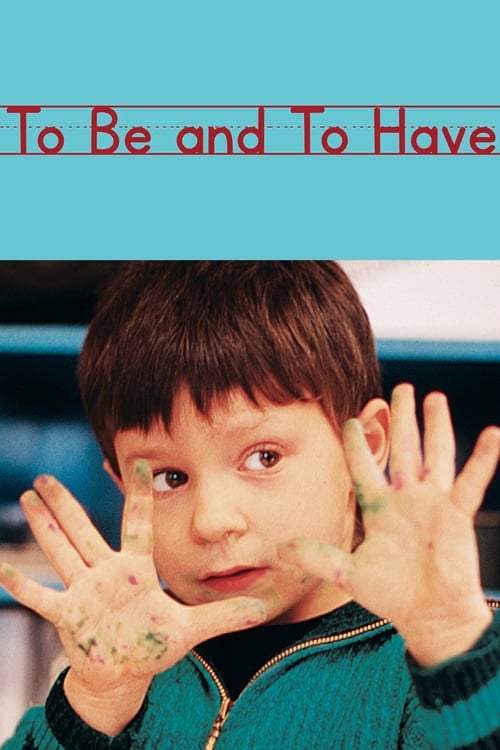
To Be and to Have
2002 · Nicolas Philibert
For a calm, restorative evening when you want gentleness and patience instead of plot — the documentary equivalent of slow food. Deep comfort, with a lump in the throat by the end.
What it's about
In a hamlet of two hundred people in rural Auvergne, one teacher, Georges Lopez, runs the village's single classroom — a dozen children aged four to twelve, all learning together. Across a full school year, the film simply watches: dictation and arithmetic, playground disputes, snow, harvest, and the patient daily work of teaching children not just to read but to be people.
The experience
Quiet, unhurried, and quietly profound — no narration, no interviews, just attention. It sneaks up on you: twenty minutes in you're absorbed in whether a four-year-old can wash his hands properly, and by the end the smallest moments carry surprising emotional weight.
The craft
Nicolas Philibert's craft is invisible: patient observational camerawork, a full year of seasons shaping the structure, and editing that finds narrative and character in unstaged classroom life. There's no thesis and no voice-over — the film trusts you to watch, and that restraint is exactly why it lands.
Why it matters
It became a phenomenon in France — one of the most successful documentaries in the country's history — and a touchstone for observational filmmaking, sparking a national conversation about rural schools and what teaching actually is.
Snapshot
To Be and to Have (Être et avoir) is Nicolas Philibert's observational documentary about a single-room rural school — a classe unique — in Saint-Étienne-sur-Usson, a hamlet of barely two hundred people in the Auvergne. Across one school year, a single teacher, Georges Lopez, shepherds roughly a dozen children aged four to twelve through reading, arithmetic, dictation, and the slow work of becoming socialized. The film has no voice-over, no interviews in the conventional sense, no archival inserts and no thesis announced from outside the frame. Its title — the two French auxiliary verbs être and avoir, "to be" and "to have," chalked and conjugated in the classroom — gestures at the elemental nature of what is being transmitted: not merely grammar but the foundational categories of identity and possession that a child must learn to inhabit. Premiered out of competition at the 2002 Cannes Film Festival, the film became a phenomenon, one of the most widely seen documentaries in French cinema history and a touchstone for the early-2000s revival of theatrical non-fiction. It is also, as later events made clear, a case study in the ethical fault lines of observational filmmaking.
Industry & production
The film emerged from the French art-house documentary infrastructure rather than from television's reportage tradition, even though public broadcasting underwrote it. It was produced by Maïa Films with the participation of Arte France Cinéma, Les Films d'Ici, the Centre National de la Cinématographie, and Canal+ — the characteristic French co-financing assembly that allows a feature documentary to be conceived for the cinema screen and a year-long shoot to be sustained. Philibert had by 2002 built a reputation across more than a decade of patient, institution-centered documentaries, and that track record made a project with no script and an open-ended shooting schedule financeable.
The production model was immersion: Philibert and a small crew embedded in the school across an academic year, filming from the winter of one calendar year into the following summer, so that the seasons of the high Auvergne plateau — snow, thaw, spring, the harvest light of the final term — became the film's natural structure. This is slow, low-ratio-in-spirit but high-ratio-in-fact filmmaking; a great deal was shot to yield a roughly hundred-minute film. The commercial outcome dwarfed expectations for the form. On release the film drew well over a million admissions in France and ran for an extended theatrical engagement, making it one of the highest-attended documentaries the country had seen and a substantial international export. (Specific final admission and gross figures circulate in various forms; I avoid citing a precise number where the record is inconsistent.)
That very success generated the production story most often attached to the film today. After the film became profitable, the teacher Georges Lopez, along with some of the children's families, brought legal action against Philibert and the producers, seeking remuneration and asserting rights over their depicted image and, in Lopez's case, a claim to co-authorship or to a share of the proceeds as a "performer." The French courts ultimately rejected these claims, holding that the subjects of a documentary are not, on these facts, co-authors or paid performers entitled to a cut of profits. The episode became a landmark reference point in French debates about the rights of documentary subjects.
Technology
To Be and to Have belongs to the lineage of lightweight, sync-sound location shooting that lightweight film cameras and portable recording made possible, even as it was made on the eve of the documentary's digital turn. The film was shot photochemically on 16mm-format film stock and finished for 35mm theatrical projection, a workflow that preserves a soft, grain-bearing, filmic image rather than the flatter video look that would soon dominate low-budget documentary. The choice matters: the warm, slightly burnished texture of the classroom and the painterly snow-and-pasture landscapes are partly an artifact of shooting on film, and they give the modest material an unexpected pictorial dignity. Sound was captured live in the room — the scratch of pencils, the teacher's low voice, the ambient hum of a working classroom — without the prosthetic of narration or scored commentary layered over events as they unfold.
Technique
Cinematography
The cinematography — credited to a small team working with Philibert, including Katell Djian and Laurent Didier among the camera personnel — is built on stillness and patience. The dominant grammar is the held shot: a fixed or barely moving frame on a child's face as it works through a problem, the camera waiting out hesitation, frustration, and the small dawning of comprehension. Philibert composes the classroom frontally and in depth, often isolating a single pupil while the rest of the room remains a soft background presence of sound and movement. Against the interior scenes he sets recurring exterior tableaux of the Auvergne countryside — cattle in snow, a tractor crossing a field, the road that brings the children to school — wide, composed, almost contemplative landscape shots that mark the turning of the seasons and lend the year its arc. The restraint is a moral as much as an aesthetic position: the long lens and the unhurried take let behavior reveal itself rather than being cut into legibility.
Editing
Editing, by Philibert himself, is the film's true authorship, and it was recognized as such with the César for Best Editing in 2003. With no narration to carry exposition and no interviews to supply structure, the entire meaning of the film is constructed in the cut — in the selection of which moments to keep, the rhythm of how long to hold them, and the seasonal ordering that turns a year of footage into a coming-of-age in miniature. The edit resists climax; it accumulates. Small motifs — a recurring difficult pupil, a quarrel between two boys mediated by the teacher, the looming transition of the oldest children to secondary school — are threaded patiently so that an emotional shape emerges without ever being underlined. The final movement, as the school year ends and Lopez says goodbye to the departing children, gathers an unexpected weight precisely because the film has spent ninety minutes refusing to manipulate.
Mise-en-scène / staging
Because this is observational documentary, "staging" is largely a matter of where the camera stands and what the filmmaker chooses to honor in an unstaged reality. The classroom itself is the set: one room, mixed ages, the cartography of small desks, the blackboard, the stove. Philibert treats this confined space theatrically in the best sense — as an arena with a clear geography, a central figure, and a rotating ensemble — without falsifying it. The natural choreography of a one-room school, in which a four-year-old's nap coexists with an eleven-year-old's long division, becomes the film's mise-en-scène.
Sound
Sound is diegetic and close, the texture of a working room rendered without embellishment. The decision to forgo voice-over is itself a sound design: it forces attention onto the actual speech of the classroom — dictation, recitation, the patient repetition of a teacher's questions — and onto the silences in which children think. Philippe Hersant's score is used sparingly, more as occasional punctuation around the landscape passages than as continuous emotional underlining, preserving the documentary's commitment to the unscored real.
Performance
No one performs, and yet the film lives on faces. Georges Lopez emerges as a figure of remarkable steadiness — soft-spoken, exacting, unhurried — and the film's affection for him is unmistakable, which is part of what made the later legal dispute so charged. The children, especially the youngest (whose struggles with handwriting and with each other become small set-pieces) and the oldest (facing departure), carry the film's emotional content simply by being attended to. The "performances" are the ordinary self-presentations of people aware of a camera that has been present long enough to become unremarkable.
Narrative & dramatic mode
The film is a year-in-the-life structured as an unforced coming-of-age. Its dramatic mode is observational and durational: tension and resolution arise from real developmental arcs — a child learning to read, a conflict resolved, a graduation approaching — rather than from imposed plot. The seasonal cycle provides the three-act scaffolding, with the end of the school year functioning as both literal conclusion and elegiac climax. It is melodrama's opposite: emotion earned through accumulation and withholding.
Genre & cycle
To Be and to Have is a feature documentary in the observational tradition, and more specifically an "institution film" — a study of a single bounded social world, in this case a school. It arrived within, and helped define, the early-2000s wave of documentaries that succeeded as theatrical cinema, a cycle that includes high-profile international titles of the same moment and that demonstrated audiences would pay to see non-fiction on a big screen. Within Philibert's own corpus it belongs to a cycle of films about closed institutions and communities of care and instruction.
Authorship & method
Philibert is the film's author in every meaningful sense — director, editor, and shaping intelligence — and To Be and to Have crystallizes a method developed across his earlier work. His approach is one of long immersion and earned trust: he enters an institution, stays until the camera is naturalized, and finds the film in the editing rather than imposing it in advance. He refuses the apparatus of explanation — no narrator, no expert testimony, no statistics — trusting attention itself to produce understanding. Key collaborators include the camera team (Katell Djian, Laurent Didier, and others working alongside Philibert), composer Philippe Hersant, whose restrained score frames the landscape passages, and the production stewardship of Maïa Films and Les Films d'Ici. But the authorial signature is unmistakably Philibert's: humane, unhurried, attentive to process and transmission.
Philibert's prior filmography is the essential context. La Ville Louvre (1990) observed the great museum from behind the scenes; In the Land of the Deaf (Le Pays des sourds, 1992) entered deaf culture and sign language; Every Little Thing (La Moindre des choses, 1997) documented life at the La Borde psychiatric clinic. Each is a patient portrait of a self-contained world and a community of care, and To Be and to Have is the popular culmination of that practice.
Movement / national cinema
The film is a flagship of French documentary cinema and of France's distinctive support for non-fiction as an art-house theatrical form, sustained by CNC funding, Arte's editorial commitment, and a network of distributors and cinemas receptive to documentary. It descends from the cinéma direct / cinéma vérité heritage associated with French and Québécois observational filmmaking of the 1960s, but it softens that movement's sometimes confrontational or provocational edge into something warmer and more contemplative. Its rural Auvergne setting also places it within a French cultural preoccupation with la France profonde — the deep, vanishing countryside — and with the slow disappearance of the one-room school as an institution.
Era / period
Released in 2002, the film sits at a hinge moment: the last flowering of photochemical documentary before digital video became the default, and the beginning of documentary's commercial renaissance in cinemas. It also captures a specific historical subject in mid-disappearance — the classe unique, the small rural multi-age school that rationalization and demographic decline were steadily closing. Part of the film's elegiac charge comes from this awareness that it is recording something nearly gone.
Themes
At its center is transmission — the patient, unglamorous handing-down of literacy, numeracy, and social formation from one generation to the next, and the figure of the teacher as the agent of that passage. Around this cluster childhood and its thresholds (the youngest learning the most basic forms; the oldest crossing out of the protected world of the classe unique into adolescence and the larger school), and time itself, rendered through the turning seasons. The title's grammar — être and avoir, being and having — quietly thematizes the deepest stakes: a child learning not only to conjugate but to be a self and to possess a world. Underlying it all is a meditation on rural France and on an endangered institution, and an implicit ethics of attention: the film argues, by its method, that to watch carefully and without judgment is itself a form of respect.
Reception, canon & influence
Critical reception was warm to rapturous. Reviewers praised the film's tenderness, its restraint, and Lopez's quiet authority, and its theatrical success in France was extraordinary for a documentary — a long run and admissions figures more typical of fiction features. It accumulated significant honors, including the Louis Delluc Prize for 2002, the European Film Award for Best Documentary, and the César for Best Editing in 2003, and it traveled widely internationally as one of the defining art-house documentaries of its moment.
Looking backward, the film draws on the observational and direct cinema tradition and on Philibert's own decade of institution portraits; its refusal of narration and its trust in duration are inherited positions, here brought to an unusually large audience. Frederick Wiseman's lifelong study of American institutions is a frequent comparison point for the broader mode, though Philibert's register is gentler and more lyrical than Wiseman's.
Looking forward, the film's influence runs along two tracks. Aesthetically and commercially, it helped prove that patient observational documentary could succeed theatrically, contributing to the early-2000s documentary boom and encouraging a wave of education- and childhood-focused non-fiction. Ethically, its aftermath became as influential as its style: the litigation by Georges Lopez and the families turned To Be and to Have into a permanent reference in discussions of documentary consent, the rights of filmed subjects, and the moral economy of profiting from real lives — a cautionary text taught alongside the film's craft. Philibert himself continued his career as one of France's most respected documentarians, later returning to the territory of care institutions, and To Be and to Have remains the work for which he is most widely known and the high-water mark of its particular humane, observational tradition.
A Deleuzian reading
Start with a small hand and a pencil.
The full Deleuzian reading of To Be and to Have →
Reception
A surprise sensation in 2002 — a quiet documentary about a one-room village school that became a genuine box-office hit in France and won the Prix Louis Delluc — its afterglow was complicated when its beloved teacher sued the filmmakers, and it's now remembered both as a doc-cinema high point and a cautionary tale.
How To Be and to Have was received, from release to now →
Influences: the films it descends from and the films it influenced
- Nanook of the North (1922) — Founds the durational portrait of a self-contained world performed by non-actor subjects filmed within their own daily process — the ethnographic patience Philibert inherits and domesticates to a classroom.
- Farrebique (1946) — Organizes a single rural French household by the agrarian seasonal cycle — the autumn-to-summer 'la France profonde' structure and landscape-tableau cutaways that Philibert's seasonal architecture directly echoes.
- Primary (1960) — Pioneers lightweight synchronous-sound 16mm direct cinema that follows subjects unobtrusively without staging, the photochemical-hinge technology and observational ethic underwriting Philibert's held shots.
- Chronicle of a Summer (1961) — Establishes the French cinéma-direct lineage of filming real people with sync sound and trusting recorded encounter over commentary — the national tradition Philibert extends in its gentler, non-participatory register.
- High School (1968) — Defines the institution film built with no narration, no interviews and no score, letting meaning accrue entirely through the edit — the structural model Philibert softens but follows scene-grammar for scene-grammar.
- The Children of Golzow (1961) — Longitudinal observational filming of a single primary-school class over years, treating childhood transmission inside one room as a documentary subject worth sustained, undramatized attention.
- First Graders (1984) — Patiently observes a Tehran primary school with the camera held at child height, finding drama in small disciplinary and pedagogical exchanges — the attentive framing of children-as-subjects Philibert refines.
- Homework (1989) — Builds an entire documentary from frontal, durational shots of schoolchildren answering questions, trusting the unadorned face and voice without commentary — a direct precedent for Philibert's classroom close attention.
- Land of Silence and Darkness (1971) — Philibert's patient observational portrait of a rural French schoolteacher inherits Herzog's model of the sustained look that permits inner life to emerge without narration; the editing's episodic accumulation and the camera's contemplative stillness before faces thinking constitute a formal lineage from the Straubinger encounter sequences.
- Belfast, Maine (1999) — Wiseman's observational grammar compressed into a single room: no interviews, no narration, fixed medium shots of teaching sessions filmed to completion, with the year's dramaturgy discovered in the edit rather than scripted in advance.
- The Class (2008) — Stages a single-classroom durational study performed by real students and a real teacher playing versions of themselves, importing Philibert's one-room observational realism into fiction.
- Babies (2010) — Extends the voiceover-free, dialogue-light observational study of early childhood whose meaning is assembled purely in the cross-cut edit — the post-Philibert education/childhood documentary boom in commercial form.
- Three Sisters (2012) — Pushes durational observation of rural childhood to an austere extreme — diegetic sound only, no score or narration, the camera simply abiding — carrying Philibert's patience past its lyric limit.
- On the Adamant (2023) — Philibert returns to a care institution with the identical method — immersion, no narration, attention to transmission and process — confirming the schoolhouse film as the template of his mature practice.
- Honeyland (2019) — Philibert constructs a pedagogical year in a single-room French village school into dramatic shape entirely through editorial selection of non-professional subjects in their authentic working environment, demonstrating the same strategy Georgiev employs in Honeyland: classical narrative form achieved without the apparatus of fiction.
- La Ville Louvre (1990) — Philibert's own method origin: observing an institution from behind the scenes until the camera is naturalized, finding the film in the cut rather than imposing a thesis.
- Récréations (1992) — Wordless observational study of a French nursery playground that films children's self-governing social world at their own level with no commentary — the same diegetic-only, non-actor-childhood craft Philibert deploys indoors.
- In the Land of the Deaf (1992) — Same authorial signature applied to a community of care and a pedagogy of transmission — long immersion, refusal of voiceover, attention to teaching as process.
- Every Little Thing (1997) — The La Borde clinic portrait that perfects Philibert's 'stay until trust is earned' immersion and sparing-score lyricism, the direct methodological rehearsal for the schoolhouse.
- Profils paysans: L'approche (2001) — Static held shots of aging 'France profonde' farmers, diegetic speech only and severe duration — the contemporaneous rural-observational tableau that brackets Philibert's project.
- The Teacher Who Promised the Sea (2023) — Shares the observational grammar of the single-room rural school, letting the daily teacher-pupil rhythm and the printing/writing tasks become the drama.
- The Chorus (2004) — Documentary sibling from the same moment — the compassionate-versus-authoritarian pedagogy debate rendered through a patient, gentle rural teacher, the non-fiction counterpart to Mathieu's idealized humanism.
Similar films
- Chronicle of a Summer (1961) — influence & lineage
- Diary of a Country Priest (1951) — shared sensibility
- The Tree of Wooden Clogs (1978) — shared sensibility
- The Gleaners and I (2000) — shared sensibility
- Amour (2012) — shared sensibility
- The Child (2005) — shared sensibility
- The Chorus (2004) — shared sensibility
- Au Revoir les Enfants (1987) — shared sensibility
All the films related to To Be and to Have →