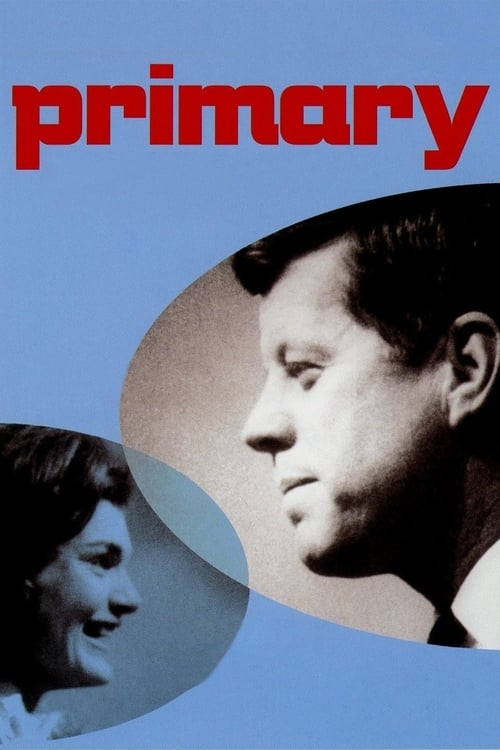
Primary
1960 · Robert Drew
For when you want a time machine more than a movie — a short, real dose of history that pairs well with an election season or a documentary kick. Comfort-adjacent in length, bracing in how present it feels.
What it's about
Two senators — John F. Kennedy and Hubert Humphrey — crisscross Wisconsin in the spring of 1960, fighting for the Democratic presidential nomination one handshake, rally, and hotel-corridor huddle at a time. A small crew with a portable camera and synchronized sound simply follows them: no narrator lectures, no staged interviews, just the grind and adrenaline of a campaign as it happens. It's a snapshot of American democracy at street level, with a young Kennedy on the edge of history.
The experience
Fast, close, and strangely intimate — you feel elbowed along in the crowd, watching famous men be tired, nervous, and charming at close range. At under an hour it moves like a sprint, and the roughness of the footage reads as immediacy rather than flaw.
The craft
This is the film that invented a way of shooting: handheld cameras light enough to trail a candidate through a crush of supporters, sound recorded on the fly, editing that trusts moments instead of narration. The famous shot following Kennedy through a packed hall into the glare of the stage still feels electric — you're not told what a campaign is like, you're inside one.
Why it matters
The founding work of American direct cinema, it rewired documentary filmmaking and set the template for every fly-on-the-wall political film and campaign doc since.
Snapshot
Primary is a fifty-three-minute documentary chronicling the contest between Senator John F. Kennedy of Massachusetts and Senator Hubert Humphrey of Minnesota in the 1960 Wisconsin Democratic presidential primary. Produced by Robert Drew for Time Inc.'s broadcast division, it is the foundational text of American direct cinema — the first sustained attempt to record unfolding political reality with synchronized sound and a fully portable camera, without staged interviews, scripted narration, or the apparatus of conventional reportage. Its importance is disproportionate to its modest length and limited original broadcast: it demonstrated that a small crew could follow public figures into hotel corridors, motorcades, and campaign offices and emerge with a film that felt like lived experience rather than illustrated argument. The famous unbroken tracking shot following Kennedy from the street, through a crowd, and up onto a stage in Milwaukee — held on the back of his head and the surrounding bodies — became the signature image of a new documentary grammar. Within a few years the techniques pioneered here would reshape nonfiction film on both sides of the Atlantic and bleed into fiction filmmaking as well. Primary was selected for the National Film Registry by the Library of Congress in 1990 and preserved by the Academy Film Archive in partnership with The Film Foundation in 1998.
Industry & production
Primary emerged from a specific institutional crucible: Robert Drew's unit inside Time Inc., the corporate parent of Time, Life, and a portfolio of broadcasting interests. Drew, a Life magazine correspondent and editor, had become convinced that television journalism remained captive to the "illustrated lecture" — narrators explaining images, interviews staged for the camera, reality pre-digested. Drawing on the candid-photography ethos of the Life picture essay, he sought a film equivalent: journalism that showed rather than told. Time Inc. underwrote the development of lightweight equipment and the production itself, with the resulting film intended for distribution through stations and outlets connected to the company's broadcast holdings rather than a major network in prime time.
The production gathered an extraordinary group of young filmmakers who would become the central figures of American documentary for a generation: Richard Leacock, Albert Maysles, D. A. Pennebaker, and Terence Macartney-Filgate worked the cameras and sound, alongside Drew as producer and organizing intelligence. The shoot was logistically improvised by necessity — the crew had to secure the trust and cooperation of two campaigns and then keep pace with candidates who moved constantly. Access was the production's true capital: Kennedy and Humphrey, and crucially their staffs, permitted the cameras into spaces normally closed to press. The record on exact budgets and the precise terms of distribution is comparatively thin, and Primary did not reach a mass audience on first release; its influence was propagated less by viewership than by the demonstration effect it had on filmmakers and broadcasters who saw what the method could do.
Technology
Primary is, before it is anything else, a technological achievement, and the film cannot be understood apart from the hardware improvised to make it. The governing problem of location documentary in the 1950s was synchronized sound. Professional sync-sound rigs were heavy, tethering camera to recorder by cable and effectively bolting the filmmaker to a tripod. To follow a candidate through a crowd, the Drew unit needed a camera light enough to carry on the shoulder and a sound recorder that could run in step with it while staying in sync — without a physical umbilical.
The unit's engineers and filmmakers, working with collaborators including Loren Ryder and others in the broader effort to crack portable sync, modified 16mm cameras (notably Auricon-derived bodies) for handheld operation and paired them with a recorder synchronized by an accurate crystal or tuning-fork-based timing reference rather than a connecting cable. This wireless-sync principle is the hinge on which the whole aesthetic turns: it freed camera operator and sound recordist to move independently through a space, each tracking the action on their own feet. The equipment used on Primary was still transitional and cumbersome by later standards — the gear was heavy, the magazines short, the operation physically punishing — and not every passage achieves clean sync. But the breakthrough was real and consequential. The technical lineage runs directly from Primary through the further refinement of the Drew-unit rigs to the lightweight Éclair and Nagra combinations that standardized portable sync-sound documentary worldwide within a few years.
Technique
Cinematography
The camerawork is the film's revolution made visible. Shooting handheld on 16mm, operators including Leacock, Maysles, and Pennebaker abandoned the locked-off frame for a mobile, searching, eye-level perspective that moves with the body. The image is frequently unstable, grainy, and reactive — the camera hunts for the significant face, reframes as a subject turns, loses and recovers focus. The celebrated Milwaukee shot, generally credited to Albert Maysles, follows Kennedy from behind through a packed hall and up onto the platform in a single continuous take, the operator physically wading through the crowd; it converts the spectator into a participant pressed into the candidate's wake. Elsewhere the camera lingers in cramped hotel rooms catching the slack, waiting hours of a campaign — Humphrey making radio appeals, Kennedy backstage — privileging the texture of duration over the staged highlight. Available light governs the look: deep shadows, blown highlights, and high contrast are accepted as the cost of intimacy, and that very roughness reads as authenticity.
Editing
Editing on Primary had to solve a new problem — how to shape footage that was gathered without a script. The film cross-cuts between the two campaigns to build a parallel structure, contrasting Kennedy's telegenic glamour and the crowds he draws with Humphrey's more workmanlike, retail style of barnstorming. Drew's background in the Life picture essay shaped the approach: scenes are assembled to let meaning accumulate through juxtaposition and observed detail rather than through argument imposed by narration. There is some connective voice-over and the structure leans on the chronological spine of the primary itself, building toward election night and the result. The cut respects the integrity of observed moments — holding on faces, allowing pauses — rather than chopping action into illustrative fragments, and in doing so it models a documentary editing logic of selection-from-life that would define the form.
Mise-en-scène / staging
The animating principle of Primary is the refusal of staging. There are no reconstructions, no marks for subjects to hit, no setups arranged for the lens. The "mise-en-scène" is therefore the real world's own arrangement: the geometry of a crowded hall, the cramped clutter of a hotel room, the choreography of a motorcade and a rope line. What the filmmakers controlled was position and attention — where to stand, whom to watch, when to keep rolling. This is the meaning of the direct-cinema ideal as Leacock often framed it: the filmmaker as observer who does not intervene, ideally a presence the subjects forget. In practice the candidates were performers acutely aware of cameras, and part of the film's lasting fascination is the friction between the politician's self-presentation and the camera's patient effort to catch the moments between performances.
Sound
Synchronous location sound is Primary's defining sensory innovation and the payoff of its technology. For the first time, the spectator hears the actual ambient world of a campaign locked to the image of it: the swell of a crowd, a speech delivered into a hot room, the murmur of aides, the scratch of a radio broadcast. The sound is raw and imperfect — muddy, sometimes drifting, occasionally swamped by room noise — but its imperfections are inseparable from its truth-claim. Where prior documentary sealed images under a controlled narrating voice and scored music, Primary lets the event speak in its own acoustic texture. The limited, functional voice-over present in the film is a vestige of older practice; the future the film points toward is one in which the recorded sound of reality carries the burden of meaning largely on its own.
Performance
The "performances" in Primary are real people being themselves under observation — yet performance is precisely the subject. Kennedy emerges as a study in charismatic ease: the film captures the magnetism, the crowds of young women, the relaxed command that television would soon amplify into the presidency. Humphrey, by contrast, is rendered with unexpected warmth and pathos — voluble, earnest, working smaller rooms with evident effort, a man whose decency the camera registers even as it senses he is being outshone. Jacqueline Kennedy appears in one of the film's most quietly revealing passages, her gloved hands twisting behind her back as she addresses a crowd, a gesture of nerves the candid camera catches precisely because no one staged it away. These are not actors' performances but they are performances nonetheless, and the film's drama lies in the gap between public projection and observed human reality.
Narrative & dramatic mode
Primary invents a dramatic mode that would become the documentary default: the observational present tense, in which suspense derives from a genuinely unresolved real-world outcome. The film borrows the armature of a sporting contest — two competitors, a defined field (Wisconsin), a finish line (the vote count) — and trusts that structure to generate tension without editorializing about who should win. Its mode is fundamentally non-expository: rather than marshaling evidence toward a thesis, it accumulates observed moments and lets the viewer infer character and stakes. This is storytelling by selection and arrangement of the actual, and it carries a built-in epistemology — the claim that truth is best approached by watching closely and intervening little. The dramatic charge comes not from narration but from the friction of two temperaments and two styles of seeking power, observed at close range during a few decisive days.
Genre & cycle
Primary is the originating work of American direct cinema, the documentary cycle that ran through the 1960s and was carried forward by the filmmakers it trained. It stands at the head of the Drew Associates body of work — Yanki No!, The Children Were Watching, and above all Crisis: Behind a Presidential Commitment (1963) — and its personnel seeded the two most important independent documentary practices of the era: Leacock-Pennebaker (whose Don't Look Back and Monterey Pop applied the method to the music world) and the Maysles brothers (Salesman, Gimme Shelter, Grey Gardens). It is the American sibling of France's roughly contemporaneous cinéma vérité, exemplified by Jean Rouch and Edgar Morin's Chronique d'un été (1961); the two movements shared lightweight technology and a hunger for unmediated reality but diverged philosophically, the French tradition embracing the camera as a provocateur that catalyzes truth, the Americans aspiring to the fly-on-the-wall ideal of pure observation. Within the longer history of nonfiction film, Primary marks the decisive turn from the scripted, voice-of-God documentary inherited from Grierson and the wartime newsreel toward the observational paradigm that has dominated ever since.
Authorship & method
The authorship of Primary is genuinely collective, which is part of its historical meaning, but Robert Drew is its organizing author — the producer-theorist who defined the goal and assembled the team. Drew's method was journalistic and conceptual: identify a "crisis structure," a real situation with built-in stakes and a deadline, secure access, deploy a small mobile crew, and let the drama play out on camera. His ambition was explicitly to free television journalism from the lecture and to make it behave like the candid photo-reportage of Life.
The collaborators were not technicians executing a vision but co-inventors. Richard Leacock, who had shot for Robert Flaherty on Louisiana Story, brought both craft and the philosophical commitment to non-intervention that became direct cinema's creed. Albert Maysles contributed an extraordinary eye and the physical audacity behind the Milwaukee tracking shot. D. A. Pennebaker brought a lyrical, music-attuned sensibility that would flower in his concert films. Terence Macartney-Filgate, a veteran of the National Film Board of Canada's pioneering Candid Eye series, added experience in observational shooting. Crucially, several of these figures were also engaged in the engineering of the portable sync-sound rigs, so that on Primary the roles of author, craftsman, and inventor collapse into one another. There is no conventional screenwriter — the "writing" is the structuring of reality in production and the cut — and no traditional score is the point; the film's "composition" is its arrangement of recorded actuality.
Movement / national cinema
Primary is a foundational document of postwar American independent and documentary cinema and the keystone of the direct-cinema movement specifically. It belongs to a transatlantic moment around 1960 in which several national cinemas, enabled by converging lightweight technologies, simultaneously reached toward greater immediacy — the French New Wave's location shooting and the cinéma vérité of Rouch, the British Free Cinema movement's poetic observation, the candid work of the National Film Board of Canada. Primary's distinctly American inflection is its fusion of this technical liberation with the institutional muscle and photojournalistic tradition of Time Inc., and with a characteristically American subject: the machinery of democratic politics. The movement it launched became the dominant strain of American nonfiction film and a recurring resource for American fiction directors seeking documentary texture.
Era / period
The film is inseparable from its precise historical instant: 1960, the threshold of the Kennedy era and the dawn of a fully televisual politics. It captures the moment when image, charisma, and the close-up camera were becoming decisive instruments of American power — a transformation that the Kennedy-Nixon television debates would dramatize for a mass audience later that same year, and that Drew's own Crisis would extend into the Kennedy White House. Primary sits at the hinge between the print-and-radio political culture of the first half of the century and the television age, and it both records and embodies that shift: a film made possible by new cameras, about a politician uniquely suited to the new visual medium. It is, in this sense, a period document twice over — of a campaign and of a media revolution happening at the same time.
Themes
At its surface Primary is about an election, but its deeper themes are charisma and democracy, observation and authenticity, and the emerging power of the image in public life. The film is an early, prescient meditation on political celebrity — the way Kennedy's televisual magnetism draws crowds and bends a room — set against Humphrey's older, more laborious mode of retail persuasion; in that contrast the film quietly registers a transformation in how power is won. Reflexively, it is also about looking itself: the entire enterprise advances a thesis that truth resides in patient, unintrusive attention to behavior, and that the recorded surface of reality — a nervous gesture, a tired face, the back of a candidate's head in a crowd — discloses more than any commentary could. Underneath runs the tension, never fully resolved in direct cinema, between the ideal of the invisible observer and the reality that cameras change what they record, especially when their subjects are professional performers of self.
Reception, canon & influence
Primary did not arrive as a popular sensation; its limited initial distribution meant its first audience was small, and its reputation grew through the filmmakers and broadcasters who recognized what it had achieved. The detailed contemporary critical record is comparatively thin, and any account that claims a large first-run audience or specific box-office figures would be inventing them. What is securely established is the film's canonization over the following decades: it is now universally regarded as the founding work of American direct cinema, was inducted into the Library of Congress's National Film Registry in 1990 as a work of enduring cultural significance, and was preserved by the Academy Film Archive with The Film Foundation in 1998.
The influences on Primary are clear and acknowledged. It inherits the candid-photography ethos of the Life picture essay that shaped Drew; the observational craft Richard Leacock carried from his apprenticeship with Robert Flaherty; and the contemporaneous experiments in lightweight, observational filmmaking at the National Film Board of Canada and in the British Free Cinema and French traditions. Technologically it stands on the broad mid-century effort to achieve portable synchronous sound.
Its influence forward is vast and ongoing. Most immediately it generated the entire Drew Associates filmography and, through its personnel, the defining independent documentary careers of the 1960s and beyond — Leacock and Pennebaker (Don't Look Back, Monterey Pop) and the Maysles brothers (Salesman, Gimme Shelter, Grey Gardens) — while running in parallel to Frederick Wiseman's institutional observational cinema. The observational grammar Primary codified became the default mode of serious documentary and, eventually, of the verité-styled wing of television, reaching forward to reality programming and the handheld immediacy of modern news. Its aesthetic also migrated into fiction: the handheld, available-light, reactive camera became a shorthand for realism that directors from the New Hollywood onward have drawn upon to lend invented scenes the charge of the actual. Few films of comparable length have exerted so wide an influence; Primary is less a single work than the source code of a way of seeing.
A Deleuzian reading
The camera is behind a man's head.
The full Deleuzian reading of Primary →
Reception
Barely seen on its 1960 broadcast — only a handful of Time-Life-owned stations aired it and the networks passed — it's now enshrined as the founding document of American direct cinema and sits in the National Film Registry.
How Primary was received, from release to now →
Influences: the films it descends from and the films it influenced
- Nanook of the North (1922) — Established the long-take, patient watching of a single real protagonist's lived activity that Leacock absorbed as Flaherty's creed and carried directly into Primary's non-interventionist observation.
- Louisiana Story (1948) — Leacock served as Flaherty's cameraman here, learning the available-light, patient handheld coverage of unstaged action that he reproduced as the shooting method of Primary.
- The Days Before Christmas (1958) — The NFB 'Candid Eye' experiment in unscripted, lightweight observational shooting that Macartney-Filgate brought in person to Drew's crew as practical technique.
- Listen to Britain (1942) — Built meaning from non-expository montage of recorded actuality with no narrating voice, a precedent for Primary's refusal of the lecture and trust in arranged sound and image.
- Man with a Movie Camera (1929) — Vertov's kino-pravda doctrine that the camera seizes life-as-it-is supplied the theoretical root that cinéma-vérité, Primary's parallel movement, explicitly named itself after.
- Crisis: Behind a Presidential Commitment (1963) — Extends Primary's signature 'crisis structure' — real situation with built-in stakes and a deadline plus secured access — to a Kennedy administration confrontation.
- The Chair (1962) — Applies the ticking-clock crisis structure and selection-from-life editing to a death-row appeal, sharpening the present-tense suspense Primary pioneered.
- Dont Look Back (1967) — Pennebaker's handheld, available-light reactive camera shadowing a public figure backstage is a direct continuation of the music-attuned sensibility he developed on Primary.
- Monterey Pop (1968) — Translates synchronous-location-sound observational coverage into the concert film, deploying multi-camera direct cinema on live performance.
- Salesman (1969) — Albert Maysles evolves the physical audacity of Primary's Milwaukee tracking shot into sustained intimate handheld observation of ordinary, non-famous subjects.
- Gimme Shelter (1970) — A crisis-structure verité in which the non-interventionist camera happens to record unplanned real catastrophe, the logical extreme of Drew's access-and-let-it-play method.
- Grey Gardens (1975) — Long-take observation of subjects openly performing for the lens, extending Primary's 'observed self-presentation' into a study of people staging themselves.
- Titicut Follies (1967) — Institutional observational cinema with no narration, no interviews, and structure built entirely in the edit — the parallel, non-Drew codification of the same observational grammar.
- Medium Cool (1969) — Imports direct cinema's handheld, available-light camera and real-event shooting into a fiction film, borrowing Primary's charge of the actual to authenticate invented scenes.
- The French Connection (1971) — Stages narrative with documentary-style handheld, reactive, available-light coverage — the New Hollywood adoption of Primary's verité look as shorthand for realism.
- Pompei: Below the Clouds (2025) — The originating direct-cinema work whose synchronous-sound, fly-on-the-wall observation without narration is the movement Rosi descends from and refines into a composed-frame variant.
- A Hard Day's Night (1964) — Drew, Leacock, and Pennebaker established the handheld celebrity-in-transit grammar — following subjects through hotel corridors, cars, backstage corridors, and crowd gauntlets — that Lester and Taylor appropriated wholesale as AHDN's fictional documentary register.
- Momma Don't Allow (1956) — British Free Cinema's handheld, available-light filming of a real social gathering with no commentary — the contemporaneous observational ethos Primary independently shared.
- Chronique d'un été (1961) — Used the same new lightweight portable sync-sound rigs in the same moment, but as participatory cinéma-vérité — the provoking counterpart to Primary's fly-on-the-wall non-intervention.
- Chronicle of a Summer (1961) — Parallel exploitation of the same Nagra-plus-lightweight-camera leap for synchronous sound on the move, but as fly-on-the-wall observation — the non-interventionist twin to Chronicle's interventionist branch.
Similar films
- Medium Cool (1969) — influence & lineage
- Man with a Movie Camera (1929) — influence & lineage
- The History of Concrete (2026) — shared sensibility
- All the President's Men (1976) — shared sensibility
- Chronicle of a Summer (1961) — shared sensibility
- United 93 (2006) — shared sensibility
- Soundtrack to a Coup d'Etat (2024) — shared sensibility
- I Am Cuba (1964) — shared sensibility
All the films related to Primary →