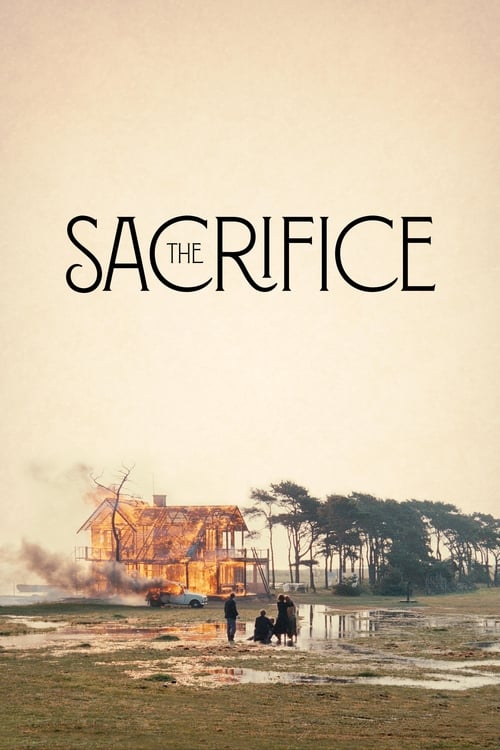
The Sacrifice
1986 · Andrei Tarkovsky
For when you want a film to chew on for days — something grave, beautiful, and demanding, best watched alone at night with the phone off. This is challenge viewing, not comfort viewing.
What it's about
On a remote stretch of the Swedish coast, a retired actor and intellectual named Alexander celebrates his birthday with family and friends — until the radio announces that nuclear war has begun. As the household sinks into dread, Alexander makes a desperate, private vow to give up everything he loves if the world can be spared. It's an end-of-the-world story told not with explosions but with one man's conscience over a single day and night.
The experience
Slow, hushed, and hypnotic — long unbroken takes, murmured philosophy, a mounting dread that gathers like weather. It asks for patience and rewards it with images and a final stretch you won't shake for a long time.
Performances
Erland Josephson carries the film as Alexander — a man arguing with God in real time — with a weary, burning conviction that makes the abstract feel life-or-death.
The craft
Shot by Sven Nykvist, Ingmar Bergman's great cinematographer, in long floating takes and muted northern light, with Bach's St. Matthew Passion threading through the silence. Whole scenes unfold in single shots of astonishing choreography, including one of the most audacious extended sequences ever attempted on film. See it on the biggest screen you can.
Why it matters
Tarkovsky's final film, made in exile and completed as he was dying, it stands as his testament — a summation of a career spent insisting cinema could bear spiritual weight, and a touchstone for every slow-cinema director since.
Snapshot
Andrei Tarkovsky's final film is a slow-burning apocalyptic parable set over the course of a single day on the Swedish coast, in which a retired intellectual named Alexander strikes a bargain with God to avert nuclear catastrophe — and then keeps his word. Running to nearly two and a half hours with a handful of cuts in its extended takes, The Sacrifice distils everything Tarkovsky had explored across his career — longing, faith, guilt, the burden of consciousness — into what is simultaneously a farewell to cinema and a testament to a civilization he believed was spiritually bankrupt. Shot by Ingmar Bergman's longtime cinematographer Sven Nykvist, performed by a predominantly Swedish cast led by Erland Josephson, and saturated with Bach's St. Matthew Passion, the film occupies a singular place in the canon: the work in which an artist, dying, makes his peace with the world by staging its possible destruction.
Industry & production
The Sacrifice was produced as a Swedish–French co-production between the Swedish Film Institute and Argos Films, with Anna-Lena Wibom serving as the Swedish producer. It was Tarkovsky's second consecutive film made entirely outside the Soviet Union — he had shot Nostalghia (1983) in Italy — and, following his public announcement in 1984 that he would not return home, it was the first he undertook with full knowledge that exile was permanent. The Swedish Film Institute's involvement gave him access to a professional Scandinavian infrastructure, and the casting of Josephson, a cornerstone of Bergman's repertory company, gave the film an immediate cultural address within Nordic art cinema. Financing was modest by any Western standard; Tarkovsky worked, as he had throughout his career in the Soviet system, without the commercial pressures of a studio apparatus, but also without a large budget. The shoot, which took place on the island of Gotland off the Swedish coast, was completed in 1985. Tarkovsky received a terminal lung cancer diagnosis in December of that year, during post-production. He died on 29 December 1986, approximately six months after the film's premiere. The film's status as a final statement was thus not retrospectively imposed by critics but was something Tarkovsky himself knew — a knowledge that inflects every frame.
Technology
The film was shot on 35mm using anamorphic lenses, producing the wide 2.39:1 ratio Tarkovsky had favoured since Solaris. The anamorphic format accommodates the horizontal sweep of coastal landscapes and the interior volumes of Alexander's house without compositional distortion, and it allows Nykvist to position figures at extreme distances within the frame. No significant optical or post-production effects were employed; the aesthetic of the film is one of radical material honesty. The sound mix — silence, wind, distant music, diegetic noise registered with the same attentiveness as image — was managed with the same care Tarkovsky brought to all his late productions. The film's most consequential technological episode is one of catastrophic failure: during the filming of the climactic sequence in which Alexander burns down his house, the camera malfunctioned and ran out of film before the building had fully collapsed. The entire structure, purpose-built for the sequence, had to be reconstructed and the shot repeated. This anecdote — exhaustively documented by crew members and by Tarkovsky's own diary entries, later collected and published — has become one of cinema's defining legends of will over material circumstance.
Technique
Cinematography
Sven Nykvist brought to The Sacrifice the philosophy of luminous economy he had refined over decades with Bergman: a preference for natural and available light, an avoidance of theatrical illumination, a sensitivity to the specific temperature of Nordic daylight. The collaboration was the only one between Nykvist and Tarkovsky, and in some respects it represents a confluence of two of the most rigorous visual sensibilities in postwar European film. Nykvist's palette here runs to gray-greens, bleached whites, and the particular diffuse silver of overcast coastal light. Long lenses compress the landscape; the wide frame makes the isolated house and the surrounding trees and sea feel simultaneously intimate and cosmically exposed. The film's most celebrated image — the lateral tracking shot following Alexander as he runs to torch his home, the camera dollying slowly to reveal the burning structure from increasing distance — required exceptional coordination between the cinematographer and the camera operator to sustain the take across its full duration. The black-and-white inserts (including a reproduction of Leonardo's Adoration of the Magi) punctuate the color sequences with a register of contemplative stillness.
Editing
Michal Leszczylowski edited the film and maintained Tarkovsky's characteristic commitment to duration: individual shots extend well beyond the threshold at which commercial cinema would cut, forcing the viewer into a different temporal relation with the action. The editing rhythm is liturgical rather than dramatic; transitions are slow, sometimes imperceptible, and the accumulation of elapsed time within shots becomes itself a subject. Tarkovsky had theorized his editing principle as the "sculpting in time" he described in his written work — the preservation of real-time observation within the frame — and The Sacrifice is perhaps its most uncompromising application.
Mise-en-scène / staging
The film's opening shot — an unbroken take lasting several minutes in which Alexander and his young son plant a withered tree beside a coastal path while Alexander delivers a monologue on language and silence — establishes the method immediately: actors move through space that the camera observes rather than controls, and dialogue is not cut to but lived alongside. The house interiors are dressed with the density of habitation: books, papers, drawings, objects that carry biographical weight without being explicatory. The staging of the birthday gathering has the quality of a late Chekhov act, with conversation weighted by what is not said. When the war announcement comes — through a television and radio that distort and fragment — Tarkovsky stages a physical dissolution of the household: figures collapse, drift apart, gather in doorways. The burning of the house in the final act is staged at a remove, the camera tracking Alexander as he sprints away from the camera and then wheeling to hold the inferno at distance — a refusal of spectacle even in spectacle.
Sound
Sound in The Sacrifice is treated with the attention usually given to the visual image. Silence is structural, not incidental; extended passages contain only ambient outdoor sound, distant wind, the creak of the house. Bach's St. Matthew Passion enters the film at its most extreme moments of grief and ecstasy, its counterpoint functioning as theological commentary. Tarkovsky's use of pre-existing music was always curatorial rather than illustrative — he chose Bach not to tell the audience how to feel but to invoke a tradition of spiritual witness against which Alexander's private bargain can be measured. The diegetic sounds of the household — voices, footsteps, the hum of the television before its signal degrades — are recorded with hyperreal clarity, making their disruption by the war announcement feel like a tear in the fabric of the audible world.
Performance
Erland Josephson carries the film almost entirely on the force of his physical and vocal presence. His Alexander is not a hero but a man of surplus thought — articulate, self-aware, paralyzed by that awareness — and Josephson renders this without condescension toward the character or the audience. The performance is extended, discursive, physically deliberate; it demands the patience the film itself asks of the viewer. Susan Fleetwood as Alexander's wife, Allan Edwall as the mystical postman Otto, and Valérie Mairesse as the woman Maria are drawn with similar specificity. Edwall's Otto — eccentric, tender, inhabited by a kind of folk-cosmological certainty — functions as the film's most explicitly supernatural agent without ever becoming merely allegorical. The performances were conducted in Swedish and English across the multilingual cast, a linguistic hybridity that Tarkovsky allowed to remain visible, contributing to the film's atmosphere of civilisational dislocation.
Narrative & dramatic mode
The film is structured as an inverted miracle play. The first act assembles Alexander's world — family, friends, a house full of memory and meaning — with meticulous anthropological care. The war announcement in the second act destroys that world not visually but acoustically and psychologically: the images remain serene while the characters disintegrate. Alexander's bargain — if God averts disaster, he will give up everything, burn his house, take a vow of silence — is made in solitude, in a scene of raw, unironic prayer. Whether the war was real or a dream, whether it has actually been averted, and whether Alexander's self-sacrifice is efficacious or delusional, the film declines to resolve. The final image — the boy, now watering the dead tree alone, asking "In the beginning was the Word" to the sky — does not offer consolation so much as it poses the question again, from the next generation's distance.
Genre & cycle
The Sacrifice exists within the tradition of Northern European spiritual cinema — the films of Bergman, Dreyer, and the late work of Robert Bresson — but it also belongs to the cycle of Cold War eschatological fiction that emerged in force in the early 1980s. The contemporaneous anxiety about nuclear annihilation (evident across European and American culture from roughly 1981 to 1987) gives the film's premise an immediate referential grounding that distinguishes it from pure parable. It is not, however, a political film in any programmatic sense; the war is apocalypse as metaphysical event, not as policy failure. Within Tarkovsky's own filmography, it closes the trilogy of exile and longing that began with Nostalghia, extending that film's meditation on homesickness and sacrifice into fully eschatological territory.
Authorship & method
Tarkovsky wrote the screenplay himself. The script's themes — the complicity of the intellectual with modernity's catastrophe, the inadequacy of language, the necessity of extreme gesture — are continuous with the concerns of his earlier work, particularly Mirror and Stalker. His working method with actors was collaborative within strict parameters: he sought not naturalistic performance but a heightened quality of lived attention, and he rehearsed extensively to achieve takes of the duration his shooting style required. His collaboration with Nykvist was, by all accounts, one of deep mutual respect, though the two men came from different visual traditions. Where Nykvist's work with Bergman had emphasized facial close-up and the intersubjective space between characters, Tarkovsky pushed toward longer shots that subordinated faces to landscape and duration. The convergence of their methods is one of the remarkable technical facts of the film. The film is dedicated to Tarkovsky's son Andryusha — a private signature that renders the film's themes of legacy and inheritance biographical as well as philosophical.
Movement / national cinema
The Sacrifice is neither straightforwardly a Soviet film nor a Swedish one. Tarkovsky made it in exile, in Swedish with Swedish and French funding, using Swedish technical infrastructure and a cast drawn from the Bergman repertory — yet it is unmistakably the work of a Russian sensibility steeped in Orthodox Christian spirituality and the tradition of Russian literary existentialism from Dostoevsky and Tolstoy forward. It sits, productively, in the no-man's-land between national cinemas: too alien in its concerns to be absorbed into the Scandinavian canon, too Western in its production circumstances to be claimed straightforwardly by Soviet or Russian cinema history. This displacement is constitutive of its meaning; it is a film made by a man without a country, for a civilization he experienced as also, in some deeper sense, homeless.
Era / period
The film belongs to the decade's intensification of Cold War anxiety, the moment between the heightened nuclear tensions of the early Reagan years and the tentative thaw of the mid-to-late 1980s under Gorbachev. Artistically it belongs to the final phase of the European art cinema paradigm established in the 1950s and 1960s — a paradigm that would, within a decade, be substantially dissolved by economic pressures and changing exhibition habits. In this sense, The Sacrifice is a late monument to a particular mode of cinema-as-spiritual-practice that had Bresson, Bergman, and Dreyer as its earlier exemplars.
Themes
The film's governing themes are sacrifice, silence, and faith. Alexander's vow to give up his voice and his home recapitulates the logic of Abraham's willingness to sacrifice Isaac — extreme submission as the only form of authentic belief available to a modern consciousness too sophisticated for simple piety. The dead tree that Alexander and his son plant at the film's opening, with the promise that if it is watered daily it will eventually bloom, becomes the film's central emblem: faith as patient, irrational maintenance against all visible evidence. Language and its failure run throughout: Alexander has been a journalist and actor, a professional user of words, and his bargain — silence in exchange for the world — is simultaneously a renunciation of his vocation and an acknowledgement that speech has not saved anything. The relationship between father and child, civilization and its inheritors, closes the film with the boy's unanswered question to the sky.
Reception, canon & influence
The Sacrifice premiered at the Cannes Film Festival in May 1986 and was awarded the Grand Prix du Jury as well as additional prizes, including recognition from the FIPRESCI jury and the Ecumenical Jury. The critical reception was one of reverence inflected by mourning: Tarkovsky's illness was known within the film world, and many reviews were simultaneously assessments of a career and elegies for its maker. The film consolidated his reputation, which had been built steadily in the West through retrospectives and the international success of Stalker, as the preeminent spiritual filmmaker of his generation. Among the films that shaped The Sacrifice, Bergman's work — particularly Persona, Winter Light, and Cries and Whispers — is the most legible influence, though Tarkovsky consistently distinguished his concerns from Bergman's on theological grounds, viewing Bergman's vision as fundamentally Protestant and humanist where his own was rooted in Orthodox immanence. The influence of Tolstoy's late spiritual fiction, particularly the renunciatory arc of The Death of Ivan Ilyich, has been frequently noted by scholars. Looking forward, the film's legacy is visible in the work of filmmakers who have acknowledged Tarkovsky's influence: Lars von Trier, Terrence Malick, Carlos Reygadas, and Béla Tarr each share something of its preoccupation with duration, landscape, and extreme gesture as moral event. Within the broader category of "slow cinema" as critically codified in the 2000s and 2010s, The Sacrifice functions as a founding document — an argument that cinema's unique capacity lies precisely in its ability to make the viewer inhabit time rather than consume it.
A Deleuzian reading
A dead tree, propped up with stones, on a gray coastal path.
The full Deleuzian reading of The Sacrifice →
Reception
Premiered at Cannes 1986 to huge respect but some grumbling that it was Tarkovsky doing Bergman — it took the Grand Prix (plus three other awards) yet not the Palme, which some felt was a snub. His death months later transformed it into a testament, and it's now read as one of cinema's great farewells.
How The Sacrifice was received, from release to now →
Influences: the films it descends from and the films it influenced
- Ordet (1955) — The inverted miracle play as structural template: a domestic patriarchal household in which an impossible act of faith is filmed without irony and treated as literally efficacious, the exact genre form Tarkovsky adopts for Alexander's apocalyptic vow and its fulfillment.
- Ugetsu (1953) — The extended lateral tracking shot as a moral-temporal device—following characters through spatial transitions in a single unbroken take so that ethical consequence accumulates in real time rather than through montage—the direct formal ancestor of Tarkovsky's sustained lateral tracking through the island estate.
- Winter Light (1963) — Sven Nykvist's flat, diffuse, gray natural light as a theological condition rather than atmosphere—the specific overcast palette and soft-box diffusion that defines Swedish spiritual cinema's visual grammar—which Tarkovsky inherited wholesale and transposed from Bergman's Protestant landscape to his own Orthodox register.
- Persona (1966) — Nykvist's anamorphic widescreen technique—the way the wide frame empties lateral space around faces to create spiritual pressure—which Tarkovsky repurposed away from Bergman's intersubjective close-up and toward longer takes that subordinate the face to landscape; Erland Josephson's performance mode was formed within this Bergman repertory and carried intact into his lead role in The Sacrifice.
- Au hasard Balthazar (1966) — The structural use of canonical classical music (Schubert's piano sonata) as a transcendent frame for bodily degradation and sacrifice, establishing the formal principle that Bach's St. Matthew Passion performs in The Sacrifice: sacred counterpoint as the film's ethical address to the viewer rather than emotional underscoring.
- The Travelling Players (1975) — Extreme-duration lateral tracking shots—some exceeding ten minutes—that traverse historical time within a single take, developing independently the same formal conviction Tarkovsky holds: that unbroken lateral movement is cinema's primary instrument for making the viewer inhabit time rather than consume it.
- Nostalgia (1983) — Tarkovsky extends Nostalgia's metaphysical-cinema grammar into Swedish exile with Sven Nykvist continuing Lanci's long-take available-light protocol; the nine-minute house-burning shot escalates the candle-crossing's combustion-as-spiritual-act staging; acoustic bilingualism (Swedish/French) and lyric structure without causal resolution reappear as permanent features of Tarkovsky's late aesthetic.
- Cries and Whispers (1972) — Tarkovsky specifically engaged Sven Nykvist as cinematographer, transporting Nykvist's available-light long-lens methodology directly from his Bergman collaborations — the weighted camera, the tonal precision in interior spaces, the patience with duration — into Tarkovsky's own chamber drama of mortality and spiritual crisis.
- The Silence (1963) — Tarkovsky recruited Sven Nykvist as cinematographer precisely to access his low-key high-contrast lighting and sustained close-up method, making The Sacrifice a direct transfer of The Silence's cinematographic DNA into a Russian metaphysical idiom about silence, sacrifice, and inexpressible spiritual crisis.
- The Ascent (1977) — Carries forward the Christian-ordeal narrative in which one man's self-immolating act redeems others — the martyr's logic Shepitko gives Sotnikov, staged with the same solemn duration.
- Shame (1968) — Shot on Bergman's home ground (Gotland/Fårö) by Sven Nykvist with Erland Josephson, it literalizes the Shame lineage: nuclear apocalypse dramatized through one household's disintegration.
- Mother and Son (1997) — Extreme extended takes in anamorphically distorted natural landscape with near-total silence and Nykvist-derived diffuse light; the film inherits Tarkovsky's principle that duration within a single take is the formal equivalent of duration in dying—the entire structure enacts this as an explicit tribute.
- Breaking the Waves (1996) — The sacrifice narrative in which an irrational, extreme vow made to God saves another person—directly echoing Alexander's bargain—set against northern European Protestant landscape; von Trier cited Tarkovsky as his model for treating extreme spiritual gesture as cinematically literal rather than metaphorical event.
- Werckmeister Harmonies (2000) — Very long lateral tracking shots through provincial Hungarian space—János's nocturnal walk through the town is structured as a single sustained lateral movement—that directly inherit The Sacrifice's formal conviction that dread accumulates through unbroken duration rather than edited rhythm.
- The Return (2003) — Tarkovskian lateral tracking shots through Russian lakeland landscape, Nykvist-derived natural light in Mikhail Krichman's photography, and a father whose self-destruction structures the sons' moral formation—a direct genetic inheritance of The Sacrifice's central visual and dramatic architecture.
- Silent Light (2007) — Natural light cinematography, extended takes, and a miracle play structure in which a dead woman returns to life—filmed with the same formal gravity and absence of irony as Dreyer and Tarkovsky—with ambient natural silence as the primary register of spiritual presence rather than scored sound.
- Melancholia (2011) — Wagner's Tristan und Isolde performs the structural function Bach's St. Matthew Passion performs in The Sacrifice: the classical score is established in the prologue as an eschatological frame that pre-absorbs the catastrophe, so the ending arrives as already-mourned rather than as shock or climax.
- The Tree of Life (2011) — Emmanuel Lubezki's natural light cinematography in conscious dialogue with Nykvist's methods—diffuse backlight and wide-angle lens subordinating faces to environment—and the liturgical editing rhythm that treats non-narrative image sequences as the film's primary structural substance, not ornamental digression.
- Three Days (1991) — Near-silent extended takes in Baltic coastal landscape that directly apply The Sacrifice's sound design principle—silence as positive structural material, ambient natural sound as spiritual texture—with minimal dialogue and static or very slowly drifting camera inherited from Tarkovsky's treatment of silence as architecture.
- The Love That Remains (2025) — Models the elemental long take in which a house, a tree and human figures are filmed against weather over extended duration, the unbroken shot itself carrying spiritual and temporal weight rather than narrative information.
- The Turin Horse (2011) — Apocalyptic domestic crisis filmed in extreme long takes in which the world's ending is contained within a single farmhouse — the closest formal and thematic precedent for Turin Horse's scheme of a cosmos gradually extinguishing within a restricted rural interior over numbered days.
- Victoria (2015) — The climactic multi-minute burning-house shot proves the long take as an endurance stunt with no safety net, one performance and one camera run that must not fail — the exact terror Victoria sustains for 138 minutes.
- A Visitor to a Museum (1989) — Its sustained apocalyptic plan-séquence — dread built through minutes-long unbroken takes as characters await annihilation — supplies the model for filming civilization's end as a slow liturgical vigil rather than an event.
- Wings of Desire (1987) — Henri Alekan's B&W cinematography as the register of spiritual perception (angels see in B&W, mortals in color) parallels Tarkovsky's B&W inserts as incursions of memory and sacred truth into the color present; both films treat a Cold War northern European city-in-exile as eschatological landscape requiring the same liturgical slowness.
- Antichrist (2009) — Tarkovsky's Nordic apocalyptic mode — a marriage in crisis, ritual around a single tree, and long-take spiritual dread — supplies Antichrist's grammar of metaphysical anxiety staged in austere natural space.
- Dead Man's Letters (1986) — Released the same year and also staging nuclear annihilation as an intimate interior chamber-drama, it turns a protagonist's private vow to God into the film's structural spine — the identical 'reason-as-prayer' gesture against catastrophe.
- Testament (1983) — Delivers the war entirely through a radio bulletin into a house and a low rumble that shakes the crockery, then holds long takes on the household's response; catastrophe exists only as reaction, never as image.
Similar films
- Ordet (1955) — influence & lineage
- Winter Light (1963) — influence & lineage
- Au Hasard Balthazar (1966) — influence & lineage · same viewing thread
- Andrei Rublev (1966) — same viewing thread
- Mirror (1975) — same viewing thread
- The Turin Horse (2011) — same viewing thread
- Godland (2022) — same viewing thread
- Nostalgia (1983) — shared sensibility
All the films related to The Sacrifice →
Watch it with: curated runs of related films
- Transcendental Style — A run for when you want cinema as prayer — faith, ritual, and the turning of seasons rendered in long takes and painterly stillness, where time itself becomes the subject rather than the story.