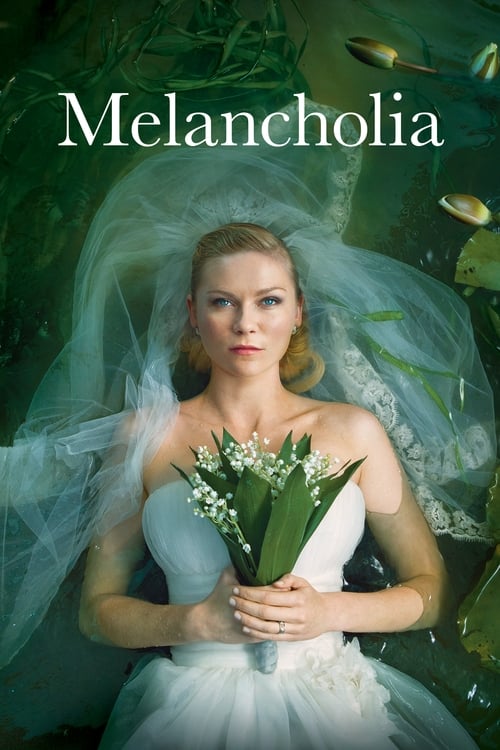
Melancholia
2011 · Lars von Trier
For when you want to be devastated by something beautiful — a film to sit with in the dark and chew on for days, not a comfort watch. Reach for it when you're willing to let a movie about depression and doom actually get under your skin.
What it's about
Two sisters, one sinking into depression and one holding the family together, collide over a lavish wedding reception at a remote mansion — while a rogue planet named Melancholia drifts toward Earth. The film unfolds in two halves, one for each sister: first the wedding that falls apart in slow motion over a single night, then the quiet, dread-soaked days as the planet grows larger in the sky. Kirsten Dunst plays the depressive bride whose despair turns into eerie calm; Charlotte Gainsbourg plays the composed sister who starts to crack.
The experience
It opens with ravishing slow-motion images set to Wagner, then drops you into raw, handheld intimacy — a film that feels like anxiety and grief given a body. It's heavy, hypnotic, and strangely gorgeous, moving at the pace of dread rather than plot, and it ends by pressing all that weight directly onto you.
Performances
Kirsten Dunst won Best Actress at Cannes for this: she plays depression not as tears but as a terrible, lucid stillness, and it's career-defining work. Charlotte Gainsbourg matches her as the rational sister whose composure erodes scene by scene.
The craft
Von Trier splits the film into two named movements and two visual registers — an operatic, super-slow-motion overture of apocalyptic tableaux, then jittery handheld naturalism for the human story. The Wagner prelude recurs like a tide, and the planet itself is rendered with a painterly beauty that makes annihilation look like a mercy. This one genuinely rewards the biggest screen and best speakers you can find.
Why it matters
It became the centerpiece of von Trier's late 'depression trilogy' and one of the most acclaimed art films of the 2010s, widely cited as cinema's most truthful portrait of depression — the insight that the depressed person may be the one best equipped to face catastrophe. It cemented Dunst's reassessment as a serious dramatic actress.
Snapshot
Melancholia is Lars von Trier's apocalyptic chamber drama, a film that stages the literal end of the world as an intimate two-hander between sisters. It opens with an overture of super-slow-motion tableaux — bodies, horses, a bride caught in the drag of her own train — set to the prelude of Wagner's Tristan und Isolde, and then retreats into a near-documentary handheld register for the story proper. That story is split into two named movements: "Justine," a disastrous wedding reception; and "Claire," the days during which the rogue planet Melancholia sweeps toward Earth. Kirsten Dunst plays Justine, a depressive whose despair curdles into an eerie composure as annihilation nears; Charlotte Gainsbourg plays Claire, the "sane" sister whose control disintegrates in exact proportion to the approaching catastrophe. The film premiered in competition at the 2011 Cannes Film Festival, where Dunst won Best Actress and where von Trier's remarks at the press conference produced one of the festival's most notorious scandals. It stands as the central panel of von Trier's loosely grouped "Depression Trilogy," between Antichrist (2009) and Nymphomaniac (2013).
Industry & production
Melancholia was produced through von Trier's Danish company Zentropa, the outfit he co-founded with Peter Aalbæk Jensen, and financed as a European co-production spanning Denmark, Sweden, France, and Germany — a pooling of national funds and broadcaster money characteristic of von Trier's post-Dogville features. The wedding and estate sequences were shot largely in Sweden, with Tjolöholm Castle on the Swedish west coast serving as the manor and its grounds, including the golf course that recurs as a motif. Von Trier, a famously reluctant traveler who avoids flying, worked close to home in Scandinavia as was his custom.
The picture assembled an unusually starry international ensemble for a von Trier film: alongside Dunst and Gainsbourg, the cast includes Kiefer Sutherland as Claire's wealthy husband John, Alexander Skarsgård as the groom, Charlotte Rampling and John Hurt as Justine's estranged parents, Stellan Skarsgård as her boss, and Udo Kier and Brady Corbet in supporting roles. Reportedly, Penélope Cruz had been attached before Dunst took the role, though the specifics of that changeover belong to production lore and I would flag the details as thinly documented.
The film's release was overshadowed by von Trier himself. At the Cannes press conference, riffing — by his own later account, disastrously and as a joke — on his German ancestry, he made comments in which he said he "understood" and "sympathized" with Hitler and described himself as a Nazi. The festival declared him persona non grata, an unprecedented sanction against a former Palme d'Or winner. The competition film was allowed to remain, and Dunst's Best Actress win stood, but the incident dominated coverage and von Trier subsequently adopted a period of public silence. The scandal is inseparable from the film's release history even though it bears no relation to the work's content.
Technology
Melancholia is a digitally originated film that exploits the widening gap, around 2010–2011, between two very different digital capabilities. Its narrative body was shot on lightweight digital cameras handheld, in von Trier's established post-Dogme manner, prizing mobility and available-feeling light over pictorial polish. Its overture, by contrast, depends on high-speed digital cinematography: the prologue's images are slowed to a viscous crawl that only specialized high-frame-rate capture makes possible, rendering motion as something closer to painting than to photography. This bifurcation — coarse, reactive handheld for the human drama; hyper-controlled ultra-slow-motion for the cosmic frame — is the film's foundational technical idea, and it is enabled by digital tools that let von Trier move fluidly between the roughest and the most rarefied registers within a single production. Visual effects render the planet Melancholia and its approach; the effects are deployed sparingly and photorealistically, folded into naturalistic skies rather than foregrounded as spectacle. I would not assign specific camera or effects-house credits without documentation to hand, so I leave those unnamed rather than guess.
Technique
Cinematography
The film was photographed by Manuel Alberto Claro, marking the beginning of his collaboration with von Trier (he would continue on Nymphomaniac). Claro's work here is defined by its two contradictory modes. The prologue is a suite of composed, painterly, super-slow images — a bride wading through gray water in the manner of Millais's Ophelia, a wooded landscape quoting Bruegel's The Hunters in the Snow, dead birds falling, a horse collapsing in slow motion — lit and framed with a stillness that recalls old-master painting. Once the story begins, the camera goes handheld, restless, and reactive, whip-panning to catch dialogue, drifting focus, framing loosely. Natural and practical light dominate the interiors; the exterior night scenes bathe in the sourceless blue glow of the approaching planet. The visual argument is that "normal" life is shot as chaos and catastrophe is shot as beauty — an inversion that carries the film's entire thesis about depression and clarity.
Editing
Editing was handled by Molly Malene Stensgaard, von Trier's longtime cutter, whose association with him stretches back through Dancer in the Dark, Dogville, and Antichrist. The film's structure is boldly non-suspenseful: the prologue shows us the ending — Earth's destruction — before the story has begun, so the editing withholds no outcome and generates dread from certainty rather than surprise. Within scenes, the cutting is elliptical and rhythmically loose, matching the handheld coverage; the wedding movement in particular accretes through fragments, jumps, and overheard exchanges. The two-part architecture ("Justine" / "Claire") is itself an editorial gesture, partitioning the film into a study of one sister and then the other.
Mise-en-scène / staging
The single principal location — the isolated manor, its terrace, and the surrounding golf course — becomes a closed world, a stage on which the family's dysfunctions and then the human response to extinction can be observed without escape. The estate's manicured luxury (the eighteenth hole, the horses, the stone bridge) reads as a fragile human order set against the indifferent cosmos. In the final passages, staging strips down to elemental gestures: the "magic cave," a lean-to of bare branches that Justine builds so that Claire's young son can face the end without terror. The recurring number motif — Justine insists the course has eighteen holes and later notices, impossibly, a nineteenth flag — quietly threads uncanny detail through the naturalistic space.
Sound
The film's most consequential sound decision is its refusal of a conventional score in favor of a single recurring piece: the prelude to Wagner's Tristan und Isolde. That yearning, unresolved, chromatically suspended music returns throughout, binding the overture to the climax and lending the apocalypse an operatic grandeur of unconsummated longing. Around it, the sound design favors intimate, close-miked naturalism — wind, insects, the creak of the estate, the electrical hum and hail-like debris as Melancholia nears — so that the Wagner erupts against a bed of quiet, unglamorous reality. There is no credited original composer in the traditional sense; the film's musical identity is Wagner's.
Performance
Dunst's Justine is the film's engine, and her performance modulates from brittle, sabotaging misery in the wedding half to an almost serene lucidity as the end approaches — the depressive who, having always expected the worst, is uniquely equipped to meet it. It won her the Best Actress prize at Cannes. Gainsbourg's Claire runs the opposite arc, from competent caretaker to unraveling panic, and the two performances are calibrated as mirror images. The supporting playing is sharply etched in brief strokes: Sutherland's rationalist confidence, Rampling's acid cruelty, Hurt's feckless charm, Skarsgård's baffled tenderness as the abandoned groom. Von Trier's actor-centered, often improvisation-tolerant method leaves room for these performers to inhabit discomfort directly.
Narrative & dramatic mode
Melancholia is structured as a diptych framed by prophecy. The overture functions as a mythic prologue that reveals the ending, converting the film from a suspense narrative into a tragedy of foreknowledge — we watch not to learn whether the world ends but how the characters meet an end already shown. Part One, "Justine," is a corrosive social drama of a wedding coming apart, closely observed and almost satirical in its anatomy of family and money. Part Two, "Claire," contracts to a domestic vigil as the planet approaches, shifting into an existential and metaphysical key. The dramatic mode is anti-heroic and anti-redemptive: there is no rescue, no last-minute reprieve, no scientific solution. The film's power comes from the reversal of who copes — the "ill" sister becomes the calm one — which reframes depression not as a failure to see reality but as an unbearable clarity about it.
Genre & cycle
The film hybridizes the art-house family drama with the apocalyptic science-fiction "impact event" film, deliberately draining the latter of its genre machinery. Where the Hollywood disaster picture (Deep Impact, Armageddon, and their kin) mobilizes crowds, governments, and heroic intervention, Melancholia stays inside one family and refuses agency entirely — a rebuke of the genre's optimism and spectacle. It belongs equally to a lineage of contemplative "end of the world" art cinema. As part of von Trier's Depression Trilogy, it also participates in a cycle of his own making: three films exploring female protagonists and states of psychological extremity, of which Melancholia is the most cosmic in scope.
Authorship & method
Melancholia is a von Trier auteur work in the fullest sense: sole director and sole credited screenwriter, developing a concept he has publicly tied to his own experience of depression and to the notion — reportedly suggested to him in therapy — that depressive people remain calm under pressure because they already expect disaster. That autobiographical seed distinguishes it from his more provocation-driven projects; von Trier described it, unusually for him, in gentler terms, even worrying it might be too "pretty."
His key collaborators shape the film decisively. Cinematographer Manuel Alberto Claro established the dual visual grammar of painterly overture and handheld body. Editor Molly Malene Stensgaard, a long-term partner, gave the film its structure of pre-revealed catastrophe. The absence of a composer is itself an authorial choice: von Trier's substitution of Wagner's Tristan prelude for an original score aligns the film with a Romantic tradition of love, death, and yearning, and is as much a directorial signature as any image. The ensemble was cast for von Trier's recurring interest in performers willing to be stripped bare. Notably, the film mostly sets aside the formal games — the chalk-outline sets of Dogville, the chapter cards and hectoring narration — of his earlier work, retaining only the two-part titling and the handheld immediacy, so that authorship here is expressed through tone and structure more than through overt device.
Movement / national cinema
The film is a product of Danish cinema and specifically of the Zentropa milieu that von Trier and Peter Aalbæk Jensen built into a European powerhouse. Its handheld, natural-light aesthetic descends directly from Dogme 95, the 1995 manifesto von Trier co-authored with Thomas Vinterberg, even though Melancholia is emphatically not a Dogme film — it uses non-diegetic music, effects, and composed images the manifesto forbade. What survives is the ethos: mobility, immediacy, distrust of gloss. As a co-production drawing Swedish, French, and German resources, it also exemplifies the pan-European financing model that sustains ambitious Nordic auteur cinema, positioning von Trier as the flagship figure of a small national industry with outsized international reach.
Era / period
Arriving in 2011, Melancholia sits in a moment of digital maturation, when high-frame-rate and high-resolution digital capture had become artistically flexible enough to support both rough naturalism and hyper-composed imagery in one film. It also arrives amid a small early-2010s wave of art-cinema apocalypses and cosmic-dread films that treated the end of the world as psychological and philosophical rather than logistical. Culturally, its release is bound to the Cannes scandal, an event that fixed the film in memory as much for its off-screen controversy as its content, and that reflected the heightened, instantaneous media environment of the period, in which a director's few unguarded sentences could eclipse the reception of the work.
Themes
The film's governing theme is depression reimagined as insight: Justine's illness is figured not as delusion but as a truer apprehension of a hostile, empty universe — "the earth is evil," she tells Claire, "we don't need to grieve for it." Against this is set the fragility of rationalism and control, embodied by John, whose scientific confidence that the planet will pass collapses into private suicide when it does not, and by Claire, whose competence dissolves. The film meditates on the indifference of the cosmos, the smallness of human ritual (weddings, wealth, etiquette) against annihilation, and the paradox that acceptance can be a form of grace. Wagnerian Liebestod — love-death, the fusion of desire and extinction — underwrites its Romantic sensibility. And it explores sisterhood as a structure of inverse mirrors, each woman carrying what the other lacks. Underlying it all is a bleak consolation: the "magic cave," a lie told to a child, as the only shelter art or love can offer against the real.
Reception, canon & influence
Critically, Melancholia was widely received as a major work and, for many, von Trier's finest and most humane film, praised especially for its overture and for Dunst's performance, which the Cannes jury honored with Best Actress. Reception was inevitably entangled with the press-conference scandal; a number of commentators wrestled explicitly with separating the film from the filmmaker, and the controversy shaped its awards trajectory in the broader season. I would avoid citing specific box-office figures or awards tallies beyond the Cannes acting prize, as I cannot verify precise numbers here.
Looking backward, the film draws on deep sources: Wagner's Tristan und Isolde for its musical and emotional architecture; European Romantic and Symbolist painting (Bruegel, Millais) quoted directly in the overture; the tradition of the philosophical apocalypse; and, in dialogue and contrast, the Hollywood impact-disaster film it inverts. Von Trier's own Dogme aesthetic and his prior Depression Trilogy entry, Antichrist, are its most immediate lineage.
Looking forward, Melancholia helped consolidate a mode of contemplative, art-house apocalypse in which the end of the world is an interior and metaphysical event rather than an action spectacle, and it is frequently invoked as a touchstone for later "quiet apocalypse" and cosmic-dread cinema. It reaffirmed Dunst as a serious dramatic actor and launched Manuel Alberto Claro's ongoing partnership with von Trier. Within the director's oeuvre it is the pivot of the trilogy and, for many viewers, the most emotionally accessible entry point into his difficult body of work. Its imagery — a bride adrift in water, two planets meeting in a silent sky, a shelter of bare sticks against the light — has entered the shared visual vocabulary of twenty-first-century art cinema.
A Deleuzian reading
Start with the horse.
The full Deleuzian reading of Melancholia →
Reception
At Cannes 2011 the film itself was nearly swallowed by von Trier's disastrous press-conference Nazi joke, which got him declared persona non grata — yet Kirsten Dunst still won Best Actress. A decade on, the scandal has faded and the film hasn't: it's routinely ranked among the greatest films of the 2010s.
How Melancholia was received, from release to now →
How to watch Melancholia: what to notice on a first viewing
- Watch the camera shift from painterly stillness to handheld shakiness. Von Trier opens on composed, super-slow-motion tableaux, then drops into restless, whip-panning handheld camerawork for the story proper. Separates two orders of image: contemplation without action, and life shot as constant, anxious motion.
- Listen for Wagner's Tristan prelude returning across the film. The same unresolved chromatic chord recurs from the overture to the climax, with no other score to compete with it. The music never resolves because the film gives its characters nothing to resolve toward.
- Watch Justine sabotage the wedding while Claire tries to manage everything. Dunst's Justine drifts, disappears, and undoes her own reception; Gainsbourg's Claire scrambles to hold the event together around her. Their arcs are set up as exact opposites from the first scenes.
- Notice the film split into two named parts, Justine then Claire. Part One studies one sister in close social detail; Part Two studies the other, in the same house, under different pressure. The two-part shape asks you to hold each woman separately before you see them as mirrors.
The whole guide to watching Melancholia, with the keys for a rewatch →
Influences: the films it descends from and the films it influenced
- Antichrist (2009) — The immediate predecessor in the Depression Trilogy that invented Melancholia's dual grammar: a Phantom-camera super-slow-motion prologue set to a single pre-existing classical vocal piece (Handel's 'Lascia ch'io pianga'), paired with a handheld naturalist body — Claro/Stensgaard's method carried directly forward.
- The Sacrifice (1986) — A pre-apocalyptic domestic gathering that ends with a house consumed by fire and uses Bach's St Matthew Passion as a score-substitute rather than composed music; von Trier's dedication of Antichrist to Tarkovsky marks the acknowledged debt for this contemplative, non-suspenseful end-times structure.
- Solaris (1972) — Establishes the device of an on-screen painterly quotation — Bruegel's 'Hunters in the Snow' held in slow contemplation — that Melancholia's overture directly echoes when it stages Bruegel and Millais's Ophelia as living tableaux.
- 2001: A Space Odyssey (1968) — The template for scoring slow cosmic tableaux with pre-existing Romantic concert music (Strauss) in place of an original score, so the music becomes an authorial signature governing the imagery's tempo.
- Persona (1966) — Two women whose psychologies mirror and invert across the film — the model for Justine and Claire's swapped competence under catastrophe (the 'mirror-image arcs'), shot in Bergman-Nykvist chamber intimacy.
- Cries and Whispers (1972) — A chamber drama of sisters confined to a single manor estate, with Sven Nykvist's painterly, deep-hued interiors — the antecedent for Melancholia's isolated-manor staging and its diptych of sisterhood.
- L'Âge d'Or (1930) — Deploys Wagner's Tristan music to charge erotic-morbid yearning, the same liebestod strategy by which von Trier fuses love, death and longing through the Tristan prelude instead of a composed cue.
- Last Year at Marienbad (1961) — The precedent for frozen, symmetrical figures posed against a grand estate's manicured grounds — formal super-slow tableaux that arrest narrative time, echoed in Melancholia's overture garden compositions.
- Deep Impact (1998) — The Hollywood impact-disaster template Melancholia formally inverts: von Trier pre-reveals the collision in the overture and strips out rescue, suspense and the survival-narrative apparatus this genre depends on.
- The Fire Within (1963) — Demonstrates the same wager Malle proved — that clinical depression can be filmed with total gravity and formal beauty, built around a single interior performance and pre-existing classical music rather than plot.
- Shame (1968) — Openly Bergmanesque: stages the end of the world as a chamber drama within a single estate, filtering global apocalypse through the psychological state of a couple/family.
- Last Night (1998) — The bulk of the film is a wedding dinner conducted under strict etiquette while the planet closes in, subordinating event to behavior and withholding the collision until the final seconds — the same refusal to let spectacle displace the manners study.
- First Reformed (2017) — Extends the 'depression-as-clarity' proposition — despair as lucid perception of doom — into ecological-cosmic dread, using austere framing and withheld affect in the von Trier/Tarkovsky contemplative lineage.
- Aniara (2018) — A Scandinavian 'quiet apocalypse' of drift toward oblivion that refuses action-spectacle for slow existential dread, inheriting Melancholia's model of the end as a metaphysical, non-suspenseful process.
- Seeking a Friend for the End of the World (2012) — Adopts the pre-revealed, un-averted impact and redirects the disaster film entirely onto a two-hander relationship, the popular-register version of Melancholia's suspense-free countdown to certain annihilation.
- The House That Jack Built (2018) — Manuel Alberto Claro's painterly desaturated tableaux and the associative prologue-montage aesthetic carry directly into Jack, the two films sharing DP and editor Molly Malene Stensgaard.
- Thunderbolts* (2025) — Model for literalizing depression as an engulfing external force made visually physical — a black annihilation that the Void's erasure-as-negative-space staging echoes.
- The Drama (2026) — The wedding reception rendered as a slow, mortifying unraveling of decorum, Scandinavian dread infiltrating a ritual built on sincerity.
- The Turin Horse (2011) — A near-simultaneous domestic apocalypse in which the world extinguishes without spectacle inside an isolated farmhouse, rendered in long-take dread — the same interiorized, action-less end-of-world Melancholia pursues.
- Take Shelter (2011) — Renders apocalyptic premonition as clinical mental illness and builds toward a literal shelter, paralleling Justine's depressive calm-as-foreknowledge and the bare-stick 'magic cave' as futile protective gesture.
- Another Earth (2011) — Places a second planet visibly hanging in the sky as a metaphysical double rather than an action threat — the identical 'approaching celestial body as inner mirror' image, released the same year.
- The Tree of Life (2011) — A wordless cosmic overture detached from plot and scored to concert-hall classical music, premiering at the same Cannes — a parallel bid to open a family drama with metaphysical, painterly image-music.
- Perfect Sense (2011) — Stages a global apocalypse experienced intimately through the progressive loss of the senses, matching Melancholia's decision to locate the end of the world in interior, felt experience rather than exterior catastrophe.
- mother! (2017) — Stages a cosmic apocalypse entirely through a bourgeois estate and a disintegrating house party, making a domestic celebration the microcosmic vessel for world-ending allegory.
- Nymphomaniac: Vol. I (2013) — Cinematographer Manuel Alberto Claro's digital sensibility and the Depression Trilogy framework transfer wholesale — the desaturated, clinical digital surface of Nymphomaniac is a continuation of Claro's work here.
Similar films
- Antichrist (2009) — influence & lineage · often watched together
- Solaris (1972) — influence & lineage · often watched together
- The Tree of Life (2011) — influence & lineage · often watched together
- 2001: A Space Odyssey (1968) — influence & lineage · often watched together
- Persona (1966) — influence & lineage · often watched together
- Cries and Whispers (1972) — influence & lineage · often watched together
- Anatomy of a Fall (2023) — often watched together
- Possession (1981) — often watched together