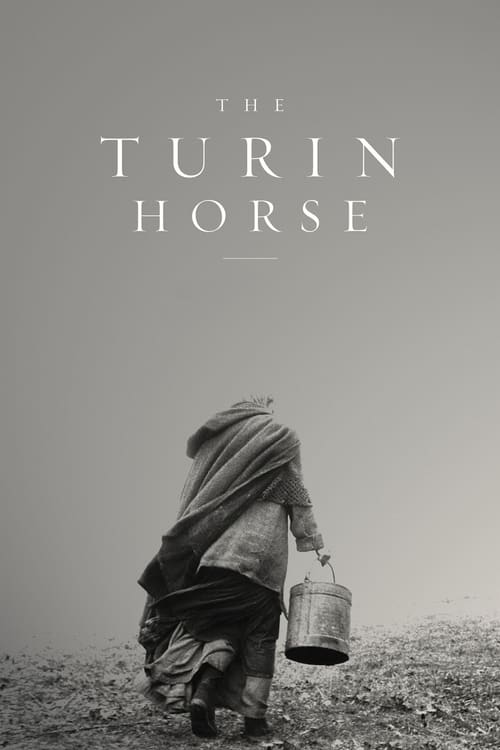
The Turin Horse
2011 · Béla Tarr
For when you want to be challenged, not comforted — a monastic, lights-off, phone-in-another-room experience for a night when you're ready to stare into the void and see what stares back. Absolutely not a casual watch.
What it's about
On a windswept plain, an aging farmer and his daughter live out a routine of brutal simplicity: draw the water, boil the potatoes, dress, tend the horse. Over six days, that routine begins to fail piece by piece — the horse won't pull, the wind won't stop, and the world outside seems to be going out like a lamp. It opens with the story of Nietzsche's collapse in Turin after embracing a beaten cart horse, then asks the question no one asked: what happened to the horse?
The experience
Slow is the point: long, hypnotic takes, howling wind, the same chores repeated until tiny changes hit like thunderclaps. It's crushing and strangely purifying — less a story you follow than a weather system you sit inside.
The craft
Shot in stark black and white in roughly thirty long takes across 146 minutes, with a camera that circles the farmhouse like the wind itself and a grinding, repetitive score that becomes the film's heartbeat. Béla Tarr announced it as his final film, and it plays like one — the biggest, darkest screen and best speakers you can find will make it physical.
Why it matters
Tarr's declared farewell to cinema and the summit of the slow-cinema movement, it won a major prize at Berlin and became the reference point for films that use duration itself as their material.
Snapshot
The Turin Horse is a 146-minute, black-and-white Hungarian film composed of approximately thirty long takes, following a father and daughter over six days as their daily routines — boiling potatoes, drawing water from the well, tending a failing horse — progressively collapse into silence, darkness, and entropy. The film opens with a spoken prologue about Friedrich Nietzsche's documented breakdown in Turin in January 1889, when he reportedly threw his arms around a horse that was being flogged in a piazza, collapsed, and never recovered his sanity. The film then pivots: "but what happened to the horse?" What follows is not an answer so much as an act of cosmic pessimism — a meditation on uncreation, exhaustion, and the possible end of the world rendered through the lives of the most marginal people imaginable. Tarr declared it his final film, and it functions as a summation and elegy for his entire method: slow, hypnotic, inexorable.
Industry & production
The Turin Horse was produced by TT Filmműhely, Béla Tarr's Budapest-based production company, which has backed his work since the early 1990s. The film received co-production support from German and Swiss partners — a funding structure typical of Tarr's late career, in which European art-cinema subsidy networks sustained projects with limited commercial prospects. Tarr has never worked within the mainstream Hungarian film industry in any conventional sense; TT Filmműhely functions as a semi-autonomous artist's studio. The film was shot on location in rural Hungary under conditions that were physically extreme — the persistent, howling wind that dominates the soundtrack and the mise-en-scène is not a sound-design invention but an actual meteorological reality of the shoot, incorporated wholesale into the film's atmosphere. Precise production budget figures are not in the public record. The film premiered in competition at the 61st Berlin International Film Festival in February 2011, where it won the Silver Bear Grand Jury Prize. This was consistent with Tarr's late-career festival standing: Werckmeister Harmonies had received the FIPRESCI Prize at Berlin in 2000, and The Man from London screened in competition at Cannes in 2007 despite an arduous, protracted production.
Technology
The Turin Horse was shot on 35mm black-and-white film stock at a moment when digital acquisition was rapidly becoming the industry standard. This was not conservatism but a considered aesthetic choice: Tarr's cinema has always been premised on the material fact of celluloid — its grain, tonal depth, and the specific quality of deep blacks that digital sensors of that period could not reliably replicate. The decision to work in black and white removes the film from any legible historical era and aligns it with the tradition of European art cinema that Tarr consciously inhabits. The film's approximately thirty shots — an extraordinarily low count for a feature of nearly two and a half hours — are all of extended duration, placing immense technical demands on the camera crew. Many involve complex, carefully choreographed camera movement within confined interior spaces, requiring dolly and crane work in a cramped farmhouse built for the production. The result is a film in which virtually every shot functions as a set piece, demanding precision from both the technical crew and the performers simultaneously, with no coverage to fall back on.
Technique
Cinematography
The director of photography is Fred Kelemen, a German filmmaker and cinematographer who had previously collaborated with Tarr on The Man from London (2007), where he replaced Tarr's long-serving DP Gábor Medvigy. Kelemen's work on The Turin Horse represents one of the most sustained achievements in contemporary black-and-white cinematography. The film's opening shot is justly celebrated: a continuous sweeping take of the horse pulling a cart through a violently wind-scoured landscape, the camera circling and tracking in a single unbroken movement that immediately establishes the film's temporal and tonal world. Inside the farmhouse, Kelemen works within radical constriction — the space is small, the light source ostensibly natural — and achieves a range of grays and deep blacks that carries enormous emotional weight. The work has been compared by critics to Sven Nykvist's collaborations with Bergman, though Kelemen's palette is considerably more austere and the film's relationship to darkness more absolute. Over the six days of the film's diegetic time, the available light systematically diminishes, until the final day approaches near-total darkness — a cinematographic enactment of entropy rather than a narrative statement about it.
Editing
Editing is by Ágnes Hranitzky, Tarr's wife and co-director of The Turin Horse. Hranitzky has edited all of Tarr's major films since Damnation (1988), and their collaboration is so integral to the work's meaning and form that she receives co-director credit here and on The Man from London. In a film of approximately thirty shots, the editor's conventional function — managing continuity, rhythm, pacing across many cuts — is largely dissolved. Hranitzky's editing is instead an exercise in structural architecture: deciding the length and exact placement of each take, the precise moment of each cut, the overall rhythm of a film built from repetition and gradual diminishment. The editing rhymes the repeated daily actions — the same compositional approach to the potatoes boiling, the same staging of the father dressing with the daughter's help — while introducing minute variations that register the entropy accumulating across days. The cuts are never invisible in the classical sense; each one marks a threshold crossed, a day ending.
Mise-en-scène / staging
The mise-en-scène is defined by radical reduction. The farmhouse is the primary space; there are no establishing shots that situate it within any legible geography or social context. The wind outside is a constant physical force against which the characters must labor simply to cross the threshold between interior and exterior. Staging is choreographic in the strictest sense: Tarr rehearses extensively before shooting, and the movements of actors, camera, and props are worked out with precision before the camera rolls. The long takes demand that everything be correct in a single unbroken duration, producing a quality of quiet inevitability in the performances. Objects are granted extraordinary significance through repetition — the pálinka bottle, the potatoes, the bucket at the well — and the horse's progressive deterioration functions as the film's central visual metaphor for a world losing the will to continue. When the horse stops moving, stops eating, and simply stands in its stall, the staging renders that stasis as existential crisis rendered through an animal body.
Sound
The sound of The Turin Horse is dominated by two elements: the wind and Mihály Víg's score. The wind is recorded and mixed with unusual directness — it is not smoothed into background atmosphere but allowed to howl and fill the sound field with a relentlessness that becomes genuinely oppressive over the film's duration. Víg's score, which he has composed for all of Tarr's major films since Damnation, consists of a single recurring theme: a cyclical, heavily repetitive motif played on strings and organ that evokes simultaneously folk music and something grimly mechanical. The theme loops and accumulates, mirroring the film's own structural repetition without commenting on it ironically. Dialogue is sparse in the extreme and weighted with great care when it does arrive; the most sustained verbal passage — the neighbor Bernhard's nihilistic monologue — arrives as a rupture in the film's near-silence, its oratorical density all the more striking for the surrounding quiet.
Performance
János Derzsi, a regular in Tarr's company since minor roles in Sátántangó (1994), carries the role of the father — a one-armed, taciturn man whose physicality communicates stoicism and exhaustion without recourse to conventional dramatic expression. Erika Bók, also a Tarr regular from Sátántangó, plays the daughter. Both performers work within the Bressonian mode Tarr has long favored: minimal gesture, avoidance of psychological display, the body as the primary expressive instrument rather than the face or voice. The daughter's single sustained action — attempting to leave with her belongings, then returning — is rendered without explanation or resolution, demanding that the viewer project interpretation onto behavior that the film conspicuously refuses to gloss. The neighbor Bernhard (the actor is not prominently identified in widely available production documentation) delivers his monologue in a register that is intensely literary and oratorical, unmistakably Krasznahorkai's voice transposed directly to the screen.
Narrative & dramatic mode
The film organizes itself around a structure of six days — an explicit inversion of the biblical creation narrative, a week of uncreation in which each day strips something further away. The horse will not move. Gypsies arrive and take water from the well. Bernhard comes with his speech of total nihilism — a diagnosis of a world that has defiled everything of value and been left with only debris and vacancy. The daughter attempts to leave but returns. The well runs dry. The horse refuses to eat or drink. The lamp goes out. Darkness descends. There is no plot in any conventional sense; causality is replaced by entropy as the organizing principle. The dramatic mode is closer to Beckett than to any narrative cinema tradition — each day's repetitions carry the structure of Endgame, in which the question is not what will happen but how long things can continue to go on. The film explicitly refuses resolution, catharsis, or interpretive guidance. It enacts its pessimism rather than arguing for it.
Genre & cycle
The Turin Horse belongs to the tradition of European metaphysical art cinema — a loosely defined but coherent body of work encompassing Carl Dreyer's late films, Andrei Tarkovsky's Stalker and The Sacrifice, and the films of Chantal Akerman, particularly Jeanne Dielman, 23 quai du Commerce, 1080 Bruxelles (1975), which shares the film's interest in the philosophical and political weight of domestic repetition. It participates in the early-twenty-first-century critical discourse around "slow cinema" — a category encompassing filmmakers like Lav Diaz, Nuri Bilge Ceylan, and Carlos Reygadas — though Tarr's practice predates this framing by decades and is not reducible to it. The film is also, obliquely, a ruin of the Western: a farmstead, a dying animal, a landscape without mercy, a way of life ending without witnesses or mourners. This generic shadow is never foregrounded but provides a structural undertow, the horse carrying the freight of frontier mythology drained of its mythic energy.
Authorship & method
Béla Tarr (b. 1955, Pécs) began his career in the late 1970s making rough, socially engaged Hungarian realist films — Family Nest (1979), The Prefab People (1982) — before radically transforming his practice in the mid-1980s under the influence of Miklós Jancsó's long-take aesthetics and, crucially, his encounter with the novelist László Krasznahorkai. Krasznahorkai has written or substantially contributed to the screenplays for all of Tarr's major works from Damnation (1988) onward, and his voice — syntactically relentless, apocalyptically inflected, obsessively recursive — is the literary engine of the Tarr cinema. Mihály Víg, a Hungarian musician and actor, has composed for Tarr since Damnation and appeared as the mysterious Irimiás in Sátántangó. Ágnes Hranitzky has edited all of Tarr's major films and co-directed his last two features, her contribution to the work's rhythm and structure being inseparable from what the films are. This core collaboration — Tarr, Krasznahorkai, Víg, Hranitzky — is one of the most sustained and coherent creative partnerships in world cinema of the past four decades. The Turin Horse is its declared final statement.
Movement / national cinema
Tarr is a Hungarian filmmaker, but his cinema is not comfortably housed within Hungarian national cinema, which has its own distinct tradition rooted in Jancsó's political long-take films, the literary adaptations of István Szabó, and the social comedies of Márta Mészáros. Tarr's work has been more systematically received and canonized in Western European and North American art-cinema circuits — it is primarily a festival and repertory cinema, circulating through institutions whose orientation is transnational. The Turin Horse received Hungarian state support and belongs to the Hungarian-language film tradition, but its aesthetic allegiances and reception patterns are pan-European. Tarr is compared most readily to Tarkovsky, Dreyer, and Akerman rather than to any Hungarian precursor, and the film's concerns — entropy, the void left by God's absence, the silence of the universe — are not specifically Hungarian, whatever local conditions of production and funding shaped their expression.
Era / period
The Turin Horse is an early-twenty-first-century film released at a moment of significant transition: the near-complete industrial shift to digital production, the globalization of festival circuits, the emergence of streaming platforms as distribution channels for art cinema. It stands as a self-conscious rearguard action — shot on celluloid, using craft methods developed over decades, committed to the long take as both formal and ethical proposition — and as a statement of finality. Tarr's public announcement that this was his last feature positioned it explicitly as an end-of-era document: the conclusion of a body of work begun in the late socialist Hungary of the 1970s and ended in the post-national, digitally mediated landscape of the 2010s. The film's declared terminus also functions as a kind of allegory: the world the Tarr cinema had been building since Damnation — austere, wind-blasted, metaphysically stranded — simply runs out of light.
Themes
The Turin Horse is organized around entropy — the inexorable tendency of all systems toward disorder, dissolution, and eventual stillness — experienced as temporal duration rather than argued as proposition. The six-day structure makes this accumulation legible as lived time: the viewer does not receive information about the collapse but inhabits it. The Nietzsche prologue opens a second thematic register: the collapse of a philosopher of will and vitality into helpless, silent compassion for a suffering animal. The film meditates on the gap between Nietzsche's philosophy — the will to power, the affirmation of life against nihilism — and the world as it actually presents itself in the film's diegesis: exhausted, desolate, indifferent to whatever we would affirm. Krasznahorkai's recurring preoccupation with the death of God and the vacancy that follows is present throughout, most explicitly in Bernhard's monologue, which diagnoses a world that has destroyed everything sacred and useful and been left with only rubbish. The horse itself — which Nietzsche's breakdown legend places at the center of his final sane act — functions as an emblem of mute, suffering presence that cannot be consoled, cannot be reasoned with, and eventually simply stops. That the film offers no explanation for the horse's refusal, or for the darkening of the world, is not a withholding but a position: there is no explanation.
Reception, canon & influence
Critical reception: The Turin Horse was received as a masterpiece by a substantial portion of the international critical community on its release. The Silver Bear Grand Jury Prize at Berlin 2011 validated a career-long investment by European festival institutions in Tarr's work. Critics including Jonathan Rosenbaum, who had long championed Tarr in the Anglophone world, received it as a definitive late work equal to Sátántangó. It appeared on numerous critics' year-end and decade-end lists and entered the 2022 Sight & Sound Greatest Films poll, placing within the range of films drawing significant votes from the international critical community — a rapid canonization given its youth. Some dissenting voices noted the film's programmatic quality, its sense of executing a predetermined aesthetic position rather than discovering something new; this is a minority position, but it reflects the risk inherent in declaring a last film.
Influences on the film (backward): The film's long-take aesthetics derive most directly from Miklós Jancsó, whose elaborate unbroken takes are a founding model for Tarr, though Tarr's camera is far more dramatically mobile and emotionally invested than Jancsó's cool planimetric surveys. Tarkovsky's Stalker and The Sacrifice are relevant precedents for the metaphysical landscape and the sense of sacred urgency embedded in duration. Akerman's Jeanne Dielman is the key reference for the structuring of domestic labor as philosophical argument — the radical claim that repetitive household work, filmed without irony or condescension, can carry the weight of an entire cosmology. Bresson's late films — Au hasard Balthazar in particular, with its suffering animal as spiritual center and its systematic refusal of sentimental identification — shadow the entire film. Samuel Beckett's theatrical vision of entropy, especially Endgame's staging of an ending that cannot quite arrive, is the film's most pervasive literary ghost, filtered through Krasznahorkai's prose and transposed from the stage to the windswept Hungarian plain.
Legacy and influence (forward): The scholarly record on forward influence is, as of the time of writing, necessarily thin — the film is too recent for its effects on other filmmakers' practice to be thoroughly documented. What can be said is that The Turin Horse arrived at a critical moment in international discourse around slow cinema and was immediately taken up as a limit case, the film that had pressed furthest in certain directions, by critics and filmmakers thinking about duration, attention, and the ethics of the long take. Its status as Tarr's declared final film gave it an additional retrospective weight, encouraging systematic reassessment of his entire career and the building of a Tarr literature in monograph and journal form. Filmmakers working in modes of sustained, rigorous minimalism — Lav Diaz, Lisandro Alonso, and others — share aesthetic territory with Tarr, though lines of documented direct influence are difficult to establish from the public record. Its influence on film culture and pedagogy may ultimately prove as significant as any influence on practice: it is a film that resets the terms of what duration, repetition, and minimalism can ask of a viewer and what they can, in return, produce.
A Deleuzian reading
Watch them eat the potato.
The full Deleuzian reading of The Turin Horse →
Reception
It arrived already anointed — the Jury Grand Prix at Berlin 2011, billed as Béla Tarr's farewell to cinema — and fifteen years on it's settled in as the terminal statement of slow cinema, the film people mean when they say 'the last great one of its kind.'
How The Turin Horse was received, from release to now →
Influences: the films it descends from and the films it influenced
- Au hasard Balthazar (1966) — Establishes the non-anthropomorphized animal as spiritual center — Balthazar's suffering filmed as bare fact rather than allegory — and Bresson's method of training actors to suppress psychological expression directly models the performance restraint Tarr demands of his cast.
- Red Psalm (1972) — Jancsó's elaborately choreographed unbroken takes — some approaching ten minutes, with the camera moving through open landscape as a participant in the action — constitute the founding model of Hungarian long-take cinematography that Tarr directly absorbs and then radicalizes toward metaphysical ends.
- The Travelling Players (1975) — Sustained multi-minute unbroken lateral takes compress historical duration within a single camera movement, establishing the long take as a temporal container — the shot as unit of time rather than the cut — that Turin Horse inherits as its primary structural logic.
- Jeanne Dielman, 23 quai du Commerce, 1080 Bruxelles (1975) — Domestic tasks filmed in strict real-time without narrative punctuation, with repetition across three days becoming the structural and cosmological argument — the direct formal model for Turin Horse's six-day scheme of repeated labor filmed at full unabbreviated duration.
- Stalker (1979) — Sustained tracking shots through deteriorated post-industrial landscape couple extreme duration with eschatological urgency, and Tarkovsky's deployment of ambient diegetic sound — water, wind, dripping — as spiritual texture is the direct precedent for Turin Horse's wind-dominated soundscape carrying the weight of cosmic entropy.
- Nostalghia (1983) — The candle sequence — Andrei carries a lit candle across an empty thermal bath in a single unbroken eight-minute shot requiring multiple takes to complete — establishes the extreme long take as an act of faith and a test of endurance, the formal position Turin Horse most fully realizes across its entire length.
- The Sacrifice (1986) — Apocalyptic domestic crisis filmed in extreme long takes in which the world's ending is contained within a single farmhouse — the closest formal and thematic precedent for Turin Horse's scheme of a cosmos gradually extinguishing within a restricted rural interior over numbered days.
- Damnation (1988) — The first fully realized deployment of the Tarr/Krasznahorkai/Víg collaboration within long-take tracking-shot grammar: rain-saturated Hungarian industrial landscape filmed in sustained moving shots with Víg's score as recurring structural anchor — the complete methodology Turin Horse inherits and strips to its barest elements.
- Werckmeister Harmonies (2000) — Shot by Fred Kelemen in the same long-take grammar with Krasznahorkai's screenplay and Víg's score, its 39-shot structure and choreographic precision in black-and-white 35mm constitute the immediate formal prototype that Turin Horse then reduces to maximum austerity in 30 shots.
- Woman in the Dunes (1964) — Tarr's two-hander of a father and daughter performing identical daily labor in a failing landscape — high-contrast black-and-white, anti-cathartic, structuring days as diminishing repetitions — is the most formally direct descendant of Teshigahara's Sisyphean-labor durational approach.
- Mouchette (1967) — Slow-cinema austerity built on repetition, amplified ambient sound, and the suffering of the humble, extending the Bresson/Balthazar line of patient attention to the abused.
- Ordet (1955) — Stark monochrome, repetitive ritual gesture, and the camera's slow circling glide around an austere farmhouse make explicit Tarr's debt to Dreyer's subtraction and frieze composition.
- Norte, the End of History (2013) — Takes up Turin Horse's challenge of extreme long-form duration in unbroken takes with a black-and-white visual register, extending Tarr's formal proposition that sustained viewer attention in the face of minimalist austerity constitutes an ethical act rather than an aesthetic luxury.
- Horse Money (2014) — Long takes in severely restricted interior spaces with non-professional actors held to Bressonian restraint; Costa sustains the human face in close-up as a site of historical inscription rather than psychological expression, extending Tarr's method of duration as a form of witness to social suffering.
- Jauja (2014) — Sustained takes in landscape as metaphysical space, with minimal causal narrative driven by physical traversal of terrain rather than plot logic — extending the slow-cinema proposition that the camera's patient attendance on landscape and bodily movement can substitute for dramatized causality.
- Cemetery of Splendor (2015) — Extended duration organized around a cyclical structure of sleep and waking, with bodies in states of suspended animation filmed in long still takes that make temporal suspension itself the subject — extending Turin Horse's formal exploration of entropy and cessation as structural principles.
- Sound of Falling (2025) — A single isolated farmhouse set sustained by slow-cinema duration and available-light chiaroscuro, the dwelling itself becoming the film's protagonist.
- Afternoons of Solitude (2025) — Builds dread from durational repetition and mortality, the slow-cinema rhythm of recurring near-identical actions that Serra's editing of repeated faenas inherits.
- Kaili Blues (2016) — Tarr and Hranitzky's achievement of extreme sustained duration on near-micro-budget conditions, using natural diffuse window light as the sole cinematographic tool and refusing artificial illumination, directly models Bi Gan's use of available light and minimal equipment to sustain a long take without studio infrastructure.
- The Painted Bird (2019) — Fred Kelemen's available-light Rembrandt-esque 35mm monochrome, extended static long takes in an oppressive single landscape, and duration-as-accumulation as formal argument against narrative resolution make this the most proximate contemporary European influence on Smutný's cinematographic discipline in The Painted Bird.
- Beanpole (2019) — Structural slow pacing where duration is itself the dramatic event, not a container for events; diegetic ambient texture — wind, repetitive physical labor — deployed as primary emotional register in place of musical scoring.
- Dear Comrades! (2020) — Tarr's Academy ratio monochrome with elliptical Bressonian tempo, ambient sound foregrounded over near-absent score, and depth-staged durational observation of bodies under institutional constraint is the formal extreme toward which Dear Comrades!'s aesthetic logic tends.
- Son of Saul (2015) — Tarr's durational long take as a moral instrument — Nemes apprenticed under Tarr and transposes the sustained, unbroken shot from contemplative distance to claustrophobic proximity bound to a single body.
- An Elephant Sitting Still (2018) — The reduced monochromatic palette and slow gliding takes that hold on characters mired in stalled, repetitive lives are the Tarr method Hu Bo absorbed as his student.
- Liverpool (2008) — Long takes tracking a solitary figure through a landscape of wind and snow with near-zero dialogue and no psychological explanation of behavior; the camera's patient non-interpretive attention to physical labor and bodily presence in harsh environment operates in the same formal register as Turin Horse.
- Once Upon a Time in Anatolia (2011) — Long-take nighttime landscape cinematography in which a repetitive procedural action — searching the same terrain for a body — accumulates existential weight through duration and recurrence rather than narrative development, working the same structural claim as Turin Horse's six-day repetitions.
- The Love That Remains (2025) — The slow-cinema limit-case of long-take duration and figures-in-landscape under relentless weather, where the camera's patience with elemental endurance, not event, structures the film.
- The White Ribbon (2009) — Tarr's locked-off long takes documenting physical rural labor in exhausting real time — with no orchestral score, only a single repeating accordion motif — constitute a parallel formal statement to Haneke's mode, arrived at through Tarr's independent development of the slow-cinema long-take.
- EO (2022) — A draft animal as the silent moral fulcrum of human degradation, scored to an insistent, repetitive percussive figure — the closest contemporary kin in the same Bressonian–East European line.
- The Seventh Continent (1989) — Shares the slow-cinema lineage of repeated daily rituals (dressing, eating, the well) filmed in austere, music-stripped long takes as a structural march toward extinction.
- Landscape in the Mist (1988) — Distills the leached monochrome palette, sparse diegetic sound, and the sequence-shot as endurance into an austere endgame of the contemplative tradition this film helped codify.
- Silent Light (2007) — Wide, deep, static rural compositions carried by diegetic ambient sound and near-wordless austerity — the same formal grammar.
- Silent Friend (2026) — Hungarian art-cinema sibling: rigorous unity of place, durational long-looking, and a human figure decentered against elemental, indifferent nature.
- The Ascent (1977) — Extends the endurance-as-ordeal image into monochrome extremis: wind, whiteness, and a face weathering privation, treating physical suffering as a metaphysical trial the way Shepitko does.
- Winter Sleep (2014) — Contemporary slow-cinema kin: durational long takes and relentless weather/landscape treated as existential force rather than backdrop.
- This Is Not a Burial, It's a Resurrection (2020) — Mosese trained at Tarr's film.factory; the debt is direct — durational tableaux, ostinato repetition, and the apocalyptic stubbornness of rural people refusing to leave dying ground.
Similar films
- Damnation (1988) — influence & lineage · same viewing thread
- Au Hasard Balthazar (1966) — influence & lineage · same viewing thread
- The Sacrifice (1986) — influence & lineage · same viewing thread
- Once Upon a Time in Anatolia (2011) — influence & lineage
- Andrei Rublev (1966) — same viewing thread · often watched together
- Afternoons of Solitude (2025) — influence & lineage · same viewing thread
- Werckmeister Harmonies (2001) — same viewing thread
- Still Life (1974) — same viewing thread
All the films related to The Turin Horse →
Watch it with: curated runs of related films
- Transcendental Style — A run for when you want cinema as prayer — faith, ritual, and the turning of seasons rendered in long takes and painterly stillness, where time itself becomes the subject rather than the story.