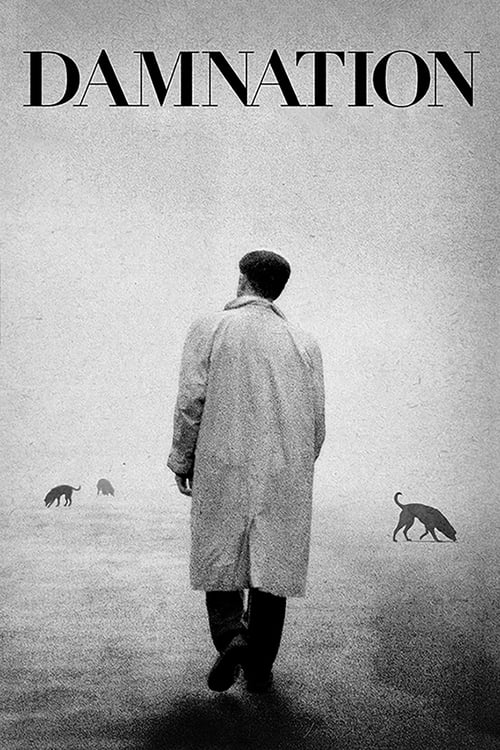
Damnation
1988 · Béla Tarr
For a patient, contemplative night when you want to sink into a film rather than be entertained by it — lights off, phone away, no clock. Firmly on the challenge end of the scale, and worth it.
What it's about
In a derelict Hungarian mining town where the rain never seems to stop, a solitary man named Karrer has one thing keeping him alive: the married singer at the Titanik Bar. To clear his way to her, he maneuvers her husband into a smuggling job that will take him out of town. That noir triangle is really just the frame — the film's true subject is the town itself: mud, fog, stray dogs, and people worn smooth by waiting.
The experience
Slow, hypnotic, rain-soaked black and white — the camera glides past crumbling walls and drinking halls at its own unhurried pace. Surrender to it and it becomes a trance; fight it and it will feel like weather. It leaves a mood on you for days.
The craft
This is the film where Béla Tarr arrived at the style that made his name: vast monochrome long takes, a soundscape of rain and scraping wind, and images composed like slow-moving photographs. It marks the start of his partnership with novelist László Krasznahorkai, whose bleak, hypnotic sensibility runs through every scene. A dark room and good sound turn it from bleak to overwhelming.
Why it matters
The turning point of Tarr's career and a founding document of the slow-cinema tradition that reshaped art film over the following decades.
Snapshot
Damnation (Hungarian: Kárhozat) is the film in which Béla Tarr becomes "Béla Tarr." After a decade of raw, hand-held social realism, Tarr here arrives at the slow, gliding, monochrome manner that would define the rest of his career and make him one of the central figures of late-twentieth-century art cinema. Karrer, a man hollowed out by solitude in a derelict mining town, loves the married singer of the Titanik Bar; to clear his path he maneuvers her husband into a smuggling job that will take him away, and in doing so corrodes whatever remained of himself. The plot is almost vestigial — a noir love triangle reduced to its ashes. What the film is about, in its bones, is weather, mud, duration, and the slow physics of decay. It is also the first collaboration between Tarr and the novelist László Krasznahorkai, a partnership that would produce Sátántangó and Werckmeister Harmonies and reshape what "literary" cinema could mean.
Industry & production
Damnation was produced within the Hungarian state film system in the final years of the Kádár era, as "goulash communism" visibly disintegrated around it. Tarr had emerged from the orbit of the Béla Balázs Studio and the documentary-inflected "Budapest School," and his earlier features (Family Nest, 1979; The Outsider; The Prefab People) were made cheaply and combatively inside that apparatus. By 1988 he was an established if difficult figure, and Damnation was made through the standard Hungarian studio production channels (Mafilm/Hungarian film-industry structures) on a modest budget. Precise production figures — exact budget, shooting schedule, box-office — are not reliably documented in the English-language record, and I will not invent them; what is clear is that this was a small, state-supported art film made outside any commercial logic, in a country a year away from the collapse of its political system. That timing matters: the film's atmosphere of terminal exhaustion reads, in hindsight, as a portrait of a whole order winding down, though Tarr has consistently resisted narrowly political readings of his work.
Technology
There is little to report here that is technologically novel, and it would be misleading to imply otherwise. Damnation was shot on 35mm black-and-white film stock using conventional late-1980s equipment. Its achievements are achievements of craft and choreography, not of apparatus: the long take is realized through patient camera operation, dolly and crane movement, and meticulous blocking rather than through any new device. The one practical "technology" worth flagging is mundane and essential — the near-constant rain that drenches the film was substantially produced and controlled on set (rain machines, hoses), since weather of that consistency cannot be left to chance. The innovation of Damnation lies entirely in how ordinary tools are deployed, not in the tools themselves.
Technique
Cinematography
Shot by Gábor Medvigy, Damnation is the foundational statement of the Tarr long-take aesthetic. The film opens on one of the most celebrated shots in his oeuvre: a slow, lateral track watching the buckets of an aerial coal-conveyor crawl across a gray, ruined landscape — an image of mechanical, indifferent motion — before the camera reverses to discover Karrer at his window, watching the same thing we are. That structure (the world moving on its own; a man watching it move) is the film in miniature. The camera throughout favors extended takes that drift, creep, and circle, often beginning on an apparently incidental detail — a wall, rain on a window, a wet street — before slowly disclosing a human figure. Compositions are deep, frontal, and architectural; Medvigy's black-and-white is silvered and tactile, registering the grain of crumbling concrete, the sheen of mud, the texture of wet plaster. The camera moves at a pace closer to breathing than to action, so that space and time themselves become the subject.
Editing
Edited by Ágnes Hranitzky, Tarr's lifelong creative partner (later credited as co-director), the film is built from relatively few shots of great length. The cut is not used for rhythm, emphasis, or the manufacture of suspense, but mainly to move between durations; the "drama" plays out within the take rather than across cuts. This is montage as deceleration — the opposite of the standard continuity grammar — and it forces the viewer into the film's own tempo. The editing's restraint is exactly what gives the long takes their gravity: nothing rescues the viewer from the duration of a glance, a walk, a downpour.
Mise-en-scène / staging
The film's world is a single, coherent zone of ruin: a played-out industrial town, the dilapidated Titanik Bar, rain-blackened streets, mud that seems to be reclaiming everything. Tarr stages the human body against this decaying architecture with a near-sculptural deliberateness — figures stand, wait, lean, walk through standing water — and the staging often emphasizes the smallness and stasis of people inside vast, indifferent space. Packs of stray dogs recur as motif and, by the end, as something Karrer himself merges into. The legendary set-piece is the dance in the Titanik Bar, a long, drunken, swaying sequence among society's wrecks that functions like a danse macabre — abjection rendered as ritual. The wet, the gray, the litter and rubble are not "atmosphere" decorating a story; they are the story's actual content.
Sound
Sound is central, not supporting. The film is saturated with environmental noise — relentless rain, wind, the groan of machinery, dogs barking, the hum of the bar — built into a dense, near-continuous sonic field. Against this, Mihály Víg's music supplies recurring, mournful, accordion- and barrel-organ-tinged melodies that feel exhumed from some older, sadder world. The singer's performance in the bar is a diegetic hinge of the whole film. Tarr treats voice — particularly the long, incantatory monologues delivered by several characters — as a kind of music too: speech slowed and weighted until it tips toward prophecy.
Performance
Performance in Damnation is anti-expressive and durational. Miklós Székely B. plays Karrer with a heavy, sunspeaking impassivity, a face that absorbs rather than projects; his is a performance of endurance and inertia. Vali Kerekes is the singer, glamorous and weary in equal measure, the film's single source of allure inside the murk. György Cserhalmi plays the husband. Several secondary figures — most memorably the cloakroom/bar woman who delivers an apocalyptic, almost biblical monologue — function less as psychological characters than as oracles. Tarr directs actors to be present in time rather than to "act"; the result is faces that the camera studies the way it studies a wall or a puddle.
Narrative & dramatic mode
The narrative skeleton is pure noir: a fatalistic man, a married woman he desires, a scheme to remove the husband, a betrayal that poisons the schemer. But Tarr drains this skeleton of plot momentum almost entirely. Causation is downplayed; scenes are organized by mood and duration rather than by the engine of "what happens next." The dramatic mode is elegiac and quasi-philosophical — characters periodically stop the (already minimal) action to deliver dense, fatalistic speeches about ruin, judgment, and the end of things. Krasznahorkai's literary sensibility is audible in this: long, looping, apocalyptic rhetoric grafted onto a near-static visual world. The film is less a story than a condition held up for contemplation, with Karrer's degradation — culminating in his crawling, dog-like, in the mud — as its terminal image.
Genre & cycle
Nominally Damnation sits at the intersection of drama and crime, and its triangle-and-betrayal armature places it in dialogue with film noir and the European art-cinema melodrama of alienation. But it belongs most truly to the cycle it helped inaugurate: what would later be called "slow cinema" or contemplative cinema. Within Tarr's own filmography it is the pivot between his early socially engaged realism and the metaphysical late period — the first of the four great black-and-white films (Damnation, Sátántangó, Werckmeister Harmonies, The Turin Horse) that constitute his mature canon. It is genre cinema dissolved in duration: the crime story survives only as a residue.
Authorship & method
Damnation is the keystone of one of art cinema's most cohesive author-collaborations. Béla Tarr directs, but the film is unimaginable without three recurring partners. László Krasznahorkai, the novelist, co-wrote the screenplay — this is the beginning of a partnership that runs through Sátántangó (adapted from his novel) and beyond, and that fuses Krasznahorkai's long-sentence, apocalyptic prose-vision with Tarr's long-take image-vision. Ágnes Hranitzky edited and was Tarr's permanent creative collaborator (and co-director on later films); the films' tempo is a joint authorship. Mihály Víg composed the music and became Tarr's house composer (and, in later films, an actor). Cinematographer Gábor Medvigy translated the new aesthetic into images. Tarr's method, consolidated here, is famous for its long preparation and rejection of conventional psychology and conventional storytelling; he has spoken of being interested not in stories but in what is underneath them — time, dignity, decay. Damnation is where that method first fully cohered.
Movement / national cinema
The film is a landmark of Hungarian cinema and a deliberate break from its immediate lineage. Tarr emerged from the documentary-realist "Budapest School" and the Balázs Béla Studio milieu, and his early work belonged to that confrontational, social-problem tradition. Damnation turns decisively away from it toward the metaphysical and the formal. At the same time it extends a deeper Hungarian inheritance — the long, choreographed sequence-shot associated above all with Miklós Jancsó, whose camera-as-protagonist established that a Hungarian film could be built from a few enormous takes. Tarr takes that grammar and slows it, darkens it, and turns it inward. Internationally, the film slots into the broader European tradition of cinematic alienation descending from Antonioni.
Era / period
Damnation is a document of the very end of Eastern-bloc state socialism, made in 1988 in a Hungary one year from systemic collapse. Without being topical or allegorical in any explicit way, it is steeped in the exhaustion of a dying order: defunct industry, abandoned infrastructure, a population marooned in a landscape that no longer produces anything. It belongs to that brief, charged late-Cold-War moment when Central European artists were registering the spiritual aftermath of a system before its political end was official. Read with hindsight, its ruin feels prophetic; read in its moment, it feels like an honest weather report.
Themes
The governing themes are decay, entropy, and solitude. The world of Damnation is one in which everything — buildings, machines, relationships, bodies — is in the process of returning to mud. Love appears only as obsession and betrayal; desire is a trap rather than a redemption. Rain functions as a near-cosmological principle, an unceasing dissolution. Animality is a recurring undertow — the stray dogs, and finally Karrer's own descent onto all fours — suggesting the thinness of the membrane between the human and the bestial. Running beneath all of it is an apocalyptic, quasi-religious register, voiced in the characters' fatalistic monologues: a sense of judgment, of "the end," of damnation not as a future punishment but as a present, ambient condition. Dignity-in-degradation — Tarr's abiding concern — is already fully present.
Reception, canon & influence
Backward (influences on the film). Damnation synthesizes several lineages. From Michelangelo Antonioni it inherits the cinema of alienation — landscape and architecture as expressions of inner emptiness. From the Hungarian sequence-shot tradition of Miklós Jancsó it takes the long, mobile take as a structural principle. Critics have long invoked Andrei Tarkovsky as a kinship (duration, the spiritual weight of the long take, water and ruin), though Tarr himself has tended to resist the comparison and to stress that his concerns are more materialist than transcendental. Tarr's own earlier turn — especially the stylized, theatrical Almanac of Fall (1985) — is the immediate stepping-stone, and his formative debt to the raw humanism of John Cassavetes in his realist period lingers in the attention to faces. And the literary apocalypticism of László Krasznahorkai is a direct, named influence baked into the script.
Critical reception. Damnation was received as a major art-cinema event and as the announcement of a new Tarr; it consolidated his international festival reputation and is now widely regarded as the threshold work of his mature period. (Specific contemporaneous reviews and any awards are unevenly documented in the English-language record, and I won't manufacture citations; the durable critical consensus, however, is unambiguous about the film's pivotal status.)
Forward (legacy / what it shaped). Within Tarr's own work, Damnation is the prototype for Sátántangó (1994), Werckmeister Harmonies (2000), and The Turin Horse (2011) — and for the Tarr–Krasznahorkai–Hranitzky–Víg collective authorship that produced them. More broadly, it became a touchstone of the international "slow cinema" movement that gathered force in the following decades. Its DNA is visible in filmmakers who took up the long take and the contemplative tempo — Gus Van Sant's so-called "Death trilogy" (Gerry, Elephant) is a frequently cited Anglo-American instance of Tarr's influence, and his manner echoes through a generation of festival auteurs working in extended duration and austere landscape. Damnation is, in short, the film where one of cinema's most distinctive grammars was first written down — a small, rain-soaked Hungarian feature that turned out to be a founding document.
A Deleuzian reading
Start with the buckets.
The full Deleuzian reading of Damnation →
Reception
Barely seen outside the festival circuit in 1988, it's since been canonized as the moment Béla Tarr became BÉLA TARR — the film where the long takes, the rain, and the black-and-white gloom all clicked into place. What was once a Hungarian obscurity is now the standard-issue 'start here' recommendation for the whole Tarr filmography.
How Damnation was received, from release to now →
Influences: the films it descends from and the films it influenced
- L'Avventura (1960) — Establishes the grammar of dead-time and architecture-as-affect that Tarr inherits — landscape and built space held in duration so emptiness becomes the subject rather than the backdrop.
- The Red and the White (1967) — Codifies the Hungarian sequence-shot as a structural principle — the choreographed long mobile take across open terrain that Tarr converts from political ballet into existential drift.
- Stalker (1979) — Model for duration as spiritual weight and for water/ruin/decaying industrial texture filmed in long takes, though Tarr materializes what Tarkovsky transcendentalizes.
- Faces (1968) — Source of Tarr's earlier realist attention to the held human face under emotional duress, the documentary closeness that survives into his mature anti-expressive performance register.
- Almanac of Fall (1985) — Tarr's immediate stepping-stone — the stylized, theatrical, colored-light staging and slow tracking through claustrophobic interiors that he strips to monochrome austerity in Damnation.
- Berlin: Symphony of a Great City (1927) — Ancestor for the city-as-machine montage of dripping pipes, mining buckets, and mechanized environment, which Tarr decelerates from rhythmic montage into static decaying tableau.
- Red Desert (1964) — Tarr's extreme-duration long takes of rain-soaked mining machinery and abandoned industrial infrastructure—environment as the sole expressive agent, characters dissolved into setting—scale Antonioni's industrial-desolation grammar into the maximalist slow cinema tradition Tarr would extend through Sátántangó.
- The Travelling Players (1975) — Consolidates the contrapuntal use of period-song performance within an unbroken take and the deep-focus tableau of figures fixed in a decaying landscape.
- Sátántangó (1994) — Directly extends Damnation's method — the seven-hour adaptation of Krasznahorkai built entirely from the long take, mud, rain, and danse macabre tavern scene scaled to epic length.
- Werckmeister Harmonies (2000) — Refines the Tarr–Krasznahorkai–Hranitzky–Víg collective authorship and the slow tracking shot following a single figure through a depopulated town under Víg's repeating elegiac score.
- The Turin Horse (2011) — The endpoint of the method seeded here — entropy, animality, and wind-scoured repetition reduced to thirty long takes, the materialist apocalypse Damnation first sketched.
- Gerry (2002) — The named Anglo-American transmission of Tarr's grammar — extended tracking takes of figures walking across austere landscape with stripped narrative, Van Sant citing Tarr directly.
- Elephant (2003) — Carries Tarr's long Steadicam following-shot behind characters through corridors into an American idiom, contemplative tempo masking an impending atrocity.
- Destiny (2006) — Long-duration static-to-slow-panning takes, fatalistic accumulation of incident in the lives of the underclass, and diegetic music as the sole affective signal in an otherwise non-expressive formal system — a precursor that arrives at formally similar results through sustained duration rather than Bressonian performance restraint.
- The Man from London (2008) — Established the mature Tarrian grammar The Man from London perfects — a rain-soaked found-location noir built from slow tracking long takes over a betrayal plot, with Víg's circling accordion motif as structuring pulse.
- Béla Tarr's manner via Sayat Nova lineage / Hard to Be a God (2013) — Parallel maximalist long-take immersion in mud, rain, and animal squalor with a roving camera through decaying material space, a kindred materialist grotesque.
- Once Upon a Time in Anatolia (2011) — Slow-cinema kin extending the contemplative long take across nocturnal landscape with diegetic environmental sound and noir-skeleton plot subordinated to duration.
- Stray Dogs (2013) — Shares the held static long-duration shot of bodies in rain-soaked urban decay, anti-expressive performance, and time itself foregrounded as the film's true material.
- The Death of Mr. Lazarescu / Police, Adjective (2009) — Eastern-European slow-cinema sibling sharing the long real-time take, drab late/post-socialist milieu, and refusal of conventional psychology Tarr pioneered.
- Béla Tarr–indebted Turin school / Le Quattro Volte (2010) — Extends Damnation's theme of animality and decay-entropy through wordless long observational takes where livestock, landscape, and human ritual share equal durational weight.
- Hamlet Goes Business (1987) — Contemporary monochrome deadpan reworking of a genre/noir skeleton with anti-expressive performance and industrial gloom, a parallel late-80s austerity born of the same moment.
Similar films
- The Turin Horse (2011) — influence & lineage · same viewing thread
- Satantango (1994) — influence & lineage
- Werckmeister Harmonies (2001) — same viewing thread
- The Sacrifice (1986) — same viewing thread
- Shadows of Forgotten Ancestors (1965) — same viewing thread
- Godland (2022) — same viewing thread
- The Man from London (2008) — shared sensibility
- Nostalgia (1983) — shared sensibility
All the films related to Damnation →
Watch it with: curated runs of related films
- Transcendental Style — A run for when you want cinema as prayer — faith, ritual, and the turning of seasons rendered in long takes and painterly stillness, where time itself becomes the subject rather than the story.