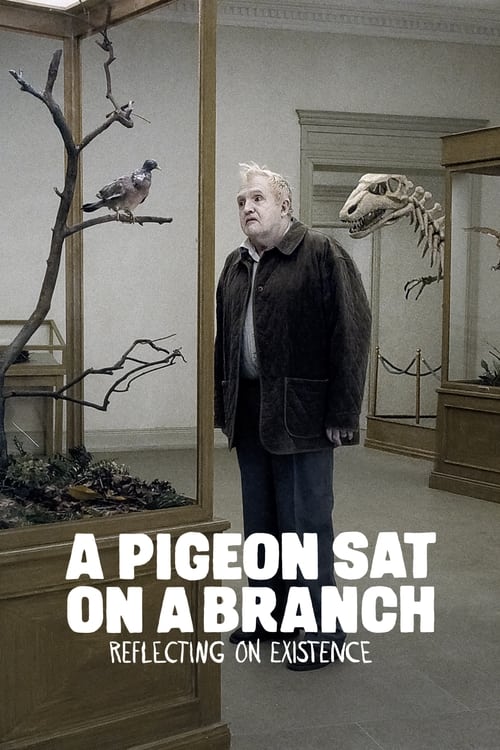
A Pigeon Sat on a Branch Reflecting on Existence
2014 · Roy Andersson
For when you want something genuinely strange and unhurried — a dry, philosophical comedy to sink into rather than a fast night's entertainment. More challenge than comfort, though the laughs are real.
What it's about
Two glum salesmen trudge through a wintry Swedish city hawking novelty gags — vampire teeth, a laughing bag, a rubber fright mask — insisting all the while that they just want to help people have fun. Around them the film assembles dozens of self-contained scenes: a dance class, a bar, a ferry office, strange irruptions of history, each one a small comedy of human awkwardness, longing, and cruelty.
The experience
Slow, deadpan, and pitched somewhere between a chuckle and a shudder — you study each fixed frame like a diorama, waiting for the tiny absurd thing to happen. It's very funny in a way that leaves a bruise.
The craft
Every scene is a single unmoving wide shot on a meticulously built studio set, the actors powdered pale and arranged like figures in a painting; nothing ever cuts, so your eye wanders the frame and finds jokes hiding in the corners. The muted colors and precise, quiet soundscape reward patience and a big screen.
Why it matters
It won the Golden Lion at Venice and completed the trilogy about being a human being that Roy Andersson spent a decade and a half building, sealing his reputation as one of cinema's true originals.
Snapshot
A Pigeon Sat on a Branch Reflecting on Existence is the third and concluding panel of Swedish director Roy Andersson's so-called "Living trilogy" (or "trilogy about being a human being"), following Songs from the Second Floor (2000) and You, the Living (2007). Composed of roughly three dozen self-contained tableaux—each a single, static, deep-focus wide shot staged on a constructed set—it pursues no continuous plot. A loose thread follows two hapless novelty-goods salesmen, Sam and Jonathan, peddling vampire teeth, a "laugh bag," and a fright mask called "Uncle One-Tooth," their refrain "we want to help people have fun" curdling into bleak irony. Around them, the film assembles a frieze of human smallness, cruelty, and longing, opening with three vignettes it labels "meetings with death" and culminating in scenes of historical and colonial atrocity. The film won the Golden Lion at the 71st Venice International Film Festival in 2014, the capstone recognition of a body of work built over decades at a deliberately glacial pace. It is at once one of Andersson's most accessible films—drier, more rhythmically comic—and among his most morally severe.
Industry & production
Andersson occupies a singular position in world cinema: a director who finances and produces his features substantially through his own Stockholm advertising studio, Studio 24, where he has shot commercials since the 1980s. This arrangement grants him near-total autonomy and the luxury of extreme slowness; he constructs every set himself rather than shooting on location, and a single tableau may take days or weeks to build and rehearse. The Living trilogy films were each separated by roughly seven years, a tempo unthinkable inside conventional production economics but enabled by his self-sustaining studio model.
A Pigeon was produced by Andersson's company Roy Andersson Filmproduktion in coproduction with partners across Sweden, Germany, Norway, and France, with backing from the Swedish Film Institute and other European public-funding and broadcast bodies—the standard pan-European art-cinema financing mosaic. Distribution internationally ran through arthouse specialists, and the Golden Lion materially raised the film's profile and theatrical reach beyond Andersson's existing festival-and-cinephile base. Exact budget and box-office figures are not reliably documented in widely available English-language sources, and I will not invent them; what is clear is that the film operated at the modest scale typical of European auteur cinema rather than as a commercial venture.
Technology
The film's technology is inseparable from its method. Andersson works on built sets under controlled studio light, frequently exploiting forced perspective and painted or constructed backdrops to extend depth far beyond what the physical stage allows—a window onto a "city," a "desert" horizon, a distant street. This trompe-l'œil deep space, achieved practically rather than through extensive digital extension, is a defining technical signature. Where digital tools are used, they tend to be invisible, in the service of seamlessly stitching constructed foreground and painted/illusory background into a single continuous deep-focus image. The production sits at the transitional moment when digital capture and post had matured enough to support such invisible compositing, but Andersson's aesthetic deliberately conceals technology rather than displaying it; the goal is the look of a painting come to faint, twitching life, not the look of a special effect.
Technique
Cinematography
Cinematography is the film's most immediately recognizable element. The credited camera work is associated with Andersson's regular collaborators (István Borbás and Gergely Pálos are credited as cinematographers on the film). Every shot is a locked-off, frontal, wide-angle composition in deep focus, so that foreground and background figures remain equally sharp and the viewer's eye is free to roam the frame. There are essentially no camera movements, no close-ups, and no conventional coverage; each scene is one image. The palette is drained to a sickly, chalky range of grays, pale greens, and washed beiges, and the actors wear heavy whiteface makeup that renders skin corpse-like and uniform. Lighting is flat and shadowless, evoking institutional fluorescence and the diffuse gray of overcast Nordic daylight. The fixed-frame strategy turns the spectator into an observer at a fixed remove—closer to looking at a diorama or a Northern Renaissance genre painting than to watching classical narrative cinema.
Editing
Because each scene is a single take, "editing" in the conventional sense of intra-scene cutting barely exists; the cut occurs almost exclusively between tableaux. The film's rhythm is therefore architectural rather than kinetic, built from the duration of each held shot and the sequencing of the vignettes—when to let an image breathe to the point of discomfort, when to release it. The precise English-language credit for the editor is not something I can confirm with certainty, so I will not assert a name; what matters formally is that montage is displaced from within the shot to the macro-level ordering of discrete panels, a structure closer to a suite of paintings or a collection of short prose pieces than to a plotted screenplay.
Mise-en-scène / staging
Mise-en-scène is, for Andersson, the entire art. Each tableau is obsessively designed: a flophouse bar, a dance studio, a hospital corridor, a flamenco class, a military barracks. Figures are arranged with painterly deliberateness, often facing the camera or aligned along the frame's depth, and background action frequently comments on or ironizes the foreground. The staging owes an explicit debt to painting—Andersson has repeatedly cited the Northern tradition, and the film's title is widely understood to allude to Pieter Bruegel the Elder's The Hunters in the Snow, with its small birds perched in the foreground branches surveying human activity below. The "pigeon reflecting on existence" is, in effect, the film's own detached, contemplative point of view.
Sound
Sound is spare, precise, and crucial to the deadpan. Dialogue is delivered slowly and affectlessly; long silences and the small sounds of a room—a clock, a chair, distant traffic—carry enormous weight. Recurrent verbal motifs structure the film, most famously the phone-call line, repeated by several characters in different scenes, "I'm happy to hear you're doing fine." Music is used sparingly and pointedly (a barmaid's song, the marching and dance numbers), and the contrast between gentle melody and atrocity is one of the film's sharpest weapons. The specific music credits are not something I can reliably attribute here, and I decline to invent them.
Performance
Andersson casts largely non-professional or little-known actors and directs them toward a flattened, anti-naturalistic register: minimal expression, slow cadence, bodies that sag and shuffle. The two salesmen, played by Holger Andersson and Nils Westblom, embody this exhausted affect—their pale, jowled faces and querulous bickering ("you're the one who's grumpy") become a vaudeville of defeat. Performance here is closer to tableau vivant and silent-comedy pantomime than to psychological acting; characters are types and figures within a composition rather than rounded individuals, which is precisely the point.
Narrative & dramatic mode
The film abandons conventional dramatic causality for an episodic, paratactic structure—a sequence of discrete scenes that rhyme, echo, and accumulate rather than build toward a plot. Its dramatic mode is tragicomic and absurdist: each vignette is a small, self-enclosed sketch, frequently structured like a joke (setup, hold, deflation) but pointed toward mortality, failure, and indifference. The recurring salesmen provide the thinnest connective tissue, while motifs—deaths, phone calls, the refrain about happiness, a recurring bar—stitch the panels into a loose unity. The effect is cumulative and tonal rather than teleological; meaning emerges from juxtaposition, as in poetry or painting, not from resolution.
Genre & cycle
Generically the film is a hybrid: deadpan comedy, drama, and fantasy, with strong currents of the absurd and the surreal. As a cycle, it is the terminus of Andersson's Living trilogy, sharing its predecessors' tableau form, whiteface aesthetic, and metaphysical-comic register; viewers familiar with Songs from the Second Floor and You, the Living will recognize the continuity of method and worldview. More broadly it belongs to a lineage of slow, formally rigorous European art cinema and to a tradition of static-tableau and "human comedy" filmmaking that runs alongside, but distinct from, mainstream narrative comedy. It is comedy in the classical, almost philosophical sense—comedy as a way of looking at the whole human condition—rather than genre comedy aimed at laughs alone.
Authorship & method
Andersson is the controlling author in the fullest auteurist sense: writer, director, and producer, working out of his own studio, designing his own sets, and refining a style so consistent that any frame is instantly identifiable as his. His method is famously painstaking—building complete sets indoors, exploiting forced perspective, rehearsing extensively, and shooting each scene as one immaculate composition. His background in advertising is not incidental: decades of commercial work funded the features and honed his command of the single, self-sufficient image that delivers its meaning in one shot. Among his key collaborators, the cinematography is credited to István Borbás and Gergely Pálos; the contributions of his production designers, set builders, and craftspeople are central to the result, though English-language documentation of individual below-the-line credits (editor, composer, sound) is comparatively thin, and I have flagged above where I cannot confirm specific names rather than guessing. The authorial vision, in any case, is singular and total.
Movement / national cinema
The film is a flagship of contemporary Swedish art cinema, but Andersson stands somewhat apart from any national school. His sensibility is more readily linked to a pan-European and Northern tradition—Ingmar Bergman's metaphysical seriousness reconfigured as comedy, Jacques Tati's choreographed deep-focus gags, Samuel Beckett's stripped-down existential repetition, and the Flemish/Dutch painting of Bruegel and his successors. Within Swedish cinema he is sui generis, a one-studio movement of his own, though his international success has made him one of the most recognizable Swedish directors of the post-Bergman era and an exemplar of the festival-driven European auteur model.
Era / period
Released in 2014, the film belongs to a moment of mature, slow, festival-oriented art cinema and to the digital era's capacity for seamless practical-effects compositing. Yet its temporal setting is deliberately unmoored: most scenes read as a drab, timeless mid-to-late twentieth-century present, while the film abruptly ruptures chronology with historical incursions—most strikingly the arrival of King Charles XII of Sweden, riding to the catastrophic Battle of Poltava (1709), into a contemporary bar. This collapsing of past and present, of national-historical grandeur and present-day banality, situates the film as a meditation on history's continuities rather than as a period piece anchored to its release year.
Themes
The film's governing theme is, in Andersson's recurring phrase, "man's inhumanity to man"—cruelty, indifference, and the casual evil that ordinary people permit. Mortality saturates it from the opening "meetings with death." Failure, loneliness, and thwarted tenderness recur, as does the commodification of joy embodied by the salesmen hawking fun they cannot feel. Two scenes crystallize the moral vision: Charles XII's vainglorious march to slaughter, deflating national myth into folly; and a harrowing late tableau of colonial atrocity, in which Black captives are herded into a giant rotating brass cylinder set alight while well-dressed white elders sip drinks and listen to the resulting "music"—an unflinching allegory of imperial exploitation and the comforts built upon it. Against this, the film holds small gestures of grace and the detached, melancholy gaze of the title's pigeon, contemplating existence from its branch.
Reception, canon & influence
Critical reception was strong and, after the Golden Lion, prominent. Reviewers widely praised the film's formal audacity, deadpan wit, and moral gravity, while some found its glacial rhythm and emotional coolness alienating—a familiar split in responses to Andersson's work. The Venice win confirmed his standing as a major contemporary auteur and brought the Living trilogy a wave of retrospective appreciation. Influences on the film run backward to Northern Renaissance painting (Bruegel above all, named in the title's conceit), to Beckett's absurdist minimalism and bleak comedy, to Tati's deep-focus visual gags, and to Andersson's own earlier films, which had already established the style the trilogy perfects. Its legacy forward lies less in direct imitation—Andersson's method is too idiosyncratic and labor-intensive to spawn a school—than in its consolidation of the static-tableau, single-shot mode as a recognized and respected possibility in art cinema, and in cementing Andersson as a reference point for filmmakers and critics interested in painterly framing, deadpan absurdism, and cinema as moral inquiry. Andersson continued in the same vein with About Endlessness (2019), and A Pigeon remains, for many, the most fully realized and rewarding entry point into his austere, mordant, and unmistakable body of work.
A Deleuzian reading
A pigeon sits on a bare branch, and below it people go quietly about the business of dying.
The full Deleuzian reading of A Pigeon Sat on a Branch Reflecting on Existence →
Reception
It won the Golden Lion at Venice in 2014, then promptly split general audiences — walkouts and raves in equal measure. A decade on it's settled in as the go-to entry point for Roy Andersson's deadpan universe, the finale of his 'Living trilogy' that made him a cult name far beyond Sweden.
How A Pigeon Sat on a Branch Reflecting on Existence was received, from release to now →
Influences: the films it descends from and the films it influenced
- Playtime (1967) — Deep-focus widescreen tableaux in which multiple gags play simultaneously across the full depth of a single locked composition — the direct model for Andersson's distributed-action one-shot scene.
- Mon Oncle (1958) — Deadpan choreography of small human figures against geometric architecture, with sound effects and minimal dialogue used as recurring comic motifs rather than exposition.
- The Phantom of Liberty (1974) — Episodic-paratactic chain of loosely linked absurdist vignettes with no central protagonist, the structural template for Andersson's vignette catalog.
- The Discreet Charm of the Bourgeoisie (1972) — Deadpan staging of bourgeois ritual as a recurring absurdist set-piece, the interrupted-dinner motif anticipating Andersson's looping verbal refrains.
- The Color of Pomegranates (1969) — Frames built as static, frontal living paintings where the immobile tableau itself, not cutting or camera movement, delivers the meaning of the shot.
- The General (1926) — The unsmiling 'stone face' whose comedy derives entirely from impassivity against unfolding chaos — origin point for Andersson's anti-naturalistic deadpan performers.
- Songs from the Second Floor (2000) — First full deployment of his studio-built, forced-perspective tableau with pancake-pale makeup and desaturated gray palette, the style A Pigeon perfects.
- You, the Living (2007) — Second Living-trilogy entry using identical locked-off single-take vignettes, painterly deep-focus sets, and deadpan verbal motifs addressed to camera.
- Kitchen Stories (2003) — Builds explicitly on the observer-effect conceit — two deadpan figures cataloging human behavior — within rigidly composed, near-monochrome wintry frames held in unbroken takes.
- About Endlessness (2019) — Direct continuation of the same studio-built static-tableau method, distilling the single self-sufficient composition into even shorter standalone shots.
- Super Deluxe (2019) — Deadpan, static, symmetrically composed tableaux that stage absurd human folly without moral comment — the anti-judgment absurdist framing device.
- The Match Factory Girl (1990) — Deadpan minimalist staging with affectless, blank anti-naturalistic performance and a desaturated proletarian palette, an austere comic register parallel to Andersson's.
- Dog Days (2001) — Rigorously frontal, locked static tableaux of human cruelty and loneliness, composed with documentary-grade exactitude into self-contained images of misery.
- Divine Intervention (2002) — Tati-descended deadpan sight gags staged in static long-shot tableaux, delivering political and existential absurdity through composition rather than dialogue.
- Dogville (2003) — Stripped theatrical staging on a single constructed set with Brechtian distanciation, treating the controlled artificial space as an instrument of moral inquiry.
- Dogtooth (2009) — Affectless, anti-naturalistic ensemble performance inside clinical static framing, mining absurdist cruelty from the gap between deadpan delivery and content.
- The Grand Budapest Hotel (2014) — Planimetric frontal compositions and flattened deadpan blocking that turn the frame into a painterly plane, a parallel codification of the static-tableau mode.
- The Love That Remains (2025) — Extends the same deadpan-absurdist craft: meticulously composed static frontal tableaux where melancholy comedy emerges from figures held motionless in a flatly-lit, theatrically deep frame.
- Noi the Albino (2003) — Continues the symmetrical frontal absurdist tableau into ever-more-static deadpan compositions populated by pale, affectless figures.
- Asteroid City (2023) — Static, frontally-composed planimetric tableaux populated by pallid, affectless performers delivering lines into a flattened diorama-like space — the deadpan-frontal aesthetic pursued in a parallel key.
- Shadows in Paradise (1986) — Extends the shared tableau-blocking idiom to its purest form: single locked-off compositions, pale color palette, non-reactive performances, and absurdist working-class pathos held in unbroken static frames.
Similar films
- You, the Living (2007) — influence & lineage
- Songs from the Second Floor (2000) — influence & lineage
- The Grand Budapest Hotel (2014) — influence & lineage
- The Last Viking (2025) — shared sensibility
- Anomalisa (2015) — shared sensibility
- The Square (2017) — shared sensibility
- The Hypothesis of the Stolen Painting (1978) — shared sensibility
- Isle of Dogs (2018) — shared sensibility
All the films related to A Pigeon Sat on a Branch Reflecting on Existence →