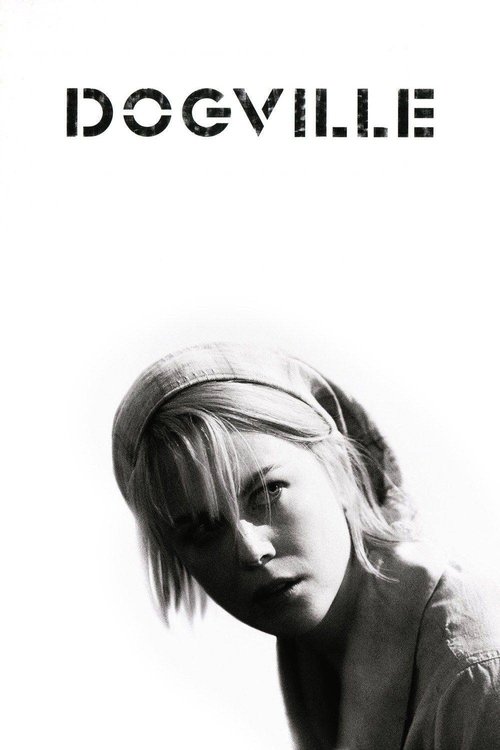
Dogville
2003 · Lars von Trier
For when you want to be shaken, not soothed — a film to chew on for days and argue about with whoever watched it with you. Absolutely not comfort viewing; pick it when you're up for a moral gut-punch.
What it's about
During the Depression, a mysterious woman fleeing gangsters arrives in a tiny Rocky Mountain town and offers to work for the residents in exchange for shelter. At first the town's charity seems genuine — but as the risk of hiding her grows, so does the price they extract, and the arrangement curdles into something much darker. It's a fable about what ordinary, decent-seeming people will do when they hold all the power over someone with none.
The experience
Hypnotic and increasingly suffocating — three hours that tighten like a vise, laced with dry, narrated wit that makes the cruelty land harder. It's a film that provokes rather than entertains, and it will leave you arguing with yourself on the way out.
Performances
Nicole Kidman gives one of her bravest performances as the fugitive Grace, holding onto an almost saintly composure as the town closes in — the whole film rests on her face and she carries it.
The craft
The audacious gimmick is the whole town: no sets, just chalk outlines and labels on a black soundstage, with mimed doors and invisible walls. Instead of feeling cheap, it strips away every distraction until only human behavior is left — a storybook narrator and chapter titles complete the fable framing while a restless handheld camera keeps it uncomfortably intimate.
Why it matters
One of the most divisive films of its decade — hailed as a masterpiece and denounced as anti-American in almost the same breath — and a landmark demonstration that a film can throw out sets entirely and still grip an audience.
Snapshot
Dogville is Lars von Trier's three-hour moral parable about a fugitive woman who takes refuge in a tiny Depression-era Rocky Mountain township and is slowly absorbed, exploited, and finally enslaved by its inhabitants. Its notoriety rests less on the story than on its staging: the film unfolds on a black soundstage where the town is reduced to chalk outlines on the floor, labels reading "Elm St." or "dog," and a handful of props. Conceived as the first panel of von Trier's unfinished "USA: Land of Opportunities" trilogy, it pairs a deliberately archaic, chaptered storybook structure with a restless handheld digital camera, and resolves its fable of charity-turned-cruelty in an act of annihilating retribution. It premiered in competition at Cannes in 2003 and immediately split critics between those who saw a Brechtian masterwork and those who saw a punishing, schematic provocation tinged with anti-Americanism. Nicole Kidman, then at the height of her post-Moulin Rouge!/The Hours prominence, anchors the film as Grace, and the cast assembles a striking mix of American veterans and von Trier's European regulars.
Industry & production
Dogville was produced by Vibeke Windeløv for von Trier's Danish company Zentropa, in the elaborate multinational co-production structure typical of European art cinema, drawing partners across Denmark, Sweden, France, Norway, the Netherlands, Finland, Germany, the UK and Italy. It was shot largely at the Film i Väst facilities in Trollhättan, Sweden — the regional production hub nicknamed "Trollywood" that von Trier favored — on a single large stage. The single-set conceit was, among other things, an economy: it concentrated resources on cast and shooting time rather than location work and construction. Reported budgets cluster around the $10 million range; I would treat the precise figure as approximate rather than certain.
The most-cited production fact is biographical: von Trier's well-documented phobia of flying meant he had never visited the United States, and he made an entire trilogy about America without setting foot there — a detail he embraced rather than concealed, framing the films as deliberately mediated, second-hand visions of the country. Casting drew Kidman at a career peak; she reportedly committed to the larger trilogy, though her involvement did not continue past the first film, and the role of Grace was recast (with Bryce Dallas Howard) in the 2005 sequel Manderlay. The supporting ensemble — Paul Bettany, Lauren Bacall, Ben Gazzara, Patricia Clarkson, Stellan Skarsgård, Chloë Sevigny, James Caan, Philip Baker Hall, Blair Brown, Jeremy Davies, Harriet Andersson, Jean-Marc Barr, Udo Kier — knits together Hollywood elders, American independents and members of von Trier's recurring European troupe. John Hurt provided the dry, omniscient narration.
Technology
The film was shot digitally rather than on celluloid, consistent with von Trier's embrace of lightweight video through the late 1990s and early 2000s (The Idiots, Dancer in the Dark). Digital acquisition was integral to the method: it allowed long takes, low light levels on a near-black stage, and a roaming, operator-driven camera unconstrained by the reloading and bulk of film. The bare soundstage itself is the film's defining "technology" in a theatrical sense — an engineered void in which lighting cues, not built walls, summon day and night, the gooseberry bushes, or the town's single street. The closing-credits sequence layers an analog technology of a different order: a montage of still photographs of American hardship set to David Bowie's "Young Americans," using documentary-style imagery to yank the abstraction back toward a historical referent.
Technique
Cinematography
Cinematographer Anthony Dod Mantle — already associated with Dogme 95 and a key figure in the era's digital aesthetic — shot the film handheld, with a roving, observational restlessness that contrasts sharply with the geometric stillness of the chalk-line set. The camera hunts among the actors, reframes constantly, and refuses the composed tableau the stage might invite. Lighting carries enormous narrative weight precisely because there are no walls or sky: an overhead light shift is the only signal of dawn or dusk, and the encroaching darkness of the later chapters does literal and figurative work as Grace's situation worsens. Overhead "God's-eye" wide shots periodically pull back to reveal the entire town as a diagram, reasserting the artifice and the spectator's clinical vantage. The visual grammar is thus a deliberate collision: intimate, jittery, quasi-documentary handheld coverage performed inside a frankly abstract diagram.
Editing
The film is segmented into a prologue and nine numbered chapters, each introduced by an intertitle that often wryly previews or summarizes what follows — a literary, chaptered architecture that slows and formalizes the rhythm. Within scenes, the cutting follows the handheld camera's logic, favoring continuous observation and frequent reframing over classical shot/reverse-shot decoupage. The pacing is patient to the point of severity across roughly three hours, building an accretive sense of routine, complicity and escalating abuse before the abrupt tonal rupture of the finale. The chapter structure also lets Hurt's narration bridge ellipses and pass judgment, knitting the episodes into a moral progression.
Mise-en-scène / staging
This is the film's signature. The town of Dogville exists only as white outlines on a dark floor — buildings, property lines, the main street ("Elm Street"), even the dog Moses rendered as the written word "dog." Actors mime opening doors that aren't there (with sound effects supplying the latch and creak), and the absence of walls makes everyone perpetually visible to everyone else, so that private cruelties play out in plain communal sight. The conceit derives openly from theatrical antecedents — Thornton Wilder's Our Town, with its bare stage and stage-manager narrator, and Bertolt Brecht's epic theater, with its anti-illusionist devices. By stripping away realist set dressing, von Trier forces attention onto behavior, language and power, and converts the spectator into a witness who cannot hide behind the comfort of verisimilitude.
Sound
Because the physical world is largely absent, sound effects do the work of conjuring it: doors, dogs, weather and objects are present aurally where they are missing visually, a continuous reminder of the gap between what we hear and what we see. Hurt's narration is the dominant sonic and structuring presence — measured, ironic, and morally inflected, it frames the townspeople with a detachment that can read as compassion or contempt. The score draws on older art-music sources rather than a conventional symphonic underscore, reinforcing the film's mannered, presentational distance, and the climactic deployment of Bowie's "Young Americans" over Depression-era photographs lands as a calculated shock of pop-historical specificity.
Performance
Performances are pitched within the artifice yet emotionally exposed by it. Kidman's Grace moves from luminous gratitude and forbearance to depletion and, finally, cold resolve; the role demands she sustain dignity and increasing degradation in an environment that affords no realistic refuge. Bettany's Tom Edison is the town's self-appointed moral spokesman and aspiring writer, whose high-minded idealism curdles into self-serving betrayal — arguably the film's sharpest portrait. The veterans lend gravity and Americana: Bacall, Gazzara, Clarkson, Caan as Grace's gangster father. The acting style sits between naturalism and stylization, the bareness of the stage amplifying every gesture and leaving nowhere for the actors to hide.
Narrative & dramatic mode
Dogville is a fable or moral demonstration more than a psychological drama — a parable that sets up a controlled experiment and runs it to its conclusion. The mode is openly didactic and ironic, mediated by an omniscient narrator who editorializes, foreshadows, and assigns a quasi-Biblical weight to events. Its structure is episodic and accumulative: the community's small kindnesses curdle by degrees into exploitation and abuse, each chapter ratcheting the moral pressure. The finale stages a reversal — Grace's debate with her father over whether the townspeople deserve mercy or judgment — that recasts the entire preceding narrative as a test of arrogance, forgiveness and accountability, and answers it with devastating finality. It is a drama built to argue rather than merely to depict.
Genre & cycle
Nominally a crime-drama-thriller — there are gangsters, a fugitive, and a violent climax — Dogville subordinates genre machinery to allegory. It belongs most coherently to the lineage of the philosophical art-film parable, and within von Trier's own output to the "USA: Land of Opportunities" trilogy. That cycle was planned as three films; Manderlay (2005), addressing slavery, followed, while the projected third installment (variously referred to as Wasington/Washington) was never realized. Read against the period, it also participates in a strand of early-2000s art cinema interrogating America from the outside, and in von Trier's recurring cycle of films built around a suffering, sacrificial heroine (the so-called "Golden Heart" women of Breaking the Waves and Dancer in the Dark, of which Grace is a darker, retributive variation).
Authorship & method
Dogville is unmistakably an auteur project: von Trier wrote and directed, and the film bears his trademarks — provocation, conceptual rigor, formal constraint as creative engine, and a moral universe in which a woman's goodness is stress-tested to destruction. The single-set rule functions like the self-imposed "obstructions" and the Dogme 95 vow of chastity (which von Trier co-authored with Thomas Vinterberg) that recur throughout his practice: an arbitrary limitation that paradoxically liberates. He has cited the "Pirate Jenny" song from Brecht and Weill's Threepenny Opera — in which a downtrodden woman fantasizes about a ship that will come to destroy her tormentors — as a germinating image for the film's revenge logic.
The key collaborators sharpen that vision. Cinematographer Anthony Dod Mantle translated the conceptual stage into a living, handheld visual field. Editor Molly Marlene Stensgaard, a frequent von Trier collaborator, shaped the chaptered, durational rhythm. Rather than commission a wall-to-wall original score, the film leans on pre-existing art-music selections, reinforcing its presentational distance. Production designer Peter Grant and the design team faced the singular challenge of building a "town" out of markings and light. Producer Vibeke Windeløv managed the sprawling co-production. The result is collaborative execution in service of an authorial thesis.
Movement / national cinema
The film issues from Danish national cinema and the Zentropa milieu that von Trier and Peter Aalbæk Jensen built into a force in European production. Its formal DNA runs through Dogme 95 — the 1995 manifesto-movement von Trier launched with Vinterberg that prized handheld immediacy and stripped-down means — even though Dogville is not itself a Dogme film and in fact violates several of its tenets (it uses non-diegetic narration, extensive sound design, and a frankly artificial set). More broadly it sits within the European art-cinema tradition of intellectual provocation and within a Nordic lineage of austere moral seriousness; the casting of Bergman veterans like Harriet Andersson quietly underscores that heritage. It is, pointedly, a European film about America, its outsider vantage a structuring premise rather than an incidental fact.
Era / period
The story is set in the 1930s, during the Great Depression, in the fictional small town of Dogville in the Rocky Mountains of Colorado — a milieu of scarcity, hard labor and insularity that the film evokes through dialogue, costume and behavior rather than built environment. The closing montage of Depression-era documentary-style photographs makes the historical setting explicit, anchoring the abstraction in a recognizable American iconography of poverty. As a production, the film belongs to the early-2000s moment when affordable high-quality digital video reshaped art-cinema aesthetics, and when von Trier was among the most internationally prominent and combative figures in world cinema.
Themes
At its core the film interrogates charity and its hidden price: the town's "support has a price," and Dogville anatomizes how communal kindness can shade into entitlement, exploitation and abuse once a vulnerable outsider becomes dependent. It dramatizes power and complicity — how an entire community can be drawn, person by person, into collective cruelty while each participant rationalizes their part. It probes the ethics of forgiveness versus accountability, culminating in Grace's recognition that excusing others' wrongs out of empathy can itself be a form of arrogance — the assumption that they cannot be held to the standards one holds oneself. Around these run motifs of original sin, human nature under pressure, gender and sexual violence, and the moral hazards of idealism, embodied in Tom's hollow rhetoric. The bare stage universalizes the parable: this could be any community, which is precisely the discomfort it intends.
Reception, canon & influence
Dogville was among the most divisive films of its year. Premiering in competition at Cannes 2003 (where the Palme d'Or went to Gus Van Sant's Elephant), it drew passionate advocacy and equally passionate hostility. Admirers hailed the audacity of the staging, Kidman's performance, and the film's intellectual force; detractors found it schematic, sadistic toward its heroine, and — especially given the final photo montage scored to Bowie — guilty of glib anti-Americanism, a charge von Trier's outsider stance and trilogy framing only intensified. That debate has largely sustained the film's reputation: it is now widely regarded as one of von Trier's major works and a touchstone for discussions of Brechtian distanciation in cinema.
The influences on the film are unusually legible. Thornton Wilder's Our Town supplies the bare stage and narrator; Brecht's epic theater supplies the anti-illusionist method and the Verfremdungseffekt; the "Pirate Jenny" ballad from The Threepenny Opera supplies the revenge fantasy of the wronged servant woman. Von Trier's own "Golden Heart" heroines prefigure Grace, even as she inverts their pure martyrdom into judgment.
Its forward legacy lies less in literal imitation — few filmmakers attempted the full chalk-outline conceit — than in its demonstration that radical theatrical abstraction can carry a feature-length narrative on screen, expanding the vocabulary available to ambitious filmmakers and reinvigorating Brechtian technique for a new generation of critics and directors. Within von Trier's career it inaugurated the unfinished America trilogy continued by Manderlay, and it cemented his standing as one of the era's defining provocateur-auteurs. It remains a fixture of film-studies curricula on adaptation, theater-cinema hybridity, and the ethics of spectatorship.
A Deleuzian reading
A woman raps her knuckles on the air.
The full Deleuzian reading of Dogville →
Reception
Booed by some and branded anti-American by US critics at Cannes 2003 — where its Palme d'Or snub was itself a scandal — it's since climbed to become perhaps von Trier's most acclaimed film, a fixture on best-of-the-2000s lists.
How Dogville was received, from release to now →
Influences: the films it descends from and the films it influenced
- Dancer in the Dark (2000) — Anthony Dod Mantle's restless handheld digital acquisition, the durational tragedy of a doomed innocent woman, and pre-existing music over wall-to-wall score are the immediate craft template Dogville inherits.
- From the Life of the Marionettes (1980) — Chapter-titled case-study architecture with explicitly theater-derived staging on a marked bare floor — von Trier literalising the theater-derived staging device Bergman kept latent, and applying it to the same systematic forensic exposure of communal pathology.
- Ali: Fear Eats the Soul (1974) — Radicalizes the tableau-of-onlookers and Brechtian distancing into a bare stage where a whole community's collective gaze turns on an outsider — Fassbinder's staring townsfolk taken to their theatrical extreme.
- West Indies: The Fugitive Slaves of Liberty (1979) — Confines an entire allegory of bondage and exploitation to one bare theatrical soundstage with chalk-line abstraction and choric narration — the total-theater single-set with Brechtian distanciation carried to its limit.
- Pastoral: To Die in the Country (1974) — Brechtian theatrical staging with walls reduced to chalk outlines so the whole house is nakedly exposed — the wall-drop reveal turned into an entire film's set logic.
- The Young One (1960) — Strips the sealed-community moral laboratory to its bones as an anti-consolatory American parable, pursuing Buñuel's impossibility-of-innocence by systematically corrupting every apparent innocent.
- The Menu (2022) — Von Trier literalized Brechtian theatrical devices in cinematic space — chapter-title intertitles dividing the film into named acts, deliberate anti-naturalism replacing illusionism — establishing the specific formal grammar of the intertitle-as-chapter-break that The Menu's course structure directly adopts.
- The Lobster (2015) — Pairs an allegorical rule-bound community with a detached, ironically omniscient narrator (John Hurt) — the same droll explanatory voiceover device The Lobster uses to gloss its social mechanics.
- The House That Jack Built (2018) — Supplies the numbered-chapter, narrator-framed morality-tale structure and the stripped architectural staging; von Trier cannibalizes it directly in the self-citation montage.
- Aattam (2024) — A playwright-director stages an ensemble on a near-bare set so blocking reads openly as theatrical dramaturgy, and a community's collective moral reasoning curdles into self-interest under scrutiny.
- Good Boy (2026) — Von Trier's choice to run a moral experiment on a bare floodlit stage where every room is visible at once is the conceptual basis for playing the cellar as a theatrical space with marked positions rather than a naturalistic prison.
- Fjord (2026) — The village as declared moral laboratory — a small community handed an outsider and observed under controlled, chaptered conditions — is the experimental frame Fjord adopts without the chalk lines.
- Our Town (stage/1940 film) (1940) — Thornton Wilder's bare-stage convention — a narrator-Stage Manager and props mimed against an empty set — is the direct structural template for Dogville's chalk-outlined town and omniscient narration.
- The Threepenny Opera (1931) — Brecht/Weill's 'Pirate Jenny' ballad supplies the wronged-servant revenge fantasy von Trier cites as the germinating image, and the Brechtian song-as-distanciation device the film transposes to needle-drops.
- Ivan the Terrible (1944) — Theatrically stylized blocking and expressionist pools of light isolating figures on a near-abstract stage prefigure Dogville's set-by-lighting approach where darkness, not walls, defines space.
- Day of Wrath (1943) — Dreyer's austere Scandinavian moral-trial cinema — a persecuted woman tested to destruction by a closed pious community — is the national-ancestral mode von Trier inherits and abstracts.
- Persona (1966) — Bergman's rupture of the film's own illusion (the burning celluloid, the dissolving identities) models the self-conscious anti-illusionism and durational two-hander intensity von Trier extends to a whole town.
- Week-end (1967) — Godard's Brechtian intertitles, chapter cards and direct address as political distanciation devices are the New Wave precedent for Dogville's chaptered structure and editorializing narrator.
- The Element of Crime (1984) — Von Trier's own debut establishes the authorial signature of overhead control, sodium-lit abstraction and conceptual rigor as creative engine that Dogville radicalizes into pure stage.
- Breaking the Waves (1996) — The 'Golden Heart' martyr-heroine whose goodness is stress-tested to destruction, plus handheld chaptered structure with hymn/song interludes, is the direct authorial precursor Grace inverts into judgment.
- The Idiots (1998) — The Dogme 95 vow von Trier co-authored — arbitrary self-imposed constraint as liberation, handheld digital immediacy — is the methodological 'obstruction' logic the single-set rule continues.
- Festen (1998) — Vinterberg, von Trier's Dogme co-author, supplies the handheld digital chamber drama of a community's buried cruelty exposed at a gathering — the sibling realization of the same vow.
- Manderlay (2005) — The literal continuation of the unfinished America trilogy reuses the identical chalk-outline set, overhead camera, chaptered narration and moral-parable engine — the closest descendant by design.
- Elephant (2003) — The Cannes-2003 Palme winner sharing the festival moment, Van Sant deploys floating omniscient camera and durational tableaux over a community before catastrophe — a sibling experiment in formal detachment from violence.
Similar films
- Dancer in the Dark (2000) — influence & lineage · same viewing thread
- Breaking the Waves (1996) — influence & lineage · same viewing thread
- The Idiots (1998) — influence & lineage
- Day of Wrath (1943) — influence & lineage
- The Celebration (1998) — influence & lineage
- The Girl with the Needle (2024) — same viewing thread
- Vagabond (1985) — same viewing thread
- Persona (1966) — influence & lineage · often watched together
All the films related to Dogville →
Watch it with: curated runs of related films
- The World Against Her — A run of women worn down or driven to extremity by a merciless community, marriage, or economy — watch them near each other and the sacrifice, the drift, and the violence start to rhyme.