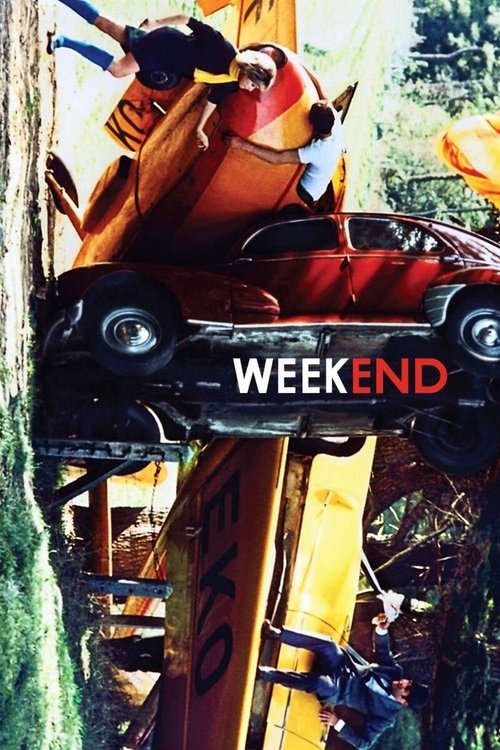
Weekend
1967 · Jean-Luc Godard
For when you're feeling adventurous and a little angry at the world — when you want cinema that attacks rather than soothes. This is the deep end: confrontational, funny, and unlike anything in your queue.
What it's about
A scheming bourgeois Parisian couple set off for a weekend drive to the countryside to collect an inheritance — each quietly plotting against the other. Almost immediately the trip stops making normal sense: the road becomes an endless traffic jam of wrecks and corpses, and the journey spirals through a France collapsing into absurdity, violence, and open revolution. It's a comedy, technically.
The experience
Savage, hilarious, and deliberately exasperating — it keeps breaking its own story to harangue, digress, and shock, daring you to stay in your seat. Watching it feels like being a passenger in a car whose driver has decided to crash on purpose, brilliantly.
The craft
It contains one of the most famous shots in movies: a single, seemingly endless sideways tracking shot down a honking country-road traffic jam, a whole society gridlocked in one unbroken take. The color is acid-bright, the sound cuts against the image, and intertitles interrupt like slogans — every tool of moviemaking turned into a weapon against moviemaking itself.
Why it matters
Made on the eve of the May 1968 upheavals, it stands as Godard's furious farewell to commercial cinema — the film where he declared the story over and walked off the set of the industry entirely. Its provocations still mark the outer edge of what a mainstream-adjacent film can be.
Snapshot
Week-end is Jean-Luc Godard's scabrous farewell to the commercial cinema he had spent the decade detonating from within. Nominally the story of a bourgeois Parisian couple, Roland and Corinne, who drive into the countryside to secure an inheritance — each privately scheming to murder the other and her parents — the film abandons plot almost immediately for a picaresque descent through a France collapsing into gridlock, wreckage, revolution, and finally cannibalism. It is at once a comedy, a horror film, a political tract, and an essay on the death of narrative cinema, announced in its closing intertitles "FIN DE CONTE" (end of story) and "FIN DE CINÉMA" (end of cinema). Made in the months before the upheavals of May 1968, Week-end stands as the terminal work of Godard's so-called first period, after which he largely renounced feature filmmaking for the militant collective work of the Dziga Vertov Group. It remains one of the most cited and most aggressive films of the late nouvelle vague.
Industry & production
Week-end was produced in 1967 within the French–Italian co-production framework common to art cinema of the period, drawing on producers associated with Godard's prolific run of the mid-1960s. The film belongs to an extraordinary burst of productivity: Godard directed several features in 1966–67 (Masculin féminin, Made in U.S.A., 2 ou 3 choses que je sais d'elle, La Chinoise, and Week-end), working fast, cheaply, and with a recurring crew. By this point Godard's commercial standing rested less on box office than on his centrality to international art-house and festival culture; his films were events for critics and cinephiles even when they alienated general audiences.
Production was characteristically rapid and improvisatory. Godard worked from loose scenarios rather than conventional shooting scripts, building sequences around locations, ideas, and texts he wished to stage. The film's most demanding set piece — the lateral tracking shot along a kilometres-long traffic jam — required substantial logistical coordination of vehicles, animals, and performers along a country road, and is one of the few moments in the film that betrays heavy advance planning rather than on-the-day improvisation. Beyond this, precise production budgets and shooting-schedule figures are not well documented in the accessible record, and I will not invent them.
Technology
Week-end was shot in 35mm color, the format Godard had embraced through his collaborations with cinematographer Raoul Coutard across the decade. The technology is conventional for 1967 European production; what is unconventional is its deployment. Godard and Coutard favoured available light, real locations, and lightweight, mobile camera setups that descended from the nouvelle vague's foundational break with studio practice. The signature long tracking shots depended on dolly track and a wheeled camera platform laid along the roadside, a deliberately "primitive" mechanical solution that foregrounds the apparatus rather than concealing it. Sound was recorded with the era's portable equipment but treated as an expressive, often abrasive material rather than a transparent record — see below. There is no exotic technical innovation here; rather, standard tools are turned against their normal purpose, made to announce themselves as machinery.
Technique
Cinematography
Raoul Coutard's photography is built around two opposed registers. The first is the long, unbroken lateral tracking shot, of which the traffic-jam sequence — running roughly seven to eight minutes — is the most celebrated example in Godard's entire body of work and among the most famous shots in cinema. The camera glides past stalled cars, picnicking drivers, sailboats on trailers, animals, overturned vehicles, and finally a bloody pileup of corpses, the everyday and the catastrophic rendered with the same even, affectless motion. The horizontal track becomes an argument in itself: consumer society laid out as a single continuous frieze. Coutard's color is hard and saturated — the recurring red of blood and bodywork especially — and the compositions are frontal and frieze-like, refusing depth-of-field naturalism in favour of a flattened, almost Brechtian planarity.
Editing
Agnès Guillemot, Godard's regular editor through this period, cuts Week-end as a deliberately broken object. The film is partitioned by full-screen intertitles — printed in blunt capitals, sometimes punning, sometimes contradictory ("LE WEEK-END," "SCÈNE DE LA VIE PARISIENNE," "FAUX TRAGÉDIE") — that interrupt scenes, comment on them, and dispute the very chronology they purport to mark. Against these fragmenting captions, the editing also withholds cutting where convention demands it: the long takes refuse the relief of a cut, forcing duration on the viewer. The rhythm therefore oscillates between extreme continuity (the unbroken track) and extreme discontinuity (the intertitled collage), a montage strategy that treats the cut and the refusal-to-cut as equally rhetorical.
Mise-en-scène / staging
Staging is theatrical and declamatory. Characters frequently address the camera or deliver long, essayistic monologues to no one in particular — most famously the two refuse collectors, an African and an Arab, who lean on their truck and deliver speeches on colonialism, the Third World, and class while the bourgeois couple sulk. Historical figures intrude into the contemporary landscape: a man identifying himself as Saint-Just declaims revolutionary rhetoric from the roadside, and a character invokes Emily Brontë and Tom Thumb in a country field. The famous farmyard sequence stages a pianist performing a Mozart sonata to peasants while the camera executes slow 360-degree pans, collapsing high culture and rural labor into a single circling gaze. The mise-en-scène consistently refuses psychological realism, treating the frame as a stage for ideas, citations, and tableaux.
Sound
Sound in Week-end is openly antagonistic. The traffic-jam shot is scored less by music than by the relentless, maddening blare of car horns, a wall of noise that makes the sequence physically wearing. Dialogue is frequently buried, overlapped, or competing with ambient din; quotations and recitations are delivered flatly. Antoine Duhamel's music (see below) enters and cuts off abruptly rather than smoothing transitions. Throughout, sound is used to alienate rather than immerse — to remind the spectator that they are watching a constructed artifact, not eavesdropping on life.
Performance
Mireille Darc and Jean Yanne play Corinne and Roland as flatly venal, affectless bourgeois — performances pitched deliberately against sympathy or depth. The film opens with Corinne recounting a sexual confession (the "analyst" monologue) in near-darkness, a long set piece delivered as toneless narration rather than dramatized scene. Throughout, actors recite rather than emote; figures such as Saint-Just and the garbage men function as mouthpieces for blocks of text. This is performance as citation, in keeping with Godard's Brechtian distrust of identification. Darc and Yanne were established screen presences whose star familiarity Godard exploits precisely to hollow it out.
Narrative & dramatic mode
Week-end begins as something like a black-comic crime story — a couple plotting mutual and parental murder for money — and systematically dismantles that scaffolding. The inheritance plot is a pretext; once the couple sets off, the film becomes an episodic odyssey, a road movie that is really an inferno, with each "station" a tableau of social breakdown. Causality loosens, characters wander in from literature and history, and the diegesis is repeatedly punctured by intertitles and direct address. By the final act the couple has been absorbed into a band of cannibal guerrillas in the woods, and the narrative resolves not into a denouement but into the announcement of its own impossibility: "END OF CINEMA." The dramatic mode is essayistic and Brechtian — anti-illusionist, discursive, and intent on keeping the viewer critically awake rather than emotionally absorbed.
Genre & cycle
The film cannibalizes genres as readily as its characters cannibalize each other. It draws on the road movie, the apocalyptic satire, black comedy, the political essay-film, and, in its closing movement, outright horror. Within Godard's own output it belongs to the cycle of increasingly politicized, increasingly fragmented films that runs through 2 ou 3 choses que je sais d'elle and La Chinoise in 1966–67 — works in which narrative pleasure is progressively sacrificed to ideological critique. It is best understood not as a genre film but as a deliberate demolition of genre, and indeed of the feature film as a form, which is why its title cards frame it as the "end" of both story and cinema.
Authorship & method
Week-end is among the purest expressions of Godard's authorial method at the close of his first decade: filmmaking as collage, citation, and argument. He worked from a skeletal scenario, building the film out of literary and political texts (Saint-Just, the Brontë reference, Maoist and Third-Worldist rhetoric), genre fragments, and long real-time takes. The method is essayistic — the director thinks aloud through images and sound, and the film's coherence is rhetorical rather than dramatic.
His key collaborators are central to the result. Raoul Coutard, his cinematographer since À bout de souffle (1960), executes the hard-edged color and the bravura tracking shots. Agnès Guillemot, his editor across the 1960s features, shapes the intertitled, fractured structure. Composer Antoine Duhamel — who had also scored Pierrot le fou (1965) — supplies music used in abrupt, anti-illusionist bursts. The screenplay is Godard's own, characteristically assembled from quotation and improvisation rather than conventional dramaturgy. The collaboration with this tight, recurring team is what allowed the speed and the formal daring; Week-end is the culmination of their decade-long working relationship, after which Godard's practice changed radically.
Movement / national cinema
Week-end is a late, extreme product of the French nouvelle vague — the movement Godard helped launch as a Cahiers du cinéma critic turned filmmaker. By 1967 the early new-wave spirit of youthful, location-shot freedom had, in Godard's hands, mutated into something harsher and more overtly political, anticipating the radicalization of French intellectual life that would erupt in May 1968. The film sits at the hinge between the nouvelle vague proper and the militant, collective cinema Godard pursued immediately afterward through the Dziga Vertov Group. As French national cinema, it is also a savage portrait of France itself — its consumerism, its automobiles, its bourgeoisie — turned into a landscape of apocalypse.
Era / period
The film is saturated with the political temperature of the late 1960s: anti-colonial and Third-Worldist discourse, Maoist and revolutionary rhetoric, the critique of consumer capitalism, and a pervasive sense of Western civilization in terminal decay. Released in the year before the May 1968 strikes and student revolts, Week-end now reads as one of cinema's most prescient anticipations of that rupture, even as it remained grounded in the immediate concerns of 1967 — the automobile economy, bourgeois leisure, and the violence underwriting prosperity. It is, emphatically, a film of its moment, and one that helped define how that moment would be remembered cinematically.
Themes
The film's governing theme is the violence concealed within bourgeois normality — the proposition that consumer society is already a slaughterhouse, with the car crash as its emblem and cannibalism as its logical endpoint. Related currents run throughout: the indictment of consumerism and private property (the inheritance plot, the endless commodities strewn across the roadside); colonialism and the Third World (the refuse collectors' speeches); the bankruptcy of bourgeois sexuality (Corinne's opening confession); the relationship between revolution and barbarism; and, reflexively, the exhaustion of cinema and narrative themselves. The traffic jam crystallizes all of this — a society immobilized by its own machines and possessions, indifferent to the corpses at the end of the line.
Reception, canon & influence
Week-end was, and remains, a divisive and confrontational work; it was received as a deliberate provocation, the most apocalyptic statement yet from a director who had spent the decade challenging audiences. Over time it has been firmly canonized as one of Godard's essential films and a landmark of 1960s political modernism, regularly discussed as the capstone of his first period and as a key text in the prehistory of May 1968. Detailed contemporary box-office and award figures are not well attested in the accessible record, and I will not fabricate them.
Looking backward, the film draws on a dense web of sources Godard openly cites or invokes: the Brechtian tradition of anti-illusionist theater; revolutionary history (Saint-Just); literature (the Brontë and folk-tale references); Marxist, Maoist, and anti-colonial political writing; and the literary motif of the catastrophic traffic jam, which critics have frequently linked to Julio Cortázar's short story "The Southern Thruway" (though the precise extent of any direct debt is debated, and I flag it as an association rather than a documented adaptation). It also extends the political and formal experiments of Godard's own immediately preceding films.
Looking forward, Week-end exerted outsized influence on subsequent cinema. Its long lateral tracking shot became a touchstone for filmmakers and critics as a demonstration of how duration and camera movement can carry argument — its DNA is visible in later directors' bravura single-take sequences. Its essayistic, fragmented, intertitle-driven form helped license decades of political and avant-garde filmmaking that refuse conventional narrative pleasure. And the film's announcement of the "end of cinema" became a recurring reference point for debates about the medium's exhaustion and renewal. For Godard himself it marked a decisive break: the last of his commercial features before he turned to the collective, militant work of the Dziga Vertov Group, making Week-end both a culmination and a threshold in one of cinema's most consequential careers.
A Deleuzian reading
Start with the shot everyone remembers: the camera slides sideways along a country road for seven, eight minutes, past stalled cars, picnic tables, a sailboat on a trailer, kids throwing a ball, a zoo cage, and at last a smear of corpses and bright red wreckage — all of it filmed with the same even, indifferent glide, scored by nothing but the idiot bleat of car horns.
The full Deleuzian reading of Weekend →
Reception
In 1967 it landed as a scandalous, misanthropic provocation — Godard torching his own commercial career on screen — and it split critics accordingly; now it's canonized as the ferocious capstone of his legendary 1960s run, the last 'movie-movie' before he vanished into radical filmmaking.
How Weekend was received, from release to now →
Influences: the films it descends from and the films it influenced
- À bout de souffle (1960) — Godard and Coutard's debut establishes the anti-illusionist toolkit Weekend escalates — jump-cut discontinuity, available-light handheld shooting, and genre fragments quoted rather than inhabited.
- Vivre sa vie (1962) — Its twelve numbered tableaux with intertitles, frontal framing, and Anna Karina's affectless recitation supply the Brechtian episodic-with-cards structure Weekend collages.
- Le Mépris (1963) — Coutard's wide-screen lateral tracking and hard primary-color blocks (the red/blue/white apartment, the villa) are the exact cinematographic grammar Weekend's tracking shot extends.
- Les Carabiniers (1963) — A deliberately crude, anti-illusionist deflation of the war film that pioneers Godard's strategy of demolishing a genre from inside its own conventions.
- Pierrot le fou (1965) — The immediate template: Coutard's saturated color, Antoine Duhamel's music deployed in abrupt anti-illusionist bursts, and an essayistic episodic road-movie built from quotation.
- La Chinoise (1967) — Made months earlier, it installs the direct-to-camera Maoist recitation and primary-color planar interiors that Weekend turns toward apocalypse.
- Touch of Evil (1958) — Its bravura unbroken opening crane-and-track shot is the canonical precedent for using sustained duration and camera movement as an authorial argument, which Weekend's traffic-jam take quotes and outlasts.
- Ugetsu (1953) — Mizoguchi's gliding lateral tracking shots that traverse a scene in unbroken real time are the deep-historical source of Weekend's signature lateral traveling movement.
- The Exterminating Angel (1962) — Buñuel strips the affectless bourgeoisie down to savagery via a surreal, anti-naturalist conceit — the precise tonal and satirical method Weekend pushes to cannibalism.
- Tout va bien (1972) — Godard literalizes Weekend's lateral-tracking-as-argument with the cutaway-factory and supermarket traveling shots, extending the device into overt Brechtian political diagram.
- The Discreet Charm of the Bourgeoisie (1972) — Carries forward the affectless-bourgeois episodic satire, refusing narrative resolution and treating the dinner-party class as a target for formal sabotage.
- La Grande Bouffe (1973) — Extends Weekend's vision of the bourgeoisie consuming itself to death, staging social apocalypse through grotesque appetite with the same deadpan affect.
- Goodfellas (1990) — The unbroken Copacabana Steadicam shot inherits Weekend's logic of the bravura single take deployed as a self-conscious statement about duration and mastery.
- The Player (1992) — Its eight-minute opening tracking shot openly cites the cinephile lineage of the long take, with characters discussing famous tracking shots — Weekend's gambit turned into knowing homage.
- Sátántangó (1994) — Tarr's slow, sustained lateral tracking shots make duration itself the carrier of meaning, the most extreme inheritance of Weekend's demonstration that a held take can argue.
- Children of Men (2006) — The extended unbroken takes through chaos descend directly from Weekend's principle that camera movement across real time can deliver political weight no cut could.
- Yes (2025) — Models the picaresque road-descent through a society's rot, intertitle chaptering, jazz rupture and the long take as political weapon — Lapid's satirical-fable architecture.
- Crash (1996) — Car crashes aestheticized as formal-erotic objects through distanced, non-judgmental observational camera — Crash's treatment of automotive wreckage as aesthetic-libidinal material rather than shock spectacle derives its observational distance and tableau staging directly from Godard's highway carnage sequences.
- Funny Games (2008) — Godard established the Brechtian formal vocabulary — intertitles, direct-to-camera address, non-diegetic sonic intrusion that ruptures the fiction — which Haneke inherits for Paul's wink and the thrash-metal crash over the opening credits; both films also use a bourgeois couple's violence-saturated journey as a critique of the middle-class consumer subject, with form weaponized to prevent emotional absorption.
- Natural Born Killers (1994) — Supplies the Brechtian anti-illusionist toolkit — intertitles, direct address, collage and bourgeois-media critique — that NBK deploys to rupture identification.
- Atonement (2007) — The lateral tracking long take used as a panoramic survey of social catastrophe, precedent for the Dunkirk beach as a horizontal pan across a tableau of collapse.
- Playtime (1967) — Released the same year, it shares Weekend's frontal planar composition and deep-staged use of mechanized traffic and abrasive diegetic sound as a critique of consumer modernity.
- 2 ou 3 choses que je sais d'elle (1967) — Its whispered essayistic voice-over and dissection of consumer society run the same anti-illusionist, rhetorical-not-dramatic method in the same year.
- Theorem (1968) — Godard interpolates B&W documentary-register sequences into color fiction as simultaneous Marxist editorial commentary on the bourgeoisie — the same ontological strategy Pasolini deploys in Teorema's factory sequences, with both films released the same year treating the color/B&W distinction as a political epistemology rather than a stylistic choice.
- Funny Games (1997) — Model for Brechtian estrangement inside genre — direct address, intertitles, and characters who acknowledge the cinematic apparatus to break identification, the device Paul turns on the viewer with his winks and asides.
- Dogville (2003) — Godard's Brechtian intertitles, chapter cards and direct address as political distanciation devices are the New Wave precedent for Dogville's chaptered structure and editorializing narrator.
- Salò, or the 120 Days of Sodom (1976) — Shares the Brechtian use of detached wide framing and bourgeois cannibalism-as-allegory to refuse identification and indict the spectator's appetite for the spectacle of violence.
- Antonio das Mortes (1969) — Parallel deployment of Brechtian tableaux, long mobile lateral takes, and interpolated commentary to estrange a political allegory rather than immerse in it.
- Roma (1972) — The rival solution to the same problem: gridlock as inferno rendered as a single lateral tracking indictment held at analytic distance, against Roma's immersive rain-and-headlight descent down the Grande Raccordo.
Similar films
- Pierrot le Fou (1965) — influence & lineage · often watched together
- Vivre Sa Vie (1962) — influence & lineage · often watched together
- Contempt (1963) — influence & lineage · often watched together
- The Discreet Charm of the Bourgeoisie (1972) — influence & lineage · often watched together
- La Chinoise (1967) — influence & lineage
- Breathless (1960) — influence & lineage
- PlayTime (1967) — influence & lineage
- Satantango (1994) — influence & lineage
All the films related to Weekend →