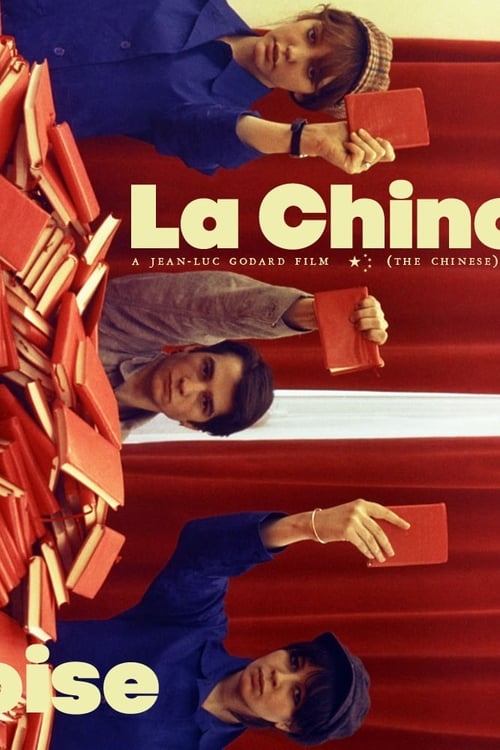
La Chinoise
1967 · Jean-Luc Godard
For when you're feeling intellectually restless and want cinema that provokes rather than soothes — a film to argue with, ideally with someone else in the room. Pure challenge; come caffeinated.
What it's about
In the summer before the upheavals of 1968, five Parisian students turn a borrowed bourgeois apartment into a Maoist cell — reading aloud from the Little Red Book, staging lectures for each other, painting slogans on the walls, and debating whether real change requires violence. What begins as theory hardens toward an actual plan, and the film watches its young revolutionaries with a gaze that is part affection, part alarm.
The experience
Playful, jagged, and argumentative — a film that talks at you, interrupts itself, and dares you to keep up. It's funnier than its subject suggests, in a deadpan, absurdist way, and it leaves you unsettled about how easily conviction slides into extremism.
Performances
Jean-Pierre Léaud brings his live-wire, boyish intensity to the cell's true believer, while Anne Wiazemsky's cool, unreadable calm makes her student the film's most quietly chilling figure.
The craft
Godard shoots the apartment in blazing primary reds, blues, and yellows, turning a political seminar into pop art, and constantly breaks the frame — interviews to camera, visible film equipment, slogans as intertitles. It's less a story filmed than an essay performed, and the design alone makes it endlessly screenshot-able.
Why it matters
Released months before May 1968, it looked eerily prophetic almost immediately, and it marks the hinge where Godard abandoned conventional narrative for openly political filmmaking — a turning point studied ever since.
Snapshot
La Chinoise arrives at the pivotal hinge of Jean-Luc Godard's career, standing between the formally exuberant but still narratively navigable films of his early nouvelle vague decade and the deliberately anti-cinematic, agit-prop work that would consume him after 1968. Released in France on 30 August 1967—less than nine months before the events of May 1968 that would upend French society—the film depicts a small Maoist cell of Parisian students sequestered in a borrowed bourgeois apartment for a summer, debating revolutionary theory, rehearsing slogans from Mao's Little Red Book, and eventually attempting a political assassination. Godard simultaneously inhabits and interrogates his subjects' ideology, producing a film that is neither propaganda nor satire but something more uncomfortable: a Brechtian audit of revolutionary desire that diagnosed the political mood of a generation with uncanny accuracy. Its reputation as prophecy and as formal provocation has only solidified in the decades since.
Industry & production
La Chinoise was produced under the banner of Anouchka Films, Godard's own production company (named after Anna Karina, his first wife, from whom he was separating around this period), in co-production with Les Productions de la Guéville, Athos Films, Parc Film, and Simar Films. The relatively modest budget and compressed shoot—the film was made quickly, with principal photography taking place in spring and early summer 1967—was characteristic of Godard's working practice throughout the 1960s. By this point Godard had established the core crew and collaborators that had enabled his extraordinary run of output since À bout de souffle (1960), and La Chinoise was assembled with that same infrastructure while signaling a decisive departure in political orientation.
The casting is pointedly non-spectacular. Anne Wiazemsky, then nineteen years old and a philosophy student at Nanterre—the university that would become the epicenter of May 1968—plays the cell's most theoretically certain member, Véronique. Wiazemsky was the granddaughter of writer François Mauriac and had appeared in Robert Bresson's Au hasard Balthazar (1966); she and Godard would marry later in 1967. Jean-Pierre Léaud, already defined by his role in Truffaut's Antoine Doinel cycle, plays Guillaume, a theater actor whose revolutionary commitment is filtered through performance. Juliet Berto, later an important figure in French cinema, plays the working-class member of the cell, Yvonne, whose presence raises questions the film cannot quite resolve about the class constituency of student radicalism. Michel Semeniako and Lex de Bruijn complete the cell.
The film received the Special Jury Prize at the Venice Film Festival in 1967, though its reception in the broader commercial marketplace was limited; Godard's films of this period were increasingly resistant to mainstream exhibition and audience comfort.
Technology
La Chinoise was shot on 35mm color film—Eastmancolor—using the crisp, vivid palette that Raoul Coutard had refined across his partnership with Godard. Godard embraced the period's portable camera technology, enabling the close-quarters, immediate shooting style the apartment setting demanded. Direct sound was recorded on set, consistent with the nouvelle vague's longstanding preference for location audio over studio dubbing, and this choice contributes to the documentary rawness of the film's interview segments and confrontational monologues. No technologically exceptional innovation distinguishes this film from its immediate predecessors in Godard's output; the radicalism is formal and rhetorical rather than mechanical.
Technique
Cinematography
Raoul Coutard's work here is as important for its conceptual choices as its optical execution. The apartment set is saturated with primary colors—reds and whites dominate, referencing simultaneously the French tricolor and the omnipresent red of Maoist iconography. Piles of Little Red Books serve as set dressing but also as chromatic architecture. Coutard shoots the space frontally and flatly, resisting depth-of-field naturalism in favor of compositions that read as tableaux: slogans scrawled on walls, figures posed against backgrounds of political imagery. The lighting is characteristically bright and even, stripping theatrical shadow from faces and flattening the image toward the graphic. This flatness is not imprecision but a politics of surface—images that announce themselves as images.
Editing
Agnès Guillemot, Godard's primary editor through much of the 1960s, cuts the film in a mode that refuses continuity grammar even when the footage seems to invite it. Scenes interrupt themselves; intertitles intrude; the rhythm alternates between long, testing stretches of dialogue and abrupt, jarring transitions. Godard had been moving toward an essay-film approach since at least Masculin Féminin (1966) and La Chinoise accelerates this: the editing functions less to construct story than to create argument, juxtaposing registers (fiction, documentary interview, lecture, theatrical performance) so that their incompatibility becomes the film's subject.
Mise-en-scène / staging
The apartment functions as a laboratory and a stage. Godard's staging is frequently theatrical in the Brechtian sense—characters address the camera directly, perform for unseen audiences, recite rather than speak, and periodically step outside their roles to comment on what they are doing. The cell rehearses its politics as much as it enacts them; the line between political action and political theater is a central anxiety of the film. A chalkboard figures prominently: slogans are written and erased, lists compiled, names crossed off. This chalkboard is a mise-en-scène argument about the relationship between the word and the world—between inscription and action—that runs throughout. Numbers, titles, and slogans appear as on-screen text, extending the graphic logic of the image into language.
Sound
The sound design draws on the film's central interest in media and transmission. Voices are sometimes recorded cleanly, sometimes overlapping or halting. Godard uses direct address as a sound strategy: characters speak into microphones held in frame, making the apparatus of communication visible. Music is used eclectically rather than continuously, drawn from a range of existing sources including classical and contemporary material rather than commissioned as a unified score. The precise breakdown of musical sources in La Chinoise is somewhat less documented than in some of Godard's other films of this era; what is clear is that the music functions as commentary and interruption rather than as emotional underlining.
Performance
The performances are calibrated toward alienation in the Brechtian sense. Wiazemsky, in particular, delivers Véronique's ideological certainty with a cool opacity that invites scrutiny rather than identification; her conviction reads as both sincere and symptomatic. Léaud, trained in a more naturalistic register by Truffaut's direction, here pushes toward the ironic—Guillaume's theatricality foregrounds the performative dimension of all political commitment. The most remarkable performance in the film belongs not to an actor but to the philosopher Francis Jeanson, who appears as himself in a long dialogue scene conducted on a train with Véronique. Jeanson was the real political philosopher who organized French support networks for the FLN during the Algerian War; his presence imports historical weight and genuine intellectual seriousness into a film populated by fictional students, creating an asymmetry that complicates any simple reading of Véronique's positions.
Narrative & dramatic mode
La Chinoise has a narrative spine but is not organized around conventional narrative drive. The spine: five students form a Maoist cell over the course of a summer; they debate, lecture each other, and theorize; one of them, Henri, is expelled for revisionism; Véronique and Guillaume's relationship fractures; and Véronique attempts the assassination of a Soviet cultural minister, killing the wrong person in the process, before returning to university as May 1968 approaches. But this sequence of events is delivered through a mode that is more essay than story: documentary interview, manifesto recitation, theatrical interlude, philosophical debate. The film is structured episodically and associatively, and Godard's own off-screen voice occasionally intervenes as an interrogator or interlocutor, making the author's presence within the text explicit. The dominant dramatic mode is exposure—of positions, contradictions, fantasies—rather than revelation or resolution.
Genre & cycle
The film occupies a contested generic space. It draws on the French tradition of the film-essai (essay film), a practice Godard had been developing since at least Vivre sa vie (1962), while incorporating elements of political documentary, theatrical satire, and romance. It belongs to a specific moment in European left cinema that also includes the work of Jean-Marie Straub and Danièle Huillet, Chris Marker, and the later Godard of the Dziga Vertov Group period. It is also identifiable as one of a cluster of 1960s films about youth radicalism and counterculture that includes, in different national contexts, works by Pasolini, Antonioni (Zabriskie Point, 1970, which came later), and Oshima. The comedy elements Godard identified in the film—and the film is often funny—derive from the gap between the students' revolutionary seriousness and the absurdity of their actual situation, a gap the film observes without condescension.
Authorship & method
Godard wrote, directed, and was the dominant creative intelligence on La Chinoise, as on virtually all his films. By 1967 his working method had evolved toward maximum authorial control and deliberate structural disruption: he wrote scripts loosely, improvised extensively during shooting, and made fundamental decisions about shape in editing. The collaboration with Raoul Coutard, which had defined the visual language of Godard's nouvelle vague work since À bout de souffle, reached its terminal phase here; after this film, Godard's movement into overtly political collective filmmaking effectively dissolved that partnership. Agnès Guillemot's editing work on this film, as on Masculin Féminin and Une femme mariée, was central to realizing the essay-film structure. Anne Wiazemsky's influence on the political trajectory of the film was personal as well as professional; her involvement with the Nanterre milieu was a direct channel into the intellectual culture the film documents.
Movement / national cinema
La Chinoise is simultaneously a document of French cinema at its peak of international cultural influence and a critique of the class formations that sustained that influence. The nouvelle vague of which Godard was the most radical member had by 1967 diverged significantly: Truffaut had moved toward more emotionally accessible work, while Godard was pushing toward formal and political territory increasingly hostile to the values of commercial art cinema. The film is embedded in a specifically French political conversation—between Gaullism, orthodox PCF (French Communist Party) communism, and the emergent ultra-left Maoism of groups like the Union des Jeunesses Communistes Marxistes-Léninistes—and requires this context to read its polemical positions accurately. The figure of Francis Jeanson locates the film within the longer history of French intellectual engagement with Third World liberation movements, particularly the Algerian War. French cinema's engagement with the Algerian War had been fraught and largely indirect throughout the early 1960s; La Chinoise's reference to Jeanson's networks is a way of naming that political history while pursuing a new one.
Era / period
1967 is a liminal moment in postwar Western culture: the same year as the Summer of Love, the Detroit riots, the Arab-Israeli Six-Day War, the escalation of the Vietnam War, and the publication of Debord's The Society of the Spectacle. La Chinoise was made in this context of intensifying international crisis and youth radicalization, and its characters are recognizably products of this moment: shaped by decolonization, by the Cuban Revolution, by the Cultural Revolution in China, and by the perceived bankruptcy of both bourgeois democracy and orthodox European communism. Godard was forty years old when he made it—older than his subjects by a generation—and the film's authorial distance from its characters' certainties reflects this age gap as much as any formal decision.
Themes
The film's central theme is the relationship between theory and practice: what it means, and what it costs, to translate political thought into political action. Véronique's willingness to commit violence—and her botched execution of it—is the film's pivot, raising the question of whether the gap between the cell's theoretical Maoism and actual revolutionary praxis is a gap that can be closed, or whether it reveals something structurally limited about the bourgeois intellectual's capacity for genuine political commitment. Secondary themes include: the role of media and image in political life (characters watch television footage, react to news, think in slogans); the relationship between art and politics (Guillaume's theater work); the class composition of radical movements (Yvonne's uneasy position); and the seductiveness of ideological certainty. The film is also, without being programmatic about it, about love—about the way political commitment inflects and deforms intimate relationships.
Reception, canon & influence
Influences on the film. Bertolt Brecht's theory and practice of epic theater is the dominant formal inheritance—direct address, didacticism, the deliberate disruption of illusionist identification. Godard had been engaging with Brecht since at least Vivre sa vie; La Chinoise is the fullest expression of that engagement. The Soviet montage tradition, particularly Dziga Vertov's kino-pravda (ciné-vérité) and his theory of the film interval, is a structural antecedent; Godard would shortly name his political collective the Dziga Vertov Group. Louis Althusser's structural Marxism, then dominant at the École Normale Supérieure, informs the film's theoretical idiom. The work of Jean-Marie Straub and Danièle Huillet—austere, anti-illusionist, politically committed—was a contemporaneous reference point. Mao Zedong's Talks at the Yan'an Forum on Literature and Art (1942), with their demand that art serve revolutionary politics, are directly cited and interrogated.
Critical reception. Initial French response was divided between those who took the Maoism seriously and those who read it as Godardian irony. After May 1968, the film's predictive dimension overwhelmed much critical discussion; it was widely cited as having foreseen the student uprising. Anglophone criticism, led by writers at Cahiers du Cinéma's English-language interlocutors and by scholars such as Richard Roud, engaged seriously with its formal innovations. Later reassessment has tended to read the film's relationship to its own politics as more ambivalent than early polemical readings allowed—the film as critique of Maoist voluntarism as much as endorsement of it. The train dialogue with Jeanson is now widely regarded as one of the great sequences in Godard's work.
Legacy. La Chinoise's forward influence operates on several tracks. Formally, it is foundational to the essay-film tradition that would extend through Godard's own Dziga Vertov Group period (Vent d'est, 1970; Tout va bien, 1972) and ramify in the work of subsequent political filmmakers globally. Its interest in media self-reflexivity and the politics of the image anticipates the concerns of 1970s Screen theory and much subsequent video art. As a document of a political mood, it remains a primary source for understanding the culture that produced May 1968—it was made, as Godard later noted, before the revolution but not before the revolutionary conditions. Its influence is detectable in politically committed filmmaking from Nagisa Oshima to Olivier Assayas; Assayas's Carlos (2010) and Something in the Air (2012) are in direct dialogue with the period and milieu La Chinoise inhabits. The film also belongs to the ongoing history of cinema's engagement with questions of political violence, a history that includes works as varied as The Battle of Algiers (1966) and Carlos. Its central question—whether the gap between theory and practice in bourgeois radical politics is bridgeable—has not been resolved, which is one reason the film does not date.
A Deleuzian reading
A wall painted flat red.
The full Deleuzian reading of La Chinoise →
Reception
In 1967 it baffled almost everyone — even actual French Maoist students dismissed it as a dilettante's cartoon of their politics — but when May '68 erupted months later, it suddenly looked prophetic, and it's now ranked among Godard's essential works.
How La Chinoise was received, from release to now →
Influences: the films it descends from and the films it influenced
- Kuhle Wampe (1932) — The only film scripted by Brecht himself establishes the three devices La Chinoise inherits wholesale: chapter-break intertitles that interrupt rather than organize, agitprop song that comments rather than expresses emotion, and characters who represent class positions rather than psychological subjects.
- Chronique d'un été (1961) — Rouch and Morin's walk-up-to-camera street interviews and studio confessions—subjects addressing the lens as confessor and interlocutor simultaneously—give La Chinoise its foundational device of the fictional cell member speaking directly to camera under the grammar of documentary testimony.
- Vivre sa vie (1962) — Godard's first systematic use of Brechtian chapter intertitles (twelve 'tableaux') dividing the film into self-interrupting units, combined with Karina's Falconetti-quoting frontal address to the lens, establishes the formal template—episodic structure plus testimonial close-up—that La Chinoise inherits and politicizes.
- Bande à part (1964) — Godard first deploys his own voice-over interrupting the diegesis mid-scene—narrating the Madison dance over his characters, addressing the audience directly above their heads—originating the authorial-voice-intervention device that La Chinoise radicalizes into systematic Brechtian political commentary.
- Nicht versöhnt (1965) — Straub demonstrates frontal flat staging—actors positioned head-on to the camera in non-psychological stasis, refusing eyeline-match conventions—as viable contemporary Brechtian cinema grammar, directly influencing Godard's decision to stage La Chinoise's apartment as a sequence of theatrical tableaux rather than naturalistic space.
- Pierrot le Fou (1965) — Coutard's first extended use of saturated primary color as compositional argument—the Mediterranean sequence's reds, blues, and yellows read as flat graphic fields, not naturalistic environment—establishes the chromatic politics-of-surface that La Chinoise inherits and intensifies in its Maoist red apartment as color-ideology made literal.
- Au hasard Balthazar (1966) — Godard casts Wiazemsky directly from Bresson's shoot to import his performance pedagogy—stillness, the actor as vessel rather than expressive psyche—then deploys that Bressonian withholding within a Brechtian frame, producing Véronique's affectively impenetrable revolutionary certainty as the meeting point of two opposed anti-naturalist methods.
- Masculin Féminin (1966) — Godard and Coutard develop here the exact interview-booth cinematography La Chinoise inherits: flat front-lit frame, subject addressing the lens directly, numbered-episode intertitle structure, and a sociological portrait-of-politicized-youth mode—making this film the direct formal template transferred wholesale into the later work.
- Week End (1967) — Made in the same year, deploying the same Brechtian chapter intertitles ('a film found in a scrap heap'), the same episodic-associative narrative refusing psychological continuity, and the same satirical political mode—extending La Chinoise's critique of bourgeois revolutionary fantasy to the French bourgeoisie's literal self-annihilation.
- Sympathy for the Devil (1968) — Godard applies La Chinoise's interrupted-essay structure directly to the Rolling Stones in studio: Brechtian intertitles (red graffiti slogans) cut across the observational footage, refusing both documentary and fictional registers their naturalism—the same structural method now applied to rock music as political text rather than Maoist student politics.
- Le Gai Savoir (1969) — With Léaud and Berto (both from La Chinoise) on a black background deconstructing sound and image, Godard strips La Chinoise's chalkboard-pedagogy apparatus of all remaining narrative—the pedagogical device La Chinoise foregrounded while sustaining story becomes here the film's entire and exclusive content.
- Tout va bien (1972) — Godard and Gorin architecturalize La Chinoise's Brechtian spatial politics into a factory set cut horizontally like a doll's house—each room visible simultaneously, workers and boss facing the camera from their spatial cells—making La Chinoise's theatrical direct-address staging the explicit load-bearing argument of an entire production design.
- Letter to Jane (1972) — Godard and Gorin freeze a single photograph of Fonda in North Vietnam and annotate it with intertitle arrows and voice-over commentary for 52 minutes—directly extending La Chinoise's chalkboard-inscription device of writing over images as political pedagogy into a complete methodology for treating any still image as ideology made legible.
- Carlos (2010) — The New Wave handheld portrait of a Maoist student cell that founds the post-New-Wave militant-cinema tradition Assayas, an ex-Cahiers critic, writes from.
- Born in Flames (1983) — Turns a radical cell into Brechtian agitprop through direct-address debate, slogans and collage, the discursive talking-politics-to-camera mode Borden's factions inherit.
- Happyend (2024) — Models political awakening as something rehearsed among a small cell of friends debating theory in a single room, the intimate-radicalization staging Happyend borrows for its student collective.
- The French Dispatch of the Liberty, Kansas Evening Sun (2021) — The Maoist student cell in primary-color rooms with slogan intertitles is directly quoted by the May-'68 'Revisions to a Manifesto' chapter's chessboard-revolt iconography.
- Throw Away Your Books, Rally in the Streets (1971) — Supplies the Brechtian recitation-to-camera and saturated primary-color political modernism that Terayama adapts into declamatory direct address and non-naturalistic tinting about thwarted student revolt.
- The Working Class Goes to Heaven (1971) — Pioneers the didactic film-as-Marxist-argument built from slogans and caricatured student ultra-leftists — the confrontational political-fable mode Petri adopts and turns against both union and vanguard.
- Cecil B. Demented (2000) — Supplies the cell structure Waters literalizes — a small ideological commune drilling slogans in a shared flat, blocked frontally against slogan-covered walls, each member taking a turn delivering a position-statement to camera; Cecil's roll-call of gang members reciting their patron directors is that same recitation device.
- 2 ou 3 choses que je sais d'elle (1967) — Shot by the identical team (Coutard, Guillemot) in the same weeks as La Chinoise, sharing Godard's whispered first-person voice-over intruding over frozen actor close-ups, the same Eastmancolor primary-color grid compositions, and the same essay-film structure—a direct twin work whose relationship to La Chinoise is replication, not influence.
- Loin du Vietnam (1967) — Godard's segment makes the camera and editing table itself the political subject—filming himself unable to film Vietnam, making the production apparatus visible as argument about the limits of Western political representation—the same self-reflexive visible apparatus La Chinoise deploys structurally within its fiction.
- Chronik der Anna Magdalena Bach (1968) — Straub-Huillet's frontal staging of Bach harpsichord performance—musicians filmed head-on in non-naturalistic stasis, musical labor exposed rather than aestheticized—develops the same Brechtian anti-illusionist blocking in parallel with La Chinoise, both films making theatrical apparatus visible as the political substance of the image.
- Memories of Underdevelopment (1968) — Sibling in Brechtian distanciation: direct-address and lecture/round-table staging that interrupt identification, mirrored in Alea's literary-panel sequence where author Desnoes folds into the fiction.
- L'Amour fou (1969) — The same problem solved a year earlier — a company of young people working a text inside a single apartment, shot in direct sound with recitations left at full length and the production apparatus (clapperboard, offscreen interviewer) admitted into the frame.
Similar films
- Masculin Féminin (1966) — influence & lineage
- Weekend (1967) — influence & lineage
- Vivre Sa Vie (1962) — influence & lineage
- Pierrot le Fou (1965) — influence & lineage
- Band of Outsiders (1964) — influence & lineage
- Breathless (1960) — shared sensibility
- Nouvelle Vague (2025) — shared sensibility
- The Battle of Algiers (1966) — shared sensibility
All the films related to La Chinoise →