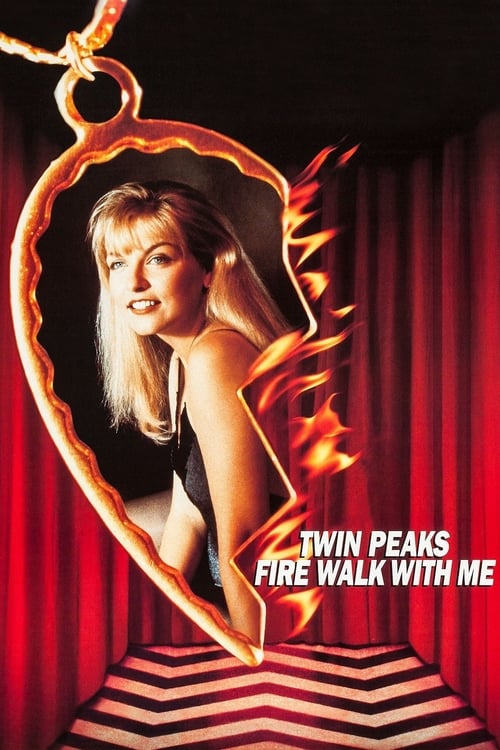
Twin Peaks: Fire Walk with Me
1992 · David Lynch
For when you want to be truly disturbed — not jump-scared, but pulled somewhere dark and strange — and you're ready for a heavy, cathartic experience rather than comfort. Not the mood for a casual night; the mood for staring into the abyss with the lights off.
What it's about
A prequel that begins as an FBI investigation into a murdered girl in a grim Washington town, then hands the film over to Laura Palmer herself: the homecoming queen of Twin Peaks, living a double life of glamour, drugs, and escalating terror in her final days. Where the TV series treated her as a mystery to be solved, this is her story from the inside — a teenage girl trying to outrun something monstrous in her own house.
The experience
Genuinely frightening and emotionally raw in a way little else is — flickering lights, roaring sound, dream logic that keeps tipping into nightmare, all anchored by real grief. It's Lynch at his most direct and most devastating; you come out shaken.
Performances
Sheryl Lee is ferocious and heartbreaking as Laura, swinging between radiance, cruelty, and terror within single scenes — a performance that took decades to get the recognition it deserved.
The craft
Lynch strips away the show's cozy whimsy and builds dread from craft alone: strobing light, sound design that roars and whispers, and Angelo Badalamenti's smokiest, saddest score. This one demands good speakers and a dark room — the sound is half the horror.
Why it matters
Booed at Cannes and dismissed as a cash-in in 1992, it's now widely ranked among Lynch's supreme achievements — one of cinema's great critical reversals, and the emotional foundation the series' later revival built on.
Booed at Cannes in 1992, dismissed as a franchise cash-in when it was the opposite — David Lynch, freed from network television's restraints, returning to Twin Peaks to honor the murdered girl the show had treated as a premise. The prequel gives Laura Palmer, in Sheryl Lee's ferocious and heartbreaking performance, the interiority the series' mystery structure denied her: her last days rendered not as puzzle pieces but as lived terror, glamour, and grace. Lynch strips away the show's cherry-pie whimsy almost entirely; what remains is his most emotionally direct film, a portrait of abuse and dissociation told through flickering lights, roaring soundscapes, and Angelo Badalamenti's smokiest score. The reappraisal took decades and is now total — critics who buried it rank it among Lynch's supreme achievements, and The Return (2017) is unimaginable without it. Lee, hired originally just to play a corpse wrapped in plastic, delivers one of the great screen performances of the nineties, much of it registered in her eyes alone.
A Deleuzian reading
A lamp starts to stutter.
The full Deleuzian reading of Twin Peaks: Fire Walk with Me →
Reception
Booed at Cannes in 1992 and savaged by critics — Tarantino quipped that Lynch had disappeared up his own ass — it's since been reappraised as one of Lynch's greatest films, a rehabilitation cemented when The Return (2017) treated it as the saga's emotional core.
How Twin Peaks: Fire Walk with Me was received, from release to now →
Influences: the films it descends from and the films it influenced
- Eraserhead (1977) — Lynch and Alan Splet's roaring low-frequency industrial sound design — the enveloping room-tone drone as dread — is the sonic technique FWWM weaponizes in the Red Room and the terror scenes.
- Blue Velvet (1986) — Established the Lynch–Badalamenti scoring partnership and the method of plunging the camera to a victim's eye level as the placid small-town surface peels back to reveal predatory evil.
- Persona (1966) — The extreme facial close-up that registers a woman's psychic fracture, and identities bleeding between two women, feeds Sheryl Lee's face-held-to-breaking and the Laura/Donna/Teresa doubling.
- Repulsion (1965) — Horror staged entirely inside a traumatized woman's disintegrating perception — hallucinated intrusions treated as literal — is the subjective-interiority grammar FWWM adopts for Laura.
- Meshes of the Afternoon (1943) — Dream-logic looping edits and recurring charged objects (the key, the ring) as a map of a woman's interior life prefigure FWWM's ring, the picture-frame doorway, and non-linear subjectivity.
- Carnival of Souls (1962) — Flickering-light, drone-organ dread of a woman suspended between the living and the dead is the cheap-sublime template behind FWWM's stuttering lamps and liminal terror.
- Vertigo (1958) — The doubled blonde constructed as a fetishized, mournful image — a dead girl who becomes an icon of male obsession — is the gaze-structure Lynch inverts by giving Laura back her interiority.
- Cries and Whispers (1972) — The trauma-and-grace theme rendered through saturated red interiors and unbearable close-up suffering anticipates FWWM's Red Room and its ending's redemptive weeping angel.
- Mulholland Drive (2001) — Carries forward the subjective-interiority structure — a woman's guilt and desire dreamed into a fractured narrative — with Badalamenti's mournful score doing the same emotional work as Laura's Theme.
- Inland Empire (2006) — Pushes FWWM's 'woman in trouble' subjective disintegration to a digital-video extreme, dissolving a performer's identity across nested realities and roaring sound.
- Twin Peaks: The Return (2017) — The sequel FWWM's critical reappraisal literally enabled; Part 8 extends the film's roaring, flickering nuclear abstraction into a full origin-of-evil poem.
- Under the Skin (2013) — Builds horror from enveloping sound design (Mica Levi's score) and a woman's alien, wordless subjectivity — the same roaring-soundscape-plus-interior-POV method FWWM pioneered.
- Hereditary (2018) — Metabolizes family trauma as horror carried almost entirely in a woman's face — Toni Collette's grief 'registered in the eyes' descends directly from Sheryl Lee's raw, undefended performance.
- I Saw the TV Glow (2024) — The clearest heir: dissociation and abuse metabolized through a haunted TV franchise, with Lynchian flickering CRT light and a Badalamenti-lineage dream-pop score scoring the interior fracture.
- Beau Is Afraid (2023) — Constructs its entire architecture from a traumatized subject's dream-logic interiority — nested guilt-spaces and literalized psychic terror — inheriting Lynch's subjective-narrative grammar.
- Weapons (2025) — The missing girl as epistemological center around which a community's concealed violence is organized; survivor-epistemology as formal device in which past violence becomes legible only through fragmentary, unreliable testimony — the procedural framing of community horror Cregger's facets explicitly acknowledge.
- Lost Highway (1997) — Directly extends FWWM's roaring industrial soundscapes and identity-dissolution editing, with Badalamenti's dread scoring pushed toward outright psychogenic fugue.
- Antichrist (2009) — Renders trauma, dissociation, and a desperate reach for grace through visceral sound design and a grieving woman's collapse — Lynch's abuse-and-interiority craft turned to punishing extremity.
- Black Swan (2010) — Female psychological horror built on doubling and subjective collapse, where the protagonist's disintegration is filmed as literal transformation — the same interior-POV horror device FWWM uses for Laura.
- Wild at Heart (1990) — Made at the same Twin Peaks-era peak with the identical Elmes/Badalamenti/Dunham toolkit — saturated reds, percussive violence, and dread-as-mood over explanation.
Similar films
- Blue Velvet (1986) — influence & lineage · same viewing thread
- Lost Highway (1997) — influence & lineage · same viewing thread
- Mulholland Drive (2001) — influence & lineage
- Inland Empire (2006) — influence & lineage
- Eraserhead (1977) — influence & lineage
- Persona (1966) — influence & lineage · often watched together
- Black Swan (2010) — influence & lineage · often watched together
- Bones and All (2022) — often watched together
All the films related to Twin Peaks: Fire Walk with Me →
Watch it with: curated runs of related films
- The Killer You Can't Look Away From — A run of murder mysteries where obsession — the witness's, the investigator's, the killer's own — curdles into pure style, from the gloved-hand giallo that invented the look to the modern heirs still working the vein.