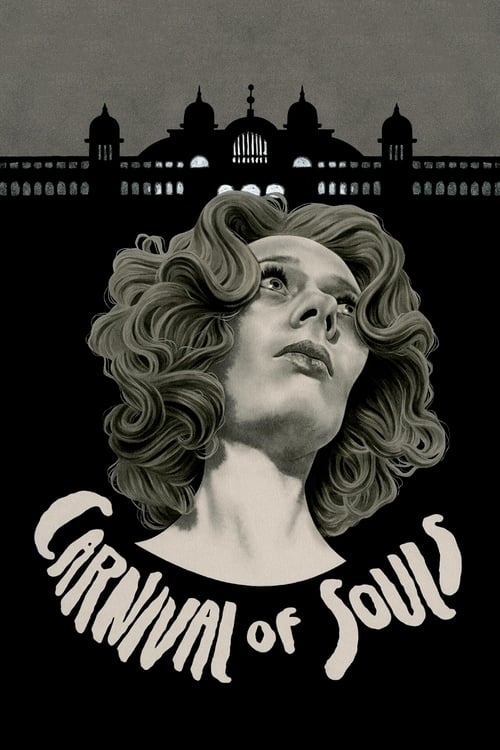
Carnival of Souls
1962 · Herk Harvey
When you're craving a real chill, not a jump-scare machine — perfect late at night, alone, lights off. Unsettling in a way that feels closer to a ghost story told quietly than a horror ride.
What it's about
A young woman is the only survivor when a car goes off a bridge into a river. Shaken, she moves to Utah to start over as a church organist — but a pale, grinning man keeps appearing where no one should be, the world around her keeps going strangely quiet, and an abandoned lakeside carnival pavilion begins pulling at her like a tide.
The experience
Eerie rather than gory — a low-budget dream that gets under your skin through silence, empty spaces, and that reedy organ score. It has the logic of a nightmare you can't wake from, and it lingers for days.
Performances
Candace Hilligoss, in nearly every frame, gives Mary a chilly detachment that is the film's secret weapon — you're never sure if she's haunted or already somewhere the living can't follow.
The craft
Made by industrial-film professionals from Lawrence, Kansas on almost no money, it turns poverty into atmosphere: stark black-and-white photography, an all-organ score, and the genuinely uncanny location of a derelict lakeside pavilion. Its rough edges are part of the spell.
Why it matters
A drive-in B-picture that fell into the public domain, haunted late-night TV for decades, and was rediscovered as an art film — its dread-over-shock approach echoing through generations of psychological horror.
Snapshot
A woman climbs out of a river's mudflats after a car goes off a bridge, and for the next eighty minutes she cannot quite rejoin the living. Carnival of Souls is the only feature directed by Harold "Herk" Harvey, a maker of industrial and educational films in Lawrence, Kansas, and it remains one of the most improbable objects in American cinema: a metaphysical horror film assembled by regional short-subject professionals on a budget that would not have covered a week of studio catering, released into drive-ins as a supporting attraction, abandoned by its distributor, allowed to lapse into the public domain, circulated for two decades on late-night television and in bargain-bin tape collections, and finally recuperated as an art film — restored, reissued theatrically in 1989, and admitted to the Criterion Collection.
Its power is inseparable from its poverty. With no money for effects, Harvey had only real places, real light, a borrowed organ, and the faces of colleagues; what he produced from them is a study of dissociation so exact that the film reads less as a ghost story than as a clinical account of a consciousness refusing its own death. Mary Henry (Candace Hilligoss) drifts through Salt Lake City as an organist who says outright that music means nothing to her, resists every man who tries to install her in a social role, periodically drops out of the audible world altogether, and is drawn toward the derelict Saltair pavilion on the Great Salt Lake, where the dead dance. The ending, which reveals that she never left the river, is the film's least interesting idea and its most quoted; what endures is the texture of the seventy-odd minutes before it.
Industry & production
The production company was Centron Corporation, a Lawrence, Kansas firm that made sponsored films — safety reels, classroom shorts, corporate promotionals — for a national non-theatrical market. Centron was a genuine industrial operation with staff cameramen, editors, and writers, and Carnival of Souls was made by that staff, largely on vacation time and weekends, using company-adjacent equipment and expertise. Harvey was a Centron director; screenwriter John Clifford and cinematographer Maurice Prather were colleagues. This is the film's defining industrial fact: it was not made by amateurs but by working professionals whose professional idiom was the informational short, applied for once to a fiction with no informational purpose.
By Harvey's own later account — most of the surviving production testimony comes from interviews given decades afterward, around the 1989 revival, so the documentary record of 1962 is genuinely thin — the premise came from seeing the shuttered Saltair pavilion on the shore of the Great Salt Lake while driving back from a shoot on the West Coast: an image of an abandoned amusement resort in search of a story. Clifford wrote the screenplay to that image. Financing came from local investors and deferred participation rather than any studio or established independent; budget figures cited in the literature vary widely, commonly in the range of roughly $17,000 to $33,000, and no authoritative accounting appears to survive. Shooting occupied roughly two to three weeks, split between Lawrence and the Salt Lake area.
Distribution was the disaster. The film went out through a small outfit, Herts-Lion International, as the bottom half of a double bill — reportedly paired with the anthology cheapie The Devil's Messenger (1961) — and the distributor's collapse meant Harvey and his collaborators saw essentially nothing. Compounding this, the copyright was never properly secured or renewed, and the film fell into the public domain. That failure became, perversely, the mechanism of its survival: with no rights-holder to restrict it, Carnival of Souls saturated late-night television and, later, every multi-film budget videotape and DVD set on the market, acquiring an audience of accidental initiates far larger than any 1962 booking pattern could have delivered.
Technology
Everything about the film's technical profile follows from the sponsored-film world it emerged from: 35mm black-and-white stock, portable lighting, and location shooting in available light — the working method of the industrial documentary rather than the studio picture. The visual grain, the reliance on real interiors, and the flat midday exteriors are the signature of that toolkit.
Two technological choices matter most. First, the film was shot without usable synchronous dialogue and post-dubbed; voices were laid in afterward. In a studio film that would register as a defect, and in some scenes here it does — but the result is a persistent slight detachment of speech from body, a hollow acoustic sameness across wildly different spaces, which aligns uncannily with a protagonist who is not fully present in the world she is speaking into. Second, the score was performed on a pipe organ and recorded, per the standard account, at the Reuter Organ Company's factory in Lawrence — the same organ-building industry that supplies the film's remarkable sequence of Mary testing instruments in a factory showroom. The film's most distinctive sonic asset was, in effect, a local industrial resource within walking distance of the production office.
Technique
Cinematography
Maurice Prather's photography is the film's great surprise: unfussy, high-contrast, and often documentary-plain, then abruptly monumental. The daylight exteriors at Saltair are shot wide and deep, the pavilion's arcades and the salt flats rendered as vacant geometry with the human figure lost inside it; the lake's blank horizon functions as a natural void, requiring no set. The opening bridge-and-river material has the flatly observational quality of newsreel — men dredging, onlookers on a bank — which makes the emergence of the mud-caked survivor feel like footage of an event rather than a staged shock.
The apparitions are lit rather than fabricated. "The Man" (played by Harvey himself, again for reasons of economy) is white-faced, hollow-eyed, frequently keyed from below or caught in reflection: in a car window at night, in a mirror, in a shop pane. The technique is elementary — makeup, hard light, a reflective surface — and it works because Prather keeps the surrounding image so ordinary. The film's scariest compositions are ones in which nothing has been done to the frame except the insertion of a face where a face should not be.
Editing
Credited to Dan Palmquist and Bill de Jarnette, the cutting is where the film's psychology lives. Mary's dissociative episodes are not eased into with dissolves or ripples; they arrive by hard cut and by subtraction. The celebrated department-store sequence simply removes the world's sound and the world's acknowledgment of her — clerks do not hear her, traffic makes no noise — and holds her in that vacuum until, in a park, birdsong returns and the audio track floods back. The horror is produced by an editorial omission rather than an added effect.
Structurally the film is a closed loop: submersion, unexplained emergence, escalating intrusion, magnetic return to the pavilion, and the dredging of the car with the body inside. Within that loop the pacing is deliberately uneven — long passive stretches of Mary being counseled, courted, or driving, punctured by intrusions — which produces the sensation of a life running down rather than a plot building. The Saltair dance, with the dead waltzing in pairs across the derelict ballroom, is the one sequence permitted extended lyrical development, and it earns its length.
Mise-en-scène / staging
There are essentially no sets. The boarding house, the church, the doctor's office, the organ factory, and above all Saltair are found spaces, and the pavilion's decay is authentic: the resort had already been shuttered and left to the elements when Harvey filmed it, and the structure burned at the start of the following decade. The film thus documents a real American ruin — a mass-leisure architecture emptied out — and stages the afterlife inside it, so that its central metaphor arrives pre-built.
Costuming and staging keep Mary visually severed from her surroundings: plain skirts, buttoned coats, a self-contained posture, repeatedly framed alone within group spaces. The ghouls, by contrast, are staged frontally and en masse, in dark clothing with chalked faces, advancing in the open. Harvey's blocking of the living is sometimes stiff and stagey, an inheritance of the classroom-film idiom; the film absorbs that stiffness because the world Mary moves through should feel like a demonstration film about human behavior rather than human behavior itself.
Sound
Gene Moore's score is nearly wall-to-wall solo organ, and it is the boldest formal decision in the film. Because Mary is an organist, the instrument is simultaneously her profession, her possible diegetic source, and the film's non-diegetic commentary; the music therefore never settles into a stable ontological position — we cannot always say whether we are hearing the soundtrack or hearing what Mary is playing or hearing what is playing her. Moore moves between churchly cadence, carnival calliope inflection, and dissonant clusters, so that sacred, amusement-park, and nightmare registers become one timbre. Against this saturation, the sudden total silences of the dissociation scenes land like physical blows, and the wind and lake ambience at Saltair supplies the only relief from the keyboard.
Performance
Candace Hilligoss, a New York–trained actress whose subsequent screen career was slight, gives a performance of deliberate opacity: wide-eyed, watchful, affectless in a way that reads as neither incompetence nor naturalism but as absence. Her refusals — of the minister's fellowship, the doctor's diagnosis, the boarder's advances — are delivered without heat, and her flatness is the film's thesis made flesh. Sidney Berger, as the leering neighbor John Linden, plays in a wholly different key: broad, sweaty, comically grotesque, an intrusion of vulgar life that the film treats as no less alienating than the ghouls. The supporting players, several of them local and non-professional, are frequently wooden; the film's estranged register converts that woodenness into an asset, as if everyone around Mary were an approximation of a person.
Narrative & dramatic mode
The film's dramatic mode is not suspense but attrition. There is no investigation, no ally, no mechanism to defeat; the ghoul cannot be fought, and the two men who might help — a minister who fires her for playing "profane" music and a physician who talks past her — are agents of social incorporation rather than rescue. Dramatic questions of the ordinary kind are withheld: we are never told why Mary survived, why the dead want her, or what the pavilion is, and the film's refusal to explain is a structural commitment rather than an oversight.
Its narrative shape belongs to a specific lineage: the retrospectively revealed death, whose canonical English-language source is Ambrose Bierce's "An Occurrence at Owl Creek Bridge" — a story that, in Robert Enrico's short-film adaptation, was circulating internationally at almost exactly the same moment. What distinguishes Carnival of Souls is that the twist is nearly irrelevant to the experience. The film is not a puzzle with a solution but an eighty-minute enactment of a state; knowing the ending in advance, as most viewers of its public-domain afterlife did, changes nothing.
Genre & cycle
In 1962, American horror was largely defined by AIP's Poe cycle — Corman's color-drenched literary gothic — with the psychological thriller ascendant in the mainstream and a coming wave of regional exploitation about to break toward explicit gore. Carnival of Souls belongs to none of these. Its nearest relatives are the Val Lewton productions of the 1940s, with their commitment to suggestion, off-screen menace, and unstable heroine subjectivity, and the contemporaneous American television anthology, above all The Twilight Zone, whose episodes about drivers, doubles, and the unwitting dead share Harvey's premise and moral tone. It arrives as a folk-art cousin to European art cinema too: reviewers and Harvey himself have reached for Dreyer's Vampyr, Cocteau, and Bergman as reference points, and the comparison holds less as demonstrated lineage than as a description of ambition — atmosphere, metaphysics, and dread in place of monster, weapon, and body count.
Retrospectively, the film has been absorbed into two cycles it predates: the American independent horror feature made outside any studio structure, and the "art horror" or slow-burn tradition in which unease is generated by duration, sound, and landscape rather than by attack.
Authorship & method
Herk Harvey directed one feature and hundreds of sponsored shorts, and the authorship question here is genuinely a group one. Clifford's screenplay supplies the structural conceit and the acid comedy of the minister and the boarder; Prather's camera supplies the documentary substrate that makes the supernatural material land; Moore's organ supplies the film's single most identifying element; Palmquist and de Jarnette's cutting supplies the dissociation. Harvey's contribution was the founding image, the decision to make the thing at all, the coordination of colleagues on non-existent money, and — literally — his own body as the ghoul, an authorial signature in the most direct possible sense.
The method is worth naming as a model: a regional non-fiction infrastructure temporarily redirected to fiction. The industrial film taught these people to shoot fast in real places with small crews and to make images legible without spectacle. Applied to metaphysical horror, those constraints yielded a style. The Criterion editions, which gathered a selection of Centron's sponsored shorts alongside the feature, made the continuity visible: the same eye that framed a factory hazard framed the salt flats.
Movement / national cinema
The film is a landmark of American regional filmmaking — cinema produced by and about a place outside the Los Angeles–New York axis, using local labor, local locations, and local capital. Its Kansas and Utah settings are not stand-ins for anywhere; the Great Salt Lake and the flat river bottoms of eastern Kansas are the film's actual subject matter as much as Mary is. In this it prefigures a durable American pattern: a single obsessive feature made from whatever a region's non-film industries could supply, a lineage that runs through Pittsburgh, Austin, and the margins of the film schools in the following two decades.
Era / period
1962 sits at the hinge of the American industry's reorganization: the studio system in terminal decline, television absorbing the B-picture's function, drive-ins and double bills sustaining a low-end theatrical economy that would take almost anything, and the Production Code losing its grip. Carnival of Souls is a product of that permissiveness at the bottom of the market — no studio would have made it, and no studio needed to.
Culturally the film registers a specific postwar American exhaustion. Mary is an unmarried professional woman moving to a new city for a job, framed by everyone around her as a problem requiring pastoral, medical, or marital correction. The pavilion she is drawn to is the corpse of mass amusement, an emblem of the leisure culture that had promised communal pleasure and is now salt-stained and empty. Read this way, the film's purgatory is less theological than sociological: a society whose institutions — church, clinic, boarding house, dance hall — have become mere forms, going through motions for an occupant who is already gone.
Themes
Denial of death. The film's controlling idea is that the psyche will construct an entire functioning world rather than accept its own extinction. Mary's Salt Lake City is a workable, banal, fully furnished place; it simply keeps failing at the seams.
Dissociation as horror. The film locates terror not in being pursued but in the loss of intersubjectivity — not being heard, not being seen, having one's speech fail to register. That is a rarity in the genre and the source of the film's continuing modernity.
Refusal of the social role. Mary declines faith, therapy, and courtship in turn, and the film neither punishes nor redeems her for it. The men who offer help are consistently self-serving, and their combined pressure is depicted as no more hospitable than the pavilion. Whether this constitutes a critique of midcentury gender expectation by design or by accident is undecidable from the record, but the text sustains the reading.
The desanctified sacred. Mary plays sacred music professionally while stating that it holds nothing for her; the organ, the film's spiritual instrument, is manufactured in a factory and dismissed by its player as a job. When she finally plays with real feeling, what emerges is profane and gets her fired. The sacred and the carnivalesque share one keyboard.
Ruin and vacancy. Emptiness — the lake, the flats, the arcades, the silent department store — is the film's principal expressive resource, standing in for the metaphysical void it has no budget to depict.
Reception, canon & influence
Contemporary reception barely exists. Booked as a supporting feature into regional houses and drive-ins by a distributor that failed, the film received little trade or critical notice at the time, and its makers returned to sponsored filmmaking. There were no awards, no significant first-run press, and no career consequences for anyone involved.
Its reputation was built entirely in the afterlife. Television syndication and, later, unrestricted public-domain video circulation turned it into a widely seen unclaimed object — the kind of film that ambushes viewers at two in the morning with no framing apparatus at all — and by the 1980s it had entered the cult canon codified in the era's survey books and repertory programming. A restoration and 1989 theatrical reissue brought Harvey and surviving collaborators back into public view, occasioning the interviews that constitute most of what we know about the production and generating a documentary record of the reunion itself. Criterion's laserdisc and subsequent disc editions completed the reversal: a film so worthless in 1962 that no one bothered to renew its copyright became, within three decades, an item of curatorial prestige, discussed in the same catalog as Dreyer and Bergman. A 1998 studio remake released under Wes Craven's name is chiefly of interest as evidence that the original's brand had acquired value.
Backward, the film's debts are legible if largely unevidenced by documents: Bierce's already-dead conceit; Lewton's suggestion-based horror; the anthology television of Serling's era; and the European art cinema Harvey invoked in retrospect, Dreyer's Vampyr above all, for its somnambulant treatment of a consciousness adrift between states.
Forward, its influence is real but should be stated carefully. The clearest line runs to George A. Romero, who acknowledged Carnival of Souls among the films that shaped Night of the Living Dead (1968) — the silent, advancing, ordinary-clothed dead of Romero's film share the register of Harvey's ghouls, as does the pairing of documentary flatness with apocalyptic content, and both films demonstrated that a horror feature of lasting significance could be made outside the industry by a crew from the industrial-film trade. Beyond that, the film functions in criticism as a permanent point of comparison: it is routinely invoked as an antecedent for David Lynch's suburban dread and for the later art-horror mode of atmospheric, sound-driven, explanation-averse films, and as the touchstone for any story in which a protagonist discovers the world has been a posthumous fiction — a device that reached mass audiences in the 1990s and 2000s and is now unthinkable without its low-budget Kansas precursor. Some of those lines of descent are documented; others are affinities that critics have found useful. The distinction matters, and the film survives either way, because its best passages — a woman speaking in a store where no one can hear her, the dead waltzing in a burned-out pavilion by a dead lake — need no genealogy to work.
A Deleuzian reading
She is at a counter in a department store, and the clerk does not hear her.
The full Deleuzian reading of Carnival of Souls →
Reception
Barely released in 1962 as a drive-in double-bill filler, it vanished, slipped into the public domain, and haunted late-night TV for decades before a 1989 theatrical revival and a Criterion edition turned it into a certified classic of American independent horror.
How Carnival of Souls was received, from release to now →
How to watch Carnival of Souls: what to notice on a first viewing
- Listen for the world's sound suddenly disappear around her. In the department store scene, clerks stop hearing her and traffic goes silent, until birdsong returns the sound all at once in a park. You are left listening the way she is, with a world that has simply stopped acknowledging her.
- Watch for the pale man's face appearing in glass or mirrors. He is lit from below and caught in reflections, a car window at night, a mirror, a shop pane, never announced by music or a cut. Nothing about the frame changes except that a face is where a face should not be.
- Watch the empty flats and pavilion arcades stretch out around her. Prather shoots the salt flats and Saltair's arcades wide and deep, a blank horizon that needs no built set to feel vacant. The place has stopped functioning as a setting and become a mood you can stand inside.
- Listen for whether the organ is a score or her playing. Because Mary is an organist by trade, the music drifts between soundtrack, her performance, and something closer to possession, never settling on one. You can never be sure if you are hearing the film's mood or her own mind.
- Watch how little emotion crosses Mary's face under pressure. Hilligoss plays her wide-eyed and watchful, refusing the minister, the doctor, and the boarder without heat or protest. Her flatness reads less like bad acting than like someone who has already checked out of her own life.
The whole guide to watching Carnival of Souls, with the keys for a rewatch →
Influences: the films it descends from and the films it influenced
- Vampyr (1932) — Harvey's cited model for a consciousness adrift between states: sparse post-synchronized dialogue laid over a slowly drifting camera, shadows and reflections that detach from their bodies, and the first-person coffin POV that makes the protagonist a spectator at her own death.
- Meshes of the Afternoon (1943) — Supplies the closed-loop grammar — hard cuts that stitch mismatched spaces into one continuous subjectivity, plus the mirror-faced double who pursues the heroine — the exact editing device Palmquist and de Jarnette use to render Mary's dissociation.
- I Walked with a Zombie (1943) — Lewton-unit suggestion horror, and specifically Carrefour: a mute, staring, ordinary-bodied figure who simply advances into frame in flat available-looking light, with no effect, makeup reveal, or musical sting to explain him.
- Dementia (1955) — A feature with no spoken dialogue at all, carrying a woman through nocturnal found locations on score and effects alone — the proof that a horror film could withhold every line of exposition and let sound design and dream logic do the narrating.
- The Night of the Hunter (1955) — The submerged-car tableau with the dead woman still seated inside it is Carnival's opening rewritten as an ending, and Laughton's use of one recurring hymn motif as the film's sole sonic signature prefigures Gene Moore's solo organ.
- The Hitch-Hiker (The Twilight Zone) (1960) — The anthology-TV blueprint Clifford's script inherits whole: a woman driving cross-country, shadowed by a silent recurring figure only she can see, the whole trip retroactively voided by the revelation that she died in the opening wreck.
- Psycho (1960) — Demonstrated the economics and texture Harvey copies — a black-and-white feature shot fast by a television crew, a heroine's highway flight as the first act's whole engine, and a single-timbre score (all strings, as Moore's is all organ) as the film's identifying sound.
- Signal 30 (1959) — The sponsored highway-safety short is Carnival's native idiom inverted: the same plain-style, available-light documentation of a Midwestern road accident, but with the driver's-ed moral lesson replaced by a metaphysical one.
- Diabolique (1955) — Builds an entire film on an unreliable POV and a perception-shattering reversal about whether the protagonist is already dead — the 'is the body really dead' subgenre Clouzot launched.
- Orpheus (1950) — A protagonist drawn across the threshold by silent emissaries of the dead, moving through a liminal zone whose physics betray she already belongs to the other side.
- Macbeth (1948) — Russell again supplies oneiric monochrome and dread architecture — vacant, light-strafed interiors — extending the Macbeth visual idiom into low-budget horror.
- Detour (1945) — An industrial-film crew and a Kansas pavilion produce the limbo-set principle at its purest: a dissociated protagonist adrift in unlit, unbounded space, style generated entirely from what the production cannot show.
- Night of the Living Dead (1968) — Romero named Carnival among its models, and the debt is legible: an industrial-film crew shooting newsreel-flat monochrome in found regional locations, with the dead as silent, ordinary-clothed figures who advance at walking pace instead of attacking.
- Let's Scare Jessica to Death (1971) — Extends the diegetic-ambiguity problem to the soundtrack itself — whispered interior voice-over that may be the heroine's illness or the ghouls addressing her — shot on unrestored New England found locations with the same refusal to confirm whether anything supernatural occurred.
- Messiah of Evil (1973) — Rebuilds the Saltair effect on the California coast: a heroine drifting through emptied modernist architecture and a dead beach town, watched by silent crowds who simply stand and stare, narrating a condition the film reveals she has already lost.
- Session 9 (2001) — Makes a real abandoned ruin (Danvers State Hospital) the film's principal apparatus rather than a set, shooting it in flat digital daylight and generating the horror from room tone, tape hiss and offscreen voices instead of staged apparitions.
- Mulholland Drive (2001) — Turns diegetic ambiguity into an explicit set piece at Club Silencio — 'no hay banda,' the singer collapses and the voice continues — inside a closed-loop structure that retroactively rereads everything preceding it as a dead woman's fiction.
- Lake Mungo (2008) — Uses documentary plainness as the horror substrate exactly as Prather's camera does — flat interviews, amateur video, no score cues — so that the drowned girl's own image, found later in her own footage, arrives as a retrospective revelation of death rather than a scare.
- It Follows (2014) — Restores Harvey's ghoul mechanics literally: unhurried figures in ordinary clothes walking straight at the camera under rules the film never explains, scored by a single-timbre synth wash that functions as Moore's organ does — continuous, unlocatable, and never keyed to what's onscreen.
- Eraserhead (1977) — This micro-budget American horror built its dread almost entirely through industrial organ and layered ambient noise assembled in post-production rather than through scored music, and left the protagonist's subjective and objective reality permanently unresolved — the two specific strategies Eraserhead would push to their logical extreme in Splet's sound design and in Henry's unanswerable dream sequences.
- Jacob's Ladder (1990) — Harvey's dead protagonist unknowingly walks among the living, haunted by spectral figures only she perceives, with the ontological ground-shift revelation retroactively reframing the entire film — the structural template for Jacob's Ladder's sustained first-person unreliable hallucination that the audience inhabits as reality.
- Under the Skin (2014) — An uncanny woman adrift among ordinary people, shot in stark available light with an eerie drone score — a low-budget prototype of the austere, ambiguity-embracing elevated-horror tone.
- Carrie (1976) — Its dreamlike, organ-scored expressionist alienation of a young woman from her community prefigures Carrie's lighting and the heroine's drift between belonging and damnation.
- The Texas Chain Saw Massacre (1974) — Regional independent horror assembled from industrial-film craft, sustaining dread through an unrelenting organ/sound-bed in place of a conventional orchestral score.
- Night Tide (1961) — Contemporaneous no-budget art-horror built the same way — real amusement-pier and boardwalk locations shot with ambient sound and minimal dialogue, around a female performance kept deliberately opaque so her supernatural status is never adjudicated.
- The Haunting (1963) — Pushes silence-as-horror to its limit: the threat is produced entirely by sound against an empty frame — breathing, pounding, a door that bulges — with nothing ever rendered visually, the studio-budget version of Harvey's withheld-explanation contract.
- Repulsion (1965) — Stages a woman's dissociation inside real rooms using sound and glass rather than optics — the tolling bell, the buzzing intercom, faces appearing in mirrors and wardrobe panels — and rests on a lead performance that gives the audience no interior access.
Similar films
- Vampyr (1932) — influence & lineage
- Repulsion (1965) — influence & lineage
- Late Night with the Devil (2024) — same viewing thread
- Mother Joan of the Angels (1961) — same viewing thread
- The Texas Chain Saw Massacre (1974) — shared sensibility
- Halloween (1978) — shared sensibility
- The Innocents (1961) — shared sensibility
- Nosferatu (1922) — shared sensibility
All the films related to Carnival of Souls →
Watch it with: curated runs of related films
- Fever-Dream Horror — Watch these when you want horror that runs on dream logic — witches, circuses, crematoria and occult dread rendered as hand-crafted, hallucinatory nightmare rather than jump-scare.