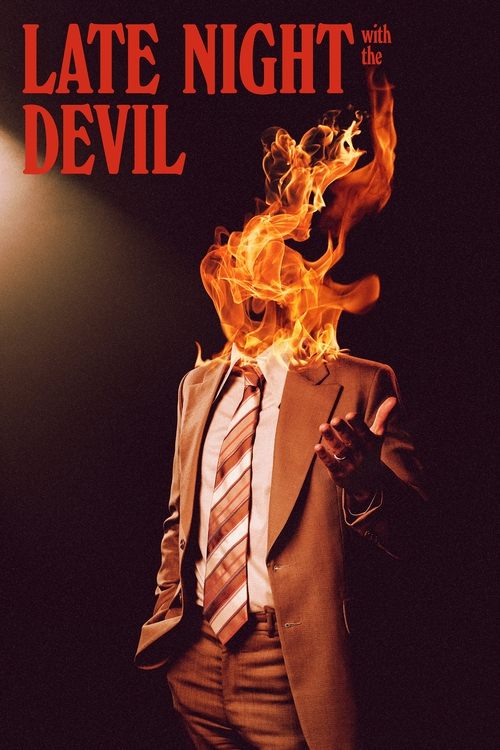
Late Night with the Devil
2024 · Cameron Cairnes
A beloved indie horror nearly derailed by three AI-generated interstitial images — the proportionality fight ("boycott over three frames?") that defined early AI-in-film ethics discourse.
For when you want a proper horror night with a hook — something clever and creepy you can put on with friends around Halloween and argue about after. It's a fun scare, not an endurance test.
What it's about
Halloween night, 1977: a struggling late-night talk show host stakes his fading career on a live broadcast featuring a parapsychologist and a girl who survived a satanic cult. The film presents itself as the recovered master tape of that broadcast — the on-air show plus behind-the-scenes footage during the ad breaks — as an occult stunt booked for ratings slips out of everyone's control in front of a national audience.
The experience
It starts as a grin-along piece of retro TV pastiche, all velour suits and applause signs, then tightens by degrees until the studio feels like a sealed room. The dread is slow, cumulative, and laced with dark comedy about a man who keeps smiling for the cameras while everything tells him to stop.
Performances
David Dastmalchian, a career character actor finally handed a lead, is the whole engine: his Jack Delroy is a pitch-perfect Carson-style charmer whose showbiz mask slips one millimeter at a time, so you watch ambition and terror fight it out on his face in real time.
The craft
The Cairnes brothers commit fully to the period-broadcast conceit — the video texture, the studio lighting, the band stings and cutaways all feel authentically 1977 — and that verisimilitude is what makes the horror land. It's a found-footage film with production design instead of shaky-cam, and it rewards a dark room and good sound when the live feed starts to go wrong.
Why it matters
A word-of-mouth indie hit that became one of the most talked-about horror films of its year and turned Dastmalchian into a leading man, it proved the found-footage idea still had fresh forms left in it.
Horror · Found footage · Possession & occult · Horror comedy & camp. A 1970s live talk show books an occult act for Halloween ratings, and the retro TV grin slowly curdles into creeping studio dread.
Snapshot
Late Night with the Devil is an Australian horror film written and directed by the sibling team Colin and Cameron Cairnes (the credited singular "Cameron Cairnes" of this brief is one half of a two-brother authorship, and the film is properly a co-direction). It stages a single catastrophe as if it were an archival artifact: the recovered master tape of a live Halloween-night broadcast of Night Owls with Jack Delroy, a fictional 1977 network talk show, on the evening the program's ratings-desperate host invites the supernatural onto his stage and cannot put it back. David Dastmalchian anchors the film as Delroy, a Carson-era smiler curdling into something more frightened and more culpable as the night proceeds. The conceit is a genre hybrid — found footage, mockumentary, and analog-broadcast pastiche — and its principal formal wager is fidelity: the film asks us to believe we are watching not a movie but a tape, complete with commercial breaks, technical faults, and the behind-the-scenes footage that "survived" alongside the aired program. It premiered at SXSW in March 2024 and reached theatrical and streaming audiences through IFC Films and Shudder, becoming one of the more commercially and critically visible independent horror releases of its year.
Industry & production
The film is a product of the mid-budget genre economy that has sustained horror as the most reliably profitable theatrical category. It was produced under the Spooky Pictures banner associated with Roy Lee and Steven Schneider — producers with deep genre pedigrees (Lee as a prolific remake and horror producer, Schneider associated with the Paranormal Activity and Insidious franchises) — a lineage that helps explain the picture's confidence in low-cost, high-concept confinement. It is an Australian production, shot in Melbourne, and its financing and craft base reflect that national industry even as its setting is the American network television of the late 1970s. Distribution in the United States came through IFC Films in partnership with the horror streamer Shudder, a pairing that has become a standard release architecture for elevated or festival-forward horror: a modest theatrical window feeding a subscription streaming home. The film reportedly performed strongly for an independent horror release, but precise box-office figures are best consulted in a current database rather than asserted here. The essential industrial fact is structural: a contained, single-location premise executed for a fraction of a studio horror budget, engineered to travel from a festival launch to streaming ubiquity.
Technology
The film's most consequential technological choices are aesthetic reconstructions rather than novelties — it is a 2024 digital production impersonating 1977 broadcast and film stock. The "aired" show is rendered to evoke the color-video texture of period network television, with the boxy framing and slightly degraded, electronic look of a program watched at home; the interstitial "behind the scenes" material recovered from the studio is presented in black-and-white on a more filmic register. This bifurcation is a designed technological fiction: contemporary cameras and post-production grading are marshaled to fake the grain, bloom, and limitations of two distinct period capture formats.
The picture also became, unintentionally, a case study in a live technological controversy of its release moment. Upon its 2024 debut it drew public criticism for using a small number of AI-generated still images as interstitial or transitional graphics. The filmmakers acknowledged the use, describing it as limited, but the episode made the film an early flashpoint in the debate over generative image tools in professional filmmaking — a debate about labor, craft, and disclosure that will likely date the film's release as much as any stylistic choice. It is worth stating plainly that the detailed internal accounts of that decision remain thin in the durable record, and the fairest summary is that the use was minor in screen time but outsized in the discourse it provoked.
Technique
Cinematography
The cinematography, credited to Matthew Temple, is the film's load-bearing illusion. Its task is not beauty in the conventional sense but plausibility: the multi-camera grammar of a live television broadcast — the wide establishing shot of the desk-and-couch set, the reverse to the guest, the reaction cutaway, the audience wide — must feel switched-in-real-time rather than composed and cut in the ordinary cinematic way. The camera therefore behaves as a studio camera would: it reframes with the slight imprecision of an operator following live action, it lets the set lighting and the on-air look flatten faces the way video does, and it treats the proscenium of the talk-show stage as a fixed theatrical space. Against this, the black-and-white behind-the-scenes passages breathe differently — handheld, more mobile, granted the intimacy of documentary access. The contrast between the two looks is the film's core visual argument: the public performance versus the thing happening underneath it.
Editing
The cutting discipline is where the "live broadcast" premise is won or lost, and the film's editing sustains the fiction with unusual rigor: it must simulate a vision-mixed program (hard cuts between cameras, the occasional graphic, the plunge to commercial) while also being a horror film that builds and detonates suspense. The seams — a dropout, a stumble in the switching, a moment where the "tape" seems to falter — are deployed as tension devices, converting the ordinary noise of broadcast into dread. The specific editing credit is not something to assert without the finished titles in hand; what can be said with confidence is that the film's construction treats the grammar of live television as its primary rhythmic engine.
Mise-en-scène / staging
The production design is a meticulous act of period reconstruction: the wood-paneled desk, the sidekick's chair, the band riser, the studio audience, and the warm, artificial glow of a late-night set circa 1977. Every object is doing double duty as verisimilitude and as trap — the stage is a single confined space from which the narrative cannot escape, and the horror is generated by contaminating a familiar, cozy television furniture with the uncanny. Staging honors the theatrical geometry of the talk show (host at desk, guests on the couch, audience as fourth wall) so that violations of that geometry register as transgressions.
Sound
Sound is essential to the broadcast illusion and to the horror. The film reproduces the sonic signature of live television — the applause cues, the band's musical stings, the sidekick's laughter, the slightly boxed acoustics of a studio — and then weaponizes the erosion of that soundscape. Diegetic period music and audience response establish normalcy; their disturbance signals the supernatural. The original score is credited to composers working in a period idiom (the durable record associates the music with Glenn Richards and Roscoe James Irwin, though the finer details of the credit are best verified against the titles). The larger point is that the film's terror is substantially auditory: it lives in what a live microphone catches when the show goes wrong.
Performance
David Dastmalchian's Jack Delroy is the film's center of gravity and its most discussed achievement — a character actor long celebrated in supporting roles handed a lead and building a full portrait of ambition, grief, and complicity beneath a broadcaster's practiced warmth. The performance is calibrated to two registers at once: the on-air Jack, all teeth and timing, and the between-takes Jack, frightened and compromised. The supporting ensemble is built for the talk-show format — Laura Gordon as the parapsychologist Dr. June Ross-Mitchell, Ingrid Torelli as the unnervingly poised possessed girl Lilly, Ian Bliss as the professional skeptic and debunker Carmichael Haig, Rhys Auteri as the sidekick Gus, and Fayssal Bazzi as the psychic Christou. An uncredited-in-body narration frames the recovered footage; the durable record associates that documentary voice-over with Michael Ironside.
Narrative & dramatic mode
The film's dramatic mode is a nested fiction: a brief documentary prologue establishes the myth of Jack Delroy and his cursed final broadcast, and the body of the film then "plays the tape." Within that frame the structure obeys the escalating logic of a talk-show rundown — a monologue, a first guest, a second, an act designed for spectacle — with each segment ratcheting the supernatural stakes until the format itself collapses. The genius of the design is that dramatic irony is built into the premise: the prologue has told us the night ends in disaster, so every ingratiating beat of the broadcast is shadowed by our foreknowledge. The behind-the-scenes interludes function as a second narrative track, letting us see the human machinery — and the moral compromises — that the aired show conceals. The result is a tragedy dressed as an artifact: a portrait of a man who trades everything for ratings, delivered in the grammar of the medium that both made and unmade him.
Genre & cycle
Late Night with the Devil sits inside several overlapping horror cycles. It is a found-footage / mockumentary horror, heir to the tradition of presenting the fictional as recovered document. It is an entry in the demonic-possession subgenre, drawing on the post-Exorcist iconography of the afflicted young woman and the clash between belief and skepticism. And it belongs to the broader contemporary "analog horror" sensibility — the revival of VHS-era and broadcast textures as a source of dread, and the fascination with cursed or corrupted media. Its most specific generic kinship is with television-as-horror: the fear that the domestic screen might transmit something malignant directly into the home, a premise the film shares with a well-established lineage of broadcast-horror fictions.
Authorship & method
The controlling authorship is that of the Cairnes brothers, Colin and Cameron, who wrote and directed the film as a unit. Their method here is high-concept containment executed with formal fidelity — the discipline to sustain a single, difficult conceit (a "live" broadcast) across a feature without breaking character. Their earlier features, the horror-comedy 100 Bloody Acres (2012) and Scare Campaign (2016), established their interest in genre mechanics and in horror's relationship to performance and media; Late Night with the Devil is the fullest realization of that interest. The key collaborators — cinematographer Matthew Temple, the period-idiom score, and the design team responsible for the reconstructed 1977 studio — are subordinated to a single unifying idea. Above all, the film is a vehicle for and a collaboration with David Dastmalchian, whose lead performance is inseparable from the film's conception; it is difficult to imagine the picture working without an actor able to hold the double register of showman and haunted man.
Movement / national cinema
The film is best located within contemporary Australian genre cinema, a sector that has produced an outsized run of internationally successful horror and horror-adjacent work in recent decades. That national industry — resourceful, technically strong, and adept at translating local craft into globally legible genre product — is the film's true home, even though its diegesis is entirely American. The picture thus participates in a familiar pattern: Australian filmmakers and crews reconstructing an American cultural surface (here, the network television of the late 1970s) for a global audience, with distribution routed through American genre distributors. It is Australian cinema wearing American television as a costume.
Era / period
Two eras matter. The first is the film's setting — 1977, the height of American occult and paranormal fascination, of network late-night as a genuine cultural monoculture, and of the anxieties (Satanic panic in embryo, celebrity secret societies, television's saturation of domestic life) that the film mines for texture and theme. The second is its moment of making — a 2024 release into a horror marketplace shaped by streaming, festival launches, and a nostalgia economy that prizes analog and broadcast textures. The film's power derives from the friction between these eras: a scrupulously reconstructed 1977 surface animated by very contemporary preoccupations with media, spectacle, and the ethics of what we put on screen — a friction sharpened, at release, by its own AI-image controversy.
Themes
At its center the film is about ambition and its price: a man who will trade authenticity, and eventually far more, for the ratings that validate him. Around that runs a sustained meditation on media and spectacle — the way live television flattens the sacred and the horrifying alike into content, and the complicity of the audience that tunes in for exactly the disaster the film delivers. It engages the perennial horror dialectic of belief versus skepticism, staging a debunker against a believer and refusing either the easy last word. It touches grief and bargaining, personal loss as the engine of a Faustian arrangement. And it is, finally, self-aware about its own form: a horror film about broadcast, transmitted to us as broadcast, implicating the act of watching in the evil it depicts.
Reception, canon & influence
Critically, the film was received as a strong, inventive genre entry, with particular and widespread praise reserved for Dastmalchian's lead performance, which many treated as a career-defining showcase. Its reception was complicated at release by the AI-generated image controversy, which became a significant part of the conversation around the film and an early public test case for how audiences and critics would treat generative tools in professional filmmaking — a debate whose long-term settling is not yet part of the durable record.
Its influences run backward to a rich lineage: the post-Exorcist possession film; the media-as-horror tradition of "the broadcast that should not have aired," of which the British television hoax-horror tradition is the most cited antecedent; the satirical portrait of television's moral corrosion associated with 1970s screen drama about the medium; and the analog-horror and found-footage traditions that taught audiences to read degraded media as a signature of dread. Its own 1977 setting lets it draw directly on the occult panic and secret-society anxieties of that decade.
Forward, its legacy is still forming, but its clearest contributions are twofold. As craft, it is likely to be cited as a benchmark for the single-broadcast, sustained-fidelity conceit — proof of how far a contained "live TV" premise can be pushed at feature length. And as a career event, it functions as the film that moved David Dastmalchian from valued supporting player to bankable lead. Its accidental role in the AI-image debate may prove the most historically legible thing about it: whatever its standing as horror, Late Night with the Devil arrived at precisely the moment the industry began arguing about generative images, and it will be remembered partly as an early artifact of that argument.
A Deleuzian reading
Wood-paneled desk.
The full Deleuzian reading of Late Night with the Devil →
Reception
A SXSW 2023 sensation that became a genuine 2024 indie hit — it gave IFC Films its biggest opening ever, and even a pre-release firestorm over its use of AI-generated art couldn't stop it becoming one of the year's best-reviewed horror films.
How Late Night with the Devil was received, from release to now →
How to watch Late Night with the Devil: what to notice on a first viewing
- Watch for the picture tearing or the switching stumbling. The Cairnes brothers simulate a vision-mixed live program: hard cuts between studio cameras, a graphic, a plunge to commercial. Dropouts and mistakes in the switching arrive where a jump scare would normally go. Ordinary broadcast noise becomes the most frightening thing in the room. You start examining the picture instead of watching it.
- Notice when the image switches to black and white. The aired show is flat color video, boxy and lit for broadcast, with the operator reframing a touch late the way a live camera does. The surviving backstage footage is handheld monochrome, free to move. The public performance and the thing happening underneath it are split at the level of grain.
- Listen for the applause cues, the band stings, the sidekick's laugh. The film rebuilds the sound of 1977 network television exactly, down to the boxed acoustics of a studio. Then it lets that soundscape erode. The terror is largely what a live microphone catches. You already know how a talk show is supposed to sound. The wrongness reaches your ear before it reaches your eye.
- Watch David Dastmalchian's face in the seconds after applause stops. On air, Jack Delroy is all teeth and timing. In the backstage footage he is frightened and compromised. Dastmalchian keeps both men running at once and lets you catch the switch between them. The broadcaster's smile is a posture the whole machine around him is holding in place.
- Follow the rundown: monologue, first guest, second guest, the big act. You know the shape of a talk show, so you always know how much show is left. A documentary prologue has already told you this broadcast went wrong. The schedule does the work a ticking clock usually does. Every warm beat of Jack's patter runs at the same time as your knowledge of what the tape is.
The whole guide to watching Late Night with the Devil, with the keys for a rewatch →
Influences: the films it descends from and the films it influenced
- Ghostwatch (1992) — Originated the feature-length 'live' studio-broadcast hoax — real presenters anchoring a desk while outside-broadcast feeds and simulated call-ins escalate — a haunted-telecast structure Cairnes reconstructs almost beat-for-beat.
- The Stone Tape (1972) — Nigel Kneale's conceit that recording technology itself can capture and replay the supernatural underwrites the film's premise that a surviving master tape is the horror artifact.
- Network (1976) — Supplies the on-air-breakdown set piece and the ratings-driven moral corrosion of television that motivates Jack Delroy's Faustian bargain for a numbers spike.
- The Exorcist (1973) — Sets the medicalized, restraint-and-guttural-voice grammar of child possession that the on-set Lilly/séance sequence directly quotes.
- Rosemary's Baby (1968) — Models the banal satanic secret-society ('The Grove') that furnishes the film's 1970s cult-panic backstory and the ordinary-faces-hiding-a-coven texture.
- Cannibal Holocaust (1980) — Invented the recovered-footage frame in which degraded media is presented as authentic evidence — the nested-artifact logic behind the 'surviving broadcast tape' conceit.
- Special Bulletin (1983) — A TV-movie that faked a continuous live news broadcast complete with period video texture and lower-thirds, precedent for sustaining broadcast fidelity across a feature.
- Videodrome (1983) — Advances the television signal as a vector of contagion and hallucination — the broadcast-as-infection idea underlying the show's final on-air rupture into unreality.
- The Blair Witch Project (1999) — Taught audiences to read camera failure and image decay as the signature of dread, the analog-artifact grammar the film maps onto 1977 videotape.
- Talk Radio (1988) — Confines its horror to a single live broadcast carried by a charismatic, self-destructing host, the contained-broadcast star-vehicle structure Dastmalchian inherits.
- The King of Comedy (1982) — Anatomizes the late-night talk-show as a machine of desperate ambition and performed intimacy, the host/guest pathology the film's talk-show reconstruction inhabits.
- Scare Campaign (2016) — The Cairnes' own prior study of a hoax-TV/prank format collapsing into real horror is the method — horror as a function of media performance — refined here into sustained live-broadcast containment.
- WNUF Halloween Special (2013) — Reconstructs a complete period local-TV broadcast — fake commercials, VHS artifacts, a live on-air paranormal investigation — the nearest formal twin to Cairnes's single-telecast conceit.
- Local 58 (2015) — Codified 'analog horror,' making interrupted and decaying broadcast television the horror object itself, the native-web idiom the film ports to feature cinema.
- Host (2020) — Proves the modern single-conceit containment horror sustained inside one unbroken media format in real time, the discipline Cairnes extends to a full talk-show telecast.
- Deadstream (2022) — Stages a supernatural collapse inside a live performer's broadcast feed, pairing showmanship and audience-facing patter with on-air possession exactly as the film does.
- When Evil Lurks (2023) — Contemporary possession film that likewise dismantles the authority figures meant to contain the demonic, arriving via the same streaming-led international genre pipeline in 2023.
- Talk to Me (2023) — The other Australian possession film of its year to run its supernatural event through a recording apparatus, committing to in-camera practical effects staged for a diegetic audience.
- Buddy (2026) — A period-exact broadcast reconstructed as found object — studio lighting, tape texture, audience reactions on cue — that decays into horror without leaving the show's own format, with the crowd's laughter repurposed as an instrument of dread.
Similar films
- The Blair Witch Project (1999) — influence & lineage · same viewing thread
- Longlegs (2024) — same viewing thread
- The First Omen (2024) — same viewing thread
- undertone (2026) — same viewing thread
- [REC] (2007) — same viewing thread
- The Medium (2021) — same viewing thread
- Gonjiam: Haunted Asylum (2018) — same viewing thread
- Incantation (2022) — same viewing thread
All the films related to Late Night with the Devil →
Watch it with: curated runs of related films
- Fever-Dream Horror — Watch these when you want horror that runs on dream logic — witches, circuses, crematoria and occult dread rendered as hand-crafted, hallucinatory nightmare rather than jump-scare.
- The Camera Kept Rolling — A run of found-footage and fake-documentary horror. Every film rhymes on the same dread: someone points a camera at the dark, insists on filming, and leaves us the recording. It moves from the Maryland woods to Barcelona stairwells, Seoul asylums, Taiwanese curses and Thai shamans.