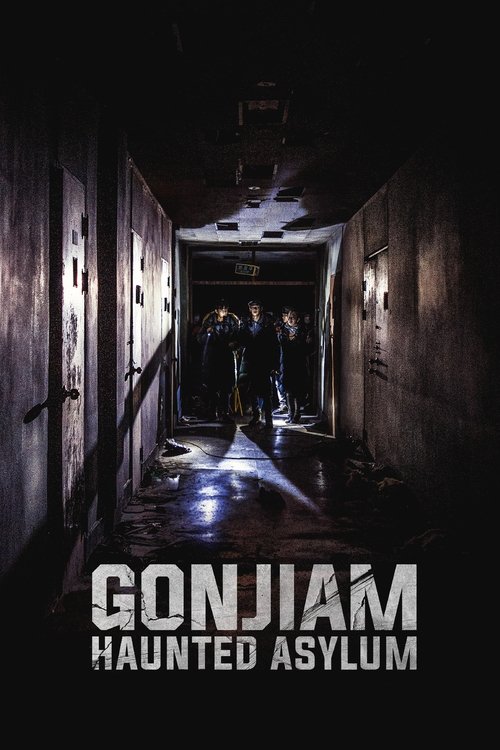
Gonjiam: Haunted Asylum
2018 · Jung Bum-shik
For when you're craving a real scare — the group-watch, scream-at-the-screen pick for a dark room and a dare. Pure adrenaline horror; don't expect comfort, expect to check behind the door afterward.
What it's about
Seven young people — the crew of a horror web channel plus recruits brought in for the night — break into the abandoned Gonjiam Psychiatric Hospital to livestream an investigation of its infamous Room 402. The host wants a million viewers and the ad money that comes with them, so some scares have been staged in advance. The drama lives in the gap between the frights the crew planted and the ones the building starts supplying on its own.
The experience
A ratchet that tightens one corridor at a time — playful and jokey early, then genuinely nerve-shredding once the hospital stops cooperating. The face-mounted cameras put you uncomfortably close to every widening eye, and the last stretch is a sustained panic attack.
The craft
The film is assembled almost entirely from the cameras the characters carry and wear — handhelds, body rigs aimed back at their own faces, fixed units, a drone — plus the live feed with its viewer counter, which becomes its own source of dread. It's found footage rebuilt for the livestream age, and it demands a dark room and good speakers to work its tricks.
Why it matters
A major box-office hit that proved found footage could thrive in Korean cinema, it updated the subgenre for streaming culture and turned the real Gonjiam hospital into one of horror's famous locations.
Snapshot
Gonjiam: Haunted Asylum (곤지암) is a South Korean found-footage horror film that brought a long-running Western subgenre into the culture of livestreaming. Seven young people, some running a horror web channel and some recruited for the night, enter the abandoned Gonjiam Psychiatric Hospital to broadcast an investigation of its rumoured Room 402. Their leader wants the stream to reach a million viewers and the ad revenue that comes with it. The film is built almost entirely from cameras the characters carry and wear: handhelds, body rigs pointed back at their faces, fixed units placed around the building, and a drone. On screen they show the live feed, and the drama turns on the gap between the scares the host has staged and the ones the building supplies itself.
The film is notable on three counts. It was a large domestic hit for a genre that had been commercially weak in Korea for most of the 2010s. It drew on a real place that Korean internet culture had already turned into a legend, which made its release controversial. And it shows Jung Bum-shik, an elegant period stylist in Epitaph (2007), moving to a deliberately rough, participatory, first-person aesthetic.
Industry & production
The film was produced by Hive Media Corp and distributed in Korea by Showbox, one of the country's major distributor-investors. It opened in late March 2018. By Korean standards it was a mid-to-low budget production, cast mostly with newcomers rather than stars. That was an economic choice and an aesthetic one: the found-footage premise needs faces the audience does not recognise. Its domestic admissions were widely reported at more than 2.6 million. Korean press at the time placed it among the most-attended Korean horror films ever, generally second only to Kim Jee-woon's A Tale of Two Sisters (2003). The exact ranking depends on how "horror" is defined, so it is best treated as a reported benchmark rather than a fixed fact.
The production's main controversy was its source. The real Gonjiam Psychiatric Hospital in Gwangju, Gyeonggi Province, had been closed for years. It was a fixture of Korean online ghost lore and urban-exploration "dare" culture, and in 2012 CNN Travel included it in a list of the world's creepiest places, which raised its profile abroad. Before the release, the building's owner went to court to stop the film, arguing that it would harm the property's reputation and value. Local officials also voiced concern that the film would draw trespassers. The court refused to block the release. Press coverage of the dispute added to the film's notoriety.
The film was not shot at the real hospital. Production used a disused school building in Busan, which the crew dressed to stand in for the asylum. The publicly documented detail on the location is limited, so the specifics are best taken from contemporary Korean production reporting rather than assumed here. The decision itself fits the film's logic: Gonjiam is a legend location, and the film recreates a legend rather than documenting a site.
Marketing aimed at teenagers and twenty-somethings, the audience most fluent in the web-broadcast idiom the film imitates. Promotional material stressed the "experience" of the film (immersion, live-stream presence, a ride-like structure) rather than its narrative.
Technology
The film is defined by the consumer and prosumer recording technology of the 2010s:
- Action cameras and body rigs. The film's signature image is the face-cam: a small camera on a chest or shoulder rig, pointed back at the wearer's face from very close range. It turns each cast member into both subject and operator, and it records fear in tight close-up while the threat stays off-frame or blurred behind them.
- Handheld and fixed units. Handheld cameras give the conventional point-of-view coverage. Static cameras placed in corridors and rooms provide surveillance-style wide shots, a device familiar from Paranormal Activity (2007).
- Drone footage. Aerial shots of the hospital and the surrounding woods add a perspective that earlier found-footage films could rarely justify. They also make the building look isolated and hemmed in.
- Livestream interface. The on-screen viewer counts and broadcast framing reflect the technical and economic reality of platforms such as YouTube and Korea's AfreecaTV. In the film's world, attention becomes money in real time.
Contemporary reports and interviews said the actors operated many of the cameras themselves and were trained to do so. This is part of the film's established production story. How the shooting was divided between the actors and the professional camera crew is not fully documented in English-language sources.
Technique
Cinematography
The visual design depends on multiple diegetic sources. Instead of one "found" camera, as in The Blair Witch Project (1999), the film cuts between several feeds. That gives it something close to conventional coverage while keeping the premise intact. The face-cam is its most distinctive tool. Because the lens is fixed to the body, the face stays steady while the background lurches, and anything moving in the dark behind a character becomes the source of dread. Night-vision-like low-light imagery, torch beams, and the narrow fields of action cameras keep most of the frame dark. Much of the horror is therefore about what cannot quite be seen at the edge of a fisheye frame.
Editing
The editing imitates a broadcast assembled by a base-camp operator, with occasional cuts to feeds that no one is watching. The first half is unusually patient. The group arrives, sets up equipment, jokes, and stages small fake scares. This performs "content creation" while building up the space. The second half quickens sharply, with cuts between failing cameras, corrupted signals, and characters cut off from one another. Glitches and dropouts work both as realistic artefacts and as punctuation. The structure follows a steady escalation toward Room 402, which keeps the narrative clear despite the fragmented sources.
Mise-en-scène / staging
The asylum is staged as a linked set of themed spaces: a lobby, corridors, wards, a director's office, a hydrotherapy-style room, and the locked door of 402. These are dressed with the debris of abandonment, such as files, wheelchairs, beds, and graffiti. The film draws a meaningful line between staged and actual horror. The host has planted crew members to fake effects, so the audience first watches manufactured scares and then sees the building exceed them. Ghostly figures and possession effects (bodies contorting, darkened eyes, unnatural movement) are used sparingly at first and then all at once. Staging and framing generate fear before the effects do.
Sound
The film largely avoids a conventional orchestral score. That is consistent with found-footage practice and with its claim to be a live feed. Fear is built through diegetic sound: breathing and chatter picked up by body-worn microphones, echoing footsteps, doors, wind, and distortion and signal noise as the equipment fails. Some sound design does work beyond strict realism, especially low tones and sudden spikes during the climactic sequences. Close microphones on the face-cams create an uncomfortable intimacy: the audience hears the characters' panic from inches away.
Performance
The ensemble was mostly unknown or little-known at the time of release. Wi Ha-joon plays Ha-joon, the channel's host and organiser. Park Ji-hyun, Oh Ah-yeon, Moon Ye-won, Park Sung-hoon, Lee Seung-wook, and Yoo Je-yoon play the others, and the characters largely share the actors' first names. That is a common found-footage strategy for blurring performer and role. The performances aim for the casual, joking register of web-broadcast personalities and then degrade into fear. The ensemble gets less room for individual characterisation than conventional drama would allow, which critics noted. The cast's main achievement is physical: performing fear for a lens a few inches from the face, while also operating it. Wi Ha-joon's later fame (notably in Squid Game, 2021) has given the film a retrospective "early role" interest abroad.
Narrative & dramatic mode
The narrative mode is mock-documentary, more precisely mock-livestream. The film presents itself as the recorded archive of a broadcast. Dramatically, it builds tension through a slow opening, a bonding and set-up phase, small staged scares, and then the collapse of control as the supernatural takes over.
At the centre is a structural irony. Ha-joon is a showman whose interest in horror is commercial: he wants viewers, and he fabricates events to get them. The film moves from a satire of manufactured fear into actual fear, and the fabrication itself becomes complicit. The final movement pushes toward Room 402 and to a conclusion where the broadcasting apparatus that promised mastery over the haunted space has turned into its trap. The film resolves its scares rather than its characters, and it works more as an escalating experience than a character study.
Genre & cycle
Gonjiam belongs to the international found-footage cycle that The Blair Witch Project revived and Paranormal Activity and [REC] (2007) consolidated. Its closest generic relative is the "ghost-hunting show" variant, especially Grave Encounters (2011). That film also sends a paranormal-TV crew into an abandoned psychiatric hospital, and Gonjiam is often compared with it. Its specific novelty is updating the conceit from broadcast television to personal livestreaming, where audience metrics are visible on screen and the creator is a self-made entrepreneur rather than a network employee.
Within Korean cinema, it comes in a long line of horror films set in institutions: schools (the Whispering Corridors series, from 1998), hospitals (Epitaph itself), and family homes. Korean found-footage had been rare before it. Its commercial success showed that the mode could work in a local market where horror had struggled for a decade.
Authorship & method
Jung Bum-shik first came to prominence co-directing Epitaph (Gidam, 2007) with Jung Sik. That film was an elegant, melancholy horror anthology set in a Japanese-colonial-era Seoul hospital, and it has a cult reputation for its formal beauty. He later directed a segment of the omnibus Horror Stories (2012) and worked outside horror as well. Gonjiam reverses his earlier style: Epitaph is composed, painterly, and elegiac, while Gonjiam is raw, immersive, and youth-oriented. Both films share a fascination with the hospital as a container of the dead.
Jung co-wrote the screenplay with Park Sang-min. His reported method involved training the young cast to operate equipment and developing the shoot around the actors' own handling of the cameras. That blurs the usual line between cinematographer and performer, so the camera department is harder to credit in the conventional way. Detailed English-language documentation on the cinematographer's and editor's specific contributions is sparse, and this dossier does not assign particular choices to named crew members. With minimal score, the composer's role is less prominent than in most Korean genre productions.
Movement / national cinema
The film belongs to the commercial South Korean cinema that grew out of the late-1990s industrial renaissance. It is not tied to an art-cinema movement. Korean horror had a boom from the late 1990s to the mid-2000s, with films such as Whispering Corridors, Phone (2002), A Tale of Two Sisters, and Into the Mirror (2003). Afterward it was widely described as commercially exhausted, and many 2010s releases performed poorly. Gonjiam's success was read in the Korean press as a sign of renewed demand, especially among younger viewers, when the genre was presented through a format they recognised.
It also reflects the specific Korean media environment: a very high-bandwidth, mobile-first culture in which personal broadcasting (on AfreecaTV and later YouTube) had become a significant entertainment industry, complete with "BJs" (broadcast jockeys), donation systems, and stunt content.
Era / period
The film belongs to the late 2010s. By then found-footage had been a global horror staple for a decade, and newer variants were moving toward screens and platforms: Unfriended (2014), Searching (2018), and later Host (2020). Gonjiam sits between the classic found-footage film and the "screenlife" film. It keeps the physical camera but frames its output as networked, monetised live content.
The period also saw growing anxiety about attention economies and the ethics of influencer stunts. Urban exploration and trespass at abandoned "haunted" sites had become popular online content. That made the real Gonjiam hospital both a symbol and a practical problem, as the owner's lawsuit and the local concerns showed.
Themes
- Commodified fear. The film's central theme is the conversion of fear into views and views into money. Ha-joon's faked scares and million-viewer target make the horror broadcast itself the object of critique.
- Authenticity and fabrication. The film keeps playing staged effects against real events, testing whether the audience, inside and outside the fiction, can tell them apart. It suggests that a culture of fabricated spectacle leaves people unable to recognise real danger.
- Institutional haunting. The asylum carries implicit histories of confinement and abuse. The film mostly uses them as atmosphere rather than examining them; some critics have noted that the patients' history stays a backdrop to the youths' ordeal.
- Technology as false mastery. The characters bring cameras, sensors, and a base-camp station to dominate the space. The equipment becomes the means of their exposure and isolation.
- Youth and spectatorship. Like many found-footage films, it implicates its viewers, here explicitly modelled as a live online audience whose appetite drives the escalation.
Reception, canon & influence
Critical reception. Korean and international reviewers generally received the film well as a genre exercise. Critics singled out its sustained tension, the face-cam device, and its efficient escalation. Common reservations were the thin characterisation and its reliance on familiar found-footage beats; several reviewers saw it as a polished and energetic synthesis rather than a reinvention. It circulated on the international genre-festival circuit and in overseas distribution, and its reputation among genre fans abroad grew afterwards, helped in part by its lead actor's later fame. A detailed record of individual festival selections and awards is not reliably documented here, so none are asserted.
Influences on the film (backward). Its most direct models are The Blair Witch Project (the expedition into a legend site, footage from a doomed group), Grave Encounters (a paranormal broadcast in an abandoned asylum, staged effects overtaken by real ones), Paranormal Activity (fixed surveillance cameras), and [REC] (handheld immersion and a confined escalating space). Japanese found-footage horror such as Noroi: The Curse (2005) is a plausible regional reference point for Asian mock-documentary horror, though no direct line is documented. Within Korea, the institutional-horror tradition, including Jung's own Epitaph, supplies the setting and its associations.
Legacy (forward). Gonjiam's clearest legacy is commercial and industrial: it showed that low-budget, newcomer-cast horror could become a breakout hit in the Korean market of the late 2010s. It is often cited in discussions of the Korean genre revival together with later mockumentary-inflected horror such as The Medium (2021), a Thai-Korean co-production produced by Na Hong-jin. Any causal influence between the two should be treated as unproven. Its mix of livestream culture and haunted-location horror anticipated a broader global wave of streamer and influencer horror in the following years. Gonjiam is a prominent example of that trend rather than its proven origin. In the canon of Korean horror, it marks the point when the genre's classic institutional settings (the school, the hospital) met the platform culture of a new generation.
Influences: the films it descends from and the films it influenced
- Ghostwatch (1992) — Presents a 'live' paranormal broadcast whose cheerful TV format is slowly overrun by a real haunting. Gonjiam uses the same template, with a streaming show instead of a TV special and on-air hosts as the victims.
- The Last Broadcast (1998) — A crew from a low-budget paranormal show goes into a legend site to get content for their audience and is destroyed there. It is the first fake-documentary horror film built on a ghost-hunting show doing its rounds.
- The Blair Witch Project (1999) — The actors were trained to shoot the film themselves, and the filmmakers manipulated their reactions while they did. Gonjiam took over that method of performer-operated cameras, along with the expedition into a legend site and the slow-burn structure.
- Noroi: The Curse (2005) — Builds an Asian found-footage horror film from several footage sources: a handheld investigator camera, TV-variety clips and surveillance video. This is the regional model for Gonjiam's mix of media formats.
- Epitaph (Gidam) (2007) — The director's earlier film sets its horror in a colonial-era hospital used as a container of the dead. Gonjiam keeps that institutional setting but replaces Epitaph's composed, painterly frames with raw body-cam chaos.
- [REC] (2007) — A TV-crew camera moves into a sealed building that keeps getting worse. Its last act in night-vision darkness, where the frame is the only light, is the source of Gonjiam's fisheye-darkness climax.
- Paranormal Activity (2007) — Static locked-off cameras watch empty rooms with long, held stillness. Gonjiam places fixed cameras the same way in Room 402 and the corridors, cutting between them and the roaming body cams.
- Grave Encounters (2011) — A ghost-hunting reality show films in an abandoned asylum. The film first shows the crew faking scares for the camera, then sets real phenomena against them. Gonjiam takes over this staged-versus-real structure directly.
- As Above, So Below (2014) — Rigs a whole crew with GoPro/head-mounted cameras and body-mounted multicam for a livestream descent through a single labyrinthine location — the most direct inheritor of the helmet-cam multicam strategy.
- Session 9 (2001) — It uses a real abandoned psychiatric hospital and its numbered room as the locus of the horror, with the crew's recording gear capturing presences offscreen, the same structure as Session 9's tapes.
- Host (2020) — A séance on a video call, built from cameras the actors operated themselves in their own homes. It carries Gonjiam's performer-as-cinematographer method and its glitches-as-scares into a fully screen-based film.
- Spree (2020) — Builds the whole film from a would-be streamer's body and dashboard cameras, with live chat on screen. It extends Gonjiam's critique of fear and violence made into content for viewer counts.
- Dashcam (2021) — A livestreamer's constant on-air commentary and rolling chat continue while real horror overwhelms the broadcast. The mock-livestream is used the way Gonjiam uses it, as the show the characters refuse to stop.
- Incantation (2022) — A Taiwanese found-footage film in which a group of YouTube ghost-busting vloggers break a taboo while filming. It extends Gonjiam's East Asian mix of content-creator crews and multi-source footage, and adds direct address to the audience.
- Deadstream (2022) — A disgraced streamer locks himself in a haunted house with a body-rigged face-cam, several fixed cameras and live chat on screen. It is close to a comic remake of Gonjiam's apparatus.
- Late Night with the Devil (2023) — A live TV broadcast whose producers stage a supernatural segment for ratings that becomes real on air. It keeps Gonjiam's device of staged scares overtaken by real ones, with fear sold as a product as the motive.
- Hell House LLC (2015) — A crew building a staged scare attraction plants fake effects that slowly turn real, all recorded on the crew's own cameras. It sets up the same tension between staged and real scares inside a commercial fear product.
- Unfriended (2014) — Turns the interface itself into the frame, with on-screen chat and live feeds driving the scares. Gonjiam's livestream overlays and viewer-count scenes are halfway toward that screenlife grammar.
- The Den (2013) — Horror filmed entirely through webcam and live-video-chat capture, where an unseen online audience watches the victim. This prefigures Gonjiam's horror of streaming to a crowd.
- The Medium (2021) — An Asian mockumentary produced in Korea that starts as a calm documentary and turns into chaotic night-vision footage from body-mounted and fixed cameras. It uses the same slow-burn-to-collapse editing.
Similar films
- [REC] (2007) — influence & lineage
- The Medium (2021) — influence & lineage
- Noroi: The Curse (2005) — influence & lineage
- Incantation (2022) — influence & lineage
- Backrooms (2026) — same viewing thread
- undertone (2026) — shared sensibility
- Ghost Stories (2018) — shared sensibility
- Skinamarink (2023) — shared sensibility
All the films related to Gonjiam: Haunted Asylum →
Watch it with: curated runs of related films
- Trapped in the Dark — Watch these as a run of survival horror where the place itself — a chained-shut bathroom, a cabin cellar, a lightless cave, an endless fluorescent nowhere, an emptied city — turns into the thing hunting you.