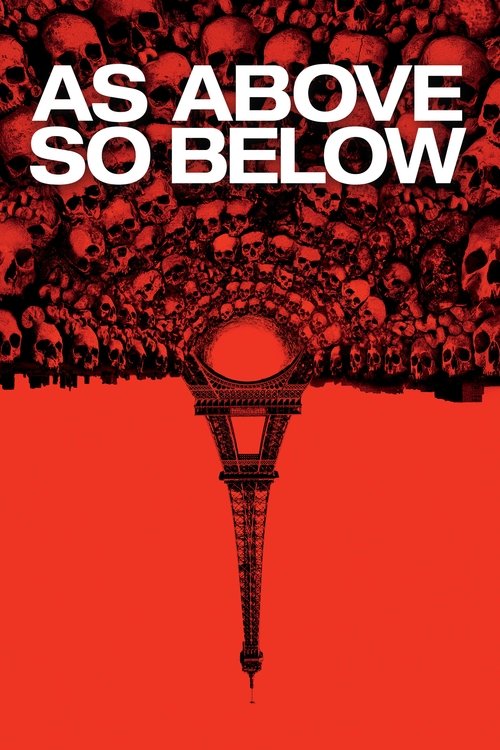
As Above, So Below
2014 · John Erick Dowdle
When you're craving a real scare with an adventure-movie spine — tomb-raiding setup, horror payoff. Not one for claustrophobes or a relaxing night; it's a white-knuckle pick for horror night with the lights off.
What it's about
A driven young scholar-adventurer, chasing her late father's obsession, believes the legendary Philosopher's Stone lies hidden beneath Paris — and leads a small documentary crew off the tourist path into the catacombs, the tunnels stacked with the bones of millions. The deeper they go, the less the maps make sense, passages seal behind them, and each explorer starts meeting things down there that seem to know their private guilt.
The experience
Claustrophobia is the engine: tight crawlspaces, headlamp light, panic breathing, and a mounting sense that the tunnels are rearranging themselves around the crew's sins. It's an anxiety machine more than a gore film — expect to feel physically hemmed in, with a strange puzzle-box streak underneath the scares.
Performances
Perdita Weeks gives the expedition a live wire at its center — her fast-talking, almost reckless conviction makes the descent feel plausible scene by scene.
The craft
Remarkably, much of it was shot inside the real Catacombs of Paris — actual bone-lined ossuaries, not sets — and that documentary texture is what makes the found-footage, headcam-and-handheld style land. The sound design does the heavy lifting: distant chanting, ringing phones where no phone should be, and silence that makes you dread the next noise. Headphones or good speakers pay off.
Why it matters
A late-cycle entry in the found-footage boom that has steadily grown a cult following, remembered as the film that got cameras into the real Paris catacombs — and as one of the more inventive premises the format produced.
Horror · Found footage · Psychological horror · Religious horror. Headcam panic in the real Paris catacombs: tunnels close in, the maps stop making sense, and each explorer's private guilt waits below.
Snapshot
As Above, So Below is a found-footage horror-thriller that sends a small documentary crew into the ossuaries and quarry tunnels beneath Paris in search of Nicolas Flamel's Philosopher's Stone, only to find that the deeper they dig the more the labyrinth resolves into a literal descent through Hell. Directed by John Erick Dowdle from a screenplay he co-wrote with his brother Drew Dowdle, the film is best understood as the collision of two durable horror traditions: the shaky-cam, first-person "found footage" mode inaugurated by The Blair Witch Project, and the claustrophobic subterranean survival picture epitomized by Neil Marshall's The Descent. What distinguishes it historically is a production fact rather than a formal innovation — it was granted access to shoot inside the actual Catacombs of Paris, lending the picture a documentary authenticity that its genre usually has to fake. Released by Universal in August 2014 to mixed reviews and modest-but-profitable returns, it occupies a late position in the 2007–2015 found-footage cycle, at the point where the form was straining for novelty and reaching for mythic scaffolding — here, Dante and hermetic alchemy — to justify its handheld conceit.
Industry & production
The film was produced by Legendary Pictures and distributed by Universal Pictures, a studio-adjacent arrangement typical of the era's horror economics: a low budget, a marketable high-concept location, and the promise of strong margins. The reported production budget sits around $5 million, with worldwide grosses commonly cited in the low $40-million range; these figures are widely repeated in trade summaries, and while I present them as the consensus record, exact accounting for a film of this scale should be treated as approximate. Against a micro-budget, that return made it a commercial success even as its critical reception stayed lukewarm.
The signal production story is location. The Dowdles secured permission to film within the real Paris Catacombs — the network of former limestone quarries lined, in part, with the disinterred remains of millions of Parisians relocated there beginning in the late eighteenth century. Press coverage around release emphasized the logistical and human difficulties of the shoot: cramped passages roughly a hundred feet underground, no cell service, no easy egress, limited crew, and the psychological toll on cast and crew of working among genuine human bones in genuine darkness. The production could not use conventional lighting rigs or camera cranes in the tightest passages, which pushed the filmmakers toward small, body-mounted cameras and practical, carried light sources — a technical constraint that dovetailed neatly with the found-footage premise. Portions requiring effects, set dressing, and safety-controlled staging were built on sets and in other tunnel systems, but the marketing — and much of the film's authenticity — rested on the claim of the real ossuary. This is a case where the exploitation-era instinct to sell a location as a dare ("filmed where no one has filmed before") aligns with a real production achievement.
Technology
Technologically the film belongs to the GoPro moment of found footage. By 2014 the conceit had migrated from the single camcorder of Blair Witch to multi-camera, head-lamp-mounted small-sensor cameras that could be worn by each character, allowing the film to cut between subjective viewpoints while maintaining the diegetic fiction that everything is being recorded. The practical demands of the catacombs — no room, no rigging, no ambient light — made compact digital cameras and battery-powered practical lights (helmet lamps, handheld torches, flares) both a narrative alibi and a genuine necessity. The result is an image defined by hard, roving pools of light against absolute black, motion blur, sensor noise in the shadows, and the wide-angle distortion characteristic of action-cam optics. Digital acquisition also enabled the long, oxygen-starved crawls through flooded and bone-choked passages to be shot in extended handheld takes, and it made post-production stabilization, grading toward a cold subterranean palette, and seamless integration of the film's fire, water, and supernatural effects far more tractable than a photochemical workflow would have allowed.
Technique
Cinematography
Cinematography is credited to Léo Hinstin, and the film's visual grammar is entirely subordinated to its found-footage rule set. There is no omniscient camera; every frame is motivated by a character's helmet cam or handheld unit, so framing is reactive, off-center, and frequently obstructed by rock, bodies, and grasping limbs. The dominant aesthetic is the tunnel of light — a narrow cone carving into darkness, with the frame's edges swallowed — which the film uses both to generate dread (we see only what a lamp happens to catch) and to stage its scares (something is always just outside the beam). Hinstin and Dowdle exploit the real geometry of the quarries: low ceilings that force characters to crawl, junctions that read as impossible to map, and the visual horror of walls literally constructed from skulls and femurs. The trade-off is the one the whole cycle makes — authenticity and immersion purchased at the cost of legibility, with the shaky handheld image becoming disorienting by design and, for some viewers, exhausting.
Editing
Elliot Greenberg edited the film. The cutting sustains the fiction of assembled real footage while still delivering conventional suspense architecture: quick intercutting between characters' viewpoints to fracture space, sudden hard cuts and momentary blackouts as lamps fail, and an accelerating rhythm in the descent's back half as the geography turns hallucinatory. The editing must perform a delicate double duty — it has to feel "found," raw, and continuous enough to preserve immersion, yet it is in fact tightly orchestrated to time reveals and jolts. The film's structural editing choice is its clearest thematic gesture: the descent is cut as a one-way, ever-deepening spiral with no return path, so that the viewer, like the characters, loses any sense of a route back to the surface.
Mise-en-scène / staging
The production design is inseparable from the real location: the horror is furnished by authentic osteological architecture, and much of the film's power comes from staging bodies and actors against actual walls of the dead. As the group descends, the mise-en-scène shifts from documentary catacomb realism toward increasingly surreal, symbolic tableaux — a ringing telephone, a burning car, a flaming figure, a piano, a stone gate inscribed with Dante's warning — objects that could not literally be underground and that signal the film's turn from spelunking thriller to infernal allegory. This escalation is the staging's central idea: the deeper the descent, the more the "real" catacomb dissolves into a psychologized underworld built from each character's guilt.
Sound
Sound is arguably the film's strongest craft dimension. In near-total darkness the soundtrack does much of the frightening: dripping water, groaning stone, distant chanting and voices, breathing and scraping in confined space, and the sudden absence of sound when a character is separated from the group. The score is credited to Keefus Ciancia, and the film generally favors low, textural dread and diegetic-seeming noise over conventional orchestral stingers, in keeping with the found-footage aesthetic's preference for sound that feels captured rather than composed. The sonic design of enclosure — the way voices deaden and echo in tight rock passages — is essential to the sensation of being buried alive.
Performance
Performances are pitched toward naturalism and physical duress rather than showcase acting, as the mode demands. Perdita Weeks anchors the film as Scarlett Marlowe, a driven, multilingual scholar-adventurer whose obsessive quest for the Philosopher's Stone drives the group downward; the role asks for exposition-heavy fluency (alchemy, Aramaic, Flamel lore) delivered on the run. Ben Feldman plays George, the reluctant translator whose personal guilt becomes literalized in the descent, and Edwin Hodge plays Benji, the cameraman whose viewpoint we frequently share. The ensemble's task is less to build character in the traditional sense than to convey credible terror, exhaustion, and claustrophobic panic while carrying their own cameras — a physically punishing, semi-improvisational register that the real location clearly intensified.
Narrative & dramatic mode
The film's dramatic mode fuses the quest-adventure and the infernal descent. Its surface is an Indiana-Jones-in-a-tunnel treasure hunt: a scholar decodes a cryptic trail, assembles a team, and pursues a legendary object. But the screenplay progressively converts that horizontal adventure into a vertical moral journey patterned on Dante's Inferno — the group must literally pass through Hell to reach their goal, and each character is confronted underground by a manifestation of a private sin or trauma. The organizing conceit is the hermetic maxim of the title, "as above, so below": the world beneath mirrors the world above, and the catacomb becomes a mirror of the self. This gives the picture a tidy allegorical engine — descent as confession, the only way out is down and through — that lends its final act a redemptive, almost fairy-tale logic uncommon in found footage, even as the mechanics of that resolution strike some viewers as abrupt.
Genre & cycle
As Above, So Below sits at the intersection of two cycles. First, the found-footage horror wave that ran from The Blair Witch Project (1999) through the Paranormal Activity franchise (2007 onward), Cloverfield, the [REC] films, and countless imitators — a cycle that by 2014 was visibly exhausting itself and searching for fresh settings and premises. Second, the subterranean-descent survival horror lineage most directly represented by Neil Marshall's The Descent (2005), with antecedents in caving-and-catacomb dread going back through pulp adventure. The film's innovation within these cycles is to weld found footage to a mythological-alchemical quest, using Dante and hermeticism to supply the metaphysical stakes that the handheld form often lacks. It is, in genre terms, a late-cycle hybrid — a sign of a form reaching for literary and occult scaffolding to renew a premise audiences had begun to tire of.
Authorship & method
The controlling authorship is fraternal: John Erick Dowdle directed and co-wrote with his brother Drew Dowdle, a partnership that defines the film's method. The Dowdles came up through The Poughkeepsie Tapes (2007), a faux-documentary serial-killer film that established their comfort with the found-footage register; Quarantine (2008), their American remake of the Spanish [REC], which honed their handheld-horror craft; and Devil (2010), produced from an M. Night Shyamalan story, which showed their facility with confined-space suspense. As Above, So Below synthesizes these threads — the mock-documentary framing, the contagion of panic in enclosed space, the single-location pressure cooker — and pushes them into mythic territory. Their key collaborators here are cinematographer Léo Hinstin, whose lamp-in-the-dark imagery defines the look; composer Keefus Ciancia, whose textural score underpins the dread; and editor Elliot Greenberg, who preserves the "found" illusion while sculpting suspense. The Dowdles' authorial signature across the film is a willingness to graft genuine research and real, dangerous locations onto genre machinery — treating authenticity of place as a substitute for the polish the found-footage mode deliberately forgoes.
Movement / national cinema
The film is an American studio horror production shot on French soil, and it belongs less to any national cinema than to the transnational, English-language horror marketplace of the early 2010s, where American producers routinely exported productions to distinctive foreign locations for atmosphere and cost. Its most meaningful "movement" affiliation is to the international found-footage movement — a genuinely global phenomenon (Spanish [REC], Norwegian Trollhunter, American Paranormal Activity) that treated the amateur-video aesthetic as a shared vernacular across borders. Paris here is used less as a site of French national cinema than as a mythologized underworld, its real Catacombs a ready-made gothic set for an American genre picture.
Era / period
Made and released in 2014, the film is a product of the mature phase of the found-footage boom and of the digital-camera democratization that made body-worn, multi-viewpoint shooting cheap and practical. It arrives at the moment when the cycle's commercial reliability was beginning to fade and filmmakers were pushing for higher concepts, more elaborate effects integration, and more literary underpinnings to keep the form alive. Its August release date situates it squarely in the late-summer slot Hollywood reserves for lower-budget genre fare aimed at younger audiences. In retrospect it reads as one of the more ambitious late entries in a cycle that would largely give way, over the following years, to the "elevated horror" prestige mode.
Themes
The film's dominant theme is guilt as a place one must descend into. Its Dantean structure makes the underworld a moral geography: to retrieve the Philosopher's Stone — an emblem, in alchemical lore, of transmutation, healing, and spiritual perfection — the characters must first confront their buried sins, and redemption is possible only by passing through and acknowledging them. The hermetic title supplies the second theme: correspondence between the macrocosm and microcosm, outer world and inner self, so that the labyrinth is at once real stone and psychic interior. Related motifs include obsession and the ethics of the quest (Scarlett's drive endangers everyone), the transmutation of the base into the noble (alchemy as metaphor for moral change), and the ancient horror-of-the-dead resonance of the catacombs themselves — the past, literally the bodies of the past, as something the living cannot escape and must eventually rejoin.
Reception, canon & influence
Critical reception was mixed to lukewarm. Reviewers broadly praised the film's genuine location, oppressive atmosphere, and the ambition of its Dante-and-alchemy conceit, while faulting the disorienting shaky-cam, the familiar found-footage jolts, thinly drawn characters, and a resolution some found too neat or rushed. It was, in the critical shorthand of the moment, a better-than-average found-footage film hampered by the limitations of the form. Commercially it succeeded on its micro-budget, which is the more decisive fact for its place in the industry record.
Looking backward, the influences on the film are legible and openly worn: The Blair Witch Project and the Paranormal Activity/[REC] lineage for its found-footage grammar and mock-documentary framing; The Descent for its subterranean, claustrophobic survival horror and the specific terror of women crawling through impassable rock; the Dowdles' own Quarantine and Poughkeepsie Tapes for method; and, at the level of literary and esoteric source, Dante's Inferno and the hermetic tradition of the Emerald Tablet, alongside the historical legend of Nicolas Flamel and the real, storied Catacombs of Paris.
Looking forward, its legacy is more atmospheric than structural. The found-footage cycle was already waning, and As Above, So Below did not spawn a franchise or a school of imitators. Its most durable contribution is as the film that dramatized the Paris Catacombs for a mass horror audience — cementing the ossuary as a marquee horror location and demonstrating, on the strength of its real-location access, how much a genuine site can lend to an otherwise conventional genre exercise. Among horror audiences it retains a following as one of the more inventive late found-footage films, valued precisely for the ambition of its mythic overlay. Its broader influence on subsequent horror is genuinely modest, and it would overstate the record to claim more; its significance lies in that singular fusion of a real place, an old poem, and an old dream of alchemy, staged in the actual city of the dead.
A Deleuzian reading
A headlamp swings across a wall and the wall is made of skulls.
The full Deleuzian reading of As Above, So Below →
Reception
Critics shrugged it off in August 2014 as another found-footage cash-in, but a decade of horror-fan word of mouth has flipped it into a genuinely beloved cult item — it now routinely tops 'most underrated found footage' lists and gets an annual spooky-season revival.
How As Above, So Below was received, from release to now →
How to watch As Above, So Below: what to notice on a first viewing
- Watch the edge of the lamp beam, not the middle. Every light source in the tunnels is one a character is carrying. The cone catches a few feet of stone and the frame's edges go black. Dowdle stages almost everything just outside that cone. You are only ever shown what a person's lamp happens to find, so the dark stops being empty and starts being occupied.
- Notice that every shot comes from a camera someone is wearing. There is no outside view anywhere in the film. Helmet cams and handhelds carry all of it, so the picture is always somebody's looking. Often you ride Benji's camera while watching him watch. With a camera on everyone, no single witness holds the space together, and you never get a shot that would let you draw a map.
- Listen for how voices deaden in the tightest passages. Keefus Ciancia's score stays low and textural, so most of what frightens you is dripping water, groaning stone, scraping, and breathing. Rock swallows the echo when a passage narrows. Your ears tell you the size of a space your eyes cannot see, which is how the film buries you alive without showing you the walls.
- Look at the walls. They are stacked with real skulls and femurs. The Dowdles got permission to shoot inside the actual Paris ossuary, where there is no electricity. The bone architecture in frame is municipal, stacked by workers starting in the 1780s. The horror is furniture the production found rather than built, and that documentary credit is what later buys your belief in an impossible descent.
- Watch the actors' breathing as they wedge their bodies through rock. Perdita Weeks, Ben Feldman and Edwin Hodge play exhaustion and oxygen debt more than they play character. They carry their own cameras while crawling, and the strain is on their faces because the location was real. Duration here is carried by posture and breath rather than plot, which is why the crawl scenes feel longer than they are.
The whole guide to watching As Above, So Below, with the keys for a rewatch →
Influences: the films it descends from and the films it influenced
- Cannibal Holocaust (1980) — Originated the recovered-footage conceit — a diegetic reel discovered after its makers vanish — that licenses the whole 'these are the tapes they left behind' framing device.
- The Blair Witch Project (1999) — Codified the mock-doc found-footage grammar of characters getting hopelessly lost in a claustrophobic space, with handheld shaky-cam and lamp-in-the-dark framing standing in for editorial polish.
- The Descent (2005) — Supplied the specific terror of women wedging through impassable rock passages, headlamp/torch as sole light source, and the subterranean spiral as an ever-tightening claustrophobic trap.
- [REC] (2007) — Modeled the single-camera handheld contagion-of-panic inside a sealed building — the Dowdles remade it as Quarantine, carrying its cameraman-as-witness rig directly into the catacombs.
- The Poughkeepsie Tapes (2007) — The Dowdles' own faux-documentary that established their comfort with the recovered-footage register and interview/archival framing later stripped down for the catacomb descent.
- Paranormal Activity (2007) — Established the fixed/rig multicam escalation and consumer-camera aesthetic that the film industrializes into GoPro helmet-cams distributed across the whole crew.
- Quarantine (2008) — The Dowdles' honing of relentless single-location handheld horror, where the cameraman's light beam is the only way to see the threat closing in the dark.
- Cloverfield (2008) — Demonstrated the single consumer-camera POV threading terrified people through collapsing, dark, cramped underground spaces — a subway-tunnel grammar echoed in the catacomb crawls.
- Devil (2010) — The Dowdles' single-location pressure-cooker of confined-space suspense — trapped bodies, dwindling space, mounting panic — later fused with the found-footage rig.
- Hell House LLC (2015) — Extends the single-cursed-location found-footage descent with distributed multicam coverage and after-the-fact recovered footage of a crew that didn't make it out.
- Gonjiam: Haunted Asylum (2018) — Rigs a whole crew with GoPro/head-mounted cameras and body-mounted multicam for a livestream descent through a single labyrinthine location — the most direct inheritor of the helmet-cam multicam strategy.
- Catacombs (2007) — The prior horror film literally staged in the Paris ossuary, using the real bone-lined tunnels as its maze — the same marquee location the Dowdles then dramatized for a mass audience.
- Grave Encounters (2011) — A found-footage crew trapped in a spatially impossible location that rearranges and loops back on itself, the same 'the architecture is the monster' descent-into-a-maze logic.
- The Tunnel (2011) — A found-footage crew descending with camera lights into abandoned underground tunnels, mining pitch-black subterranean corridors for the same enclosure-driven dread.
- The Borderlands (2013) — Head-mounted-camera found footage that ends by crawling into a claustrophobic subterranean passage rendered as a literal descent into hell — the same helmet-cam-POV-into-the-infernal move.
- Creep (2014) — A contemporaneous late-cycle found-footage two-hander that, like As Above, leans on a single embedded camera operator and mounting dread over franchise jolts, marking the form's exhausted-but-inventive final phase.
Similar films
- [REC] (2007) — influence & lineage · same viewing thread
- Gonjiam: Haunted Asylum (2018) — influence & lineage · same viewing thread
- Creep (2014) — influence & lineage · same viewing thread
- The Blair Witch Project (1999) — influence & lineage · same viewing thread
- The Descent (2005) — influence & lineage
- Backrooms (2026) — same viewing thread
- Incantation (2022) — same viewing thread
- undertone (2026) — same viewing thread
All the films related to As Above, So Below →
Watch it with: curated runs of related films
- The Fear of God — A run of horror where faith is the battleground: believers, doubters and zealots meet the devil, damnation and an afterlife that answers back, from Puritan farms and Roman convents to the catacombs under Paris.
- The Camera Kept Rolling — A run of found-footage and fake-documentary horror. Every film rhymes on the same dread: someone points a camera at the dark, insists on filming, and leaves us the recording. It moves from the Maryland woods to Barcelona stairwells, Seoul asylums, Taiwanese curses and Thai shamans.