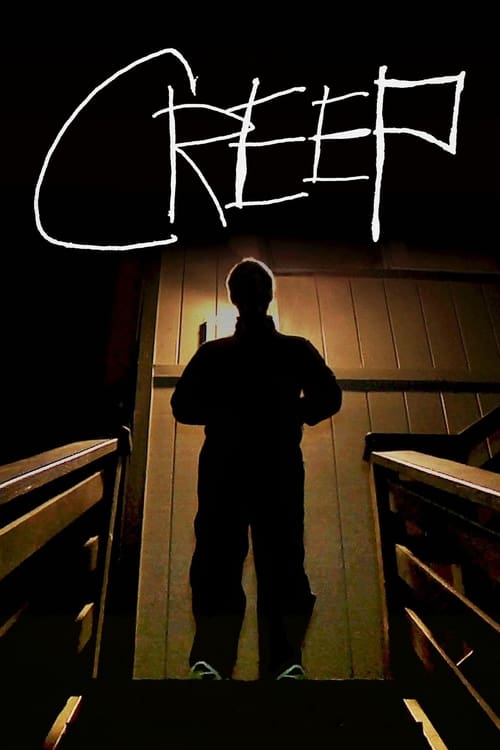
Creep
2014 · Patrick Brice
When you're craving a real scare of the creeping, psychological kind — perfect for a late night alone with the lights off, especially if found footage and awkward-tension horror are your thing. Not for viewers who need action; the horror here is a conversation going wrong.
What it's about
Aaron, a videographer short on cash, answers an online ad offering $1,000 for a day of filming at a remote mountain cabin. His client, Josef, says he's a dying man making a video diary for his unborn son — a sincere, even touching project. But as the day wears on, Josef's oversharing and boundary-pushing start to feel less like eccentricity and more like something Aaron should be driving away from.
The experience
Squirm-inducing in the best way — the dread comes not from jump scares (though it has a few) but from social discomfort, the awful politeness that keeps you nodding along when every instinct says leave. At a lean 78 minutes it tightens like a slow handshake you can't get out of.
Performances
Mark Duplass is the whole show as Josef — needy, funny, plausible, and deeply wrong — a largely improvised performance that makes ordinary friendliness feel like a trap.
The craft
Shot on a microbudget with essentially two actors and one camera, it's a masterclass in doing more with less: the found-footage format isn't a gimmick but the plot itself, since filming is literally Aaron's job. Patrick Brice (who also plays Aaron) and Duplass built it through improvisation, which gives every scene a queasy, unscripted realism.
Why it matters
A defining entry in the microbudget horror wave of the 2010s, it proved a two-person, near-improvised film could become a cult phenomenon via streaming, spawned a sequel, and made Josef one of modern horror's quietly iconic villains.
Horror · Found footage · Psychological horror. Found-footage two-hander: a videographer takes a day job filming a needy stranger at a remote cabin, and politeness curdles into dread.
Snapshot
Creep is a two-hander found-footage horror film built from a deceptively simple premise: a videographer answers a Craigslist-style ad, drives into isolation, and slowly realizes his employer means him harm. Directed by Patrick Brice in his feature debut and co-written with and co-starring Mark Duplass, the film fuses the low-fi naturalism of American mumblecore with the first-person camera grammar of the found-footage cycle. Its power lies almost entirely in performance and duration: a single unnerving man, a single increasingly trapped observer, and a running time (roughly 78 minutes) spent watching sincerity curdle into menace. Produced under the Blumhouse microbudget model and eventually distributed by Netflix, Creep became a template for how a two-actor, near-improvised horror film could travel — spawning a 2017 sequel and cementing Duplass's Josef, and his wolf mask "Peachfuzz," as a minor horror icon.
Industry & production
Creep is a product of two converging low-budget ecosystems: the Duplass brothers' mumblecore filmmaking practice and Jason Blum's Blumhouse Productions, which by the early 2010s had built a business model around tightly capped budgets and back-end profit participation. The film was produced under this microbudget banner, and its economics are visible in every frame — a cast of essentially two, a handful of locations (a mountain cabin, a diner, exteriors), and a crew small enough to be invisible within the found-footage conceit. I have not seen a reliably sourced production budget, so I will not assign a figure, but the film is unambiguously a bare-bones production by design rather than compromise.
The project originated as a collaboration between Brice and Duplass, who developed the story together and shot it with an improvisational method built on an outline rather than a locked screenplay. Creep premiered at South by Southwest in March 2014, the natural festival home for both mumblecore and the emerging "mumblegore" hybrid. Distribution followed a now-familiar independent path: after its festival run, the film was picked up and released to a wide streaming audience via Netflix in 2015, which arguably did more for its cultural reach than any theatrical footprint could have. The film's afterlife — a direct sequel, Creep 2 (2017), and franchise ambitions — is itself a case study in how streaming distribution and microbudget economics can turn a modest genre exercise into ongoing IP.
Technology
Creep is a digital-era artifact in both its diegesis and its making. The found-footage conceit is motivated by consumer and prosumer video technology: Aaron is hired precisely because anyone with a camera can be a "filming service," and the film's images are nominally the footage he shoots. This grounds the movie in the same cultural moment as Craigslist gig work, cheap HD camcorders, and the assumption that a stranger with a camera is unremarkable. The camera is a character — an alibi Josef exploits, a shield Aaron hides behind, and eventually the instrument of the film's dread.
Practically, the production leaned on lightweight digital cameras that could be operated by the actors themselves, collapsing the distance between crew and cast. This is central to the film's method: because Brice (as Aaron) frequently holds the camera, the shooting apparatus and the performance are one, allowing long improvised takes without a separate operator breaking the intimacy. The film also folds in ancillary digital surfaces — video messages, recordings, the paraphernalia of self-documentation — that would become even more pronounced in the sequel. The specific camera packages are not something I can attribute with confidence, so I flag that as a genuine gap rather than guess.
Technique
Cinematography
The visual language is strictly first-person and diegetically motivated: nearly every shot is "taken" by a camera within the story, most often Aaron's. This yields the hallmarks of the found-footage grammar — handheld instability, reframing that lags behind the action, autofocus hunting, and the constant possibility that the frame will miss the very thing we most want to see. Brice and Duplass exploit this withholding: Josef repeatedly moves toward and away from the lens, using proximity as aggression (the sudden lunge into close-up) and distance as threat (stepping out of frame, appearing behind). The camera's limited field of view becomes a suspense engine, since danger in Creep is defined by what the operator cannot cover.
Crucially, the cinematography is not purely chaotic. Because the fiction is that Aaron is a competent videographer making a keepsake film, many compositions are deliberately, even tenderly framed — a bathtub monologue, a walk in the woods — before that composure is violated. The film's dread comes from the collision between "nice video" aesthetics and predatory content.
Editing
Found footage disciplines editing toward the illusion of the unedited, and Creep mostly honors that: scenes play in extended takes that let discomfort accumulate in real time. But the film is not naïve about cutting. It uses the conceit of assembled footage — clips, gaps, and jumps that imply time and material we didn't see — to control information, particularly in its back half as Aaron reviews recordings and the relationship deteriorates. The editing rhythm is patient by horror standards: long stretches of amiable conversation are the setup, and the "scares" (often simple jump gags built around Peachfuzz or Josef's sudden reappearance) are punctuation. The film's economy in the cutting room mirrors its economy everywhere else.
Mise-en-scène / staging
The staging is intimate and claustrophobic even in open exteriors, because it is organized around a single predator and a single mark. The remote cabin and surrounding woods supply isolation without needing production design flourish; the environment does the work of cutting Aaron off from help. The film's most memorable object is a mask — the wolf mask Josef calls "Peachfuzz" — a piece of childlike whimsy weaponized into a recurring emblem of his instability. Blocking is built around invasion of personal space: Josef closes distance, touches, follows, and stages "sincere" set pieces (a bath, a story about his unborn child) whose intimacy is the threat. The mise-en-scène is essentially behavioral — what unsettles is where and how a body moves relative to the camera and to Aaron.
Sound
Because the film purports to be captured footage, its soundscape favors location audio: wind, interior room tone, footfalls, and the flatness of on-camera-mic voices. This naturalism heightens the shock when non-diegetic or manipulated sound intrudes. The film's most discussed sonic device is Josef's ritual of the "jump scare" — his own manufactured startle gags, often paired with the mask, which fold the audience's genre expectations into the character's psychology. I would not overstate a formal score; the film's fear is carried more by voice, silence, and sudden noise than by orchestration. Where the record on specific sound design credits is thin, I note it rather than embellish.
Performance
Performance is the film's true special effect. Mark Duplass's Josef is a study in weaponized sincerity: over-sharing, self-pitying, warm, and instantly wounded when boundaries are set. Duplass modulates between disarming vulnerability (the tearful confession of terminal illness, the earnest wish to film a message for his child) and flashes of something predatory, so that the viewer, like Aaron, keeps rationalizing. Brice's Aaron is a quieter, reactive performance — largely a voice and a pair of hands behind the camera — but his growing unease and fatal politeness (his reluctance to simply leave) supply the film's engine of dread. The improvisational method pays off precisely here: the halting, over-explained, socially awkward texture of the dialogue feels lived rather than scripted, which is why the manipulation lands.
Narrative & dramatic mode
Creep is a chamber thriller structured as a slow social entrapment. Its dramatic mode is closer to a two-character stage play than a conventional slasher: the "plot" is a deteriorating relationship, escalating through a series of conversations and staged intimacies rather than through action set pieces. The film runs on dramatic irony — the audience senses danger well before Aaron admits it — and on the excruciating gap between social decorum and self-preservation. Aaron's tragedy is that he keeps behaving like an employee and a polite guest when he should be fleeing. The structure moves from confinement (the cabin) to a false release and back to inescapable pursuit, with recorded footage used as a delivery mechanism for revelation. It is a mode built on discomfort and anticipation, resolving into a bleak, almost anticlimactic inevitability rather than a spectacular finale.
Genre & cycle
The film sits at the intersection of two cycles. First, the found-footage horror lineage that runs from Cannibal Holocaust (1980) through The Blair Witch Project (1999) and the Paranormal Activity franchise — the latter especially relevant given Blumhouse's role in industrializing found-footage horror as a profitable microbudget form. Second, and more distinctively, Creep belongs to "mumblegore," the early-2010s hybrid in which mumblecore's improvised naturalism and small casts were applied to horror. Related touchstones in that conversation include the Duplass brothers' own Baghead (2008) and the work of directors like Ti West and Adam Wingard. Within found footage, Creep is notable for stripping the subgenre down to human menace — no supernatural agent, no monster beyond a man — which aligns it as much with the psychological-thriller tradition of the charming predator as with genre horror.
Authorship & method
The authorship of Creep is genuinely dual. Patrick Brice directs and plays Aaron, making his feature debut; Mark Duplass co-writes, produces, and plays Josef. The two share story credit, and the film's defining method — improvisation from an outline, small crew, actor-operated cameras — is inseparable from Duplass's mumblecore practice with his brother Jay. This is auteurism of process rather than of visual signature: the "style" is a working method that privileges performance, duration, and discomfort over formal design. Brice would go on to direct The Overnight (2015), also with Duplass, and later studio comedies, confirming a sensibility attuned to social awkwardness pushed to extremes. Because the film's crew is deliberately minimal and subsumed into the conceit, key craft credits (editor, any sound or music personnel) are less individually foregrounded than in a conventional production; where I cannot confidently attribute a specific collaborator, I leave it unstated rather than invent a name. The central creative fact is the Brice–Duplass partnership as co-authors on both sides of the camera.
Movement / national cinema
Creep is firmly an American independent film, and specifically a late artifact of the mumblecore movement's migration into genre. Mumblecore emerged in the mid-2000s U.S. indie scene — low budgets, naturalistic and improvised dialogue, twentysomething social dynamics, and the Duplass brothers among its central figures. By the early 2010s that aesthetic had begun cross-pollinating with horror, and Creep is one of the purest examples of that crossover: it imports mumblecore's ethics of intimacy and improvisation wholesale into a horror shell. It is also a film of the American streaming era, its national-cinema identity shaped as much by Netflix distribution as by any regional filmmaking tradition.
Era / period
The film is thoroughly of its early-2010s moment. Its premise depends on a specific gig-economy and internet culture — the online classified ad, the disposable freelance job, the assumption of ubiquitous personal video — and its production and distribution reflect the microbudget-plus-streaming economics that defined independent genre film in that period. It arrives after found footage had matured into a recognizable, even exhausted, commercial form, which is part of why Creep reads as a distillation and interrogation of the mode rather than a naïve entry. The period texture is one of casual digital documentation, in which recording strangers is normalized, and the horror is precisely that normalization.
Themes
At its core, Creep is about the predatory abuse of intimacy and the social scripts that make prey compliant. Josef weaponizes vulnerability — illness, loneliness, impending fatherhood — turning confession into a grooming technique, and the film is acutely interested in how politeness, empathy, and the reluctance to seem rude keep Aaron in danger. It interrogates the ethics of the camera: filming as false objectivity, as intimacy, as complicity, and ultimately as the predator's medium. Loneliness runs beneath the menace; Josef's need to be seen and recorded is genuine even as it is monstrous, which is what makes him unsettling rather than merely evil. The film also probes performance and sincerity — the impossibility of knowing when a compelling emotional display is real — and the specific modern horror of the stranger who knows how to appear harmless.
Reception, canon & influence
Critically, Creep was received as a modest but effective genre exercise, praised above all for Duplass's performance and for its economy — a horror film that wrings sustained dread from two men and a camera. It was not a wide-release phenomenon in theaters; its reputation grew substantially through Netflix, where word-of-mouth turned it into a recommended-title staple and a reference point for "unsettling" streaming horror. I would be cautious about citing specific critical aggregation scores or box-office figures, as this was primarily a festival-and-streaming release, and I will not invent numbers.
Its influences (backward) are legible: the found-footage lineage of Cannibal Holocaust, The Blair Witch Project, and Blumhouse's Paranormal Activity; the mumblecore practice of the Duplass brothers and their genre hybrid Baghead; and the broader tradition of the charismatic-predator thriller. Internet horror culture — the confessional-video, creepypasta register of found digital material — is also part of its DNA.
Its legacy (forward) is concrete for a film this small. It produced a direct sequel, Creep 2 (2017), which deepened the character and is widely regarded by genre audiences as a strong follow-up, and it established Josef/Peachfuzz as a recognizable figure in 2010s horror. More broadly, Creep stands as a proof-of-concept for the two-hander, actor-authored, streaming-distributed horror film — demonstrating that improvisational mumblegore could be commercially durable and franchise-capable. Its influence is felt less in imitation of its images than in its model: minimal cast, maximal discomfort, camera-as-character, and distribution built for the streaming age.
A Deleuzian reading
Josef climbs into the empty bathtub and asks Aaron to keep filming.
The full Deleuzian reading of Creep →
Reception
It slipped out quietly — SXSW premiere in 2014, then a low-key Netflix release in 2015 — and grew almost entirely by word of mouth into one of the streaming era's defining sleeper horror hits, now a standard answer to 'actually good found footage.'
How Creep was received, from release to now →
How to watch Creep: what to notice on a first viewing
- Watch how often the frame lags behind what's happening. Nearly every shot is Aaron's own camera, so reframing hunts and drifts, and the frame can miss the very thing you most want to see. The danger in this film is defined by what the camera operator cannot cover, not by what's on screen.
- Watch Josef move toward and away from the camera. He lunges into close-up until his face fills the lens, then steps out of frame and reappears behind it, using nearness and distance as two different threats. Where his body is relative to the lens is doing more work than anything he actually says.
- Listen for the flat, on-camera-mic sound of Aaron's own voice. The soundscape favors wind, room tone, and footfalls, a naturalism that makes any sudden or manipulated noise land as a genuine shock. The ordinary quiet is what makes the film's manufactured startles register as something worse than a jump scare.
- Watch for the wolf mask Josef calls Peachfuzz. It's a piece of childlike whimsy that keeps reappearing, weaponized a little more each time into an emblem of his instability. A silly object recurring this often stops feeling silly and starts feeling like a warning.
- Watch Josef's face shift between warmth and something else. Duplass moves between disarming vulnerability and flashes of something predatory, so you, like Aaron, keep finding reasons to explain it away. The performance never fully tips over, which is exactly what keeps you rationalizing along with Aaron.
The whole guide to watching Creep, with the keys for a rewatch →
Influences: the films it descends from and the films it influenced
- Peeping Tom (1960) — Establishes the camera-as-weapon POV in which a soft-spoken predator films his victims, forcing the audience to occupy the killer's viewfinder — the first-person lens as instrument of harm that Creep literalizes with Josef's handheld.
- Henry: Portrait of a Serial Killer (1986) — Pioneers the banal, charismatic predator whose menace lives in flat everyday affect and abrupt tonal shifts rather than spectacle, the same 'nice guy who is off' register Duplass weaponizes as sincerity.
- Cannibal Holocaust (1980) — Originates the recovered-footage conceit — diegetic tapes whose very existence implicates the viewer — the framing device Creep adopts by presenting itself as Aaron's assembled Craigslist videographer files.
- Man Bites Dog (1992) — Builds the two-hander of a documentary crew filming a garrulous killer, where the operator's growing complicity dissolves the camera's safety — the exact power dynamic between Aaron's lens and Josef's performance.
- The Blair Witch Project (1999) — Codifies improvised, actor-operated handheld horror that generates dread from offscreen space and duration rather than reveals, the method Brice and Duplass shoot from an outline with a near-invisible crew.
- The Poughkeepsie Tapes (2007) — Frames a serial killer through his own compulsively recorded home tapes, the confessional-archive register of a predator who documents himself that Josef mirrors with his 'Peachfuzz' and tearful-video routines.
- Paranormal Activity (2007) — Proves the Blumhouse microbudget model — a domestic space, a consumer camera, minimal cast, patient static duration — as a commercially durable horror engine, the distribution-and-economy template Creep runs on.
- The Puffy Chair (2005) — Establishes the Duplass mumblecore practice of improvisation from a loose outline with a tiny crew privileging performance and awkward duration, the working method transplanted wholesale into Creep.
- Baghead (2008) — The Duplass brothers' direct mumblecore-into-horror hybrid — actors in an isolated cabin generating menace through improvised social discomfort — the 'mumblegore' proof-of-concept Creep refines into a two-hander.
- My Little Eye (2002) — Uses surveillance and webcam framings with a limited, low-fidelity field of view to make the recording apparatus itself the source of threat, anticipating Creep's consumer-camcorder point-of-view constraint.
- Creep 2 (2017) — Directly extends the same two-hander conceit and actor-authored improvisation, inverting the camera relationship by making Josef the one seeking to be filmed — deepening the weaponized-sincerity performance Duplass built.
- Host (2020) — Distills the Creep model to its limit — microbudget, minimal cast, camera-as-character, built for streaming release — proving actor-driven found footage stays franchise-viable and platform-native.
- Spree (2020) — Extends the early-2010s gig-economy predator into self-broadcasting culture, where a smiling, sincerity-performing killer narrates to his own camera — Josef's confessional-video menace scaled to the streaming/creator age.
- The Overnight (2015) — Brice and Duplass carry the same escalating social-awkwardness-into-transgression method into a chamber comedy, confirming personal-space invasion staged through improvisation as their shared authorial signature.
- The Sacrament (2013) — Runs a found-footage chamber piece built around a charismatic, controlling figure filmed by a wary documentarian, the same intimate-crew-versus-magnetic-predator structure worked at feature scale contemporaneously.
- Unfriended (2014) — Advances the confessional digital-material register into screenlife, sustaining an unbroken illusion-of-unedited real-time feed from consumer devices — the same faith in unmediated recording as horror surface.
- [REC] (2007) — Reduces found-footage to a single subject's direct address into the operator's lens, isolating the performance/direct-address facet [REC] used to bind the audience to Ángela.
- As Above, So Below (2014) — A contemporaneous late-cycle found-footage two-hander that, like As Above, leans on a single embedded camera operator and mounting dread over franchise jolts, marking the form's exhausted-but-inventive final phase.
Similar films
- The Blair Witch Project (1999) — influence & lineage · same viewing thread
- Man Bites Dog (1992) — influence & lineage · same viewing thread
- undertone (2026) — same viewing thread
- Sinister (2012) — same viewing thread
- Gonjiam: Haunted Asylum (2018) — same viewing thread
- [REC] (2007) — same viewing thread
- Noroi: The Curse (2005) — same viewing thread
- As Above, So Below (2014) — same viewing thread
All the films related to Creep →
Watch it with: curated runs of related films
- The Camera Kept Rolling — A run of found-footage and fake-documentary horror. Every film rhymes on the same dread: someone points a camera at the dark, insists on filming, and leaves us the recording. It moves from the Maryland woods to Barcelona stairwells, Seoul asylums, Taiwanese curses and Thai shamans.