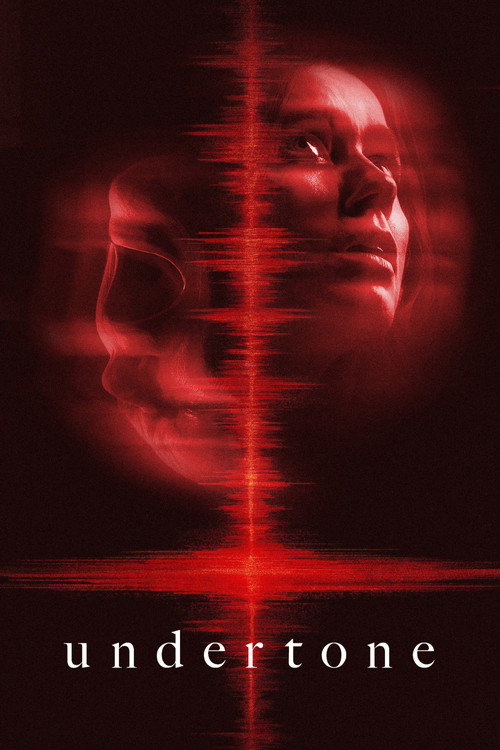
undertone
2026 · Ian Tuason
For a late night alone with headphones when you're craving a real scare — the kind that makes you mute the film to check a sound in your own house. Keep it for when you want to be unnerved, not soothed.
What it's about
Evy co-hosts a paranormal podcast, recording at night in her childhood home while caring for her comatose mother down the hall. When a run of audio files arrives at the show — recordings that seem to document a young couple living through escalating supernatural disturbances — she and her remote co-host start working through them on air. The deeper she listens, the thinner the wall gets between what's in the files and what's in her house.
The experience
A horror film that attacks through your ears — long stretches ask you to just listen, and the dread comes from what you hear and can't see. It's intimate, slow-burning and genuinely nerve-shredding in its quietest moments.
Performances
Nina Kiri holds the screen largely by herself, doing the hard work of reacting to sound — her listening face is where most of the film's fear lives.
The craft
A first feature built almost entirely on sound design: the scares are in the recordings, the room tone, the things half-heard under the hiss, which makes it a rare horror film where good speakers or headphones aren't optional but essential. The found-audio structure — a haunting delivered as files to be played back — is a clever, disciplined constraint on a low budget.
Why it matters
It premiered at the Fantasia festival and was picked up by A24, marking Ian Tuason as a debut filmmaker to watch and extending the found-footage tradition into found audio.
Snapshot
undertone (A24 styles the title in lowercase) is the first feature written and directed by the Canadian filmmaker Ian Tuason. It is a low-budget supernatural horror film that frightens mainly through what the audience hears. Nina Kiri plays Evy Babic, co-host of a paranormal podcast called The Undertone. She works at night in the house where she grew up, caring for her comatose mother. Her co-host Justin appears only as a voice (Adam DiMarco). Together they go through a run of audio files sent to the show, which seem to document a pregnant couple, Mike and Jessa (voiced by Jeff Yung and Keana Lyn Bastidas), living through escalating supernatural disturbances. As the recordings pile up, the line between the files and Evy's own house starts to give way.
The film premiered at the Fantasia International Film Festival in Montreal in July 2025 and won an audience award for Canadian features there. A24 then picked it up and released it in North American theaters on 13 March 2026. Trade tracking (The Numbers) reports a production budget of around US$500,000 and a worldwide gross of roughly US$20 million, so it became one of the most widely noted micro-budget horror successes of the year. Critics broadly praised its sound design and Kiri's near-solo performance. Many had reservations about a second half that brings in more familiar genre material.
Industry & production
undertone is a Canadian independent production that reached a wide audience through a festival acquisition, a route that has become standard for low-budget horror since the 2010s. Its life followed what is now a familiar path for the genre. It premiered at a genre festival (Fantasia, long a launch pad for Canadian and international horror), won an audience prize that drew distributor attention, and was acquired by A24. A24 gave it a wide theatrical release and a trailer campaign built around the podcast premise.
The production was very small. It was shot mostly at a single location, the house Tuason grew up in, and for most of the running time it has one actor on screen. The other principal performances were recorded as voices. These constraints were also the film's main aesthetic choices, and the press coverage of its release emphasized the gap between its reported budget and its gross. The production record available so far is thin on detail beyond these basics (financing partners, shooting schedule, post-production arrangements). This dossier does not try to fill those gaps.
Technology
The film's central technology is consumer and prosumer audio: podcast microphones, headphones, editing software, and old recordings brought into a modern workflow. Evy's work as a podcaster happens on screen. She listens, scrubs through files, isolates sounds, and plays passages backwards, so the tools of digital audio editing become the way the story's investigation unfolds. That puts the film in a tradition in which recording technology is both how evidence is gathered and how haunting gets in, a tradition that runs through electronic voice phenomena (EVP) lore and fiction about cursed media.
The production's own technology was modest, which suits a single-location digital feature. Cinematographer Graham Beasley shot it. Detailed public information on camera systems and lenses is not available in the sources reviewed here. In interviews Tuason has said that his screenplay was written around sound cues more than camera directions. That is unusual for a script, and it shows where the film's technical weight really sits: in the sound mix and the sound team's layering of voices, ambience, and noise.
Technique
Cinematography
Beasley's camera has a restricted space to work with: a family house at night, often lit low, with Evy at a desk, by her mother's bed, or moving through hallways. Because the threat is mostly heard, the images often show stillness and waiting. The camera holds on Kiri as she listens, or on parts of the house that might be hiding something. Critics noted the film's patience and slow-burn manner. Some found this absorbing, and others found it inert. Close-ups of a face reacting to sound are central to its method. A large share of what the audience sees is someone listening, and the frame invites the viewer to search the dark spaces around her. The available record does not allow a more detailed account of format, lighting design, or shot structure.
Editing
The film's editing has two layers: the picture cut, and the in-story editing Evy does to the recordings. The plot is built as a sequence of tapes. Each new file arrives, gets played, gets discussed with Justin, and gets reinterpreted, which gives the film a serial, episodic rhythm close to the narrative podcasts that inspired it. One critical account describes the film's stories as "nested" and intertwined: the couple's recordings, the podcast's framing commentary, and Evy's own domestic situation reflect and eventually leak into each other. Reviewers who found the second half weaker pointed to a speeding up of incident and a loss of the earlier "narrative drip." In this film, how fast information is released is itself an editing decision. The picture editor's identity is not established in the sources consulted here.
Mise-en-scène / staging
Most of the drama takes place in one house, and it matters that it is Tuason's actual childhood home. The film plays it as an inhabited family space rather than a gothic set: a sickroom with a bedridden parent, a home office repurposed as a recording booth, the ordinary furniture of a lived-in house. The staging rests on a few repeated positions. Evy sits at her equipment, wearing headphones and closed off from the room. Evy stands by her mother's bed. Evy moves through the house in response to a sound. This repetition lets small changes register strongly. With one actor visible for long stretches, the film's sense of population depends on the voices, so the house feels both empty and crowded.
Sound
Sound is the film's reason for existing. Critics agree that the main conceit is to deliver most of its scares through sound design, with Tuason's small sound team layering recordings, ambient noise, and background textures into a disturbing, enveloping soundscape. Reviewers describe a soundtrack full of the couple's recordings, nursery rhymes (some sung in reverse), deep distorted voices, and children's singing. Several critics observed that the film is about what's heard more than what's seen, and about the different jobs sound does in horror: evidence, atmosphere, intrusion, and possession.
The film turns the act of listening into drama. The audience hears the recordings as Evy hears them, often through her playback, and so takes on her doubt and suggestibility. Playing audio backwards, a long-running motif in occult and "backmasking" folklore, puts the old idea that hidden messages lie inside recordings into the film's working method. The record available here does not establish who composed any score or exactly where it falls between composed music and sound design. The film's design seems to blur that line on purpose.
Performance
Reviewers have called undertone a feature-length "one-woman show" for Nina Kiri, a Canadian actor known to genre audiences from Let Her Out (2016) and The Handmaid's Tale. She is nearly the only person on screen and has to carry the film largely through listening: reacting to sounds the audience may or may not fully hear, keeping up a skeptical professionalism on mic, and showing the strain of looking after a dying parent. Her scene partners are disembodied. Adam DiMarco (known from The White Lotus's second season) plays Justin entirely through voice, and Jeff Yung and Keana Lyn Bastidas play the couple in the recordings. Critics tended to treat Kiri's performance as one of the film's main strengths, including those who were unhappy with its later turns.
Narrative & dramatic mode
The narrative mixes investigative procedure with domestic grief. On the surface it follows a structure common to paranormal podcasts: material comes in, the hosts analyze it, a skeptic and a more credulous partner trade interpretations, and the stakes rise with each episode. Underneath, Evy's care for her comatose mother in her childhood home gives the haunting an emotional basis. The house is full of the past before any recording arrives.
The film builds its dread through accumulation and doubt. Recordings are fragmentary, interpretations are provisional, and a strictly rational reading stays available for a long time. Critics divided over the shift that follows. Several reviews say the second half "breaks its quiet spell," bringing in religious lore (described as drawn from Christian tradition), lullabies, and more conventional supernatural escalation. To them, the earlier ambiguity gets lost "in the feedback." Others see the convergence of the tapes and Evy's life as the intended payoff of the nested structure. Either way, the film's dramatic mode is a slow-burn, interior one that resolves late and only partly into genre spectacle.
Genre & cycle
undertone belongs to several overlapping strands of horror:
- Cursed and found media. From Ringu (1998) and The Blair Witch Project (1999) to Sinister (2012) and Lake Mungo (2008), horror has repeatedly made recorded media the carrier of contagion or the record of something that shouldn't exist. undertone moves that logic from videotape to audio files.
- Sound-centered horror and the "listening" thriller. The film draws on a lineage of films about people who process sound and become caught up in what they hear. The clearest examples are Coppola's The Conversation (1974), De Palma's Blow Out (1981), and Peter Strickland's Berberian Sound Studio (2012). Critics and audiences reached for these comparisons, as they usually do for films of this kind. They are useful as context, but they are not confirmed citations by Tuason.
- Audio drama and narrative podcasts. Tuason has named fiction podcasts as direct inspirations, including Homecoming (by Eli Horowitz and Micah Bloomberg) and The Black Tapes (Paul Bae and Terry Miles). He originally conceived undertone as a radio play. The film is part of a broader movement of podcast forms and personalities into screen fiction.
- Micro-budget, single-location horror of the 2020s. This includes the pandemic-era wave typified by Host (2020), along with other limited-cast productions in which formal restriction is the selling point.
Coverage of the release framed the film as "riding the podcast boom." It treats the true-crime and paranormal podcast both as a contemporary subject and as a structural model.
Authorship & method
Ian Tuason wrote and directed the film. Before his feature debut he built a following online with horror shorts, including 360-degree/VR-format work distributed on YouTube. That background in immersive, viewer-centered short-form horror is consistent with undertone's focus on perceptual immersion, here through the ear rather than a spherical image.
Tuason has given a clearly autobiographical account of where the project came from. He has said the idea came to him while he was caring for his terminally ill parents during the COVID-19 pandemic. The film was shot in his own childhood home, and its heroine is a carer keeping vigil over a dying mother. He has also said that his script prioritized sound cues over camera directions. That was a method decision as well as a stylistic one, and it shaped the film from the writing stage onward.
Key collaborators:
- Graham Beasley, cinematographer.
- Nina Kiri, lead actor, whose near-solo performance anchors the film.
- The voice cast (Adam DiMarco, Jeff Yung, Keana Lyn Bastidas), whose performances work as both sound design and drama.
- The sound team, which critics credit as central to the film's effect. The public record consulted here does not give the names of the supervising sound designer, editor, or composer. They should be checked against the film's full credits rather than assumed.
Movement / national cinema
undertone is a Canadian film, and it fits a long and productive Canadian connection to genre and horror filmmaking. That lineage includes David Cronenberg's body horror, Bob Clark's Black Christmas (1974), Vincenzo Natali's Cube (1997), and Ginger Snaps (2000), as well as Bruce McDonald's Pontypool (2008). Pontypool is an especially relevant forerunner: a Canadian single-location horror film in which an audio medium, a radio station broadcast, carries an infection through language and sound. undertone inherits that tradition of media-anxious, idea-driven, economically resourceful Canadian horror. Montreal's Fantasia festival, where it premiered, has long championed this kind of work. Its rise from a Fantasia audience prize to a wide A24 release is an example of Canadian genre cinema reaching the U.S. market through American indie distribution.
Era / period
The film is clearly a product of the early 2020s, in subject and in how it was made. Its premise comes from the long expansion of podcasting as a mass medium: the paranormal podcast, the investigative audio series, and the host as a public persona. Its personal origin is in the COVID-19 pandemic and the experience of home care during lockdown. Its isolation is close to that of the pandemic period: one person in a house, linked to a collaborator only by a voice over a connection.
In industrial terms it belongs to a mid-2020s moment in which micro-budget horror could produce large returns relative to cost, and in which A24 acquired festival discoveries as well as financing auteur projects. Its reported budget-to-gross ratio places it in the company of breakout low-cost horror films. Its release came during a period of strong commercial appetite for original horror.
Themes
- Listening as vulnerability. The film shows attention as an opening: to listen closely is to let something in. Evy's professional skill, careful analytical listening, is exactly what exposes her.
- Grief, caregiving, and the dying parent. The comatose mother is the film's quiet center. The house is already a place of waiting and loss, and the supernatural plot plays out on that ground. Tuason's account of caring for his own parents makes this the film's most personal layer.
- Home as archive. Shooting in the director's childhood home makes the setting a store of memory, a domestic counterpart to the archive of recordings Evy works through.
- Pregnancy and inheritance. The couple in the recordings are expecting a child. Set against Evy's dying mother, this places the film's horror between birth and death and suggests anxieties about what gets passed down through generations. Critics noted the later turn to religious lore and lullabies, which pushes these motifs toward more traditional supernatural territory.
- Mediation and belief. Like much cursed-media horror, the film asks whether recordings capture reality or create it. The podcast format, with a skeptic and a believer analyzing ambiguous evidence for an audience, raises questions about how belief is built, performed, and turned into a product.
Reception, canon & influence
Critical reception. Reviews were broadly favorable but mixed in emphasis. Critics widely called it an assured, "authoritative" directorial debut and a strong showcase for what Tuason can do on limited means. They singled out its sound design and Kiri's performance. The main recurring criticism concerned its structure. Several reviewers argued that the second half trades the eerie, gradual accumulation of the opening for a "cacophony of genre clichés," including religious mythology and lullaby motifs, and so dissipates its earlier nuance. A minority found the film's overall tone inert despite some effective scares. Audiences responded more uniformly. The film won Fantasia's audience prize for Canadian features, and its commercial performance went well beyond expectations for a production of its scale. The Numbers reports a domestic opening of about US$9.3 million and a worldwide total of about US$20.7 million against a reported US$500,000 budget.
Influences on the film (backward). Tuason has named the clearest sources himself: narrative fiction podcasts, especially Homecoming and The Black Tapes, and the radio-play form in which he first imagined the project. Beyond what he has acknowledged, the film plainly belongs to a lineage of sound-obsessed thrillers (The Conversation, Blow Out, Berberian Sound Studio), audio-borne Canadian horror (Pontypool), and cursed-media and found-footage horror (Ringu, Lake Mungo, Sinister). These latter links are critical context, not documented intentions. His earlier work in immersive 360-degree horror shorts also plausibly shaped the film's interest in the audience's perceptual position.
Legacy (forward). The film was released in March 2026, so it is too early to describe its long-term influence with confidence. Its likely significance can be outlined provisionally. Commercially, it is a prominent mid-2020s case of an ultra-low-budget, single-location horror film succeeding through festival acquisition and wide distribution, which will probably encourage further investment in similarly restricted productions. Formally, it is a high-profile example of horror built from the soundtrack outward, and of podcast storytelling moving into feature film. For Tuason, it establishes a feature career after a background in online short-form horror. For Kiri, it gave a lead role in an internationally distributed release. Any claims about sequels, imitators, or a defined "audio-horror" cycle following in its wake should wait until the record supports them.
Influences: the films it descends from and the films it influenced
- The Conversation (1974) — Walter Murch's sound design makes the same recorded phrase change meaning with each replay, so a listener's obsessive re-listening becomes the plot. Undertone's tape-by-tape playback scenes work the same way.
- Blow Out (1981) — A sound recordist pieces together a hidden event by cueing and re-cueing reel-to-reel tape, shown in close-ups of headphones, meters and his listening face. Undertone uses the same reaction-shot grammar.
- Berberian Sound Studio (2012) — Horror is built almost entirely from audio that is heard but never shown, while the camera stays on the people making and hearing it. Recorded sound gradually takes over the listener's reality, the same way Undertone's recordings leak into the frame.
- Pontypool (2008) — A Canadian single-location horror film adapted from a radio play. Language and broadcast sound carry the contagion, and off-screen voices on the line stand in for a cast we never see. This is the direct template for Undertone's radio-play origin and its disembodied voice cast.
- The Exorcist (1973) — Father Karras analyzes a tape of the possessed girl and finds it is English played backwards. This scene established reversed audio as a way to reveal demonic speech, the device Undertone's backmasking builds on.
- The Changeling (1980) — In this Canadian ghost story, a reel-to-reel recording from a séance plays back a dead child's voice that nobody in the room heard. Supernatural presence is captured only on tape and revealed only when the tape is played.
- The Haunting (1963) — Its most famous scares are pure off-screen sound, like pounding inside the walls and voices behind a door. The camera holds on the women's faces as they listen, which set the pattern for using sound as the main scare mechanism.
- Repulsion (1965) — An almost one-woman performance confined to one apartment. Amplified ambient sounds (ticking clocks, bells, dripping) chart the heroine's breakdown, a model for Undertone's near-solo performance inside a sound-filled home.
- Ringu (1998) — It defined modern cursed-media horror: watching a recording passes the curse to the viewer, and what is on the tape eventually crosses into the physical world. Undertone carries this over from videotape to audio.
- Lake Mungo (2008) — Grief horror told through home recordings that are examined frame by frame, with the haunting found in background detail on playback. This is the forensic re-examination of domestic media that Undertone does with sound.
- Sinister (2012) — The film is organized as a series of found reels that a lone protagonist screens alone at night in a house. Each reel escalates, the camera keeps cutting back to the viewer's reactions, and a children's-music motif ties the reels to a malevolent figure. It anticipates Undertone's serial tape structure and its lullaby motifs.
- Paranormal Activity (2007) — The micro-budget, single-house supernatural film whose small cost and huge box office set the business model Undertone repeated. Its scares come from waiting through long static stretches for a sound or disturbance on the recording.
- The Guilty (2018) — A one-actor film in one room where the rest of the cast exists only as voices on a phone line, so the audience builds the off-screen world from audio. It is the closest structural parallel to Undertone's near-solo lead and disembodied voice cast.
- Skinamarink (2022) — Canadian micro-budget horror shot in the director's own childhood home after he built an audience with YouTube horror. It relies on muffled, degraded audio, children's-media sound and implied voices more than images. Its origin and sonic method closely match Undertone's.
- Host (2020) — Horror made under pandemic lockdown and limited to an interface, in this case a Zoom call, with the actors in isolation. It came out of the same 2020s restrictions on production that shaped Undertone's solo, single-location form.
- Relic (2020) — A caregiving horror film set in a family home, where tending a declining parent becomes the source of the supernatural. Like Undertone's autobiographical vigil-at-the-deathbed premise, it presents the family house as a body that is decaying.
- Censor (2021) — A woman whose job is close, repeated review of recorded horror media finds that the tapes are reshaping what she perceives. The professional viewer gets pulled into the recording, which is the same arc as Undertone's listener.
- Saint Maud (2019) — A near-solo performance by a live-in carer looking after a dying woman, in which religious feeling and a voice only she hears bring on the horror. This is the same caregiver-vigil setup and religious escalation that critics noted in Undertone's second half.
Similar films
- Sinister (2012) — influence & lineage
- The Haunting (1963) — influence & lineage
- Incantation (2022) — shared sensibility
- Skinamarink (2023) — shared sensibility
- Noroi: The Curse (2005) — shared sensibility
- Gonjiam: Haunted Asylum (2018) — shared sensibility
- Insidious (2011) — shared sensibility
- The Medium (2021) — shared sensibility