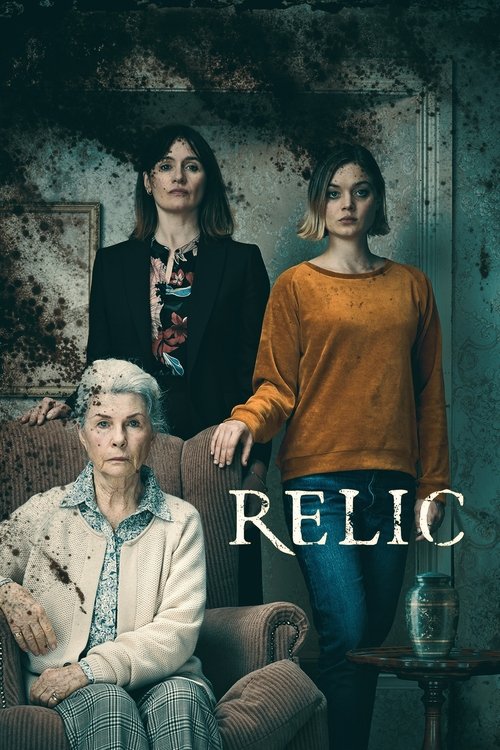
Relic
2020 · Natalie Erika James
For when you want horror that makes you feel something real — reach for it when you're ready to sit with sadness, not when you want popcorn scares. A challenge for the heart more than the nerves.
What it's about
Elderly Edna vanishes from her decaying house in rural Victoria, and her daughter Kay and granddaughter Sam drive out from Melbourne to find her. When Edna returns days later with no explanation and a strange spreading bruise, the two women stay on to care for her — and the house itself seems to rot alongside her mind, its walls growing black mould, its corridors no longer behaving. Three generations of women circle each other inside a home that is becoming a maze.
The experience
Slow, mournful, and quietly suffocating — the dread creeps in like damp rather than jumping out at you. It's as much a grief film as a horror film, and it leaves you aching more than shaken, with a finale that lands somewhere tender and strange.
Performances
Robyn Nevin is extraordinary as Edna, flickering between warmth, confusion, and something frightening, while Emily Mortimer and Bella Heathcote ground the film as a daughter and granddaughter torn between fear and duty.
The craft
Natalie Erika James directs her first feature with remarkable restraint, letting production design do the haunting: Post-it reminders, creeping mould, and a house whose geometry slowly stops making sense. The sound design is all groans and whispers in the walls — worth good speakers and a dark room.
Why it matters
A standout of the elevated-horror wave that premiered at Sundance Midnight and reached locked-down audiences in the first pandemic summer, it announced James as a filmmaker and became a touchstone for horror about aging and dementia.
Snapshot
Relic is Natalie Erika James's first feature. It is a slow, mournful haunted-house film set in rural Victoria, Australia, and it treats dementia as a slow possession of a person by the house they live in. Kay (Emily Mortimer), a middle-aged woman, and her daughter Sam (Bella Heathcote) drive from Melbourne to the family home in Creswick after Kay's elderly mother Edna (Robyn Nevin) goes missing. Edna comes back after several days with no explanation and a spreading black bruise. In the weeks that follow, the house seems to be decaying along with her. Black mould creeps across the walls, Post-it reminders pile up, and the corridors start to fold back on themselves. The film premiered in the Midnight section of the 2020 Sundance Film Festival. It reached audiences during the first summer of the COVID-19 pandemic and was widely praised as one of the most emotionally serious horror films of its moment. Its ending, a gesture of care where the genre usually stages a confrontation, is the scene it is most remembered for.
Industry & production
Relic is an Australian–American co-production. On the Australian side, Anna McLeish and Sarah Shaw of Carver Films produced it with public support from Screen Australia and Film Victoria, the usual development and financing route for Australian features of this scale. The American partners were Jake Gyllenhaal and Riva Marker's Nine Stories Productions. Anthony and Joe Russo's AGBO was also attached at the executive-producer level. That mix of a local producer, state and federal screen agencies, and US genre-friendly producers bringing visibility and sales leverage was typical of how Australian genre films found international homes in the years after The Babadook.
The project grew out of James's short film Creswick (2017), which she co-wrote and which used the same Victorian town and the same idea of a family home in decline. She developed the feature screenplay with Christian White, a Melbourne crime novelist (The Nowhere Child). The film was shot in Victoria on a modest budget; reliable published figures are scarce, and none is given here.
After Sundance, IFC Midnight acquired the film for North America and released it on 10 July 2020. Because of the pandemic it opened simultaneously in drive-ins, in the few cinemas still operating and on video-on-demand. That release pattern shaped how Relic was first seen: mostly at home, in a season when many viewers were isolated from elderly relatives. Umbrella Entertainment handled the Australian release.
Technology
Relic is a digitally shot contemporary production with no unusual technical apparatus. Its technical interest is in craft: practical effects and prosthetics, a carefully built set, and a restrained, low-light digital image. The decay of Edna's body is made mostly with prosthetic makeup, not digital creatures, and the film saves its few large transformations for the final act. The house's growing black rot was achieved through set dressing and art-department ageing. The impossible geography of the last act, where the house's interior expands into narrow, repeating passageways, depended on built spaces and controlled lighting, not obvious computer-generated environments. The dim, low-contrast image depends on modern digital sensors that can hold detail in near-darkness. The film relies on that ability, often leaving faces and corners just at the edge of what can be seen.
Technique
Cinematography
Charlie Sarroff, the cinematographer, works in a palette of muted greens, browns and greys. The light is often motivated by single practical sources such as lamps, torches and windows, and it rarely fills the frame. The camera tends toward stillness and slow, deliberate movement, holding on doorways, hallways and the dark gaps between rooms so that the audience scans the edges of the frame for movement. Several compositions isolate a character in a doorway or framed by architecture, which supports the film's idea that the house holds and shapes the people inside it. The surrounding bushland is shot as damp and enclosing rather than open, and the town is barely seen, so the house becomes a closed world. In the final act, as the corridors narrow and the lighting falls to torchlight, the cinematography shifts from domestic realism to something close to claustrophobic nightmare without an obvious stylistic break.
Editing
Denise Haratzis cut the film at an unhurried, cumulative pace. Most of its runtime builds atmosphere and family tension, not set-pieces, and the editing rarely uses the jump scare as a release. Lucid stretches of Edna's behaviour alternate with sudden lapses, and that rhythm parallels the experience of caring for someone with dementia, where ordinary hours are broken by disorientation or hostility. Recurring dream sequences, centred on a cabin and a stained-glass window, are cut in with little signposting, which keeps the border between dream, memory and haunting deliberately porous. The climax is handled with comparatively long takes. The film lets its central image of care play out instead of fragmenting it.
Mise-en-scène / staging
The house is the film's main expressive instrument. It is cluttered with a long life's possessions, and these details show both a person and a person disappearing: hand-written Post-it notes ("Take pills," "Don't follow it," and similar reminders), objects put in the wrong places, a bath left running. The spreading black mould works as an image of the disease, a stain that grows wherever Edna has been. A stained-glass window, which according to family lore came from a cabin where an ancestor died alone, links the present house to an earlier history of abandonment and decline.
The staging grows more dreamlike as the film goes on. Sam's exploration of a hidden, expanding interior of the house, with corridors that get tighter and turn back on themselves, makes literal how memory and orientation fail. That passage owes something to the impossible houses of Gothic fiction. Throughout, James stages Kay, Sam and Edna in triangular arrangements across rooms and doorways, so the film's three generations are kept visually linked and visually apart at once.
Sound
Brian Reitzell, the American composer and music supervisor, wrote the score. He is known for his work with Sofia Coppola and for the television series Hannibal. His contribution to Relic is mostly textural: drones, dissonant tones and atmospheres that blur into the house's own creaks, knocks and settling noises. The sound design makes the house audible as a body, with thumps in the walls, footsteps where nobody should be, and the drip and hiss of water. Long silences are used as tension. Neither the music nor the effects push towards spectacle, which suits the film's interest in the slow, ambient dread of watching someone decline rather than sudden shock.
Performance
The film rests on its three lead performances. Robyn Nevin is one of Australia's most senior stage actors and a former artistic director of the Sydney Theatre Company. She plays Edna as shifting continually between warmth, sharp wit, suspicion and frightening blankness, sometimes within one scene. She was widely singled out by critics. Her performance avoids caricature, so the horror of Edna's transformation always sits alongside recognisable human vulnerability. Emily Mortimer plays Kay as tightly wound and guilty, a daughter whose distance from her mother is the film's quiet accusation. Bella Heathcote's Sam is warmer and more direct with her grandmother, which sets up a generational contrast in how each woman responds. Chris Bunton has a small but significant role as Jamie, a neighbour's son whose earlier closeness to Edna becomes a source of menace and mistrust.
Narrative & dramatic mode
Relic is built as a chamber drama of three generations of women, with horror developing slowly out of family realism. The first two acts are made up of searching, caring and suspicion: Edna's disappearance and return, Kay's attempts to arrange care, Sam's tentative move towards living with her grandmother, and growing signs that something beyond illness is at work. The supernatural is never fully explained. The film suggests a family inheritance, linked to the ancestor's cabin and the stained-glass window, but it keeps the haunting metaphorical, and the decay can be read as the disease seen from inside the family.
The third act moves into open nightmare as the house traps Kay and Sam and Edna's body begins literally to come apart. The resolution turns away from the genre's usual endings of exorcism, escape or destruction. Kay chooses to stay with what her mother has become, peeling away the decayed outer layer and lying down beside the frail, blackened figure underneath, with Sam joining them. The final image hints that the same mark has begun to appear on Kay, so the inheritance continues. The ending is tragic but also an act of acceptance, and it is the film's central dramatic and thematic statement.
Genre & cycle
Relic belongs to several overlapping categories. It is a haunted-house film in the Gothic tradition, where the family home holds a family's history and its pathology. It is part of what critics and marketers in the late 2010s called "elevated" or "prestige" horror, a cycle of slow-burn, character-driven, often grief-centred films associated with distributors such as A24, Neon and IFC. Its most frequently cited companions are The Babadook (2014), Hereditary (2018), The Witch (2015) and It Follows (2014). In this cycle, illness, grief or trauma is externalised as a supernatural force, and a family's dysfunction is the true subject.
The film also sits within a smaller strand of horror about ageing and dementia. Earlier titles include The Taking of Deborah Logan (2014), a found-footage film that also blurs Alzheimer's and possession, and The Visit (2015), which uses the strangeness of elderly bodies for more sardonic effect. Relic differs from both in the seriousness and compassion of its treatment. In 2020 it arrived alongside Saint Maud and His House, other debut features that pushed horror towards psychological and social subject matter, and its close contemporary The Father (2020), a non-genre drama that also renders dementia as disorienting architecture.
Authorship & method
Natalie Erika James (director, co-writer) is a Japanese-Australian filmmaker from Melbourne. She has said in interviews that Relic came partly from her own family experience: a visit to her grandmother in Japan, who had Alzheimer's disease, and the unsettling impression left by the old family house there. Her short films Creswick (2017) and Drum Wave (2018) had already established her interest in domestic Gothic, uncanny houses and female family lines. Relic uses the short-film approach of a confined setting, few characters and a long build of atmosphere, extended to feature length. James later directed Apartment 7A (2024), a prequel to Rosemary's Baby made for Paramount+, which continued her work in female-centred psychological horror within an industrial franchise context.
Christian White (co-writer) brought a crime novelist's sense of plotting and mystery. The early sections, Edna's disappearance, the unexplained clues and the suspicion around the neighbours, are structured as an investigation.
Charlie Sarroff (cinematographer) gave the film its dim, enclosing visual atmosphere. Brian Reitzell (composer) supplied the atmospheric, drone-based score. Denise Haratzis (editor) shaped its slow, cumulative rhythm. The production design and makeup departments did essential work on the house's decay and Edna's transformation. Specific credits beyond the principal crew are not cited here, to avoid mis-attribution.
Movement / national cinema
Relic belongs to a strong period for Australian genre cinema, and especially for horror made by women and from personal experience. Jennifer Kent's The Babadook (2014) is the obvious national precedent: a South Australian, low-budget, Screen Australia–backed film about a mother, a house and grief that became an international reference point. Relic is often discussed as part of that lineage. The tradition goes back further, to the "Ozploitation" era of the 1970s and 1980s and to the Australian Gothic of films such as Picnic at Hanging Rock (1975) and Wake in Fright (1971), where the landscape and isolated settlements hold a disturbing power. Relic adds a domestic, suburban-rural setting in Victoria's goldfields, where the threat comes from inside an old family home rather than from the outback.
James's Japanese-Australian background also brings in a less obvious influence. Commentators have sometimes noted links to Japanese horror's preoccupation with houses, inherited curses and slow decay, as in Ju-on and related films. However, Relic does not adopt the visual language of J-horror directly, and explicit discussion of this influence in the critical record is limited.
Era / period
Relic was made in the late 2010s and released in 2020. It belongs to the high point of the "elevated horror" boom, when distributors and festivals actively sought arthouse-inflected genre debuts. Its Sundance premiere in January 2020 came weeks before the pandemic closed most cinemas worldwide. Its July 2020 release through drive-ins and VOD made it one of several festival horror titles that reached audiences mostly at home. Many critics noted that a film about the fear of an elderly parent's decline, and the guilt of not being present, landed with unusual force in a year when older people were especially vulnerable and often cut off from their families. That reading belongs to the moment of reception rather than the film's intent, but it shaped the film's early critical life.
Themes
- Dementia as haunting. The central idea is that the experience of dementia, for the person who has it and for the family around them, can be rendered as horror: a loved one becomes a stranger, the familiar home becomes a labyrinth, and the body decays while the person is still alive.
- Inheritance and matrilineage. Three generations of women share the house, and the closing image of the mark appearing on Kay's back makes the film's view of inheritance explicit, whether understood as genetic, emotional or supernatural. Fear of becoming one's mother is a key strand.
- Guilt, distance and care. Kay's absence from her mother's life, and her uncertainty about whether to move Edna into a care home, give the film its moral tension. The ending replaces flight or destruction with acceptance and physical care. That choice is the film's most distinctive thematic argument.
- The house as body and memory. The decaying home, the mould, the hidden passages and the stained-glass window from an ancestor's cabin all make the house a vessel for family history and for the physical deterioration of the people who live in it.
- Ambiguity of the supernatural. The film declines to separate illness from haunting and keeps both readings open. The horror comes from that uncertainty, which matches a caregiver's struggle to understand behaviour that no longer makes sense.
Reception, canon & influence
Critical reception. Relic was strongly received from its Sundance premiere and through its 2020 release. Reviews widely praised its restraint, its atmosphere and especially the three lead performances, with Robyn Nevin most often singled out. The ending was the most discussed element. Many critics called it one of the most moving conclusions in recent horror, and some viewers found the slow middle section too deliberate. The film was nominated in several categories at the AACTA Awards, Australia's main industry honours. Specific wins are not listed here, to avoid inaccuracy. It regularly appeared on critics' lists of the year's best horror films. Its aggregate critical score was high, though precise figures are not cited here.
Influences on the film (backward). Relic draws on:
- The Gothic haunted-house tradition, from Shirley Jackson's The Haunting of Hill House (and Robert Wise's 1963 film) to the impossible-architecture tradition of Mark Z. Danielewski's House of Leaves, which critics frequently invoked for the expanding-corridor finale.
- The Babadook (2014) as a national and thematic model for grief-as-monster horror.
- Hereditary (2018) and the wider elevated-horror cycle of trauma-driven family horror.
- The Taking of Deborah Logan (2014) and earlier dementia-adjacent horror.
- The director's own short Creswick (2017) and, by her own account, her family's experience of Alzheimer's.
Legacy (forward). It is too soon for a full assessment of Relic's lasting influence, and any claims should be measured. It strengthened the international profile of the Australian horror resurgence that followed, which includes the Philippou brothers' Talk to Me (2022), the Cairnes brothers' Late Night with the Devil (2023) and Daina Reid's Run Rabbit Run (2023), another film about a mother, a daughter, inheritance and haunted memory. Direct lines of influence between these titles are hard to document. It established Natalie Erika James as a director able to move into larger franchise work, as Apartment 7A showed. Within horror criticism, Relic has become a standard example of how the genre can treat ageing, illness and caregiving with compassion. It is often named alongside The Babadook as a model for using the haunted-house form to dramatise a specific, real human experience without resolving it into exorcism or escape.
Influences: the films it descends from and the films it influenced
- The Haunting (1963) — Wise's house is the antagonist. The threat comes from breathing doors and offscreen pounding instead of a visible monster, and Relic uses the same approach: the menace is the building's sounds and its warping walls, and the creature is held back until late.
- Repulsion (1965) — Polanski shows a mind coming apart through the apartment itself: cracking plaster, rotting food and walls that reach for the heroine. Relic's spreading black mould and decaying house work the same way, putting cognitive decline into the building's fabric.
- The Shining (1980) — Kubrick built the Overlook's floor plan so it could not exist, with windows that couldn't be there and corridors that don't connect. Relic's finale, where the house's corridors keep expanding and folding back, is a literal version of that disorienting geography.
- Dark Water (2002) — Nakata's spreading ceiling stain is a J-horror sign of rot that keeps growing. Relic's black mould, set in a story about mother, daughter and inheritance, uses the same slow-growing damp, and its Japanese-Australian director has cited a Japanese family house as one source.
- Lake Mungo (2008) — This earlier Victorian-set Australian grief horror builds its dread from quiet domestic spaces and a family's composure, with almost no shock cuts. It set the slow, jump-scare-free pace that Relic follows.
- Amour (2012) — Haneke keeps the camera inside an apartment while one partner cares for the other through a degenerative illness, framing them in long takes through doorways. Relic applies the same staging of care and confinement to horror.
- The Babadook (2014) — Kent's film is Relic's Australian model for a monster that is really a family member's illness. Its ending also sets the pattern Relic follows: the threat is accepted and lived with rather than driven out.
- The Taking of Deborah Logan (2014) — Robitel was among the first to make Alzheimer's symptoms such as wandering, confusion and aggression look like possession. Relic takes the same device but drops the found-footage format and the exorcism ending.
- Hereditary (2018) — Aster's grief-as-genetic-curse structure, built in slow tableau shots across three generations of women, gives Relic its template for treating what passes down the female line as horror.
- Smile (2022) — Relic's cinematographer Charlie Sarroff brought his low-light, lamp-lit night interiors and tight doorway compositions to Finn's studio horror film.
- Skinamarink (2022) — Ball takes the underlit corridor and the doorway that leads nowhere to an extreme. The whole film is a familiar house that has become impossible, the same space Relic reaches in its final act.
- Talk to Me (2022) — In the Australian horror wave Relic helped bring to international attention, the Philippous rely on practical prosthetic make-up for bodily decay rather than CGI, as Relic did with Edna's transformation.
- Run Rabbit Run (2023) — Reid follows Relic's Australian template closely: a slow haunting through the mother-daughter-grandmother line, a decaying family house in the country, and memory loss shown through spaces that become unreliable.
- Apartment 7A (2024) — James brings Relic's motivated low light and its warping apartment interiors to this Rosemary's Baby prequel. As in Relic, the building's architecture is used to show a woman's growing sense that she has lost control of her own body.
- The Father (2020) — Released the same year, Zeller's film also shows dementia through rooms that change shape: furniture and floor plans quietly shift between scenes. This is the realist counterpart to Relic's impossible-architecture metaphor.
- The Night House (2020) — Bruckner's lakeside home has a hidden mirror-image floor plan where grief takes physical form. Like Relic, it turns a familiar house into a maze with no exit, using architecture as the special effect.
- His House (2020) — Weekes uses crumbling walls as portals that open onto inherited trauma. Like Relic, it treats the rotting fabric of the house as the way into the past, and it ends with the characters choosing to live with their ghosts.
- Oddity (2024) — Confines its horror to one decaying house and builds through patient staging and silence toward a single physical manifestation — the single-location slow-burn-with-practical-payoff structure Oddity uses.
- Saint Maud (2020) — A pandemic-era women-directed elevated horror centered on two women in opposed interiors and a body in decay, sharing Saint Maud's shallow-focus intimacy and refusal of clean resolution.
- Evil Dead Rise (2023) — Literalizes home-as-unsound-foundation by having the house physically decay, shift, and mutate as an expression of maternal horror — the architectural-instability metaphor Rise stages in a condemned building.
- Bring Her Back (2025) — A contemporary Australian domestic-chamber horror that literalizes loss and bodily decay as a house-bound monster consuming the family from within.
Similar films
- Hereditary (2018) — influence & lineage
- The Babadook (2014) — influence & lineage
- The Haunting (1963) — influence & lineage
- The Father (2020) — influence & lineage
- Bring Her Back (2025) — shared sensibility
- Skinamarink (2023) — shared sensibility
- When Evil Lurks (2023) — shared sensibility
- A Tale of Two Sisters (2003) — shared sensibility