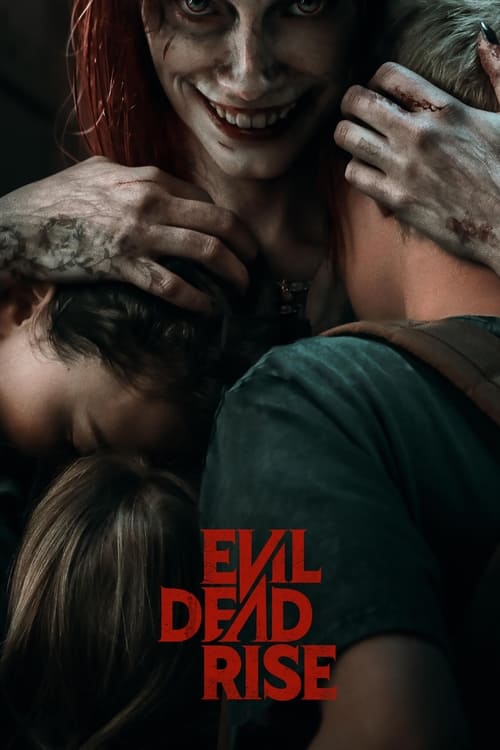
Evil Dead Rise
2023 · Lee Cronin
For when you're craving a real scare and don't want it watered down — a horror night with friends who can handle buckets of the red stuff. Comfort food only if your comfort food bites back.
What it's about
Two estranged sisters — one a road-worn guitar tech, the other a single mom raising three kids in a condemned Los Angeles apartment tower — get one night to reconnect before an earthquake cracks open something buried beneath the building. What the kids find down there is an old book that should have stayed shut, and soon a flesh-possessing demon is wearing the face of the person the children trust most. The family's fight to survive until morning plays out almost entirely inside one crumbling high-rise.
The experience
Relentless once it gets going — a mean, loud, gleefully gory ride that keeps finding new ways to make household objects and family bonds terrifying. It's grim about who it threatens, but there's a wicked streak of dark humor in how far it's willing to go.
Performances
Alyssa Sutherland is the reason to show up: as the possessed mother she contorts sweetness into pure menace, delivering taunts through a grin that gets under your skin. Lily Sullivan grounds it as the reluctant aunt forced into protector mode.
The craft
Lee Cronin leans hard on practical effects — real prosthetics, real fluids — and the tactility pays off in a way digital gore never quite manages. Trapping the mayhem in hallways, a peephole, and one apartment gives the film a pressure-cooker geometry, and the sound design turns an elevator and a cheese grater into instruments of dread. Absolutely rewards a dark room and loud speakers.
Why it matters
It proved a legacy horror franchise could leave its iconic setting behind and still feel like itself, revitalizing the Evil Dead series for a new generation and announcing Cronin as a director to watch.
Horror · Possession & occult · Splatter & gore. A demon wears a mother's face in a crumbling high-rise — relentless practical-effects splatter, mean and loud, with a wicked grin.
Snapshot
Evil Dead Rise is the fifth feature in the Evil Dead franchise and the first to abandon the series' foundational cabin-in-the-woods setting, relocating Deadite possession to a decaying Los Angeles apartment block. Written and directed by the Irish filmmaker Lee Cronin, and produced under the eye of franchise architects Sam Raimi, Robert Tapert, and Bruce Campbell, the film reframes the property's core anxiety — the intimate becoming monstrous — as a story about motherhood and sisterhood rather than doomed twentysomethings on a getaway. Its central horror is a possessed mother turned against her own children, a premise the film pursues with unrelenting practical gore. Released theatrically in 2023 after originally being developed for streaming, it was widely received as a confident, brutal continuation that honored the franchise's mix of dread and dark comedy while carving out its own claustrophobic, urban identity.
Industry & production
The film sits inside a lineage carefully stewarded by Raimi's Renaissance Pictures alongside New Line Cinema. Its most consequential production fact is a change of venue: Evil Dead Rise was initially conceived as a direct-to-streaming title for Warner Bros.' HBO Max platform before the studio pivoted it to a theatrical release, a decision that reflected both confidence in the finished film and the broader industry recalibration around streaming-versus-theatrical strategy in the early 2020s. Principal photography took place in New Zealand, primarily around Auckland, which had long served as a production base for Raimi and Tapert's work (their Hercules/Xena and Spartacus television empires, and the later Ash vs Evil Dead series). Shooting an intensely American-coded story of a Los Angeles apartment building on New Zealand soundstages is itself telling about the economics of contemporary genre production, where location is a constructed effect rather than a documentary fact.
Cronin's selection as writer-director followed his 2019 debut The Hole in the Ground, an Irish folk-horror film that impressed Raimi enough to entrust him with the franchise. The producing configuration — Raimi, Tapert, and Campbell as the guarantors of continuity, Cronin as the fresh authorial voice — mirrors how the 2013 Evil Dead was handed to Fede Álvarez: the originators supervise, a younger director executes and reinvents. On exact budget and box-office figures the public record carries specific numbers I cannot responsibly reproduce from memory without risking error; what can be stated confidently is that the film was regarded within the trade as a commercial success relative to its modest cost, consistent with the franchise's long-running profile as a reliably profitable, lower-budget horror property.
Technology
Evil Dead Rise is a digitally captured film that leans heavily on practical, in-camera effects supplemented by digital finishing rather than replaced by it. The franchise's identity has always been bound to tactile, handmade horror — prosthetics, animatronics, and prodigious quantities of fake blood — and Cronin's entry continues that commitment, staging much of its carnage with practical prosthetic makeup and mechanical gags. Digital tools serve compositing, cleanup, cosmetic enhancement of practical gore, and the sweeping camera moves (including drone-style aerial work) that bracket the story. This hybrid method is now standard for the genre: the "practical effects" branding markets authenticity, while digital post quietly extends and safeguards what the on-set effects establish. The plot device that unleashes the evil is itself an old technology — vinyl records — with priests' phonograph recordings of the Book of the Dead's incantations serving as the mechanism that summons the demons, a neat conceit that trades the franchise's usual tape recorder for something older and more liturgical.
Technique
Cinematography
The cinematography is credited to Dave Garbett, a longtime collaborator within the Raimi–Tapert orbit whose work includes Ash vs Evil Dead, giving the film an insider's fluency with the franchise's visual grammar. The most striking formal choice is spatial: where earlier entries exploited the isolation of the forest, Evil Dead Rise exploits the vertical, boxed geometry of an apartment building — hallways, stairwells, a cramped elevator, locked doors. Garbett's camera favors oppressive interiors and unnerving overhead compositions, including a signature top-down framing that renders the family's home a maze seen from above, and aerial exteriors that open and close the film. The palette is dominated by dim domestic interiors punctured by shocks of red, and the film repeatedly uses the architecture of the building — the peephole, the corridor, the flooded elevator — as framing devices that convert familiar living space into a trap.
Editing
Cut by Bryan Shaw, the film is structured around a prologue-and-payoff frame: a cold open at a lakeside setting (a nod to the franchise's woods origins) that is later revealed to be the aftermath, so the main body of the film plays as flashback to the night before. Within scenes, the editing modulates between slow-burn dread — long, quiet build-ups as possession spreads — and the franchise-mandatory bursts of frenetic violence. The rhythm honors Raimi's model without imitating his kinetic camera style directly; Cronin's film is more patient in its stalking passages and then abrupt in its shocks.
Mise-en-scène / staging
The production design's central invention is the apartment itself and the wider building, a condemned, earthquake-damaged block whose decay is legible in every frame. An early tremor cracks open a hidden bank vault beneath the parking garage, from which the children retrieve the records and the Book of the Dead — a literalization of buried, foundational evil rising up through the domestic structure (the "Rise" of the title working on multiple registers). Staging concentrates the action in and around one family unit, using locked doors, thresholds, and the peephole to organize suspense. Everyday domestic objects are weaponized in the franchise tradition — most infamously a cheese grater — collapsing the boundary between kitchen and slaughterhouse.
Sound
The score is by Stephen McKeon, Cronin's composer from The Hole in the Ground, whose music trades in dissonance and dread rather than melodic reassurance. Sound design is crucial to the possession conceit: the crackle and warp of the vinyl recordings, the distorted vocalizations of the possessed (the guttural, layered Deadite voice that has been a franchise signature since 1981), and the tactile squelch of the practical gore all do heavy narrative work. The demonic voice — taunting, obscene, mimicking the mother's affection — is arguably the film's most disturbing sonic element.
Performance
The film rests on two central performances. Alyssa Sutherland plays Ellie, the single mother whose possession transforms maternal warmth into predatory menace; her turn is the film's engine, requiring a shift from exhausted tenderness to grotesque, sing-song malevolence. Lily Sullivan plays Beth, the estranged, itinerant sister (a guitar tech facing an unplanned pregnancy) who is thrust into a surrogate-mother role as she fights to protect her nieces and nephew. The child and adolescent performers carry significant dramatic weight, since the film's horror depends on our belief in this family as a family before it is torn apart. Sutherland's performance in particular drew critical attention as one of the more memorable Deadite embodiments in the series.
Narrative & dramatic mode
Structurally the film is a survival-horror siege compressed into a single night and a single dwelling, framed by a prologue that discloses the outcome in advance and thereby loads the main narrative with dread. Its dramatic mode fuses domestic melodrama with body horror: the first act invests in a recognizable family under strain — a separation, money worries, a pregnancy, sisterly estrangement — precisely so the possession can desecrate those bonds. The register oscillates between genuine emotional stakes and grand-guignol excess, with streaks of the gallows humor the franchise is known for, though Cronin pitches the comedy far lower than Raimi's slapstick Evil Dead II. The through-line is a survival narrative in which the protective adult (Beth) must become the mother she is afraid to be.
Genre & cycle
Evil Dead Rise belongs to the possession/demonic-horror tradition and to the specific Evil Dead cycle inaugurated by Raimi in 1981. Within that cycle it is a reinvention rather than a sequel or reboot: it neither continues Ash Williams' arc nor retells the 2013 remake, but transplants the core mythology (the Book of the Dead, the Deadites, the ritual of unwitting summoning) into a new milieu. Its relocation to an apartment building consciously breaks the "cabin in the woods" convention that the original films helped codify, aligning it instead with urban-siege horror. It also participates in the 2010s–2020s wave of "elevated" or thematically-driven horror crossed with unabashed extremity, and in the broader cycle of legacy-horror-franchise revivals that studios pursued in the period.
Authorship & method
The authorship is genuinely dual. Cronin is the film's writer-director and creative author, bringing from The Hole in the Ground a preoccupation with maternal anxiety and the family unit under supernatural threat — themes that make him an unusually apt custodian for this particular story. His key collaborators reinforce a coherent method: cinematographer Dave Garbett supplies franchise-literate camerawork; composer Stephen McKeon carries over his working relationship with Cronin; editor Bryan Shaw shapes the prologue-frame structure and the tonal swings. Above them all sit Raimi, Tapert, and Campbell as producers, functioning as guarantors of tone and mythology rather than hands-on directors. This is franchise authorship as supervised delegation — the same arrangement that produced Álvarez's 2013 film — in which a distinctive newer voice is allowed genuine creative latitude within firmly maintained brand parameters. The practical-effects-first ethos is itself an authorial signature inherited from Raimi's low-budget origins.
Movement / national cinema
The film is not easily assigned to a single national cinema, which is itself characteristic of contemporary genre production. It is an American studio franchise property, directed by an Irish filmmaker, photographed by a New Zealand-based cinematographer, and shot in New Zealand. Cronin's presence links it, at least in authorial temperament, to the strong recent current of Irish and British Isles horror preoccupied with folklore, family, and the uncanny domestic — the milieu of his own debut. But Evil Dead Rise is not a folk-horror film; it is a transnational commercial production whose "American" texture is engineered rather than native. The more meaningful lineage is industrial: the Auckland-based Raimi–Tapert production infrastructure that has for decades manufactured American genre entertainment offshore.
Era / period
Made and released in the early 2020s, the film bears the marks of its moment in ways beyond its content. Its journey from an intended HBO Max streaming release to a theatrical bow is a direct artifact of the post-pandemic industry's unsettled relationship between streaming and cinemas. Aesthetically it reflects a period in which horror had reclaimed cultural and commercial prestige, and in which studios aggressively revived dormant genre franchises for a new generation. Its emphasis on practical effects also reads as a period signature — a deliberate, marketable rejoinder to an era of digitally-dominated spectacle, positioning tactile gore as a mark of authenticity.
Themes
The film's dominant theme is motherhood and its corruption. By making the possessed figure a mother and her victims her own children (and their protective aunt), Cronin turns the franchise's abstract dread of contamination into something specifically familial and gendered: the person meant to nurture becomes the thing that hunts. Adjacent themes include sisterhood and estrangement (Beth and Ellie's fractured relationship, and Beth's reluctant assumption of a maternal role), the fear of impending parenthood (Beth's pregnancy), and the fragility of the home as sanctuary. The apartment building — condemned, cracked open by a quake to release a buried evil — functions as a sustained metaphor: the domestic structure is unsound at its foundations, and what was buried beneath the family literally rises to devour it. The Deadite's cruelest weapon is mimicry of maternal love, which makes the film's horror as much psychological as visceral.
Reception, canon & influence
Critically, Evil Dead Rise was received as one of the stronger entries in the franchise's modern phase, with particular praise for its practical gore, its claustrophobic apartment setting, and Alyssa Sutherland's performance; reviewers frequently framed it as a worthy, distinctive continuation rather than a redundant retread. (I am characterizing the consensus rather than citing specific figures, which I will not fabricate.)
Its influences flow backward through a clear genealogy. Most directly it draws on Raimi's The Evil Dead (1981) and Evil Dead II (1987) and their mythology of the Book of the Dead and Deadite possession, and on Álvarez's harder-edged 2013 remake, which re-established the franchise as a vehicle for serious, extreme horror stripped of Ash's comedy. Beyond the franchise, its single-night, single-location siege structure and its theme of the possessed intimate connect it to the wider possession-horror tradition and to urban-confinement horror. Cronin's own The Hole in the Ground is a clear authorial antecedent for its maternal preoccupations.
Its forward legacy is still consolidating given its recency, but two things can be said with confidence. First, it demonstrated that the Evil Dead property could thrive without Ash Williams and without the woods, expanding the franchise's conceptual range and keeping it commercially viable as an ongoing concern — a further Evil Dead film from a different filmmaker was subsequently set in motion under the same producers. Second, it reinforced a broader industry lesson that supervised-auteur revivals of horror IP, built on practical effects and a strong thematic hook, remain a durable model. As the most recent installment at the time of writing, its full influence on the genre and the franchise remains to be seen, and I flag that the historical record on its downstream impact is necessarily thin.
Reception
Landed in 2023 as that rare legacy-franchise revival critics and gorehounds both embraced, and a sleeper box-office hit; a few years on it's settled in as proof the Evil Dead series can thrive without Ash, with Cronin handed the keys to keep going.
How Evil Dead Rise was received, from release to now →
How to watch Evil Dead Rise: what to notice on a first viewing
- Notice the shots looking straight down into the apartment. Garbett keeps returning to an overhead framing that turns the family's rooms into a maze seen from above. From that height a home reads as a floor plan with people in it. You are given the layout of the place.
- Count the doors, stairwells, and locked thresholds in each scene. This is the first Evil Dead film with no woods. Cronin works the vertical geometry of a condemned Los Angeles block instead: corridors, a cramped elevator, a peephole, chains on the inside of a door. Every architectural feature of an ordinary building is converted into a suspense device. The place people live becomes the reason they cannot leave.
- Listen for the possessed voice imitating a mother's affection. The layered guttural Deadite voice has been a franchise signature since 1981. Here it is aimed at children, and its favorite weapon is the sound of tenderness coming out of the wrong thing. The cruelest effect in the film is aural. A familiar voice keeps offering comfort, and accepting it is what gets people killed.
- Look at the cracks the tremor opens in the building. An earthquake splits the parking garage and exposes a hidden bank vault under the block. The records and the Book of the Dead come up from there, out of the ground the apartments are standing on. The title works on the architecture. What destroys this family was buried beneath their own home and rises through it.
- Watch the lakeside opening before the main story starts. Shaw frames the film with a cold open at a lake, nodding to the woods the series came from. Then the story moves to the apartment block. The cold open sets the series' tone before the family appears.
The whole guide to watching Evil Dead Rise, with the keys for a rewatch →
Influences: the films it descends from and the films it influenced
- The Evil Dead (1981) — Establishes the low-mounted 'Shakycam' force-POV rig — the camera bolted to a plank and hurtled through the space — that renders the demonic presence as a roving first-person camera, a device Rise reprises through its apartment corridors.
- Evil Dead II (1987) — Codifies the whip-pan, Dutch-angle tonal violence and the practical Deadite makeup vocabulary — milky-eyed, distended, cackling possession — that Sutherland's performance and the film's swings between menace and grotesque comedy directly inherit.
- Evil Dead (2013) — Sets the immediate template Rise operates under: comedy-stripped, extreme practical-gore-first horror made as a supervised-delegation revival, with Raimi/Tapert/Campbell guaranteeing mythology while a new auteur takes creative latitude.
- The Shining (1980) — Its elevator-disgorging-a-tide-of-blood is echoed almost shot-for-shot in Rise's apartment-hallway blood deluge, and its Steadicam pursuit of a family trapped in an oppressive interior underwrites the film's confined-domestic geometry.
- Rosemary's Baby (1968) — Relocates supernatural dread from gothic estate to a claustrophobic urban apartment block and makes maternity itself the site of horror — the two structural moves Rise builds its 'possession in a decaying tenement' premise on.
- The Exorcist (1973) — Originates the possessed-family-member template and the layered, pitch-shifted demonic-voice sound design — a human timbre corrupted by lower, doubled tracks — from which Rise's Deadite voice is engineered.
- The Hole in the Ground (2019) — Cronin's own prior feature supplies his authorial signature imported wholesale: maternal anxiety and the child/family that has become subtly, then violently, wrong under supernatural replacement.
- [REC] (2007) — Turns an apartment building into a sealed trap and uses its vertical stairwell architecture to funnel a spreading possession/infection floor by floor — the urban-siege spatial logic Rise adopts.
- Demons (1985) — Pioneers the single sealed-venue outbreak in which the possessed multiply and besiege a dwindling group, converting bystanders into attackers — the escalating deadite-siege structure Rise runs inside one flat.
- Talk to Me (2022) — A near-contemporaneous possession horror keyed to a physical summoning object and ritual, realized with tactile practical effects — the same 'cursed device triggers possession' craft as Rise's vinyl-record summoning.
- Lee Cronin's The Mummy (2026) — The direct craft precursor. David Garbett's cinematography of a sealed apartment block as a tomb, a possessed mother turning on her children, McKeon's score, and heavy practical gore all move straight into The Mummy's crew and method.
- The Descent (2005) — Shares the female-ensemble-under-siege claustrophobia driven by fractured sisterhood, executed through tight, dark spatial confinement and tactile practical creature and gore effects.
- The Babadook (2014) — A corrupted-motherhood horror where the domestic home itself becomes the unsound, hostile antagonist and the mother is the vector of threat to the children — Rise's central thematic engine in a domestic register.
- Hereditary (2018) — Deploys dollhouse and overhead god's-eye framing of the family home as a trap, and curdles maternal grief into supernatural menace — the same overhead-architecture grammar and corrupted-parent figure Rise uses.
- Relic (2020) — Literalizes home-as-unsound-foundation by having the house physically decay, shift, and mutate as an expression of maternal horror — the architectural-instability metaphor Rise stages in a condemned building.
- Barbarian (2022) — Makes the building's architecture the antagonist, weaponizing vertical descent and the unsound domestic structure as the mechanism of dread — a contemporaneous peer in urban-architecture horror.
- Don't Breathe (2016) — Álvarez's single-location siege thriller built on legible spatial geography and pursuit through a confined dwelling — the same director's confined-space craft that shapes the franchise's modern siege mode.
- Evil Dead Burn (2026) — Direct narrative and casting continuity — Alyssa Sutherland's Deadite matriarch returns — and the shift of the outbreak into a confined domestic/urban dwelling rather than the cabin.
Similar films
- Evil Dead (2013) — influence & lineage · same viewing thread
- Evil Dead II (1987) — influence & lineage · same viewing thread
- Relic (2020) — influence & lineage · same viewing thread
- The Descent (2005) — influence & lineage · same viewing thread
- Evil Dead Burn (2026) — same viewing thread
- When Evil Lurks (2023) — same viewing thread
- The Evil Dead (1982) — same viewing thread
- Lee Cronin's The Mummy (2026) — same viewing thread
All the films related to Evil Dead Rise →
Watch it with: curated runs of related films
- Trapped in the Dark — Watch these as a run of survival horror where the place itself — a chained-shut bathroom, a cabin cellar, a lightless cave, an endless fluorescent nowhere, an emptied city — turns into the thing hunting you.
- Cursed and Contagious — Watch these back to back for how each imagines evil as something that moves — a curse handed off by a smile, a demon incubated in a neighbor, a possession creeping family member by family member.
- Blood by the Bucketload — A run of horror that treats gore as showmanship: elaborate death set-pieces, practical effects by the gallon, and the giddy, squirming fun of watching it with a crowd, from Jigsaw's traps and Final Destination's chain reactions to Ready or Not's wedding-night bloodbath and The Substance's body-horror finale.