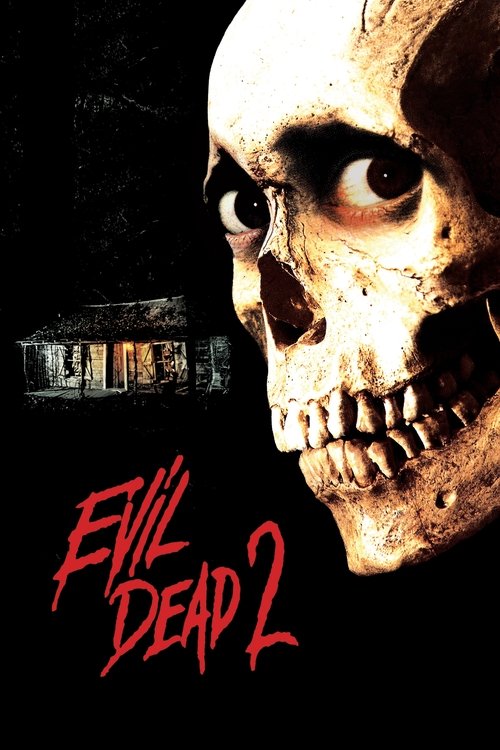
Evil Dead II
1987 · Sam Raimi
For when you want to laugh and scream in the same breath — a party movie, a midnight movie, the perfect thing when straight horror feels too grim but you still want your pulse up.
What it's about
Ash Williams brings his girlfriend to a remote cabin in the woods, where a tape recording of an archeologist reciting chants from the Book of the Dead unleashes something that wants everyone in the cabin — starting with her. What follows is one man's very long, very bad night fighting a possessing evil with whatever's at hand, up to and including a chainsaw.
The experience
A screaming rollercoaster that's somehow hilarious and genuinely nerve-jangling at once — the horror keeps escalating into slapstick and then the slapstick turns scary again. It's relentless, gleefully gross, and over before you catch your breath.
Performances
Bruce Campbell gives one of the great physical-comedy performances in genre history — matinee-idol jaw, crash-test-dummy body, throwing himself around the cabin like a one-man Three Stooges act while selling real terror underneath.
The craft
Sam Raimi bolted cameras to planks and motorcycles and sent them hurtling through the woods as the evil's point of view, tilting frames like a funhouse and drenching everything in stop-motion, prosthetics, and unnatural fluids. The low budget is the style: every effect is handmade and the seams are part of the joke. Loud speakers and a crowd make it sing.
Why it matters
It invented a tone — splatstick — that horror-comedy has been chasing ever since, and became a foundational text for a generation of genre directors who grew up on its DIY audacity.
Sam Raimi's return to the cabin is less sequel than possession: he restages his 1981 shocker's premise with real money, then accelerates it into delirium. Bruce Campbell's Ash — jaw like a matinee idol, dignity of a crash-test dummy — endures a one-man vaudeville of self-inflicted violence that owes as much to the Three Stooges as to any horror tradition, and the film invented a tone, splatstick, that horror-comedy has been chasing since. The craft is the joke: Raimi bolted cameras to planks and motorcycles and sent them screaming through the woods as the unseen evil's point of view, tilted his frames like a funhouse, and let stop-motion, prosthetics, and a flood of unnatural fluids do the rest. Dead by Dawn, as the subtitle has it, became a foundational text for a generation of genre directors — Peter Jackson's early gore farces and Edgar Wright's kinetic cutting both descend from it — and Campbell's chainsaw silhouette became modern horror's most durable icon.
A Deleuzian reading
The hand turns on him first.
The full Deleuzian reading of Evil Dead II →
Reception
A modest indie release in 1987 that horror fans loved but the mainstream ignored — decades of VHS circulation and midnight screenings turned it into the consensus pinnacle of the horror-comedy, now routinely ranked among the greatest sequels ever made.
How Evil Dead II was received, from release to now →
Influences: the films it descends from and the films it influenced
- The Evil Dead (1981) — The direct source film Evil Dead II remakes in its first act, establishing the low-mount 'shaky-cam' demon-POV rig and the improvised camera mounts (2x4 'Ram-O-Cam', shaky-cam) Raimi reprises and refines.
- The Three Stooges (Columbia shorts) (1940) — The eye-poke/slap rhythm and self-inflicted bodily punishment that Ash's one-man slapstick — the possessed hand beating him with plates — directly transposes into horror.
- Sherlock Jr. (1924) — Deadpan physical comedy treating the body as an abused prop and precise stunt choreography, the silent-slapstick grammar behind Bruce Campbell's escalating pratfalls.
- The Cabinet of Dr. Caligari (1920) — German Expressionist canted framing and warped space — the source of Raimi's aggressive Dutch angles that tilt the cabin into a nightmare geometry.
- Jason and the Argonauts (1963) — Ray Harryhausen's stop-motion armature animation, the technique Raimi apes for the jerky, herky-motion deadite corpses and the dancing/decaying bodies in the finale.
- The Texas Chain Saw Massacre (1974) — Codified the chainsaw as a horror icon and the relentless, sweaty kinetic assault that Raimi weaponizes when Ash grafts the saw onto his stump.
- Night of the Living Dead (1968) — The besieged-cabin siege structure and matter-of-fact practical gore of possession-as-contagion that Evil Dead II inherits as its dramatic engine.
- Dawn of the Dead (1978) — Tom Savini-style latex-and-Karo-syrup practical splatter, the maximalist prosthetic gore aesthetic Raimi's crew pushes into geysering absurdity.
- Halloween (1978) — The prowling subjective monster-POV Steadicam glide, ancestor to Raimi's low, rushing point-of-view of the unseen evil force tearing through the woods.
- An American Werewolf in London (1981) — Fused belly-laughs with Rick Baker's grotesque practical transformation FX, proving the horror-comedy tonal whiplash Evil Dead II lives on.
- A Nightmare on Elm Street (1984) — Surreal dream-logic set-pieces built from in-camera practical effects (rotating rooms, elastic reality) that license Raimi's laughing-mounted-head and living-room mania.
- Army of Darkness (1992) — Raimi's own direct sequel extends Ash's one-liner slapstick and Harryhausen-homage stop-motion skeletons into a full swashbuckling comic set-piece register.
- Braindead (Dead Alive) (1992) — Takes Evil Dead II's splatstick to its logical extreme — lawnmower massacre, gallons of prosthetic viscera played for slapstick — the facet's named heir.
- Shaun of the Dead (2004) — Wright's whip-pan snap-zoom kinetic cutting and horror-comedy timing are self-avowedly built on Raimi's rapid-fire montage grammar.
- Drag Me to Hell (2009) — Raimi returns to gross-out splatstick and demonic-possession gags — the flying eyeball, projectile fluids — refining the Evil Dead II shock-laugh cadence decades later.
- The Cabin in the Woods (2012) — Deconstructs the very cabin-in-the-woods deadite scenario Evil Dead II codified, turning its practical-monster menagerie into meta-genre commentary.
- Evil Dead (2013) — The reboot re-stages the cabin, the Book of the Dead, and the practical-effects gore purism as a direct homage to Raimi's blueprint.
- Ichi the Killer (2001) — Pioneers the splatter-comedy tonal whiplash — extreme practical gore played simultaneously as horror and slapstick — the editing principle Ichi weaponizes against the viewer's moral footing.
- Spider-Man 2 (2004) — The deadite rushing-POV 'shaky-cam' and possessed-limb slapstick reappear almost literally in Doc Ock's animatronic arms and the buzz-saw hospital surgery attack, a horror setpiece dropped whole into a superhero movie.
- Hot Fuzz (2007) — Raimi's kinetic crash-zooms, whip-pans and percussive insert-montages of mundane actions (loading, pouring, stamping) are the core Wright visual idiom used to make paperwork and pub-visits feel like action sequences.
- Chainsaw Man - The Movie: Reze Arc (2025) — Its frantic subjective 'shaky-cam' chase camera and comedy-to-gore tonal whiplash are echoed in Reze Arc's kinetic handheld staging and abrupt mood breaks.
- Spider-Man (2002) — The hurtling first-person 'force' camera that rushes through space at ground level is the direct stylistic ancestor of the web-swing POV shots that plunge through Manhattan canyons.
- Evil Dead Rise (2023) — Codifies the whip-pan, Dutch-angle tonal violence and the practical Deadite makeup vocabulary — milky-eyed, distended, cackling possession — that Sutherland's performance and the film's swings between menace and grotesque comedy directly inherit.
- Bad Taste (1987) — Contemporaneous DIY splatstick that shares the home-built camera rigs and gleeful practical-gore excess, the parallel branch to Raimi's aesthetic.
- The Little Shop of Horrors (1960) — Extends the verbal-and-physical velocity of horror-comedy — a tiny crew prizing kinetic energy and slapstick timing over technical polish, exactly the rough-edge-for-energy trade Corman pioneered.
- Evil Dead Burn (2026) — Codifies the instinctive splatter tonal rollercoaster (slapstick shading into gore without rule-bound structure), the exact tone-over-structure ethos Vaniček names as his organizing principle.
- Doctor Strange in the Multiverse of Madness (2022) — Supplies the fusion of splatstick horror with cartoonish slapstick timing — Dutch-angled ghoulishness played simultaneously for scares and gleeful comedy, the exact tonal register of the possessed-corpse and eyeball gags.
- Re-Animator (1985) — Raimi recalibrates his own series toward slapstick using Re-Animator's discovery that a detached, autonomous body part can be blocked and timed as a comic performer — though he routes the gag through camera choreography where Gordon routes it through actors.
- A Nightmare on Elm Street 3: Dream Warriors (1987) — Contemporaneous refinement of the same toolkit — stop-motion and claymation intercut with latex appliances, low canted wide-angle coverage, and comic timing welded onto splatter — arriving at the identical mid-80s discovery that the effects set piece plays better when the audience is allowed to laugh at it.
- The Return of the Living Dead (1985) — Shares the farce-escalation grammar in which every containment attempt — restraint, dismemberment, burial, burning — worsens the situation, and grants the dead taunting speech, the same combination of verbal undead and failed-solution structure Return runs.
Similar films
- Army of Darkness (1992) — influence & lineage
- Evil Dead (2013) — influence & lineage
- The Texas Chain Saw Massacre (1974) — influence & lineage
- The Cabin in the Woods (2012) — influence & lineage
- Dawn of the Dead (1978) — influence & lineage
- Night of the Living Dead (1968) — influence & lineage
- Halloween (1978) — influence & lineage
- A Nightmare on Elm Street (1984) — influence & lineage
All the films related to Evil Dead II →
Watch it with: curated runs of related films
- Trapped in the Dark — Watch these as a run of survival horror where the place itself — a chained-shut bathroom, a cabin cellar, a lightless cave, an endless fluorescent nowhere, an emptied city — turns into the thing hunting you.