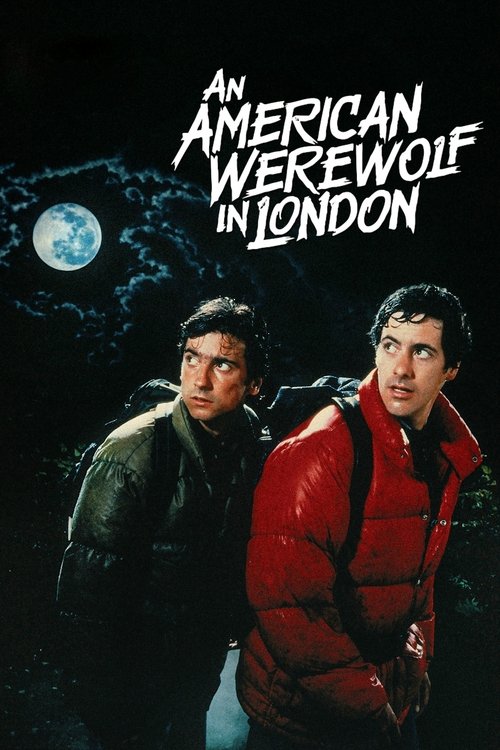
An American Werewolf in London
1981 · John Landis
For when you want a proper scare with a wicked sense of humor — the ideal pick for a horror night with friends who claim they've seen everything. A challenge for the squeamish, a classic for everyone else.
What it's about
Two American backpackers hiking the Yorkshire moors ignore a village pub's warnings and are attacked in the dark by something the locals refuse to name. One survives and wakes in a London hospital, where he falls for his nurse — while his body and dreams start changing in ways he can't explain, and the full moon approaches.
The experience
Genuinely scary and genuinely funny, often in the same scene — the jokes never defuse the dread, they sharpen it. It lopes along charmingly and then hits you with sequences of real, physical horror that still make audiences squirm.
Performances
Griffin Dunne is the secret weapon: his deadpan, increasingly grisly turn as the hero's best friend delivers the film's blackest laughs. David Naughton's easy charm and Jenny Agutter's warmth keep the human story grounded.
The craft
Rick Baker's werewolf transformation — staged in full light, in agonizing near-real time, all bone-cracking prosthetics and stretching flesh — is one of the most celebrated practical-effects sequences ever filmed, and it won the very first Academy Award given for makeup. The soundtrack's cheeky run of moon songs is a joke that keeps paying off. Watch it loud and on the biggest screen you have.
Why it matters
It proved horror and comedy could share a frame without canceling each other out, set the benchmark every screen werewolf since has been measured against, and made practical creature makeup Oscar-worthy — literally.
Snapshot
Two American backpackers cross the Yorkshire moors at night, ignore the warnings of a hostile village pub, and are attacked by something the locals will not name. One dies; the other wakes in a London hospital, falls in love with his nurse, is visited by the increasingly putrefied ghost of his friend, and turns into a wolf. An American Werewolf in London is the film that proved a horror picture could be genuinely frightening and genuinely funny in the same shot without either register canceling the other — a proposition studios had rejected for a decade before John Landis had the commercial standing to force it through.
Its historical weight rests on two things. First, Rick Baker's transformation sequence, staged in full light and in something close to real time, which retired the lap-dissolve conventions that had governed screen lycanthropy since 1941 and won the first competitive Academy Award for Best Makeup. Second, its tone: a comedy of American embarrassment abroad grafted onto a folk-horror armature, ending not with catharsis but with an abrupt cut to a doo-wop record. The film is at once a Universal monster picture made forty years late and a rebuke to the sentimentality of that tradition.
Industry & production
Landis wrote the screenplay around 1969, as a very young man working in low-level production jobs in Europe — the origin story he has repeated for decades involves witnessing a burial ritual in Yugoslavia intended to keep the dead from rising, while working on Kelly's Heroes. The script then sat unmade for roughly twelve years. The obstacle was categorical rather than budgetary: readers and executives could not determine whether they were being handed a comedy or a horror film, and the prevailing industrial logic of the 1970s had no shelf for a picture that refused to choose.
What changed was Landis's leverage. The Kentucky Fried Movie (1977), National Lampoon's Animal House (1978) and The Blues Brothers (1980) made him a director whose name carried financing. The film was ultimately mounted through PolyGram Pictures — then attempting to build a film arm on the back of a record company — with Peter Guber and Jon Peters as executive producers and Landis's longtime collaborator George Folsey Jr. producing. Universal handled the American release, an accident of distribution that is nonetheless resonant: the studio that built the classical monster cycle, and The Wolf Man (1941) specifically, released the film that dismantled it.
Production was based in Britain. Interiors were built at Twickenham Film Studios; the moors sequences were shot not in Yorkshire but in the hills of Wales, with the Slaughtered Lamb's exterior found in a Welsh village. London location work included the Underground and, most conspicuously, a night shoot at Piccadilly Circus for the climactic multi-vehicle pile-up — a logistical coup for a film of this scale, and the sequence that most visibly consumed the budget. Landis appears briefly in the carnage, a habit of his. Published budget and gross figures for the film vary between sources; what is not in dispute is that it was profitable, and profitable enough to make its effects approach immediately imitable.
The single most consequential production decision was hiring Rick Baker, who had been attached to the project in one form or another since the mid-1970s. When the film stalled again, Baker took The Howling for Joe Dante, then departed to honor his commitment to Landis when American Werewolf finally moved, leaving Rob Bottin to complete Dante's transformations. The two films opened months apart in 1981 and have been read as rivals ever since — a rivalry that was in fact a scheduling accident inside a very small community of effects artists.
Technology
Baker's transformation is a piece of engineering as much as sculpture. The governing principle was subtraction of the cut: rather than dissolving between static makeup stages, as Jack Pierce had done for Lon Chaney Jr., the sequence shows change occurring within continuous shots under unforgiving light. The methods were mechanical. Air bladders buried under foam latex skin inflated to push the back and face outward. Articulated prosthetic hands and feet, with fingers extended by internal armatures, were mounted through openings in a false floor and table so that a puppeteer working below could operate a limb while the actor's real limb was concealed. Full-scale mechanical head replicas — cable- and rod-operated, built in progressive stages of elongation — allowed the snout to push forward in-shot. The finished creature is a puppeteered quadruped, not a bipedal wolf-man: a deliberate refusal of the anthropomorphic silhouette that had made the classical werewolf legible and, by 1981, quaint.
The Academy had no competitive makeup category when production began. Its creation for the 1981 awards year is generally attributed to embarrassment over Christopher Tucker's uncredited-by-Oscar work on The Elephant Man (1980); Baker was its first recipient. The award mattered institutionally: it converted makeup effects from craft support into an awardable authorial discipline, and the decade that followed — Bottin on The Thing, Chris Walas, Stan Winston, Baker again — belongs substantially to that reclassification.
Equally demanding, and less discussed, is Jack's decomposition. Griffin Dunne appears across the film in successive stages of decay, each requiring its own build, so that the character's rot functions as a calendar of the plot.
Technique
Cinematography
Robert Paynter, a British cinematographer then moving between the Superman sequels and Landis's comedies, shoots the film with a plainness that is itself the strategy. The moors sequences use fog, low practicals and an oppressive black surround; everything after arrival in London is lit like a contemporary drama — flat hospital whites, overcast grays, the sodium wash of night streets. There is almost no expressionist grammar, no gothic chiaroscuro, no shadow-play. The transformation in particular is staged in a warmly and evenly lit flat, because Landis understood that hiding the effect in darkness would concede the point. The horror arrives inside naturalism rather than being announced by style, which is precisely why the tonal switches land.
Editing
Malcolm Campbell's cutting is where the film's comic timing lives. Dialogue scenes are cut for the rhythm of embarrassment — reaction shots held a beat too long, deadpan British performers allowed to finish. The dream sequences are constructed as nested traps: a nightmare resolves into what appears to be waking, which is itself a nightmare, the second shock cut arriving after the audience has relaxed. The most cited edit is the last one. David is shot; the film does not mourn, does not linger, does not resolve Alex's grief. It cuts to black and drops the Marcels' "Blue Moon" onto the credits at full volume. The abruptness has been read as a flaw and as the film's thesis; it is at minimum a refusal of the consolation that the monster movie traditionally offers.
Mise-en-scène / staging
The Slaughtered Lamb is a small masterpiece of blocking: a room of villagers who go silent, a pentangle on the wall, a dartboard, a chess game, and a social contract the Americans keep violating by asking questions. Landis stages it as a comedy of manners with a body count implied offscreen. The film's other great staging problem is the Underground pursuit, a sequence built almost entirely from architecture — escalators, tiled tunnels, the receding perspective of a platform — with the wolf withheld until the last possible moment. The Piccadilly Circus climax inverts this: total visibility, total chaos, a pile-up in the most photographed intersection in London. Landis's spatial instinct throughout is to place the supernatural in aggressively ordinary, well-mapped public places.
Sound
Two systems run in parallel. Elmer Bernstein's orchestral score is sparing and unshowy, reserved largely for the moors and the hospital, deliberately withdrawn from the film's biggest set piece. In its place, Landis uses a run of pop records organized by a single joke — every song is about the moon. Bobby Vinton opens the film with "Blue Moon"; Creedence Clearwater Revival's "Bad Moon Rising" and Van Morrison's "Moondance" appear at key junctures; Sam Cooke's "Blue Moon" plays over the transformation, its silken vocal set against the sound of a man's bones lengthening; the Marcels close the film. Scoring the film's most extreme physical suffering with a love song is the clearest statement of the picture's method. Landis has said he sought other moon songs and was refused by at least one artist; accounts of which, and why, are second-hand and should be treated as anecdote.
The effects track carries the horror the score declines to: wet articulation, cracking, and David's screaming, which is not stylized into monster-noise but kept human for as long as possible.
Performance
David Naughton was known chiefly from television and a soft-drink campaign, and his ordinariness is functional — he plays David as an unremarkable young man whose reasonableness is steadily stripped away. Griffin Dunne gives the film its voice: Jack is a wisecracking corpse, delivering suggestions of suicide in the tone of a friend recommending a restaurant, and Dunne plays every scene through progressively grotesque appliances without once reaching for pathos. Jenny Agutter, by 1981 well established from Walkabout and Logan's Run, plays Alex with a directness that keeps the romance from being a genre placeholder. Around them, Landis deploys a bench of British character actors — John Woodvine's skeptical Dr. Hirsch, Brian Glover's pub regular, an early screen appearance by Rik Mayall — whose naturalism anchors the comedy. Frank Oz turns up as a consular official, and supplies a Muppet gag in the hospital.
Narrative & dramatic mode
The film's structural invention is Jack. A dead best friend who returns, decaying, to explain the rules and lobby for his friend's suicide converts exposition into a running joke and gives the picture a second protagonist with no body to lose. The mode is closer to comic tragedy than to horror-comedy as later practiced: the jokes are not deflations of the horror but coexist with it, and the film never signals which register a scene will end in. David's arc is a straight line of dwindling agency — from tourist to patient to lover to killer to shot animal — while the comedy proliferates around him. The nested dream sequences do structural work too, teaching the audience that no return to safety in this film can be trusted.
Genre & cycle
1981 produced an unplanned werewolf cluster: Dante's The Howling in the spring, Michael Wadleigh's Wolfen in the summer, Landis's film in August, with Larry Cohen's Full Moon High nearby and Paul Schrader's Cat People following in 1982. What united them was less thematics than technology — a generation of effects artists had reached the point where transformation could be depicted rather than elided, and each film organized itself around that capability. American Werewolf is also a folk-horror descendant: the outsiders warned off the moors, the closed village keeping a secret, the pub as gate. It inherits from The Wicker Man and the English tradition of hostile countryside as much as from Universal's back-lot Europe.
Authorship & method
Landis's signature is tonal collision executed without a safety net, plus a taste for in-jokes that runs through his filmography — the fake title See You Next Wednesday, lifted from a line in 2001: A Space Odyssey, appears here as an entire softcore feature playing at a Piccadilly cinema, and the end credits famously offer congratulations to Prince Charles and Lady Diana, married weeks before the American release. He works with ensembles of skilled comic actors and cuts dialogue for behavior rather than punchlines, and he treats pop records as structural rather than decorative — a practice carried from Animal House and The Blues Brothers.
The key collaborators: Baker, whose contribution is authorial rather than technical, since the film's entire release strategy and reputation rest on his sequence; Paynter, whose refusal of gothic lighting is the enabling choice; Campbell, whose timing produces both the laughs and the notorious ending; Bernstein, whose restraint clears space for the needle-drops; and production designer Leslie Dilley, coming off the era's defining fantasy productions, who builds a London and a moorland that feel documentary rather than designed.
Movement / national cinema
The film sits awkwardly and productively between national cinemas: an American production, made in Britain with a largely British crew and supporting cast, about Americans failing to read English social codes. It belongs to the wave of American directors who came up through New Hollywood's aftermath and were unembarrassed by genre — Dante, Carpenter, Cronenberg working in parallel in Canada — and it participates in the early-1980s revival of British studio labor funded by American and multinational money. Its Britain is neither heritage nor swinging: it is wet, class-marked and unwelcoming.
Era / period
1981 is the hinge year for the modern horror film. The slasher cycle was at peak volume, the effects trades were being professionalised, and home video was about to make a certain kind of gore-forward horror permanently available. American Werewolf arrives at that hinge with a pre-Vietnam-era screenplay in its bones — its comic sensibility is closer to the late 1960s than to 1981 — which partly explains its lack of nihilism. Its Americans abroad are innocents, not cynics.
Themes
The film is explicitly Jewish in a way rarely noted in its marketing and central to its best readings. David Kessler and Jack Goodman are identified as Jewish; David's most violent dream places uniformed, rifle-carrying monsters in his suburban family home, slaughtering his relatives — an image that binds lycanthropy to inherited historical terror rather than to sexual awakening, the usual critical default. The wolf, in this reading, is not a repressed appetite but a thing done to you by history, transmitted by attack, incurable, and requiring your own death to end.
Around that sits a comedy of foreignness: Americans who cannot read a room, a nation that keeps its knowledge in silence and signage, a bureaucracy that will not name what happened. And under it, straightforwardly, is the horror of the body as unreliable property — bones that lengthen, skin that will not stay, a friend who keeps arriving in worse condition to remind you what you are becoming.
Reception, canon & influence
Contemporary criticism was divided along exactly the fault line that had kept the film unmade. The effects were near-universally admired; the tone was not, with several major American reviewers — Roger Ebert among the most prominent skeptics — arguing that the film committed to neither comedy nor horror and treated its story as scaffolding for set pieces. The Academy's new makeup award went to Baker, and the film's commercial performance was strong enough to make the argument moot in practice.
Looking backward, the film's debts are precise: Universal's The Wolf Man (1941) for the folklore it rewrites and the pentangle it borrows; the British folk-horror tradition for the village and the moor; and the American comedy of embarrassment for its dialogue. Looking forward, its influence is unusually traceable. Michael Jackson, having seen the film, hired Landis and Baker for "Thriller" (1983), transplanting the horror-comedy tone, the transformation-in-full-light, and the fake-movie framing device into the most widely seen short film ever made — arguably the single largest distribution event in the history of practical creature effects. The 1980s effects boom that follows, and the specific prestige attached to makeup artists as authors, descends from Baker's Oscar. The film's tonal license — horror that is funny without being a spoof — runs forward through Dante, through Evil Dead II, through Peter Jackson's early work, through Shaun of the Dead.
Its own franchise afterlife has been thin: a nominal sequel, An American Werewolf in Paris (1997), made without Landis and with digital creature work, is generally regarded as a demonstration of what the original's craft was worth; remakes have been announced periodically without materializing, and the details of those attempts are better treated as trade reporting than as film history. The original's standing, by contrast, is settled — it is the werewolf film against which werewolf films are measured, and one of the few horror pictures whose reputation rests as much on its jokes as on its monster.
Reception
Critics in 1981 were wrong-footed by the comedy/horror whiplash — Ebert among the unconvinced — but the film did solid business and has since been fully canonized as the werewolf movie, the one everything since gets measured against.
How An American Werewolf in London was received, from release to now →
How to watch An American Werewolf in London: what to notice on a first viewing
- Watch the pub go silent when the Americans ask questions. Landis blocks the Slaughtered Lamb as a room of villagers, a pentangle, a dartboard, a chess game; the silence is a wall the tourists keep walking into. The blocking turns social discomfort into the film's real warning system, felt before anyone names a wolf.
- Listen for every song naming the moon. Bobby Vinton's 'Blue Moon' opens the film, Creedence's 'Bad Moon Rising' and Van Morrison's 'Moondance' recur, building a soundtrack organized entirely around one word. The joke format tells you Landis treats pop music as structure, not decoration, throughout.
- Notice how evenly lit the transformation flat is. Robert Paynter shoots the moors in fog and shadow but London in flat naturalistic light, refusing gothic darkness even for the film's most extreme physical scene. Hiding the effect in shadow would concede the horror; full light makes the body's betrayal undeniable.
- Watch how Griffin Dunne's condition worsens each time Jack appears. Dunne delivers suicide suggestions in the tone of a friend recommending a restaurant, playing every appliance stage without reaching for sadness. A decaying corpse played for deadpan comedy keeps the film's two registers running at once.
- Notice reaction shots held a beat too long. Malcolm Campbell cuts dialogue scenes for embarrassment, letting deadpan British performers finish sentences past the point of comfort. This timing generates the comedy that runs directly alongside, not against, the horror.
The whole guide to watching An American Werewolf in London, with the keys for a rewatch →
Influences: the films it descends from and the films it influenced
- The Wolf Man (1941) — Supplies the invented folklore Landis rewrites verbatim — the pentangle, the rhyming couplet, the victim-becomes-monster contract — while Jack Pierce's locked-off lap-dissolve transformation is the exact technique Baker's articulated appliance work was built to render obsolete.
- Dr. Jekyll and Mr. Hyde (1931) — Establishes transformation as a single continuous performed event rather than a cut — Mamoulian's graduated-filter reveal of pre-applied makeup layers is the in-camera principle Baker updates with cable-actuated bladder heads and stretching latex.
- Schlock (1973) — The origin document of the Landis–Baker partnership: Baker's ape suit built on a student budget, cut by Landis for deadpan behavioral comedy rather than punchlines, is the working method the werewolf sequence scales up eight years later.
- The Exorcist (1973) — Dick Smith — Baker's mentor, with Baker himself on the effects crew — proves that prosthetic appliance work can carry a film's entire reputation, and Friedkin's near-total withholding of orchestral score in favour of silence and source cues is the sound strategy Bernstein and Landis adopt.
- Straw Dogs (1971) — The blocking template for the Slaughtered Lamb — an American outsider at the bar, locals arranged in a closed semicircle, conversation dying on entry and resuming as coded threat — staged in flat interior light with no horror grammar at all.
- The Wicker Man (1973) — British folk horror's insistence that the uncanny be photographed in open daylight on real moorland, with pagan survival encoded in pub decor and villagers' evasions rather than in lighting or score — the anti-gothic premise Paynter's cinematography inherits.
- Rosemary's Baby (1968) — Codifies the nested-dream shock structure — a dream that hands off to a second dream so the wake-up beat lands as a false floor — and shoots supernatural horror in naturally lit ordinary interiors, both devices Landis and Campbell deploy in the hospital sequence.
- Night of the Living Dead (1968) — The abrupt unconsoling cut to end credits with no denouement, plus newsreel-flat lighting that treats monstrosity as a documentary fact, is the ending grammar Landis reproduces by cutting from David's corpse straight to 'Blue Moon.'
- Animal House (1978) — Landis's own proof that pop records can be structural rather than decorative — needle-drops cut to scene architecture — and that comic ensembles play best when dialogue is edited for overlapping behavior instead of punchline rhythm.
- Michael Jackson's Thriller (1983) — The literal transplant — Landis and Baker reassembling the full-light transformation, the fake-movie framing device, and the comic-horror ghoul into a short film whose distribution made practical creature makeup a mass-culture event.
- The Thing (1982) — Bottin's effects are conceived as the film's authorial center in the way Baker's Oscar had just legitimized, staging biological transformation as an extended, brightly lit, continuous-take practical performance rather than a cutaway.
- Videodrome (1983) — Baker himself supervises, carrying the AWIL principle — the body deforming in real time, in front of the lens, under unforgiving light — into abdominal-slit and breathing-cassette rigs built on the same foam-latex and cable-mechanism vocabulary.
- Gremlins (1984) — Runs the tonal-collision license at studio scale: practical creature comedy and genuine cruelty held in the same shot without spoof signaling, with a needle-drop and holiday-standard soundtrack ironising the violence exactly as 'Blue Moon' does.
- The Return of the Living Dead (1985) — Takes Jack Goodman directly — the articulate, deteriorating corpse who argues with the living and gets funnier as the makeup gets worse — and pairs it with punk needle-drops used as structural cues rather than atmosphere.
- Shaun of the Dead (2004) — The most explicit inheritance: a British character-comedy ensemble cut for behavior, pop records timed to violence, ordinary London public space as the arena, and horror played straight enough to kill principals — Wright names the film as the model for holding both registers without parody.
- Evil Dead II (1987) — Fused belly-laughs with Rick Baker's grotesque practical transformation FX, proving the horror-comedy tonal whiplash Evil Dead II lives on.
- Ginger Snaps (2000) — Rick Baker's slow, agonizing on-screen prosthetic metamorphosis set the practical-transformation grammar Ginger Snaps borrows — plus the horror-comedy tonal hybrid held in one scene.
- Gremlins 2: The New Batch (1990) — Rick Baker's high-key, no-cutaway transformation grammar — hold the shot, let the mechanism perform under bright light — is the specific craft Baker imports when he replaces Chris Walas, enabling the Bat, Spider, and Vegetable gremlins to be lingered on instead of cut around.
- The Lost Boys (1987) — Establishes the tonal-whiplash cut — comedy beat directly into wet prosthetic horror — and the ironic pop needle-drop as scoring strategy rather than decoration; Greg Cannom's appliance work descends technically from Rick Baker's shop on this film.
- Re-Animator (1985) — Landis fixed the grammar Gordon refines — comedy generated by characters responding to the impossible with mundane practicality (Jack's helpful decomposition advice), while the transformation set piece is played dead straight in long, brightly lit, unbroken takes.
- A Nightmare on Elm Street 3: Dream Warriors (1987) — Rick Baker's air-bladder and change-o-head transformations, held in bright unbroken coverage rather than cut around, set the standard the Yagher/Shostrom crew works to in the marionette and Freddy-worm gags; Landis's false-awakening double jolt (the dream inside the dream) is the structural rhythm Dream Warriors runs on almost every reel.
- The Howling (1981) — Released months earlier with Rob Bottin — Baker's protégé, who took the job when Baker committed to Landis — executing the same air-bladder-under-latex transformation in full light, making 1981 the year the werewolf change became a sustained effects set piece rather than a dissolve.
- Cat People (1982) — Tom Burman's on-screen inside-out transformation is a direct answer to Baker: Schrader remakes the 1942 film precisely to reverse Tourneur's off-screen restraint, conceding the argument that post-1981 audiences expect to watch the change happen.
- The Company of Wolves (1984) — Christopher Tucker's snout-through-mouth werewolf transformations were commissioned as a British riposte to Baker's sequence, extending the same prosthetic-as-authored-set-piece logic while relocating it inside Angela Carter's fairy-tale frame.
- The Fly (1986) — Rick Baker's on-screen man-into-beast metamorphosis pioneered the slow, painful, prosthetic-staged bodily transformation that Goldblum's incremental Brundlefly arc extends into character drama.
- Altered States (1980) — Rick Baker's practical transformation makeup as on-camera set-piece spectacle, the same early-'80s prosthetic-metamorphosis tradition treating the changing body as the main effect.
Similar films
- Night of the Living Dead (1968) — influence & lineage
- The Thing (1982) — influence & lineage
- Frankenstein (1931) — shared sensibility
- The Invisible Man (1933) — shared sensibility
- Ginger Snaps (2000) — shared sensibility
- Beetlejuice (1988) — shared sensibility
- Bride of Frankenstein (1935) — shared sensibility
- The Elephant Man (1980) — shared sensibility