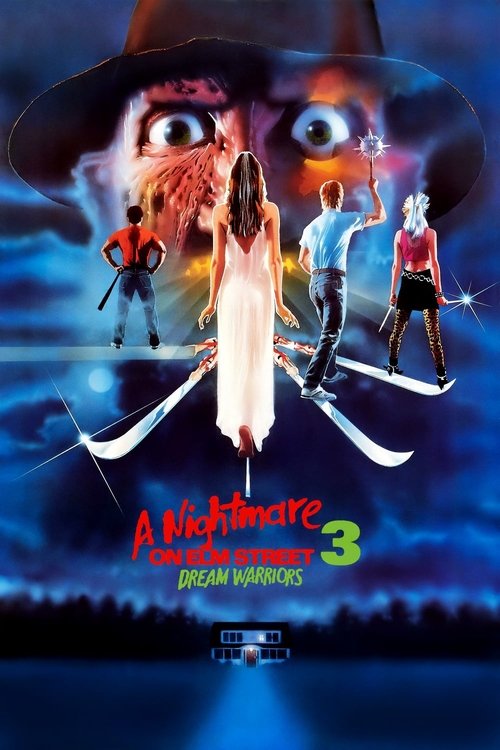
A Nightmare on Elm Street 3: Dream Warriors
1987 · Chuck Russell
For when you want classic 80s horror that's fun rather than grueling — quotable, imaginative, and fast. A perfect gateway slasher, and comfort viewing for anyone who grew up on the franchise.
What it's about
The last of the Elm Street kids are locked in a psychiatric hospital, diagnosed as suicidal by adults who can't imagine what's really killing them in their sleep. A young doctor and a returning survivor of Freddy Krueger's first rampage help them discover they can enter a shared dream — and fight back with powers they invent themselves.
The experience
A blast — scary, inventive, and weirdly rousing, with each nightmare built as its own surreal set piece. It's the rare slasher sequel that feels like an adventure movie, because the kids get to swing back.
Performances
Robert Englund's Freddy becomes a full-blown showman here, and a young Patricia Arquette, in an early role, gives the teens a real emotional center. Heather Langenkamp's return as Nancy — the survivor turned protector — gives the film its backbone.
The craft
Chuck Russell stages the dream sequences as escalating practical-effects showpieces — puppetry, stop-motion, transformations — that turned nightmare logic into spectacle and still look wonderfully handmade. The script (co-written by Wes Craven) rebuilds the premise as an ensemble fantasy rather than a body count.
Why it matters
The hinge of the whole Elm Street series: it converted a dark standalone parable into a durable franchise and made Freddy a wisecracking pop-culture star, setting the template for horror sequels that expand mythology rather than repeat it.
Snapshot
Dream Warriors is the hinge of the Elm Street series and one of the most consequential horror sequels of the 1980s — the film that converted Wes Craven's dream-logic parable into a durable commercial franchise, and in doing so converted Freddy Krueger from a half-glimpsed predator into a performing star. Released in late February 1987, it takes the surviving premise of the 1984 original — a killer who murders through sleep — and rebuilds it as an ensemble fantasy adventure. Seven institutionalized teenagers at Westin Hills Psychiatric Hospital, diagnosed as suicidal by adults who cannot conceive of the alternative, discover that they can enter a shared dream and fight back with self-invented powers. Heather Langenkamp returns as Nancy Thompson, no longer the imperiled girl but the adult intern who knows what is happening and cannot get anyone to believe her.
The film's importance is threefold. It is the first Elm Street sequel to take Craven's mythology seriously and expand it systematically, introducing the shared dreamscape, the dream-suppressant drug Hypnocil, Amanda Krueger, and the requirement that Freddy's remains be laid in consecrated ground. It is a showcase for practical creature effects at the tail end of their pre-digital golden age. And it is the moment Freddy starts talking — the point at which the series' horror begins its long, profitable migration toward black comedy.
Industry & production
New Line Cinema in 1985–86 was a small distributor that had accidentally acquired a hit. A Nightmare on Elm Street (1984), made on a shoestring by Craven after years of rejection, had rescued the company financially; A Nightmare on Elm Street 2: Freddy's Revenge (1985) confirmed the audience was reliable. But the second film had drifted from Craven's design, and its reputation — then, if not now — was as a misfire. Robert Shaye's company needed a third entry that would consolidate rather than dilute.
Craven returned to the project as co-writer with Bruce Wagner. The Craven–Wagner draft was, by consistent accounts from those involved, considerably darker and stranger than what reached the screen, and reportedly conceived as a terminal entry that would close the series rather than extend it. New Line judged it too bleak and too expensive to produce, and brought in Chuck Russell to direct and, with Frank Darabont, to rewrite. The four names — Craven, Wagner, Russell, Darabont — share the final screenplay credit, with story credit to Craven and Wagner. The specific division of authorship between drafts is one of the genuinely contested points in the film's record, and accounts differ; what is not contested is that the released film keeps Craven's mythology while replacing his despairing register with a heroic one.
For Russell this was a directorial debut; he had come up as a producer and co-writer, most relevantly on Dreamscape (1984), another film built on the premise of trained dream-entry. For Darabont it was a first produced feature credit, the beginning of a working relationship with Russell that continued through the 1988 Blob remake. Rachel Talalay, who worked through the series in production roles before directing Freddy's Dead: The Final Nightmare (1991), was among the producers.
Budget and returns are usually reported at roughly $4.5 million against a domestic gross in the mid-$40-millions — a ratio in the vicinity of ten to one, and the strongest performance of the original series until Freddy vs. Jason (2003). The consequence was structural: Dream Warriors is the film that turned New Line from a company with a franchise into a company built on one, and licensed the merchandising, syndication, and eventual television spinoff (Freddy's Nightmares, 1988) that followed.
Technology
Dream Warriors is a compendium of late-analog effects craft, and its interest today is partly archival: almost nothing in it could be achieved the same way after 1993.
Kevin Yagher, who had taken over Freddy's burn makeup from David Miller with the second film, refined the appliance work here into the version most audiences carry in memory. Mark Shostrom supervised special makeup effects, including the film's signature grotesques: the "Freddy Snake," a vast serpentine puppet built at multiple scales and shot with forced perspective as it swallows Kristen whole; and the torso of trapped souls, in which the faces of Freddy's victims press outward through the skin of his chest — a full-body appliance combined with cable-actuated puppetry.
Two sequences typify the film's method. Phillip's death is a marionette effect: tendons pulled loose from his arms and legs, his body walked across the hospital roof on visible strings. It is executed with wirework, puppet doubles, and stunt rigging, cut so that the eye is never given a stable enough look to resolve the seam. The junkyard climax animates Freddy's skeleton via stop-motion by Doug Beswick, a deliberate Harryhausen inheritance that stands out — slightly, and probably intentionally — from the film's otherwise physical texture. Optical work, including the glow effects and traveling mattes that separate dream from waking space, was handled through the era's standard optical printing pipeline.
The film also uses set architecture as an effects tool: the boiler room built as a maze of practical steam, grating, and hard shadow; a mud pit; a pier that collapses into a body-strewn void. These are not composites but constructed spaces, and the physical presence of the sets is what gives the film's dream imagery a weight the later, cheaper sequels lack.
Technique
Cinematography
Roy H. Wagner shoots the film in a hard-edged, saturated register that has become shorthand for 1980s studio horror: heavy atmospheric smoke, colored practicals bleeding through doorways, deep amber and sodium tones against sick institutional green. The distinction between waking and dreaming is not made through soft focus or a filtered look — the usual solution — but through spatial logic. Waking Westin Hills is covered in relatively flat, even, fluorescent-inflected light; the dream spaces are chiaroscuro, backlit, sourced from impossible directions. This is the film's most economical idea: the dream is not blurrier than reality, it is lit better, which is precisely what makes it seductive to its adolescent characters.
Wagner also uses low, slightly wide coverage in the dream sequences, letting ceilings and machinery loom into frame. The effect keeps the teenagers small inside spaces that Freddy demonstrably owns.
Editing
Chuck Weiss and Terry Stokes cut the film for the concealment of effects and the delivery of punchlines — two aims that pull in opposite directions and largely coexist here. The set-piece deaths are cut fast and fragmentarily on the mechanical beats and slower on the aftermath, so that the audience is given time to absorb a horror it was not allowed to inspect during execution. The film's larger rhythmic problem — moving between a group of seven teenagers, two adult protagonists, and an antagonist who can appear anywhere — is solved by treating the dream as a single continuous location that any character can be dropped into, which lets the edit jump laterally without transitional coverage.
Mise-en-scène / staging
The hospital is the film's governing idea made physical. Westin Hills is a place designed to prevent exactly the thing that will save these children: it restrains them, medicates them toward sleep, isolates them from one another, and interprets their deaths as the symptom it already expected. Every institutional affordance is inverted into a weapon — the sleep clinic, the restraints, the group therapy circle, the television in the day room.
Against this, the dream spaces are staged as adolescent self-portraiture. Will, who uses a wheelchair, dreams himself as "the Wizard Master," walking. Taryn, a recovering addict, dreams herself as a leather-clad punk with switchblades. Kincaid has strength; Joey has a voice. The film literalizes how teenagers picture themselves in the absence of adult recognition, then has Freddy attack each fantasy at its origin: Taryn is killed by fingers that become syringes, Joey is silenced, Will's magic fails. The staging is not incidental — the dream powers exist so that the film can take them away.
Sound
Angelo Badalamenti's score is the film's most unexpected asset, arriving between his Blue Velvet (1986) work for David Lynch and the Twin Peaks material that followed. He writes for the film with genuine orchestral gravity — lyrical, string-led themes for Nancy and the children, set against low brass and dissonant clusters for Freddy — refusing the synthesizer stingers that were the default idiom for horror sequels of the period. The result gives the material a melancholy it would not otherwise earn, particularly in the final act.
Sound design carries the mythology: the metal-on-metal scrape of the glove, the industrial breathing of the boiler room, the children's jump-rope rhyme used as an unhealing wound in the sound field. Against all this sits Dokken's title song, "Dream Warriors," whose MTV video featured Robert Englund in character — an early, effective instance of horror-metal cross-promotion that treated the villain as a music-video presence rather than a monster.
Performance
Englund's performance is the film's pivot point. In Craven's original, Freddy was mostly a silhouette with a few lines; here he is a comedian with an audience. "Welcome to prime time, bitch," delivered as he drives Jennifer's head through a television screen, is the series' first true catchphrase, and Englund plays the kills as bits — with timing, with relish, with a sense of the room. This is a genuine act of character creation, and it is also the moment horror's most successful boogeyman becomes a light entertainer.
Langenkamp gives the film its ballast. Playing Nancy a few years older, gray-streaked and professionally credentialed, she carries a survivor's exhaustion that the script mostly leaves to her face. John Saxon's return as her father is similarly weighted with defeat. Among the newcomers, Patricia Arquette's feature debut as Kristen is watchful and unmannered, and Laurence Fishburne — billed as Larry Fishburne — brings unusual specificity to the orderly Max, a small role played as a man who has decided to believe these kids on the evidence of having listened to them. Craig Wasson's Neil Gordon carries the plot; Priscilla Pointer's Dr. Simms is the film's real institutional antagonist.
Narrative & dramatic mode
The film's structural move is from siege to quest. Craven's original is a survival narrative in which one girl is progressively isolated. Dream Warriors replaces isolation with a team, and replaces endurance with a plan: acquire allies, discover powers, learn the villain's origin, obtain the object (his bones), perform the ritual (consecrated burial). This is fantasy-adventure architecture — the party, the mentor, the special weapon, the two-front final battle — imported wholesale into a slasher.
The consequence is that the film becomes rule-governed. Craven's dream was frightening partly because it obeyed no stated law. Here there are laws: Kristen can pull others into her dream; Hypnocil suppresses dreaming; Freddy is bound to unconsecrated remains. Legibility is traded for dread. That trade is what makes a franchise possible and what most limits the film as horror.
Dramatically, the film runs a doubled disbelief plot. The teenagers cannot be believed by the hospital; Nancy, who believes them, cannot be believed either, and is discredited precisely by her expertise. The adults are not villains in the ordinary sense — Dr. Simms is doing her job competently by the standards of her profession — which sharpens the film's argument that institutional reasonableness is itself the danger.
Genre & cycle
By 1987 the theatrical slasher cycle that began with Halloween (1978) and Friday the 13th (1980) was exhausted as a formal proposition and thriving as a franchise business. Dream Warriors belongs to the pivot that followed: the turn from stalk-and-kill realism toward the effects-driven American fantastique. Its 1987 cohort — Hellraiser, Evil Dead II, The Lost Boys, Near Dark, Prince of Darkness — is defined by elaborate physical spectacle, mythological world-building, and a permissive attitude toward humor.
Within that turn Dream Warriors is the commercial exemplar. It establishes the template that horror sequels would follow for a decade: expand the mythology, promote the villain to protagonist, build the film around discrete set-piece deaths that can be trailered individually, and attach a rock single. Parts four through six of the series pushed each of these further and, most critics agree, past the point of diminishing return.
Authorship & method
Authorship here is genuinely distributed, and honest description should say so. Craven's is the originating conception and the mythology's spine; Wagner's contributions are hardest to isolate from the outside; Russell and Darabont's rewrite supplied the ensemble structure, the dream-powers conceit, and much of the comic register. Russell directs with an effects producer's priorities — the film is organized around its set pieces, and each is staged with real clarity — while showing more patience with actors than the material required. His subsequent career (The Blob, The Mask, Eraser) confirms the profile: a director of controlled spectacle rather than a stylist.
Darabont's presence is the most interesting historical footnote. The screenwriter who would go on to The Shawshank Redemption, The Green Mile, and The Mist is discernible here in the film's sentimental humanism — the insistence that the children be characterized, that the orderly be decent, that the ending be elegiac rather than merely cliffhanging.
Among collaborators, Badalamenti and Wagner do the most to lift the film above its category, and Yagher, Shostrom, and Beswick define its surface. It is worth noting that Craven, who received a credit and a mythology restored, reportedly remained unhappy with the reworking — a tension that recurs across his relationship with the series and resurfaces, transformed into subject matter, in Wes Craven's New Nightmare (1994).
Movement / national cinema
The film belongs to no movement in the aesthetic sense. Its significance in national-cinema terms is industrial: Dream Warriors is a defining artifact of the American independent distributor's mutation into a mini-major. New Line — "the house that Freddy built" — used this film's returns to fund the expansion that eventually made it a studio capable of The Lord of the Rings. That trajectory, from exploitation distribution to prestige financing on the back of a horror franchise, is one of the central stories of American film business in the late twentieth century.
Era / period
The film is legible as a Reagan-era document without being reduced to one. Its setting draws on a real phenomenon: the 1980s boom in private adolescent psychiatric hospitalization, marketed directly to anxious parents, in which troubled teenagers were institutionalized in unprecedented numbers. Its central horror — young people dying while adults record the deaths as suicide — landed in a period of intense national anxiety about teen suicide clusters, a panic that peaked within weeks of the film's release. The film neither caused nor commented on any specific event; it drew on the ambient atmosphere.
The anti-drug register is equally of its moment. Taryn dies of an overdose administered by Freddy's syringe-fingers, and the film's pharmacological savior, Hypnocil, is itself a drug that suppresses consciousness. In a "Just Say No" decade, Dream Warriors is notably ambivalent: medication is both weapon and defense, and the institution dispensing it cannot be trusted with either.
Themes
The film's governing theme is inherited guilt. Freddy is the consequence of a parental crime — the Elm Street parents burned him, and their children pay — and the film extends that logic backward to Freddy's own conception, the "bastard son of a hundred maniacs" born to Sister Amanda Krueger after her confinement with the inmates of an asylum. Guilt propagates in both directions along the family line. Nancy's father cannot be redeemed, only killed and turned against her.
Second is the pathologization of adolescent knowledge. What the teenagers know is true; what the institution calls it is illness. The film's most enduring emotional content is not its violence but its account of not being believed by people with the authority to define reality.
Third is the dream as the last sovereign territory. Sleep is the one space these children still own, and the film's terror is that even it has been colonized. The dream-powers sequences are the film's argument for imagination as resistance — and Freddy's systematic dismantling of each power is its counter-argument.
Finally, there is the film's implicit theme of religious remainder: Freddy cannot be defeated by force, only by burial in consecrated ground. Into a secular slasher series Dream Warriors imports the grammar of exorcism, and with it the suggestion that the modern institution — hospital, therapy, pharmacology — is simply the wrong instrument for the problem.
Reception, canon & influence
Contemporary reviews were, by the standards of a third franchise entry, unusually warm, and the film has held a durable consensus position as the best of the Elm Street sequels and often as the second-best film in the series after Craven's original. Praise typically centers on the effects work, the ensemble, and the return of Langenkamp; the standing reservation, then and now, is that the film's wit and its rule-making began Freddy's slide from figure of dread to mascot.
Looking backward, the film's debts are clear. Craven's 1984 original supplies its premise and its central survivor. Dreamscape (1984), which Russell co-wrote, supplies the shared-dream-entry conceit. Ray Harryhausen's animated skeletons stand plainly behind the junkyard climax. The gothic backstory of Amanda Krueger draws on the Catholic-horror tradition running through The Exorcist and its imitators, and the ensemble-of-endangered-children structure has clear affinity with the Stephen King register dominant in mid-1980s American horror.
Looking forward, its influence is substantial. Dream Warriors established the modern template of the returning final girl — the original survivor brought back as damaged mentor — a structure later used by Halloween H20 (1998), Scream 4 (2011), and the 2018 Halloween, among many others. It established the shared-dreamspace mechanic that the series' own sequels ran on and that later dream-heist fiction, including Inception (2010), works in the same conceptual territory as, if not directly from. Its dream-powers ensemble anticipates the group-of-gifted-teenagers structure that became a genre unto itself. Freddy vs. Jason (2003) reaches directly back to this film for Westin Hills and Hypnocil, treating Dream Warriors rather than the original as the series' canonical rulebook.
Its most visible contemporary descendant is Stranger Things, whose Vecna storyline — a scarred entity killing adolescents inside visions that adults cannot see — draws openly on this material, and which cast Robert Englund in a 2022 role that functions as explicit acknowledgment. More diffusely, the film's commercial model — villain as brand, kills as marketable set pieces, licensed rock single, expanded mythology as sequel fuel — became the default operating logic of franchise horror, for better and considerably for worse.
Reception
A big hit in 1987 and the best-reviewed Elm Street sequel of its era, it's since been fully canonized — the rare part 3 that fans now routinely mention in the same breath as the original.
How A Nightmare on Elm Street 3: Dream Warriors was received, from release to now →
How to watch A Nightmare on Elm Street 3: Dream Warriors: what to notice on a first viewing
- Watch how much better lit the dream world is than the hospital. Wagner keeps Westin Hills flat and fluorescent, then floods the dreams with backlit, impossibly sourced color and smoke. The dream is not blurrier than reality. It is lit better, which is exactly why it pulls the teenagers in.
- Notice the hospital equipment: restraints, IV lines, the therapy circle. Westin Hills is built to sedate and isolate the kids, and the film keeps returning to the exact fixtures meant to help them. The place meant to protect them supplies the tools that end up used against them.
- Listen for a full string orchestra instead of synthesizer stabs. Angelo Badalamenti gives Nancy and the children lyrical, string-led themes, and answers Freddy with low brass and dissonant clusters. The score treats the kids as people worth mourning, not just as targets waiting to die.
- Watch Freddy pause for timing before and after each kill. Englund plays every death like a stand-up bit, landing a line and letting it breathe, where the original film gave him almost no lines at all. Horror's silhouette killer turns into a performer working a crowd, in real time, on screen.
- Notice the costume and power each teenager invents for their dream self. Will walks as a sword-wielding wizard, Taryn turns into a leather-clad fighter with switchblades, and each power reads as exactly what the hospital denies them while awake. The dream is the one place these teenagers still get to decide who they are.
Influences: the films it descends from and the films it influenced
- A Nightmare on Elm Street (1984) — Supplies the operative grammar Russell inherits wholesale — the dream-death rule that wounds cross back into waking bodies, the practical rotating-room gimbal for ceiling kills, Englund's glove staged in half-shadow at the edge of the frame, and Langenkamp's Nancy, whom Part 3 returns as mentor rather than victim.
- Dreamscape (1984) — Russell co-wrote it, and its central mechanic — trained subjects entering a shared dreamspace as a controlled procedure, with each dreamer's psyche rendered as a discrete effects set piece (the stop-motion Snakeman) — is transplanted directly into the Hypnocil/group-hypnosis structure of the Westin Hills sequences.
- Jason and the Argonauts (1963) — Harryhausen's ball-and-socket skeleton armatures, shot frame-by-frame and matted to live plates so the actors fence with empty air on pre-blocked marks, is the exact technique and staging logic reproduced in the junkyard skeleton fight — down to keeping the composite in wide, static coverage so the matte line never has to survive a camera move.
- An American Werewolf in London (1981) — Rick Baker's air-bladder and change-o-head transformations, held in bright unbroken coverage rather than cut around, set the standard the Yagher/Shostrom crew works to in the marionette and Freddy-worm gags; Landis's false-awakening double jolt (the dream inside the dream) is the structural rhythm Dream Warriors runs on almost every reel.
- The Thing (1982) — Rob Bottin's cable-actuated prosthetic set pieces taught the era that the creature gag can be the film's structural spine rather than its punctuation — Russell directs with the same effects-producer priority, building each Westin Hills death as a self-contained mechanical sequence with its own build, reveal, and concealment cut.
- Videodrome (1983) — Rick Baker's breathing-television prosthetic — the screen as an orifice the body is pulled into — is the direct engineering and conceptual ancestor of the TV-set kill, where a practical Freddy head and arms erupt from a working set and the CRT becomes the mouth of the attack.
- Poltergeist (1982) — Establishes the suburban child-jeopardy machine Russell operates: threat visible only to the child and dismissed by clinical adults, plus the puppet-and-wirework vocabulary — the possessed clown pulling a boy under the bed is the template for the marionette-strings kill's rigging and its low, wide-angle framing.
- One Flew Over the Cuckoo's Nest (1975) — The ward-ensemble blocking — group therapy circles, the dispensing window, sedation as institutional violence, and an orderly whose decency runs against the doctors — is the staging grammar Westin Hills borrows; Darabont's insistence that Max be a human being rather than a body count is lifted straight from this register.
- The Exorcist (1973) — Supplies the Catholic-horror apparatus for the Amanda Krueger backstory — the nun, the desecrated institution, the exhumation-and-consecration climax as the rule that finally binds the demon — plus Dick Smith's incremental degradation makeup, the model for the mummified-Freddy and Amanda prosthetics.
- Blue Velvet (1986) — Badalamenti's method here — slow, low-register string writing that plays suburban surfaces as elegy rather than shock — is the same voice he brings to the Elm Street 3 score, where the jump-rope rhyme is orchestrated as a lullaby motif instead of a sting, doing more than the material to hold dread between the effects beats.
- The Blob (1988) — Russell and Darabont immediately reran the Dream Warriors method: script built backward from a sequence of discrete practical set pieces (the phone booth, the drain), each staged in clear wide coverage with the mechanism hidden by an effects-concealment cut, and a sentimental humanist beat granted to characters the genre normally treats as fodder.
- A Nightmare on Elm Street 4: The Dream Master (1988) — Takes Part 3's dream-powers ensemble as a spec and escalates it — each survivor's death is engineered as a signature optical/prosthetic gag (the roach motel, the soul-faces chest) using the same Yagher-lineage crew and the same concealment cutting, with Freddy fully converted into the wisecracking master of ceremonies this film invented.
- Wes Craven's New Nightmare (1994) — Craven's answer to being rewritten — it takes Dream Warriors' own move (bring Langenkamp back as the damaged authority on the rules) and turns it inside out by casting her as herself, restoring the entity to non-comic dread and stripping the mythology Part 3 built back to a single unrationalized threat.
- Halloween H20: 20 Years Later (1998) — The purest structural inheritance: the original final girl returned as a medicated, institutionally-embedded adult who is disbelieved until she takes up the weapon — Laurie at the boarding school is Nancy at Westin Hills, including the staging of the survivor as the only person in the building who knows the rules.
- Freddy vs. Jason (2003) — Reaches past Craven's original to treat this film as the canonical rulebook — Westin Hills, Hypnocil, and dream-suppression as pharmacology are its entire first-act engine, confirming that the series' operating mechanics were written by Russell and Darabont rather than in 1984.
- Inception (2010) — Works the same conceptual machinery: a team enters a shared dreamspace under sedation, each member assigned a specialized dream-function, with strict transit rules and a practical rotating-corridor gimbal that is the direct descendant of Craven's spinning-room rig — Nolan's contribution is architecture where Russell's was mythology.
- The Mask (1994) — Russell's own effects-forward set-piece construction — blending practical transformation FX with dream-logic staging — is the craft he later transposed into the Mask's cartoon-physics environment.
- Terrifier 3 (2024) — The franchise architecture Leone copies exactly: occult backstory accreted sequel by sequel around a performing icon, plus the original survivor returned as a damaged adult who must face him again.
- Hellraiser (1987) — Released the same year and solving the same commercial problem the same way: Bob Keen's latex-and-appliance monster designed as a brand-legible face, an unironic orchestral score (Christopher Young) against a slasher marketplace, and mythology-as-rulebook engineered so sequels have machinery to run on.
- Evil Dead II (1987) — Contemporaneous refinement of the same toolkit — stop-motion and claymation intercut with latex appliances, low canted wide-angle coverage, and comic timing welded onto splatter — arriving at the identical mid-80s discovery that the effects set piece plays better when the audience is allowed to laugh at it.
Similar films
- A Nightmare on Elm Street (1984) — influence & lineage
- Evil Dead II (1987) — influence & lineage
- The Exorcist (1973) — influence & lineage
- Hellraiser (1987) — influence & lineage
- Scream (1996) — shared sensibility
- Scream (2022) — shared sensibility
- Scream 2 (1997) — shared sensibility
- Scream 4 (2011) — shared sensibility
All the films related to A Nightmare on Elm Street 3: Dream Warriors →